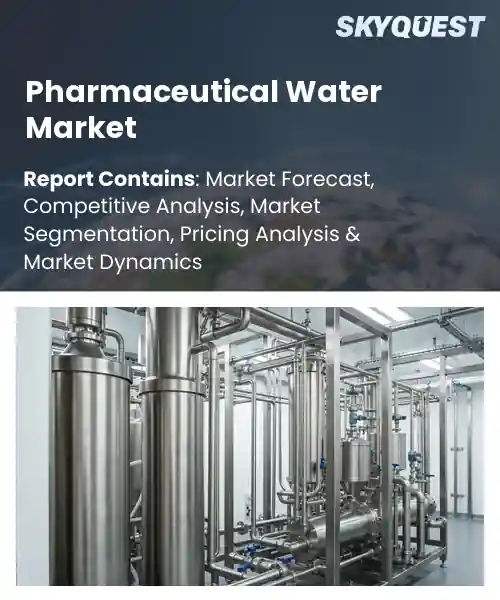
Pharmaceutical Water Market
Report ID: SQMIG35A3827
Report ID: SQMIG35A3827
[email protected]
USA +1 351-333-4748
Report ID:
SQMIG35A3827 |
Region:
Global |
Published Date: June, 2026
Pages:
157
|Tables:
146
|Figures:
78


Global Pharmaceutical Water Market size was valued at USD 43.5 Billion in 2024 and is poised to grow from USD 47.55 Billion in 2025 to USD 96.84 Billion by 2033, growing at a CAGR of 9.3% during the forecast period (2026-2033).
Regulatory compliance is the primary driver of the pharmaceutical water market, as pharmacopeial monographs and Good Manufacturing Practice standards demand consistent microbial and chemical purity for parenterals and cleaning processes. The market provides purified water, water for injection and associated generation, storage and distribution systems that serve research, formulation and manufacturing. Over the past two decades the sector shifted from distillation-dominated plants toward hybrid architectures incorporating reverse osmosis, ultrafiltration and electro-deionization with automated monitoring; global expansion and the rise of biologics have raised both volumetric demand and technical complexity. For example, mAb and vaccine production increased investment in water systems.Building on that investment momentum, regulatory tightening and the shift toward biologics and sterile formats directly drive growth by forcing manufacturers to upgrade water infrastructure and monitoring capabilities. As firms require higher-purity WFI and continuous microbial control, suppliers profit by offering validated on-site generation, automated analytics and modular skid plants that reduce qualification timelines. For example, contract manufacturers scaling vaccine fill-finish have chosen skid-mounted RO/EDI and ultrafiltration systems to quickly commission sterile suites. Water scarcity and sustainability pressures further create demand for reuse, energy-efficient distillation alternatives and zero-liquid-discharge solutions, turning regulatory and environmental constraints into commercial opportunities and aftermarket support.
How is AI enhancing pharmaceutical water quality monitoring and regulatory compliance?
AI is improving pharmaceutical water quality monitoring by combining continuous sensing with advanced analytics to detect trends anomalies and root causes. Key aspects include automated data capture data integrity and predictive alerting that reduce manual sampling and speed responses. The current state sees a shift from periodic laboratory checks to online sensors paired with machine learning for signal processing and anomaly detection. Market context shows rising demand for digital compliance tools and AI native platforms that integrate process analytical technology with quality systems. Examples include industrial water managers applying AI for leak detection and pharmaceutical software vendors enabling AI assisted monitoring to support regulatory readiness.Picarro March 2026, launched a new hydrogen peroxide analyzer aimed at improving VHP monitoring in pharmaceutical manufacturing. By supplying high fidelity real time measurements that feed AI analytics this device helps automate alerts simplify audit ready records and boost operational efficiency in regulated environments.
Market snapshot - (2026-2033)
Global Market Size
USD 43.5 Billion
Largest Segment
Water for Injection (WFI)
Fastest Growth
Water for Injection (WFI)
Growth Rate
9.3% CAGR
To get more insights on this market click here to Request a Free Sample Report
Global pharmaceutical water market is segmented by type, production method, application, distribution type, end user and region. Based on type, the market is segmented into Water for Injection (WFI), Purified Water (PW) and Highly Purified Water (HPW). Based on production method, the market is segmented into Distillation, Reverse Osmosis, Ultrafiltration and Others. Based on application, the market is segmented into Drug Formulation, Cleaning & Rinsing, Equipment Sterilization and Others. Based on distribution type, the market is segmented into Bulk Water Supply and Packaged Water. Based on end user, the market is segmented into Pharmaceutical Companies, Biotechnology Companies, Research Laboratories and Contract Manufacturing Organizations (CMOs). Based on region, the market is segmented into North America, Europe, Asia Pacific, Latin America and Middle East & Africa.
Water for Injection segment dominates because parenteral product safety hinges on water that is effectively free of endotoxins and pyrogens, making it the required choice for injectable drug formulation. Regulatory frameworks and quality by design practices drive manufacturers to invest in validated generation, storage and distribution systems for this water type, which in turn secures process reliability and consistent batch integrity across sterile production environments and regulatory compliance.
However, Purified Water is rapidly expanding due to widening use beyond nonparenteral formulations into cleaning, buffer preparation and automated processes; advances in continuous purification technologies and stronger operational controls lower entry barriers for facilities, accelerating deployment and creating opportunities for decentralized water systems and service based delivery while driving broader industry adoption.
Reverse Osmosis segment dominates because it delivers versatile, scalable pretreatment and primary purification capabilities that align with the water quality expectations for many pharmaceutical processes, enabling efficient removal of dissolved solids and organic load prior to final polishing. Its lower operational complexity compared with thermal methods, compatibility with modular system architectures and easier integration into continuous manufacturing lines incentivize widespread adoption and operational standardization across facilities and predictable regulatory compliance pathways.
Meanwhile, Ultrafiltration is becoming the fastest growing method because membrane innovations improve endotoxin and particle removal while reducing energy use and footprint; growing validation confidence and technological advances enable it to serve as a high purity polishing step or solution for diverse processes, opening avenues for decentralized purification and service models.
To get detailed segments analysis, Request a Free Sample Report
North America dominates due to a convergence of rigorous regulatory oversight, a deep concentration of pharmaceutical and biotechnology manufacturers, and advanced water purification infrastructure. A strong compliance culture drives widespread adoption of highly controlled water generation and distribution systems, while established engineering and validation services support complex installations. Suppliers and service providers benefit from mature supply chains and close collaboration with manufacturers to tailor solutions for sterile and nonsterile applications. Capital availability and a skilled technical workforce accelerate technology deployment and lifecycle management. The regional market also benefits from continuous innovation in purification technologies and robust aftermarket service networks that prioritize uptime and regulatory alignment, reinforcing long term leadership in quality critical water systems. Strong partnerships between technology vendors, engineering firms, and academic research centers further extend capabilities and accelerate adoption of efficient, validated solutions.
Pharmaceutical Water Market in United States is characterized by a concentration of innovative drug developers and manufacturers that demand rigorous water quality assurance. Established engineering firms and specialized suppliers provide validated systems and calibration, enabling consistent compliance with stringent norms. Emphasis on lifecycle validation, monitoring, and rapid service response supports complex sterile production. Close engagement between end users and technology partners fosters tailored solutions and performance improvement across water infrastructures.
Pharmaceutical Water Market in Canada is supported by an ecosystem of manufacturers, consultancies, and quality driven suppliers focused on validated purification solutions. Emphasis on regulatory alignment and scalability encourages adoption of modular systems and robust monitoring. Service networks prioritize preventative maintenance and technical support to minimize disruption. Partnerships with academic centers and investment in workforce training strengthen local capabilities and enable manufacturers to maintain consistent water quality across production environments.
Europe is experiencing rapid expansion driven by harmonized regulatory frameworks, strong industrial modernization, and significant investment in upgrading and expanding pharmaceutical manufacturing capacity. Established life science clusters and contract manufacturing growth are prompting widespread retrofits and deployment of validated water systems. Suppliers and engineering integrators leverage regional expertise to deliver modular, energy efficient, and validated solutions that meet stringent compliance expectations. Collaboration across national markets, coupled with demand for biologics and complex therapies, accelerates adoption of advanced monitoring, automation, and sustainability practices. Research institutions and public private initiatives support workforce development and innovation, while supplier networks scale to offer end to end services that reduce time to qualification and ensure consistent quality across diverse production environments.
Pharmaceutical Water Market in Germany is anchored by a manufacturing ecosystem, engineering expertise, and commitment to industrial quality standards. Suppliers and system integrators deliver customized purification, distribution, and validation services aligned with stringent expectations. Focus on process optimization, energy efficiency, and lifecycle management drives upgrades and adoption of advanced monitoring platforms. Collaboration between manufacturers and equipment vendors reinforces Germany position as a center for high quality water system innovation capability.
Pharmaceutical Water Market in United Kingdom is experiencing expansion driven by biotechnology clusters, contract manufacturing activity, and investment in digital monitoring and advanced purification techniques. Demand from emerging biologics encourages deployment of modular water systems. Collaboration between research centers, engineering firms, and service providers accelerates validation. The market benefits from an ecosystem and robust supply chains focused on innovation, agility, and scalable solutions for evolving sterile and nonsterile production needs.
Pharmaceutical Water Market in France is emerging as manufacturers modernize facilities and pursue biologics and targeted therapies. Local suppliers and integrators offer tailored purification and distribution packages that meet strict quality expectations while remaining sensitive. Collaboration between manufacturers and engineering consultancies supports retrofit strategies and deployments. Emphasis on sustainability, process efficiency, and workforce development builds capability, enabling French production sites to deliver consistent water quality for clinical and commercial manufacturing.
Asia Pacific is strengthening its role through a combination of rapid manufacturing capacity growth, targeted investments in advanced purification technologies, and tighter regulatory alignment with international quality expectations. Regional manufacturers increasingly partner with global equipment vendors and local engineering firms to deploy validated water systems suited for biologics and sterile production. Improvements in workforce expertise, expanded service networks, and emphasis on automation and remote monitoring support reliable operations and compliance. Environmental considerations and energy efficient system designs are gaining traction, while regional suppliers scale capabilities to offer integrated solutions. These factors collectively enhance the region credibility and competitiveness in supplying quality critical water infrastructure for both domestic and export oriented pharmaceutical production. Public private collaborations and focused training initiatives further accelerate adoption of best practices and shorten deployment timelines across growing industrial clusters.
Pharmaceutical Water Market in Japan benefits from precision engineering, a rigorous quality culture, and close integration between manufacturers and equipment suppliers. Local firms deliver reliable purification and distribution systems focused on validation, energy operation, and lifecycle management. Collaboration with academic institutions and global technology vendors fosters innovation in monitoring and contamination control. This enables Japanese production sites to maintain high purity standards and long term performance of critical water systems.
Pharmaceutical Water Market in South Korea is advancing as biopharma and contract manufacturers expand capacity and focus on export production. Local suppliers and integrators deliver modular purification packages, validated distribution loops, and service models to support ramp up. Emphasis on automation, digital monitoring, and workforce training improves reliability and compliance. Partnerships with global vendors and infrastructure investment help South Korea sites meet strict purity standards for regional and international markets.
To know more about the market opportunities by region and country, click here to
Buy The Complete Report
Stringent Regulatory Water Standards
Expansion Of Biologics Manufacturing
High Capital Expenditure Requirements
Complex Validation And Qualification Processes
Request Free Customization of this report to help us to meet your business objectives.
Competitive landscape in the global pharmaceutical water market is consolidating as major water services firms pursue M&A and carve outs to secure pharmaceutical accounts, exemplified by Veolia’s acquisition of Suez; vendors form supplier partnerships and validation collaborations such as BWT’s AQU@Sense validation; technology driven competition centers on continuous monitoring and digital modelling tools exemplified by Genesis AEC’s PharmaWater Pro, sharpening vendor differentiation and procurement decisions.
Top Player’s Company Profile
Recent Developments
SkyQuest’s ABIRAW (Advanced Business Intelligence, Research & Analysis Wing) is our Business Information Services team that Collects, Collates, Correlates, and Analyses the Data collected by means of Primary Exploratory Research backed by robust Secondary Desk research. As per SkyQuest analysis, a key driver is stringent regulatory compliance requirements that demand consistent microbial and chemical purity, and a second driver is the rapid expansion of biologics manufacturing which increases demand for high-purity water systems. A restraint is the high capital expenditure and complex validation needed to install and maintain advanced purification and distribution infrastructure, slowing adoption among smaller manufacturers. The dominating region is North America, supported by rigorous oversight, deep industry presence and robust service networks. The dominating segment is Water for Injection (WFI), reflecting the premium on parenteral safety and endotoxin control across sterile production and encouraging supplier innovation and aftermarket services.
| Report Metric | Details |
|---|---|
| Market size value in 2024 | USD 43.5 Billion |
| Market size value in 2033 | USD 96.84 Billion |
| Growth Rate | 9.3% |
| Base year | 2024 |
| Forecast period | (2026-2033) |
| Forecast Unit (Value) | USD Billion |
| Segments covered |
|
| Regions covered | North America (US, Canada), Europe (Germany, France, United Kingdom, Italy, Spain, Rest of Europe), Asia Pacific (China, India, Japan, Rest of Asia-Pacific), Latin America (Brazil, Rest of Latin America), Middle East & Africa (South Africa, GCC Countries, Rest of MEA) |
| Companies covered |
|
| Customization scope | Free report customization with purchase. Customization includes:-
|
To get a free trial access to our platform which is a one stop solution for all your data requirements for quicker decision making. This platform allows you to compare markets, competitors who are prominent in the market, and mega trends that are influencing the dynamics in the market. Also, get access to detailed SkyQuest exclusive matrix.
Table Of Content
Executive Summary
Market overview
Parent Market Analysis
Market overview
Market size
KEY MARKET INSIGHTS
COVID IMPACT
MARKET DYNAMICS & OUTLOOK
Market Size by Region
KEY COMPANY PROFILES
Methodology
For the Pharmaceutical Water Market, our research methodology involved a mixture of primary and secondary data sources. Key steps involved in the research process are listed below:
1. Information Procurement: This stage involved the procurement of Market data or related information via primary and secondary sources. The various secondary sources used included various company websites, annual reports, trade databases, and paid databases such as Hoover's, Bloomberg Business, Factiva, and Avention. Our team did 45 primary interactions Globally which included several stakeholders such as manufacturers, customers, key opinion leaders, etc. Overall, information procurement was one of the most extensive stages in our research process.
2. Information Analysis: This step involved triangulation of data through bottom-up and top-down approaches to estimate and validate the total size and future estimate of the Pharmaceutical Water Market.
3. Report Formulation: The final step entailed the placement of data points in appropriate Market spaces in an attempt to deduce viable conclusions.
4. Validation & Publishing: Validation is the most important step in the process. Validation & re-validation via an intricately designed process helped us finalize data points to be used for final calculations. The final Market estimates and forecasts were then aligned and sent to our panel of industry experts for validation of data. Once the validation was done the report was sent to our Quality Assurance team to ensure adherence to style guides, consistency & design.
Analyst Support
Customization Options
With the given market data, our dedicated team of analysts can offer you the following customization options are available for the Pharmaceutical Water Market:
Product Analysis: Product matrix, which offers a detailed comparison of the product portfolio of companies.
Regional Analysis: Further analysis of the Pharmaceutical Water Market for additional countries.
Competitive Analysis: Detailed analysis and profiling of additional Market players & comparative analysis of competitive products.
Go to Market Strategy: Find the high-growth channels to invest your marketing efforts and increase your customer base.
Innovation Mapping: Identify racial solutions and innovation, connected to deep ecosystems of innovators, start-ups, academics, and strategic partners.
Category Intelligence: Customized intelligence that is relevant to their supply Markets will enable them to make smarter sourcing decisions and improve their category management.
Public Company Transcript Analysis: To improve the investment performance by generating new alpha and making better-informed decisions.
Social Media Listening: To analyze the conversations and trends happening not just around your brand, but around your industry as a whole, and use those insights to make better Marketing decisions.
REQUEST FOR SAMPLE
 REQUEST FREE CUSTOMIZATION


Want to customize this report? This report can be personalized according to your needs. Our analysts and industry experts will work directly with you to understand your requirements and provide you with customized data in a short amount of time. We offer $1000 worth of FREE customization at the time of purchase.
Feedback From Our Clients


 USA (+1) 351-333-4748

