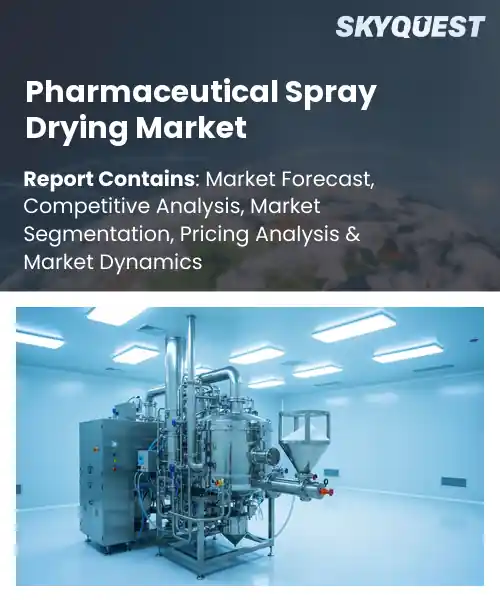
Pharmaceutical Spray Drying Market
Report ID: SQMIG35B2381
Report ID: SQMIG35B2381
[email protected]
USA +1 351-333-4748
Report ID:
SQMIG35B2381 |
Region:
Global |
Published Date: June, 2026
Pages:
157
|Tables:
175
|Figures:
79


Global Pharmaceutical Spray Drying Market size was valued at USD 3.51 Billion in 2024 and is poised to grow from USD 3.82 Billion in 2025 to USD 7.57 Billion by 2033, growing at a CAGR of 8.91% during the forecast period (2026-2033).
The pharmaceutical spray‑drying market turns liquid formulations into fine powders, so they can be loaded into capsules, inhalers, or injectables, and this step is essential for better stability, stronger bioavailability , and higher patient adherence. Its importance comes from the growing need for fast biologics and high‑potency APIs, but those also need good particle size governance.
Moreover, building on the momentum, the main driver for the pharmaceutical spray drying market growth is the expanding pipeline of biologics and gene‑therapy products, and they want particulate carriers with specifically tuned dissolution behavior. Since spray‑drying can create amorphous powder forms that improve solubility, manufacturers such as Pfizer and Novartis are frequently outsourcing the operation to specialized firms, partly to compress development timelines , and partly to reduce overall cost. This outsourcing wave then triggers investment in high‑throughput dryers and particle‑analysis instruments, which in turn opens room for equipment vendors and service providers. As a result, projects often flow toward regions with established manufacturing capabilities, especially North America and Europe, while Asia‑based hubs try to win with lower labor expenses to keep taking market share.
AI‑driven automation is basically tightening grip on critical process variables like inlet temperature, atomizer speed, and feed rate, and these factors steer the particle size distribution and moisture level at the same time. With continuous sensor‑data monitoring, algorithms can forecast drift early , before a batch goes off track, so operators can make adjustments in real time that keep product characteristics inside strict limits. That precision tends to reduce batch‑to‑batch inconsistency , cut the likelihood of out‑of‑specification lots, and shrink the time spent on quality investigations. Companies are also weaving these systems directly into current spray dryers, so offer a feedback loop that balances day‑to‑day efficiency with regulatory expectations, while also supporting the market’s growing need for consistent, high‑quality excipients and APIs.
Market snapshot - (2026-2033)
Global Market Size
USD 3.51 Billion
Largest Segment
Equipment
Fastest Growth
Services
Growth Rate
8.91% CAGR
To get more insights on this market click here to Request a Free Sample Report
The global pharmaceutical spray drying market is segmented based on offering, application, scale, end user, technology, distribution channel, and region. By offering, the market is categorized into equipment and services. Based on application, the market is segmented into amorphous solid dispersions (ASDs), API processing, biologics & protein formulations, inhalation drug formulations, and others. By scale, the market is divided into laboratory scale, pilot scale, and commercial scale operations. Based on end user, the market comprises pharmaceutical manufacturers, contract development & manufacturing organizations (CDMOs), biotechnology companies, research institutes, and others. By technology, the market is classified into open-cycle spray drying, closed-cycle spray drying, nitrogen-based spray drying, and other technologies. Based on distribution channel, the market is segmented into direct sales, industrial equipment distributors, and contract manufacturing partnerships. Geographically, the market is analyzed across North America, Europe, Asia Pacific, Latin America, and the Middle East & Africa.
As per the pharmaceutical spray drying market analysis, the equipment segment dominates, mostly because it directly fits the core need for reliable , high precision spray drying equipment that helps anchor product quality and regulatory compliance. In practice, manufacturers lean toward sturdy machines that can cope with varied formulations, so they can keep particle size and moisture content steady. Also, the whole need for scalable, repeatable processing is a big push, so players keep putting money into the latest dryers, the ones with smarter control systems and automation, to keep batch-to-batch variability down, as much as possible.
However, services segment shows up as the fastest expanding one, because companies often outsource know-how for process development, scale up, and even regulatory support. When specialists come in from outside, they can shorten time to market, since they deliver targeted fine-tuning and validation, which also cuts down capital risk. This increased dependence on external expertise basically feeds demand for service packages, helps widen market reach, and ends up building additional revenue lines.
According to the pharmaceutical spray drying market forecast, the Inhalation drug formulations segment is leading, largely because respiratory diseases are becoming more common, and that boosts demand for dry powder inhalers where particle design has to be precise, down to the details. Spray drying tends to deliver good aerodynamic behavior and stability, which matters for pushing active ingredients all the way to the lungs. So manufacturers focus here, aiming to satisfy clinical performance benchmarks, regulatory expectations, and patient adherence , and that in turn drives investment in specialized drying technology plus formulation know how.
Meanwhile, the amorphous solid dispersions segment is building the strongest growth traction, mainly because it tackles solubility headaches for poorly water soluble APIs. Spray drying can create high energy amorphous structures that improve bioavailability, so formulators adopt this route for more drug candidates. This movement increases market demand, and it opens room for both equipment makers and service innovators to step in.
To get detailed segments analysis, Request a Free Sample Report
As per the pharmaceutical spray drying market regional forecast, North America leverages a confluence of advanced research infrastructure, rigorous yet facilitative regulatory pathways , and deep capital availability that together create an environment conducive to high‑value pharmaceutical manufacturing. The region also benefits from a mature ecosystem of large multinational producers, specialized contract manufacturing organizations, and a skilled technical workforce that seems adept at integrating cutting‑edge drying technologies. Strong collaboration between academia , industry, and government accelerates innovation cycles, while robust supply‑chain networks ensure reliable sourcing of high‑purity excipients. Put together, this combination of technological leadership, regulatory confidence , and strategic investment positions North America as a benchmark for quality and efficiency in pharmaceutical spray drying.
United States Pharmaceutical Spray Drying Market
The Pharmaceutical Spray Drying sector in the United States thrives on a culture of continuous innovation supported by world‑class research institutions, and a dense network of biotech and pharmaceutical firms. The market benefits from sophisticated contract manufacturing capabilities that emphasize precision , and scalability, while regulatory agencies provide clear guidance that balances safety with speed to market. Close collaboration between industry and academic partners fuels the development of novel particle engineering approaches , which reinforces the United States’ role as a global leader in high‑performance drug delivery technologies.
Canada Pharmaceutical Spray Drying Market
The Pharmaceutical Spray Drying industry in Canada is distinguished by a strong emphasis on quality assurance and collaborative research initiatives that integrate expertise from universities and specialized manufacturers. The Canadian environment encourages public‑private partnerships that focus on developing cost‑effective and environmentally sustainable drying processes, more or less. A well‑educated technical workforce and supportive regulatory frameworks promote confidence among global partners, positioning Canada as a reliable hub for niche pharmaceutical production and innovation in advanced particle design.
The European pharmaceutical spray drying market penetration is propelled by a harmonized regulatory landscape that fosters cross‑border collaboration , and accelerates product approvals, plus deep engineering expertise that underpins sophisticated drying solutions. The region’s commitment to patient‑focused therapies stimulates demand for high‑precision inhalable formulations, while extensive research funding channels encourage breakthroughs in particle engineering and process optimization. Strong industrial clusters in Germany, the United Kingdom and France nurture a vibrant ecosystem of manufacturers, academia and technology providers, enabling rapid adoption of next‑generation spray drying techniques , and reinforcing Europe’s position as a hub for innovative pharmaceutical manufacturing.
Germany Pharmaceutical Spray Drying Market
The Pharmaceutical Spray Drying industry in Germany benefits from a legacy of precision engineering, and a dense network of equipment manufacturers that deliver highly reliable drying systems. The market is supported by intensive collaboration between research institutes , and pharmaceutical firms, fostering continuous advancements in particle morphology and process efficiency. Stringent quality standards and a proactive regulatory environment further enhance confidence among global partners, establishing Germany as a cornerstone of European spray drying excellence.
United Kingdom Pharmaceutical Spray Drying Market
The Pharmaceutical Spray Drying Market in the United Kingdom experiences rapid growth driven by a thriving biotech sector, and substantial investment in novel drug delivery platforms. Strong academic‑industry linkages accelerate translational research, while flexible regulatory pathways encourage agile development of inhalable therapies. The United Kingdom’s focus on digitalization , and advanced analytics enriches process control, positioning the market as a dynamic and fast‑evolving segment within Europe.
France Pharmaceutical Spray Drying Market
The Pharmaceutical Spray Drying Market in France is emerging through focused initiatives that blend pharmaceutical expertise with cutting‑edge material science. Collaborative programs between universities and start‑up enterprises stimulate innovation in particle engineering , and environmentally conscious drying methods. A supportive regulatory climate and strategic incentives for high‑added‑value manufacturing encourage the establishment of specialized production facilities, gradually elevating France’s influence within the European spray drying landscape.
Asia Pacific is advancing its role by blending fast industrial expansion with rising needs for inhalable and biologic therapies. Because of that, more manufacturers start leaning into advanced spray drying technologies, sometimes earlier than expected. The region also has steady governmental push toward high‑tech manufacturing, plus a larger set of skilled engineers who are good with precision process development and the details matter. In Japan and South Korea especially, collaborative research ecosystems keep nudging progress forward , improving particle design and squeezing better process efficiency out of the same equipment. At the same time, new-ish supply chain capabilities help suppliers and plants handle global quality expectations more reliably. Taken together, these pieces lift Asia Pacific’s impact in the worldwide pharmaceutical spray drying arena.
Japan Pharmaceutical Spray Drying Market
In Japan, the Pharmaceutical Spray Drying Market builds on a long standing approach to careful engineering and a culture that keeps refining how things are done, not just once but repeatedly. Tight connections between academic labs and major pharmaceutical companies help bring forward drying methods that stress precision and reproducibility. On top of that, government programs aimed at high‑technology manufacturing strengthen Japan’s ability to deliver sophisticated inhalable products , for both local use and international distribution.
South Korea Pharmaceutical Spray Drying Market
The South Korean Pharmaceutical Spray Drying Market is pushed along by a lively biotech landscape and industrial policies that look ahead. These policies basically nudge companies to adopt state‑of‑the‑art drying solutions, rather than waiting until later. There’s also a strong focus on research partnerships and rapid prototyping which makes it easier to move new formulations into scalable processes without too much delay. With a technically trained workforce and growing investment in automation, process reliability gets better over time, and that helps place South Korea as a more and more influential participant in the global pharmaceutical spray drying ecosystem.
To know more about the market opportunities by region and country, click here to
Buy The Complete Report
Increasing Demand for Inhalable Therapies
Advancements in Particle Engineering Techniques
High Capital Investment Requirements
Regulatory Complexity Across Regions
Request Free Customization of this report to help us to meet your business objectives.
The competitive landscape looks like it is being shaped by more intense R&D tie ups and some strategic buy‑ins, where firms try to fold in machine‑learning‑enhanced CFD models so they can get past the spray‑drying inefficiencies. This can be seen in how companies keep making partnerships and then stitching that know how into “new” manufacturing approaches, plus acquisitions that seem a bit like they’re meant to fill gaps quickly. For example there is a partnership between a major equipment maker and a biotech company, aimed at co‑developing high‑yield particle technologies, and then there is the recent acquisition where a big pharmaceutical conglomerate picked up a niche spray‑drying specialist to widen its solid‑dose offering, more broadly.
Top Player’s Company Profile
Recent Developments in the Pharmaceutical Spray Drying Market
SkyQuest’s ABIRAW (Advanced Business Intelligence, Research & Analysis Wing) is our Business Information Services team that Collects, Collates, Correlates, and Analyses the Data collected by means of Primary Exploratory Research backed by robust Secondary Desk research.
As per SkyQuest analysis, the primary driver of market growth is that inhalable therapies demand is rising. That pushes manufacturers toward spray‑drying because they need fine, fairly uniform particles. A second driver is the rapid advancement of particle‑engineering techniques, which can improve solubility and bioavailability for complex APIs, maybe even where traditional methods struggle. Equipment still dominates overall, since dependable dryers are essential for consistent product quality. Services are growing fast too, especially through outsourcing, because firms want agility without building everything in house. In terms of region, North America stays dominant. It benefits from advanced research infrastructure,strong capital availability, and supportive regulatory pathways. A notable restraint is the high capital investment needed for specialized dryers and clean‑room facilities, which makes it harder for smaller firms to enter the space.
| Report Metric | Details |
|---|---|
| Market size value in 2024 | USD 3.51 Billion |
| Market size value in 2033 | USD 7.57 Billion |
| Growth Rate | 8.91% |
| Base year | 2024 |
| Forecast period | (2026-2033) |
| Forecast Unit (Value) | USD Billion |
| Segments covered |
|
| Regions covered | North America (US, Canada), Europe (Germany, France, United Kingdom, Italy, Spain, Rest of Europe), Asia Pacific (China, India, Japan, Rest of Asia-Pacific), Latin America (Brazil, Rest of Latin America), Middle East & Africa (South Africa, GCC Countries, Rest of MEA) |
| Companies covered |
|
| Customization scope | Free report customization with purchase. Customization includes:-
|
To get a free trial access to our platform which is a one stop solution for all your data requirements for quicker decision making. This platform allows you to compare markets, competitors who are prominent in the market, and mega trends that are influencing the dynamics in the market. Also, get access to detailed SkyQuest exclusive matrix.
Table Of Content
Executive Summary
Market overview
Parent Market Analysis
Market overview
Market size
KEY MARKET INSIGHTS
COVID IMPACT
MARKET DYNAMICS & OUTLOOK
Market Size by Region
KEY COMPANY PROFILES
Methodology
For the Pharmaceutical Spray Drying Market, our research methodology involved a mixture of primary and secondary data sources. Key steps involved in the research process are listed below:
1. Information Procurement: This stage involved the procurement of Market data or related information via primary and secondary sources. The various secondary sources used included various company websites, annual reports, trade databases, and paid databases such as Hoover's, Bloomberg Business, Factiva, and Avention. Our team did 45 primary interactions Globally which included several stakeholders such as manufacturers, customers, key opinion leaders, etc. Overall, information procurement was one of the most extensive stages in our research process.
2. Information Analysis: This step involved triangulation of data through bottom-up and top-down approaches to estimate and validate the total size and future estimate of the Pharmaceutical Spray Drying Market.
3. Report Formulation: The final step entailed the placement of data points in appropriate Market spaces in an attempt to deduce viable conclusions.
4. Validation & Publishing: Validation is the most important step in the process. Validation & re-validation via an intricately designed process helped us finalize data points to be used for final calculations. The final Market estimates and forecasts were then aligned and sent to our panel of industry experts for validation of data. Once the validation was done the report was sent to our Quality Assurance team to ensure adherence to style guides, consistency & design.
Analyst Support
Customization Options
With the given market data, our dedicated team of analysts can offer you the following customization options are available for the Pharmaceutical Spray Drying Market:
Product Analysis: Product matrix, which offers a detailed comparison of the product portfolio of companies.
Regional Analysis: Further analysis of the Pharmaceutical Spray Drying Market for additional countries.
Competitive Analysis: Detailed analysis and profiling of additional Market players & comparative analysis of competitive products.
Go to Market Strategy: Find the high-growth channels to invest your marketing efforts and increase your customer base.
Innovation Mapping: Identify racial solutions and innovation, connected to deep ecosystems of innovators, start-ups, academics, and strategic partners.
Category Intelligence: Customized intelligence that is relevant to their supply Markets will enable them to make smarter sourcing decisions and improve their category management.
Public Company Transcript Analysis: To improve the investment performance by generating new alpha and making better-informed decisions.
Social Media Listening: To analyze the conversations and trends happening not just around your brand, but around your industry as a whole, and use those insights to make better Marketing decisions.
REQUEST FOR SAMPLE
 REQUEST FREE CUSTOMIZATION
Global Pharmaceutical Spray Drying Market size was valued at USD 3.51 Billion in 2024 and is poised to grow from USD 3.82 Billion in 2025 to USD 7.57 Billion by 2033, growing at a CAGR of 8.91% during the forecast period (2026-2033).
The competitive landscape is shaped by intensified R&D collaborations and strategic acquisitions, as firms integrate advanced machine‑learning‑enhanced CFD models to overcome spray‑drying inefficiencies. Notable moves include a partnership between a leading equipment manufacturer and a biotech company to co‑develop high‑yield particle technologies, and the recent acquisition of a niche spray‑drying specialist by a global pharmaceutical conglomerate to broaden its solid‑dose portfolio. 'GEA Group AG', 'BÜCHI Labortechnik AG', 'SPX FLOW, Inc.', 'Yamato Scientific Co., Ltd.', 'European SprayDry Technologies LLP', 'Dedert Corporation', 'Steri Technologies Inc.', 'Freund Corporation', 'Advanced Drying Systems', 'Hovione', 'Lonza Group AG', 'Catalent, Inc.', 'Recipharm AB', 'Cambrex Corporation', 'Quotient Sciences', 'PCI Pharma Services', 'Bend Bioscience', 'Particle Dynamics, Inc.', 'Upperton Pharma Solutions', 'Nanoform Finland Plc'
The rise of respiratory disorders and the growing preference for patient‑friendly delivery systems are prompting pharmaceutical companies to develop inhalable formulations. Spray drying enables production of fine, uniform particles with high bioavailability, meeting stringent regulatory expectations for inhalation products. By providing reproducible particle morphology and enhancing stability, the technology shortens development cycles and reduces formulation failures. Consequently, manufacturers are adopting spray drying to accelerate market entry of innovative inhalable therapies, which directly fuels expansion of the pharmaceutical spray‑drying market globally.
Advanced Particle Engineering: Pharmaceutical manufacturers are leveraging sophisticated particle‑engineering techniques within spray‑drying processes to tailor particle morphology, improve flowability, and enhance dissolution rates of inhalable and oral dosage forms. By integrating micronization, surface modification, and controlled agglomeration, firms can achieve consistent aerodynamic performance and reduce variability across batches. This focus on precise particle characteristics supports faster formulation development, enables higher therapeutic efficacy, and meets rising expectations for patient-centric drug delivery solutions worldwide while also complying with stringent quality standards across major markets globally.
Why does North America Dominate the Global Pharmaceutical Spray Drying Market? |@12


Want to customize this report? This report can be personalized according to your needs. Our analysts and industry experts will work directly with you to understand your requirements and provide you with customized data in a short amount of time. We offer $1000 worth of FREE customization at the time of purchase.
Feedback From Our Clients


 USA (+1) 351-333-4748

