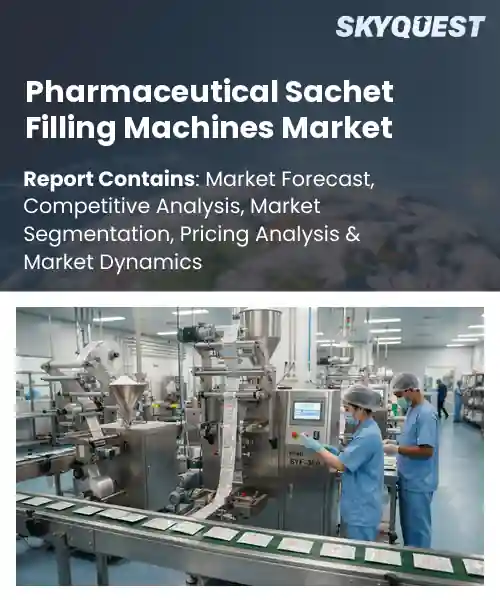
Pharmaceutical Sachet Filling Machines Market
Report ID: SQMIG20I4020
Report ID: SQMIG20I4020
[email protected]
USA +1 351-333-4748
Report ID:
SQMIG20I4020 |
Region:
Global |
Published Date: September, 2026
Pages:
157
|Tables:
146
|Figures:
78


Global Pharmaceutical Sachet Filling Machines Market size was valued at USD 420.0 Million in 2024 and is poised to grow from USD 444.36 Million in 2025 to USD 697.63 Million by 2033, growing at a CAGR of 5.8% during the forecast period (2026-2033).
The pharmaceutical sachet filling machine market supplies automated equipment that packages medicines, nutraceuticals, and vaccines into sachets. Its importance stems from rising demand for accurate, portable delivery formats, especially in emerging economies where cold‑chain logistics remain costly. Historically, the market emerged in the early 2000s when manufacturers sought alternatives to bulk blister packs for pediatric and travel‑size dosages. Adoption accelerated after 2010 as regulatory bodies endorsed sachets for improved patient compliance, illustrated by a 2015 partnership between a German equipment maker and an Indian vaccine producer to meet WHO‑recommended oral polio campaigns. This evolution underscores sector’s shift toward high‑speed equipment. Digitalization and Industry 4.0 integration constitute principal growth catalyst for global pharmaceutical sachet filling machines market because they enable monitoring, maintenance, and line changeover that reduce downtime and compliance risk. Manufacturers that embed IoT sensors into filling heads can instantly detect deviation in fill volume, prompting automatic adjustments that preserve dose accuracy and avoid costly recalls. For example, a Southeast Asian producer leveraged an analytics platform to cut batch rework by 18 % while meeting stringent FDA tracking requirements. This efficiency fuels demand for modular machines, opening opportunities for OEMs to offer subscription services and upgrades aligned with trend toward personalized medicine.
How is AI-driven automation improving efficiency in the pharmaceutical sachet filling machines market?
AI-driven automation in pharmaceutical sachet filling machines focuses on three key aspects: intelligent dosing, real‑time quality inspection, and predictive equipment care. Manufacturers now embed vision sensors that compare each sachet against exact fill specifications, while machine‑learning models analyse vibration and power signals to flag wear before failure. The result is fewer line stops, tighter product consistency and faster changeovers. Plant operators benefit from dashboards that translate raw data into actionable alerts, allowing crews to intervene only when needed. This shift reduces manual checks, shortens cleaning cycles and aligns production with strict regulatory requirements, making the market more responsive to demand spikes.IMA announced an AI‑enabled vision system for its sachet filling line in June 2024, improving fill accuracy and reducing waste. The upgrade integrates directly with shop‑floor software, allowing continuous monitoring and faster batch releases, which reinforces market growth through higher efficiency.
Market snapshot - (2026-2033)
Global Market Size
USD 420.0 Million
Largest Segment
Horizontal Sachet Filling Machines
Fastest Growth
Multi-Lane Sachet Filling Machines
Growth Rate
5.8% CAGR
To get more insights on this market click here to Request a Free Sample Report
Global pharmaceutical sachet filling machines market is segmented by machine type, product type, sachet type, automation, end user and region. Based on machine type, the market is segmented into Vertical Sachet Filling Machines, Horizontal Sachet Filling Machines and Multi-Lane Sachet Filling Machines. Based on product type, the market is segmented into Powder, Granules, Liquids and Semi-Solids. Based on sachet type, the market is segmented into Three-Side Seal, Four-Side Seal, Stick Pack and Other Sachet Formats. Based on automation, the market is segmented into Semi-Automatic and Fully Automatic. Based on end user, the market is segmented into Pharmaceutical Companies, Contract Manufacturing Organizations, Nutraceutical Companies and Research & Development Facilities. Based on region, the market is segmented into North America, Europe, Asia Pacific, Latin America and Middle East & Africa.
Vertical Sachet Filling Machines segment dominates because its compact footprint aligns with space constrained production lines, allowing manufacturers to maximize throughput without extensive floor area. The vertical orientation simplifies material feeding and gravitation assisted flow, reducing energy consumption and maintenance needs. These machines also provide easier changeovers for diverse dosage forms, meeting the agility demanded by pharmaceutical firms. Consequently, they are preferred for high mix low volume operations, reinforcing their leadership in the market.
However, horizontal sachet filling machines segment is witnessing the strongest growth momentum because manufacturers seeking higher line speeds value the feed design that ensures consistent dosing. Servo driven film handling enhances precision, and modular configurations allow scalability for drug lines. This expansion drives opportunities as firms adopt horizontal platforms for bulk sachet production.
Semi Solids segment dominates because their viscous nature requires precise dosing and controlled sealing, which vertical and horizontal machines have been optimized to handle. The need for accurate metering of creams, gels, and ointments drives investment in machines with advanced pumping and temperature control capabilities. Manufacturers prioritize equipment that can maintain product integrity and prevent contamination, reinforcing the prominence of semi solid handling solutions in the pharmaceutical sachet filling machines market.
On the other hand, liquids segment is emerging as the key high growth area because expanding demand for oral rehydration solutions, pediatric suspensions, and injectables in sachet formats pushes manufacturers toward liquid filling lines. Advances in sterile film technology and flow reduce contamination risk and speed cycles, opening opportunities for equipment makers and expanding market growth.
Powders segment dominates because they are widely used in oral solid dosage forms, and their free flowing characteristics allow high speed dosing with minimal waste. The simplicity of blending and granulation processes aligns with standard sachet filling equipment, reducing changeover time. Consequently, powder handling solutions are favored for efficiency and cost effectiveness, cementing their leadership in the market.
On the other hand, liquids segment is emerging as the key high growth area because expanding demand for oral rehydration solutions, pediatric suspensions, and injectables in sachet formats pushes manufacturers toward liquid filling lines. Advances in sterile film technology and flow reduce contamination risk and speed cycles, opening opportunities for equipment makers and expanding market growth.
To get detailed segments analysis, Request a Free Sample Report
The Asia Pacific region leverages a confluence of advanced manufacturing expertise, robust research ecosystems, and a rapidly expanding consumer health landscape. High adoption of precision engineering and automation technologies underpins the development of sophisticated sachet filling solutions that meet stringent regulatory expectations. Strategic investments by leading equipment manufacturers enhance local supply chains and foster collaborative innovation with pharmaceutical firms. Additionally, strong governmental support for cost‑effective dosage forms reinforces market uptake, while a skilled workforce drives continuous process improvement and customization capabilities, solidifying the region’s leadership position.
Pharmaceutical Sachet Filling Machines Market in Japan benefits from a mature pharmaceutical sector that emphasizes high quality and reliability. Local manufacturers prioritize precision and integration of cutting‑edge control systems, aligning with stringent domestic regulations. Collaborative research initiatives between equipment providers and drug developers accelerate the introduction of novel sachet formats, while a focus on efficiency supports the growing demand for patient‑centric packaging solutions.
Pharmaceutical Sachet Filling Machines Market in South Korea is propelled by a dynamic biotech environment and strong governmental incentives for advanced drug delivery technologies. The country’s emphasis on rapid prototyping and flexible manufacturing enables swift adaptation to emerging therapeutic trends. Partnerships between global equipment suppliers and domestic pharmaceutical firms foster technology transfer, enhancing capabilities in high‑speed, low‑contamination filling processes that cater to both domestic and export markets.
North America experiences rapid expansion driven by a heightened focus on patient adherence and the pursuit of innovative packaging that reduces waste and enhances convenience. The region’s emphasis on regulatory compliance and quality assurance fuels the adoption of highly controlled sachet filling systems. Strong investment in research and development by pharmaceutical innovators encourages the exploration of novel dosage forms, while a sophisticated logistics network supports efficient distribution of sacheted products. Collaborative ecosystems among equipment manufacturers, contract packaging firms, and drug developers accelerate technology refinement, positioning the market to meet evolving therapeutic and consumer preferences.
Pharmaceutical Sachet Filling Machines Market in the United States is shaped by a large-scale pharmaceutical industry that seeks agility and precision in packaging. Leading equipment providers concentrate on modular designs that integrate seamlessly with existing production lines, enhancing scalability. Emphasis on stringent quality standards drives the incorporation of advanced monitoring and traceability features, while a strong emphasis on patient‑focused solutions fuels demand for diverse sachet formats across therapeutic categories.
Pharmaceutical Sachet Filling Machines Market in Canada benefits from a collaborative healthcare landscape that values cost‑effective delivery mechanisms. Manufacturers focus on reliable, low‑maintenance equipment suitable for mid‑size production environments. Close ties between equipment makers and local pharmaceutical firms promote adaptation of filling technologies to meet specific regulatory and market needs, supporting the growing preference for sachet packaging in both generic and specialty drug segments.
Europe strengthens its position through a concerted emphasis on sustainability, regulatory harmonization, and cross‑border innovation networks. The region’s commitment to environmentally responsible packaging drives the development of energy‑efficient filling equipment and recyclable sachet materials. Integrated standards across member states simplify market entry for manufacturers, while strong academic‑industry collaborations accelerate the adoption of digitalization and smart manufacturing concepts. These dynamics collectively enhance Europe’s capability to deliver high‑quality, compliant sachet solutions that align with evolving patient and regulatory expectations.
Pharmaceutical Sachet Filling Machines Market in Germany is anchored by a precision engineering heritage that prioritizes reliability and advanced automation. Local equipment producers emphasize robust design and high throughput, catering to the rigorous quality demands of the pharmaceutical sector. Close cooperation with research institutes facilitates the integration of sensor technologies and real‑time data analytics, optimizing process control and reducing operational risk.
Pharmaceutical Sachet Filling Machines Market in the United Kingdom reflects a strong focus on innovation and regulatory excellence. Manufacturers adopt flexible, modular filling solutions that support rapid changeover for varied product lines. Collaborative initiatives between industry bodies and academic centers promote the development of intelligent packaging technologies, reinforcing the market’s ability to respond to emerging therapeutic trends and patient‑centric demands.
Pharmaceutical Sachet Filling Machines Market in France benefits from a robust pharmaceutical ecosystem that values quality and customization. Equipment suppliers prioritize adaptable filling platforms that can be tailored to specific dosage requirements, while adherence to strict European standards ensures consistent product safety. Strategic partnerships with biotech firms nurture the creation of niche sachet formats, supporting the country’s commitment to innovative and patient‑focused drug delivery.
To know more about the market opportunities by region and country, click here to
Buy The Complete Report
Increasing Demand for Personalized Medicine
Advancements in Automation Technology
High Initial Capital Investment
Stringent Regulatory Compliance Requirements
Request Free Customization of this report to help us to meet your business objectives.
Top Player’s Company Profile
Recent Developments
SkyQuest’s ABIRAW (Advanced Business Intelligence, Research & Analysis Wing) is our Business Information Services team that Collects, Collates, Correlates, and Analyses the Data collected by means of Primary Exploratory Research backed by robust Secondary Desk research. As per SkyQuest analysis the global pharmaceutical sachet filling machines market is being propelled primarily by the rising demand for personalized medicine, which pushes manufacturers toward flexible, small‑batch packaging solutions, while the integration of advanced automation such as robotics and AI‑driven vision systems serves as a second catalyst that boosts efficiency and dose accuracy. High initial capital investment remains a notable restraint, especially for smaller firms. Asia Pacific dominates the market thanks to its strong manufacturing base and supportive policies, and the vertical sachet filling machine segment leads due to its compact footprint and suitability for high‑mix, low‑volume production, positioning it for continued growth through 2033 and expanding applications in vaccines and nutraceuticals.
| Report Metric | Details |
|---|---|
| Market size value in 2024 | USD 420.0 Million |
| Market size value in 2033 | USD 697.63 Million |
| Growth Rate | 5.8% |
| Base year | 2024 |
| Forecast period | (2026-2033) |
| Forecast Unit (Value) | USD Million |
| Segments covered |
|
| Regions covered | North America (US, Canada), Europe (Germany, France, United Kingdom, Italy, Spain, Rest of Europe), Asia Pacific (China, India, Japan, Rest of Asia-Pacific), Latin America (Brazil, Rest of Latin America), Middle East & Africa (South Africa, GCC Countries, Rest of MEA) |
| Companies covered |
|
| Customization scope | Free report customization with purchase. Customization includes:-
|
To get a free trial access to our platform which is a one stop solution for all your data requirements for quicker decision making. This platform allows you to compare markets, competitors who are prominent in the market, and mega trends that are influencing the dynamics in the market. Also, get access to detailed SkyQuest exclusive matrix.
Table Of Content
Executive Summary
Market overview
Parent Market Analysis
Market overview
Market size
KEY MARKET INSIGHTS
COVID IMPACT
MARKET DYNAMICS & OUTLOOK
Market Size by Region
KEY COMPANY PROFILES
Methodology
For the Pharmaceutical Sachet Filling Machines Market, our research methodology involved a mixture of primary and secondary data sources. Key steps involved in the research process are listed below:
1. Information Procurement: This stage involved the procurement of Market data or related information via primary and secondary sources. The various secondary sources used included various company websites, annual reports, trade databases, and paid databases such as Hoover's, Bloomberg Business, Factiva, and Avention. Our team did 45 primary interactions Globally which included several stakeholders such as manufacturers, customers, key opinion leaders, etc. Overall, information procurement was one of the most extensive stages in our research process.
2. Information Analysis: This step involved triangulation of data through bottom-up and top-down approaches to estimate and validate the total size and future estimate of the Pharmaceutical Sachet Filling Machines Market.
3. Report Formulation: The final step entailed the placement of data points in appropriate Market spaces in an attempt to deduce viable conclusions.
4. Validation & Publishing: Validation is the most important step in the process. Validation & re-validation via an intricately designed process helped us finalize data points to be used for final calculations. The final Market estimates and forecasts were then aligned and sent to our panel of industry experts for validation of data. Once the validation was done the report was sent to our Quality Assurance team to ensure adherence to style guides, consistency & design.
Analyst Support
Customization Options
With the given market data, our dedicated team of analysts can offer you the following customization options are available for the Pharmaceutical Sachet Filling Machines Market:
Product Analysis: Product matrix, which offers a detailed comparison of the product portfolio of companies.
Regional Analysis: Further analysis of the Pharmaceutical Sachet Filling Machines Market for additional countries.
Competitive Analysis: Detailed analysis and profiling of additional Market players & comparative analysis of competitive products.
Go to Market Strategy: Find the high-growth channels to invest your marketing efforts and increase your customer base.
Innovation Mapping: Identify racial solutions and innovation, connected to deep ecosystems of innovators, start-ups, academics, and strategic partners.
Category Intelligence: Customized intelligence that is relevant to their supply Markets will enable them to make smarter sourcing decisions and improve their category management.
Public Company Transcript Analysis: To improve the investment performance by generating new alpha and making better-informed decisions.
Social Media Listening: To analyze the conversations and trends happening not just around your brand, but around your industry as a whole, and use those insights to make better Marketing decisions.
REQUEST FOR SAMPLE
 REQUEST FREE CUSTOMIZATION


Want to customize this report? This report can be personalized according to your needs. Our analysts and industry experts will work directly with you to understand your requirements and provide you with customized data in a short amount of time. We offer $1000 worth of FREE customization at the time of purchase.
Feedback From Our Clients


 USA (+1) 351-333-4748

