Pharmaceutical Processing Equipment Market
Report ID: SQMIG35J2151
Report ID: SQMIG35J2151
[email protected]
USA +1 351-333-4748
Report ID:
SQMIG35J2151 |
Region:
Global |
Published Date: August, 2025
Pages:
177
|Tables:
63
|Figures:
75


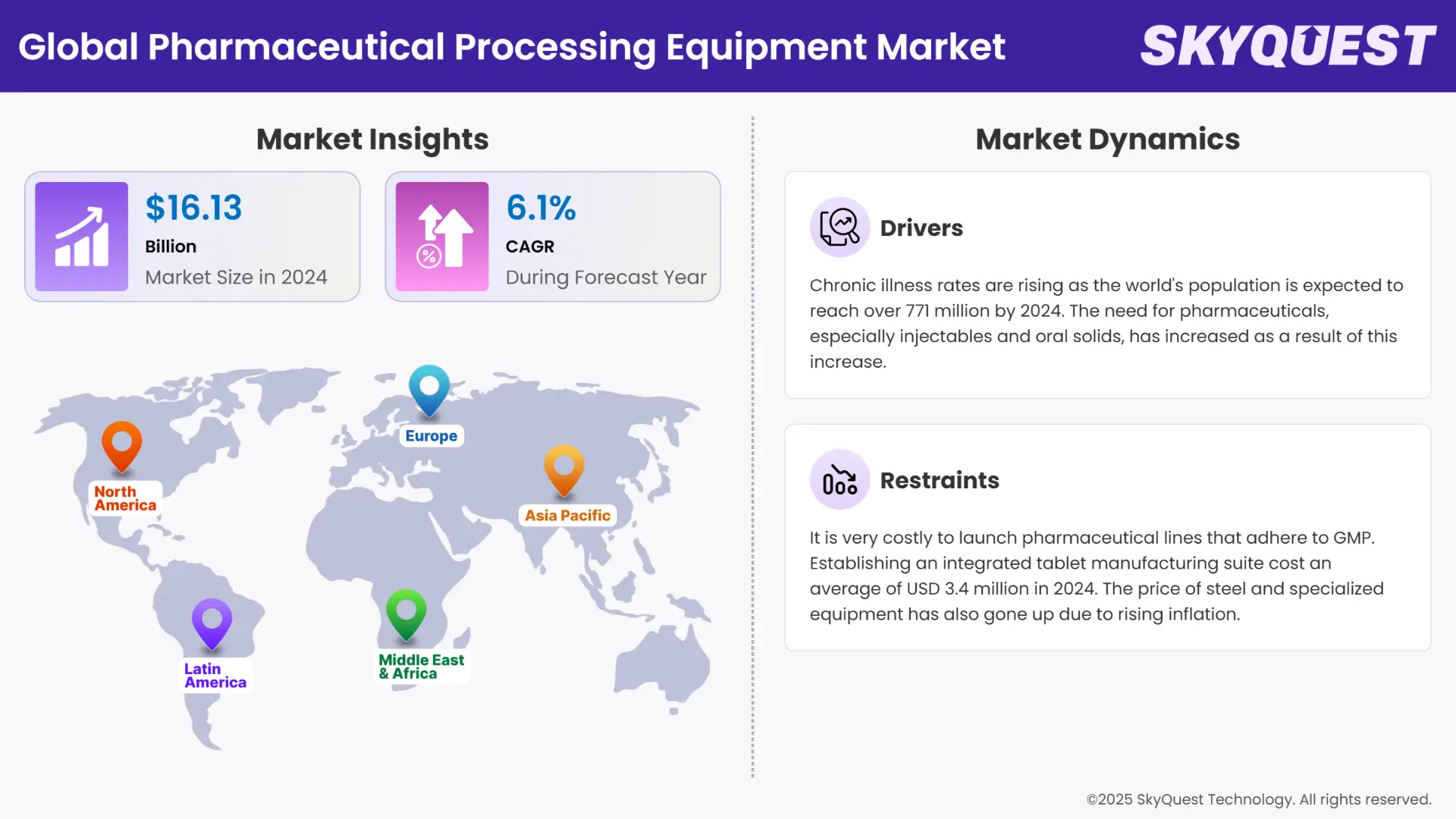
Global Pharmaceutical Processing Equipment Market size was valued at USD 16.41 Billion in 2024 and is poised to grow from USD 17.45 Billion in 2025 to USD 28.44 Billion by 2033, growing at a CAGR of 6.3% during the forecast period (2026–2033).
The increasing need for biologics, personalized medicine and advanced drug delivery technologies are driving demand for pharmaceutical processing equipment. As a result, pharmaceutical companies are being forced to move away from static equipment and towards high throughput, automated and flexible systems.
Moreover, increased adoption of IoT and AI in the global pharmaceutical processing equipment sector for predictive maintenance and real-time monitoring, as well as sustainability commitments leading to capital spending on modular production cleanrooms and energy efficient technologies that will contribute to more compliance and operationally adaptable and environmentally conscious pharmaceutical manufacturing.
What Role Does AI Play in Enhancing Product Quality and Compliance?
By automating quality control, streamlining procedures, and facilitating predictive maintenance, artificial intelligence (AI) is transforming pharmaceutical processing equipment market outlook. High compliance and throughput are ensured by AI-powered capsule fillers and inspection tools that use computer vision to identify flaws in real time.
Predictive maintenance solutions, on the other hand, use machine learning and sensor data to foresee equipment failures; Merck, for example, has used AI to cut unexpected downtime by more than 50%. These developments in smart manufacturing, when paired with process analytical technology (PAT), are accelerating drug production, raising yield, and reducing costs for the industry as a whole.
To get more insights on this market click here to Request a Free Sample Report
The global pharmaceutical processing equipment market is segmented into type, application, end-product type, and region. By type, the market is classified into API Equipment, preparation machinery, medicinal crushing machine, herbal medicine processing machinery, pharmaceutical water equipment, pharmaceutical packaging machinery, and drug testing equipment. Depending on the application, it is divided into pharmaceutical company and institute of medicine. According to end-use type, the market is bifurcated into solid and liquid. Regionally, it is analyzed across North America, Europe, Asia-Pacific, Latin America, and the Middle East and Africa.
What Makes API Equipment the Core of Pharmaceutical Manufacturing Today?
As per the 2024 pharmaceutical processing equipment market analysis, because of the global focus on production efficiency for branded and generic drugs, API equipment accounted for the largest portion of revenue. High-throughput reactors, crystallizers, and distillation equipment continue to be key parts of pharmaceuticals manufacture. For instance, in Q1 2025, a well-known CDMO in India upgraded their API processing line with cutting-edge reactor systems as a response to the increased demand of the drug pipeline. The need for reliable and scalable API synthesis platforms pushed this market segment to lead almost all capital investment and revenue.
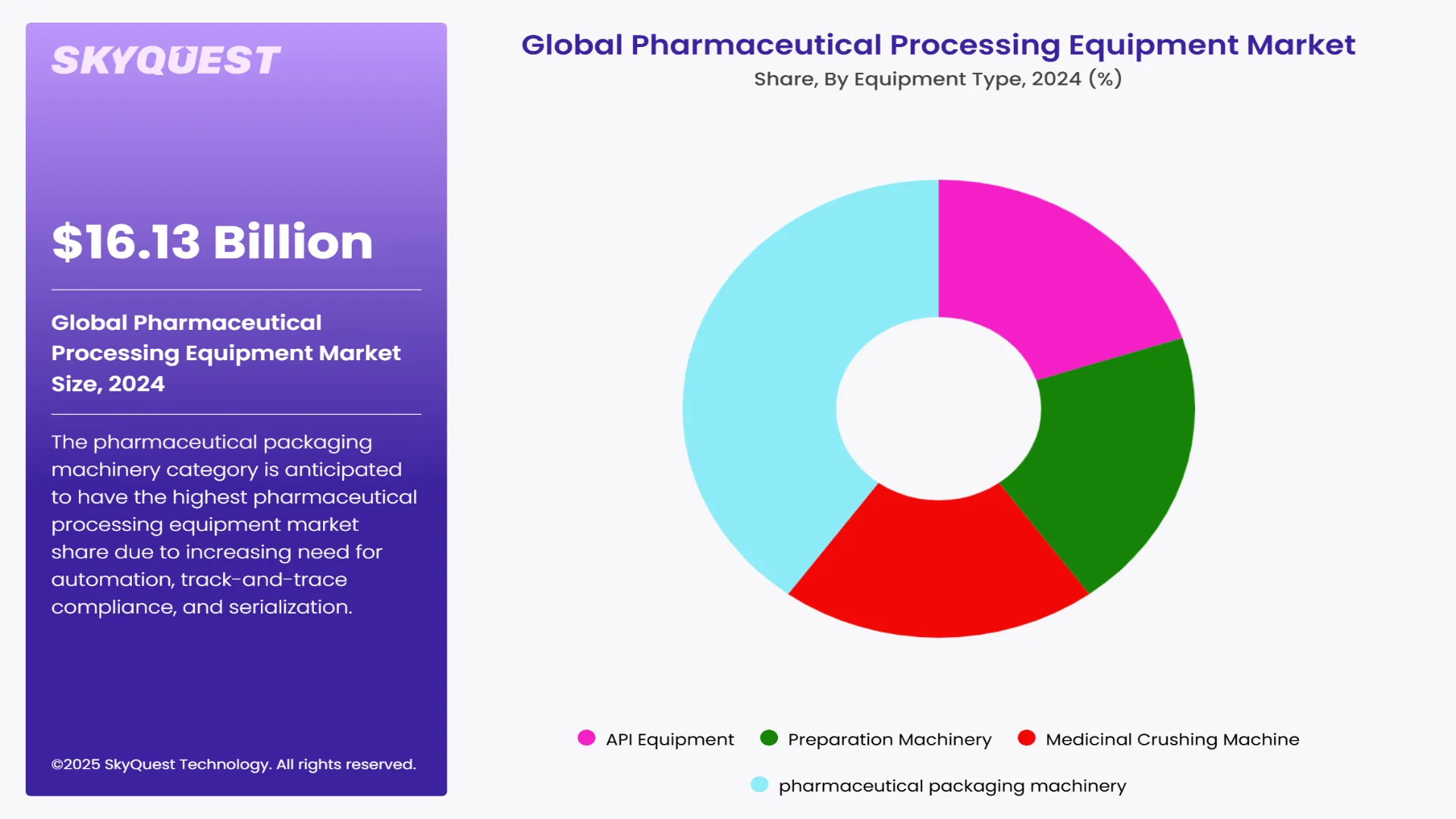
The pharmaceutical packaging machinery category is anticipated to have the highest pharmaceutical processing equipment market share due to increasing need for automation, track-and-trace compliance, and serialization. In 2024 a global pharmaceutical business deployed high-speed cartoners featuring vision inspection systems to assist in tracking compliance with changing rules and to speed up packaging. With packaging lines shifting towards automation and digitalization, more value will be injected in this market segment.
Why are Solid Dosage Forms Dominating Pharmaceutical Processing Investments?
As per the 2024 pharmaceutical processing equipment market forecast, the solid segment dominated the global market for high-volume tablet and capsule manufacturing. Blockbuster generic formulations were served by coating systems, tablet presses, and continuous granulators. The output for ambulatory drug programs was greatly increased in 2024 when a U.S. solid-dosage contract manufacturer built a continuous tablet press plant that could produce more than 100 million tablets per month. Its status as the top end-use subsegment was solidified by the broad preference for solid oral dosage forms in both consumer and chronic medications.
The liquid category is anticipated to grow quickly because of the growing demand for injectables, biologics, and oral liquids. Investments in mixers, autoclaves, and filling lines are increasing in tandem with the expansion of vaccine production and the growing demand for sterile injectable medications. For example, in response to increasing demand, a vaccine CDMO installed high-speed vial and syringe technology at its sterile filling plant in the 2025. The pharmaceutical industry's move to innovative liquid dosage and biologics is reflected in this growth.
To get detailed segments analysis, Request a Free Sample Report
Why is Asia-Pacific Emerging as a Global Hub for Pharmaceutical Manufacturing?
As per the pharmaceutical processing equipment market regional analysis, Asia-Pacific continues to dominate because of the high incidence of chronic diseases and the quick development of pharmaceutical capabilities. Aurobindo Pharma, an Indian company, pledged in April 2025 to invest more than USD 300 million in a new formulation facility. Furthermore, because of both public and private investments in pharmaceutical infrastructure across emerging nations, China's explosion in generics production is driving up regional demand for scalable processing equipment with automation and contamination control.
South Korea Pharmaceutical Processing Equipment Market
The South Korea pharmaceutical processing equipment industry is expanding because of local production and support for biotechnology companies. Biologics production contributed to an 11% increase in pharmaceutical exports in the first quarter of 2025. To meet global standards and increase their competitiveness in contract manufacturing, especially for vaccines and injectable medications, companies are progressively implementing cleanroom-compatible processing equipment.
Japan Pharmaceutical Processing Equipment Market
The aging of Japan's population and the need for biologics are two significant factors driving the Japanese pharmaceutical processing equipment market growth. In May 2025, Takeda Pharmaceuticals invested USD 200 million to upgrade its Tokyo processing systems in preparation for a high-volume R&D scale-up. The nation's emphasis on producing safe, effective medications for an aging population is supported by the need for high-throughput, fully automated technology, particularly in aseptic processing.
How is Europe Advancing Pharmaceutical Equipment Through Innovation and Regulation?
Automation and adherence to regulations are driving the pharmaceutical processing equipment market in Europe. German company B. Braun debuted a sterile processing line with cutting-edge isolator technology in June 2024. Manufacturers are emphasizing cleanroom integration and sustainable operations, which are encouraging the use of contemporary, digitalized manufacturing systems, because of EU-wide GMP compliance and significant R&D funding.
UK Pharmaceutical Processing Equipment Market
Domestic pharmaceutical manufacturing is being supported by the UK's post-Brexit investment policies. To increase productivity and flexibility, AstraZeneca set up state-of-the-art solid dosage production facilities in Manchester in 2024. The UK market now needs modular, scalable, and GMP-compliant equipment due to growing local production and the need for onshore capacity.
France Pharmaceutical Processing Equipment Market
France is working to increase the production of injectable drugs and biologics. Sanofi invested Euro 80 million in high-speed vial filling machinery in 2025 to expand its Lyon facility. Manufacturers are being forced to use precision processing equipment designed for high-volume, sterile manufacturing environments due to government support for pharmaceutical self-sufficiency and the rise of biosimilars.
Germany Pharmaceutical Processing Equipment Market
Process automation and pharmaceutical engineering innovations are driving the German pharmaceutical processing equipment market. At its Leverkusen facility, Bayer unveiled smart capsule production technology in March 2025. Germany is a major hub for the integration of cutting-edge pharmaceutical equipment because of its strong R&D pipelines, established supplier base, and emphasis on Industry 4.0 in the pharmaceutical sector.
What Drives North America's Leadership in Pharmaceutical Processing Technology?
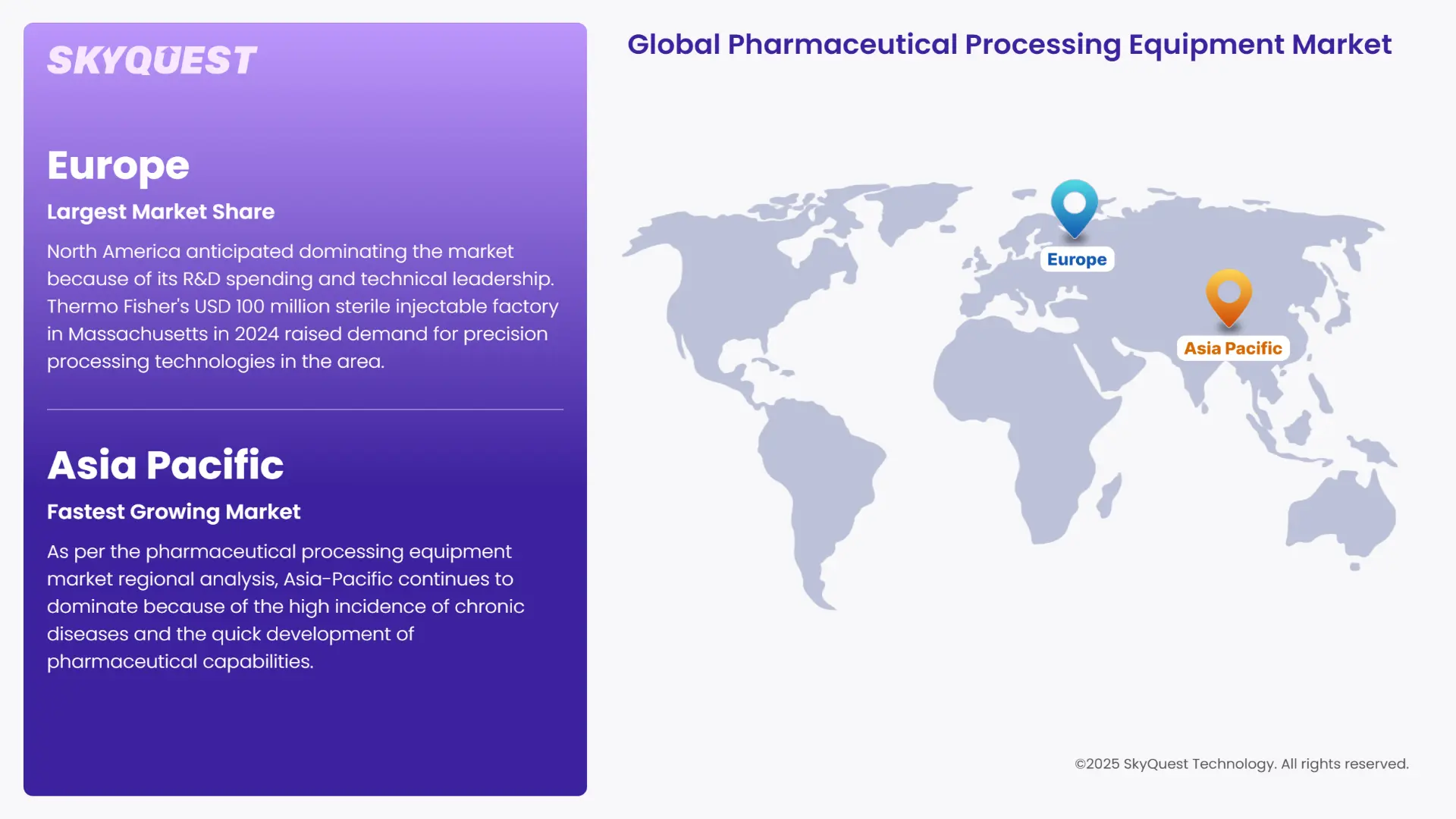
North America anticipated dominating the market because of its R&D spending and technical leadership. Thermo Fisher's USD 100 million sterile injectable factory in Massachusetts in 2024 raised demand for precision processing technologies in the area. The use of continuous and modular production technologies is still being driven by regulatory rigor, biologics, and personalized medicine.
U.S. Pharmaceutical Processing Equipment Market
Strict FDA oversight and biopharma investment are major factors in the U.S. industry's success. To boost mRNA-based production, Pfizer started setting up continuous manufacturing systems in Kalamazoo in 2025. This is in line with the country's goal of increasing its capacity for the rapid-response manufacturing of new therapeutic classes and reflects the pharmaceutical processing equipment industry trend toward digitalized, robust, and efficient pharmaceutical processing.
Canada Pharmaceutical Processing Equipment Market
The Canadian pharmaceutical processing equipment market is anticipated to lead the North American market due to strong government support in the country. In February 2024, the Canadian government spent CAD 150 million to construct facilities to produce vaccines. The need for modular, GMP-grade equipment to guarantee independence in crucial drug manufacturing was sparked by this funding. With the help of national pandemic preparation and innovation financing, Canadian companies are modernizing their sterile processing and packaging lines as pharmaceutical production rises.
To know more about the market opportunities by region and country, click here to
Buy The Complete Report
Pharmaceutical Processing Equipment Market Drivers
Chronic Illnesses and an Aging Population
Advances in Contract Manufacturing and the Development of Biotherapies
Pharmaceutical Processing Equipment Market Restraints
Exorbitant Upfront and Ongoing Expenses
Strict Conditions for Compliance and Validation
Request Free Customization of this report to help us to meet your business objectives.
A significant share of the pharmaceutical processing equipment market is controlled by industry leaders in innovation and digital manufacturing integration, including GEA Group, Thermo Fisher, and IMA Group. They can adapt equipment to meet changing needs by entering into strategic agreements with biologics manufacturers and CMOs. Merck KGaA and Sartorius place more emphasis on single-use and modular solutions, whereas Bosch (Syntegon) focuses on continuous manufacturing. R&D investment and M&A strategies continue to broaden their global reach, especially in biopharma and emerging markets.
Top Player’s Company Profile
Recent Developments in Pharmaceutical Processing Equipment Market
SkyQuest’s ABIRAW (Advanced Business Intelligence, Research & Analysis Wing) is our Business Information Services team that Collects, Collates, Correlates, and Analyses the Data collected by means of Primary Exploratory Research backed by robust Secondary Desk research.
As per SkyQuest analysis, the growing need for accuracy, speed, and adaptability in drug production is propelling the pharmaceutical processing equipment market. Industry is investing in highly efficient, automated, and AI-integrated systems due to the aging of the world's population, the rise in chronic diseases, and the rapid uptake of biology. High capital costs and intricate compliance requirements are still obstacles, though. To remain competitive, well-known businesses are forming strategic alliances and utilizing digital technology. Additionally, startups are developing innovative technologies that improve efficiency and accessibility. The market is expected to continue growing globally, with growth concentrated in biologics and emerging-market manufacturing centers, as drug development continues to shift toward customized and small-batch medications.
| Report Metric | Details |
|---|---|
| Market size value in 2024 | USD 16.41 Billion |
| Market size value in 2033 | USD 28.44 Billion |
| Growth Rate | 6.3% |
| Base year | 2024 |
| Forecast period | 2026–2033 |
| Forecast Unit (Value) | USD Billion |
| Segments covered |
|
| Regions covered | North America (US, Canada), Europe (Germany, France, United Kingdom, Italy, Spain, Rest of Europe), Asia Pacific (China, India, Japan, Rest of Asia-Pacific), Latin America (Brazil, Rest of Latin America), Middle East & Africa (South Africa, GCC Countries, Rest of MEA) |
| Companies covered |
|
| Customization scope | Free report customization with purchase. Customization includes:-
|
To get a free trial access to our platform which is a one stop solution for all your data requirements for quicker decision making. This platform allows you to compare markets, competitors who are prominent in the market, and mega trends that are influencing the dynamics in the market. Also, get access to detailed SkyQuest exclusive matrix.
Table Of Content
Executive Summary
Market overview
Parent Market Analysis
Market overview
Market size
KEY MARKET INSIGHTS
COVID IMPACT
MARKET DYNAMICS & OUTLOOK
Market Size by Region
KEY COMPANY PROFILES
Methodology
For the Pharmaceutical Processing Equipment Market, our research methodology involved a mixture of primary and secondary data sources. Key steps involved in the research process are listed below:
1. Information Procurement: This stage involved the procurement of Market data or related information via primary and secondary sources. The various secondary sources used included various company websites, annual reports, trade databases, and paid databases such as Hoover's, Bloomberg Business, Factiva, and Avention. Our team did 45 primary interactions Globally which included several stakeholders such as manufacturers, customers, key opinion leaders, etc. Overall, information procurement was one of the most extensive stages in our research process.
2. Information Analysis: This step involved triangulation of data through bottom-up and top-down approaches to estimate and validate the total size and future estimate of the Pharmaceutical Processing Equipment Market.
3. Report Formulation: The final step entailed the placement of data points in appropriate Market spaces in an attempt to deduce viable conclusions.
4. Validation & Publishing: Validation is the most important step in the process. Validation & re-validation via an intricately designed process helped us finalize data points to be used for final calculations. The final Market estimates and forecasts were then aligned and sent to our panel of industry experts for validation of data. Once the validation was done the report was sent to our Quality Assurance team to ensure adherence to style guides, consistency & design.
Analyst Support
Customization Options
With the given market data, our dedicated team of analysts can offer you the following customization options are available for the Pharmaceutical Processing Equipment Market:
Product Analysis: Product matrix, which offers a detailed comparison of the product portfolio of companies.
Regional Analysis: Further analysis of the Pharmaceutical Processing Equipment Market for additional countries.
Competitive Analysis: Detailed analysis and profiling of additional Market players & comparative analysis of competitive products.
Go to Market Strategy: Find the high-growth channels to invest your marketing efforts and increase your customer base.
Innovation Mapping: Identify racial solutions and innovation, connected to deep ecosystems of innovators, start-ups, academics, and strategic partners.
Category Intelligence: Customized intelligence that is relevant to their supply Markets will enable them to make smarter sourcing decisions and improve their category management.
Public Company Transcript Analysis: To improve the investment performance by generating new alpha and making better-informed decisions.
Social Media Listening: To analyze the conversations and trends happening not just around your brand, but around your industry as a whole, and use those insights to make better Marketing decisions.
REQUEST FOR SAMPLE
 REQUEST FREE CUSTOMIZATION
Global Pharmaceutical Processing Equipment Market size was valued at USD 16.41 Billion in 2024 and is poised to grow from USD 17.45 Billion in 2025 to USD 28.44 Billion by 2033, growing at a CAGR of 6.3% during the forecast period (2026–2033).
A significant share of the pharmaceutical processing equipment market is controlled by industry leaders in innovation and digital manufacturing integration, including GEA Group, Thermo Fisher, and IMA Group. They can adapt equipment to meet changing needs by entering into strategic agreements with biologics manufacturers and CMOs. Merck KGaA and Sartorius place more emphasis on single-use and modular solutions, whereas Bosch (Syntegon) focuses on continuous manufacturing. R&D investment and M&A strategies continue to broaden their global reach, especially in biopharma and emerging markets. 'GEA Group', 'Thermo Fisher Scientific Inc.', 'IMA Group', 'Syntegon Technology (Bosch)', 'Glatt GmbH', 'Romaco Group', 'SPX Flow, Inc.', 'ACG Worldwide', 'Bausch+Ströbel Maschinenfabrik', 'Sartorius AG', 'Merck KGaA', 'Charles Ross & Son Co.', 'Fette Compacting GmbH'
Chronic illness rates are rising as the world's population is expected to reach over 771 million by 2024. The need for pharmaceuticals, especially injectables and oral solids, has increased as a result of this increase. Manufacturers are investing in high-efficiency tablet presses, fluid-bed dryers, and cleanroom equipment to satisfy increasing output and regulatory requirements. In countries like Germany and Japan, where healthcare spending increased by more than 9% in 2024, the change is particularly noticeable.
Automation, AI, and Digital Twin Deployment: AI and digital twin technologies are changing the landscape of pharmaceutical manufacturing. Companies can cut downtime by as much as 25% by utilizing real-time analytics and predictive maintenance methods. In 2024, multiple U.S. companies implemented digital twin-based tablet press systems with adaptive control. Through integration of machine-learning models and batch record systems, consistent quality is achieved, and root-cause analysis speed is improved when process deviations occur.
Why is Asia-Pacific Emerging as a Global Hub for Pharmaceutical Manufacturing?


Want to customize this report? This report can be personalized according to your needs. Our analysts and industry experts will work directly with you to understand your requirements and provide you with customized data in a short amount of time. We offer $1000 worth of FREE customization at the time of purchase.
Feedback From Our Clients


 USA (+1) 351-333-4748

