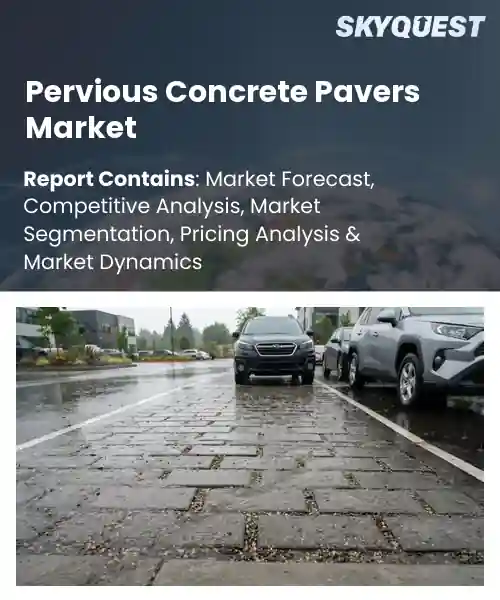
Pervious Concrete Pavers Market
Report ID: SQMIG15F2442
Report ID: SQMIG15F2442
[email protected]
USA +1 351-333-4748
Report ID:
SQMIG15F2442 |
Region:
Global |
Published Date: August, 2026
Pages:
157
|Tables:
145
|Figures:
78


Global Pervious Concrete Pavers Market size was valued at USD 11.28 Billion in 2024 and is poised to grow from USD 12.04 Billion in 2025 to USD 20.23 Billion by 2033, growing at a CAGR of 6.7% during the forecast period (2026-2033).
The global pervious concrete pavers market revolves around a building material that allows water to infiltrate through its porous structure, reducing runoff and recharging groundwater. Its importance stems from increasing regulatory pressure to manage storm‑water in urban environments and growing awareness of sustainable infrastructure. Historically, the market emerged in the early 2000s when municipalities such as Portland, Oregon, adopted permeable pavement to comply with EPA guidelines, prompting manufacturers to develop standardized paver systems. Over the past decade, adoption has expanded from parking lots to sidewalks, transit plazas, and residential driveways, illustrating an evolution from niche projects to mainstream urban planning.The regulatory push has turned pervious pavers into a cornerstone of green‑infrastructure initiatives that address flood control while contributing to carbon‑reduction targets. When cities fund climate‑resilient projects, the choice of permeable pavement eliminates the need for underground detention basins, cutting construction expenses and delivering measurable runoff reductions. Charlotte, North Carolina, reported a 45 percent drop in peak flow after retrofitting highway shoulders with pervious pavers, a success that draws private developers pursuing LEED credits and faster permits. This incentive drives manufacturers to scale production and introduce recycled‑aggregate blends, creating a loop that expands market adoption across institutional and residential applications.
How is AI-driven automation influencing the pervious concrete pavers market?
AI driven automation is reshaping the pervious concrete pavers market by linking design, mixing, and production through intelligent software and robotics. Manufacturers now use predictive models to adjust mix ratios, reducing waste and improving drainage performance. Real time sensors monitor curing, allowing rapid quality checks and faster batch turnover. The technology also enables custom pattern generation, meeting architects demand for aesthetic variety while maintaining permeability. As cities prioritize sustainable stormwater solutions, firms that embed AI in their factories can respond to project timelines more efficiently and scale output without compromising durability. This shift also reduces labor intensity and opens new opportunities for small producers to adopt advanced processes.LafargeHolcim March 2024, introduced an AI driven robotic casting line for pervious concrete pavers that adjusts mix composition on the fly and prints custom textures, cutting setup time and boosting consistency, which helps meet growing demand for green infrastructure while lowering production costs and supports faster project delivery for municipalities.
Market snapshot - (2026-2033)
Global Market Size
USD 11.28 Billion
Largest Segment
Interlocking Pavers
Fastest Growth
Grid Pavers
Growth Rate
6.7% CAGR
To get more insights on this market click here to Request a Free Sample Report
Global pervious concrete pavers market is segmented by product type, application, end user, thickness, distribution channel and region. Based on product type, the market is segmented into Interlocking Pavers, Permeable Slabs and Grid Pavers. Based on application, the market is segmented into Driveways, Sidewalks, Parking Lots and Public Spaces. Based on end user, the market is segmented into Residential, Commercial and Municipal. Based on thickness, the market is segmented into Up to 60 mm, 61–80 mm and Above 80 mm. Based on distribution channel, the market is segmented into Direct Sales, Distributors and Retail. Based on region, the market is segmented into North America, Europe, Asia Pacific, Latin America and Middle East & Africa.
[Interlocking Pavers] segment dominates because it aligns with the core aesthetic and structural preferences of designers seeking modularity, ease of installation, and robust load‑bearing capacity. Its interlocking geometry provides inherent stability, reducing the need for additional binding materials, which streamlines construction workflows. This functional versatility appeals to a broad spectrum of projects, reinforcing supplier confidence and encouraging widespread specification across residential, commercial, and institutional developments through collaborative design standards and evidence‑based performance benchmarks.
However, Permeable Slabs segment is witnessing the strongest growth momentum because increasing emphasis on stormwater management drives demand for surfaces that allow natural infiltration. Innovative concrete mixes and aesthetic customization broaden its appeal, prompting designers to specify it for sustainable projects, thereby accelerating market expansion and opening new adoption pathways.
[Public Spaces] segment dominates because municipalities prioritize environmentally friendly infrastructure that enhances community interaction and visual appeal. The need for permeable surfaces in parks, plazas, and pedestrian zones drives specification of pavers that balance durability with aesthetic flexibility. Planners value the ability to manage runoff while creating inviting public realms, prompting consistent procurement and reinforcing the segment’s central role in guiding market direction through collaborative design standards and evidence‑based performance benchmarks.
Meanwhile, Driveways segment is emerging as the key high‑growth area because homeowners increasingly adopt sustainable landscaping solutions that combine aesthetic curb appeal with functional drainage. Advances in slip‑resistant surface treatments and color varieties make pavers attractive for residential exteriors, spurring specification rates and fueling broader market expansion through consumer awareness.
To get detailed segments analysis, Request a Free Sample Report
North America leads through a combination of stringent storm‑water management regulations, well‑established green building certification programs, and a mature construction industry that readily adopts advanced paving solutions. Strong collaboration between research institutions, material manufacturers, and municipal planners accelerates product innovation and supports widespread pilot projects. End‑user awareness of long‑term environmental and cost benefits fuels demand across both new developments and retrofit initiatives. Robust financing mechanisms and the presence of large‑scale infrastructure firms further reinforce market depth, while a culture of sustainability integrates pervious concrete pavers into a broad range of public and private projects, solidifying regional dominance.
Pervious Concrete Pavers Market in the United States benefits from comprehensive federal and state guidelines that encourage low‑impact development, prompting municipalities to specify permeable solutions in public works. Industry leaders leverage extensive supply chains and advanced manufacturing capabilities to deliver high‑performance products at scale. Collaborative pilots between universities and local agencies showcase durability and environmental impact, building confidence among developers. Consumer preference for resilient, climate‑responsive infrastructure adds momentum, positioning the United States as a primary driver of market expansion.
Pervious Concrete Pavers Market in Canada is shaped by proactive water stewardship policies that prioritize reduction of runoff in urban centres. Provincial programs provide incentives for sustainable paving, encouraging adoption in residential and commercial projects. Technical expertise from engineering firms supports integration of permeable systems within cold‑climate design standards, ensuring functional longevity. Growing public consciousness of flood risk and ecosystem protection drives demand, while collaborative research initiatives refine mix designs suited to regional conditions, reinforcing Canada’s strong market presence.
Europe’s expansion is propelled by ambitious climate‑neutral objectives, rigorous urban drainage directives, and a cultural emphasis on preserving historic streetscapes through sympathetic infrastructure solutions. Leading research institutions develop tailored mix designs that address diverse climatic zones, while strong design standards promote consistent quality across borders. Financial mechanisms tied to environmental performance encourage municipalities to choose pervious solutions for new and retrofitted projects. The collaborative framework among manufacturers, regulators, and sustainability consultants accelerates knowledge transfer, fostering a market environment where innovative permeable paving gains rapid acceptance and integration into urban planning strategies.
Pervious Concrete Pavers Market in Germany benefits from a well‑structured regulatory landscape that mandates sustainable drainage in new developments, prompting engineers to specify permeable paving. Strong industrial base supplies high‑quality materials, while interdisciplinary research centres refine performance characteristics for varied soil and climate conditions. Municipal procurement policies favour solutions with proven environmental benefits, encouraging widespread rollout in residential and commercial zones. Public‑private partnerships further facilitate pilot installations that showcase durability and aesthetic compatibility, reinforcing Germany’s dominant market role.
Pervious Concrete Pavers Market in the United Kingdom experiences accelerated growth due to rigorous planning policies that prioritize flood mitigation and green infrastructure. Innovative design standards encourage integration of permeable paving within historic urban fabrics, balancing heritage preservation with modern resilience. Collaborative efforts between academia, industry, and local authorities generate best‑practice guidance that reduces perceived risk among developers. Funding schemes linked to environmental outcomes accelerate adoption in both new builds and regeneration projects, positioning the United Kingdom as the fastest‑growing market within Europe.
Pervious Concrete Pavers Market in France is emerging as municipalities implement ambitious water‑sensitive urban design frameworks that emphasize infiltration and groundwater recharge. Early adopters in eco‑districts demonstrate how permeable surfaces enhance public spaces while meeting regulatory expectations. Technical expertise from French engineering firms adapts mix designs to Mediterranean and temperate climates, ensuring performance consistency. Growing awareness among architects and planners about the aesthetic versatility of pervious pavers fuels demand, supporting the market’s transition from niche to mainstream applications.
Asia Pacific advances its position through rapid urbanisation, heightened flood risk awareness, and government initiatives that promote resilient infrastructure. Regional construction firms are increasingly partnering with material innovators to integrate pervious solutions into dense cityscapes and expanding suburban developments. Strategic investments in research focus on optimizing mix designs for tropical and monsoon conditions, enhancing durability and drainage efficiency. Cross‑border knowledge exchange within the region accelerates adoption of best practices, while growing consumer demand for sustainable urban environments drives municipalities to incorporate permeable paving in public works and private projects alike.
Pervious Concrete Pavers Market in Japan gains traction as urban planners address persistent rainfall challenges through innovative drainage strategies. Technical collaborations between universities and manufacturers tailor mix formulations to the nation’s seismic considerations and high humidity. Government guidelines encourage low‑impact development, prompting municipalities to specify permeable paving in new transit corridors and redevelopment zones. Public appreciation for clean, walkable streetscapes reinforces demand, positioning Japan as a leading adopter of resilient, eco‑friendly paving solutions.
Pervious Concrete Pavers Market in South Korea is driven by national policies that prioritize storm‑water management and green city initiatives. Industry consortia focus on developing high‑performing permeable products suitable for dense urban districts and mixed‑use developments. Pilot projects in major metropolitan areas demonstrate the ability of pervious pavers to mitigate runoff while enhancing pedestrian environments. Growing environmental consciousness among developers and local authorities fuels broader acceptance, establishing South Korea as a dynamic contributor to the regional market landscape.
To know more about the market opportunities by region and country, click here to
Buy The Complete Report
Sustainable Construction Practices
Regulatory Incentives and Standards
Higher Initial Installation Costs
Limited Technical Knowledge Among Contractors
Request Free Customization of this report to help us to meet your business objectives.
The competitive landscape of the global pervious concrete pavers market is shaped by intense rivalry among major cement and construction material firms that leverage strategic acquisitions, joint ventures, and advanced manufacturing technologies. Companies such as LafargeHolcim have expanded their pervious concrete portfolio through the acquisition of specialized technology firms, while CEMEX has partnered with infrastructure developers to pilot high‑performance permeable paver systems, accelerating market adoption and differentiation.
Top Player’s Company Profile
Recent Developments
SkyQuest’s ABIRAW (Advanced Business Intelligence, Research & Analysis Wing) is our Business Information Services team that Collects, Collates, Correlates, and Analyses the Data collected by means of Primary Exploratory Research backed by robust Secondary Desk research. As per SkyQuest analysis, the market is being propelled primarily by sustainable construction practices, as developers seek eco‑friendly paving that reduces runoff and supports green certifications, while regulatory incentives further accelerate adoption by offering tax credits and streamlined permitting. In addition, AI‑driven automation in mix design and robotic casting is a second driver that cuts waste and shortens project timelines. The interlocking pavers segment remains dominant because its modular design and load‑bearing capacity meet a broad range of aesthetic and structural needs. North America leads the market thanks to stringent storm‑water regulations, mature supply chains and strong municipal funding. However, higher initial installation costs act as a notable restraint, limiting uptake in price‑sensitive projects despite the long‑term benefits.
| Report Metric | Details |
|---|---|
| Market size value in 2024 | USD 11.28 Billion |
| Market size value in 2033 | USD 20.23 Billion |
| Growth Rate | 6.7% |
| Base year | 2024 |
| Forecast period | (2026-2033) |
| Forecast Unit (Value) | USD Billion |
| Segments covered |
|
| Regions covered | North America (US, Canada), Europe (Germany, France, United Kingdom, Italy, Spain, Rest of Europe), Asia Pacific (China, India, Japan, Rest of Asia-Pacific), Latin America (Brazil, Rest of Latin America), Middle East & Africa (South Africa, GCC Countries, Rest of MEA) |
| Companies covered |
|
| Customization scope | Free report customization with purchase. Customization includes:-
|
To get a free trial access to our platform which is a one stop solution for all your data requirements for quicker decision making. This platform allows you to compare markets, competitors who are prominent in the market, and mega trends that are influencing the dynamics in the market. Also, get access to detailed SkyQuest exclusive matrix.
Table Of Content
Executive Summary
Market overview
Parent Market Analysis
Market overview
Market size
KEY MARKET INSIGHTS
COVID IMPACT
MARKET DYNAMICS & OUTLOOK
Market Size by Region
KEY COMPANY PROFILES
Methodology
For the Pervious Concrete Pavers Market, our research methodology involved a mixture of primary and secondary data sources. Key steps involved in the research process are listed below:
1. Information Procurement: This stage involved the procurement of Market data or related information via primary and secondary sources. The various secondary sources used included various company websites, annual reports, trade databases, and paid databases such as Hoover's, Bloomberg Business, Factiva, and Avention. Our team did 45 primary interactions Globally which included several stakeholders such as manufacturers, customers, key opinion leaders, etc. Overall, information procurement was one of the most extensive stages in our research process.
2. Information Analysis: This step involved triangulation of data through bottom-up and top-down approaches to estimate and validate the total size and future estimate of the Pervious Concrete Pavers Market.
3. Report Formulation: The final step entailed the placement of data points in appropriate Market spaces in an attempt to deduce viable conclusions.
4. Validation & Publishing: Validation is the most important step in the process. Validation & re-validation via an intricately designed process helped us finalize data points to be used for final calculations. The final Market estimates and forecasts were then aligned and sent to our panel of industry experts for validation of data. Once the validation was done the report was sent to our Quality Assurance team to ensure adherence to style guides, consistency & design.
Analyst Support
Customization Options
With the given market data, our dedicated team of analysts can offer you the following customization options are available for the Pervious Concrete Pavers Market:
Product Analysis: Product matrix, which offers a detailed comparison of the product portfolio of companies.
Regional Analysis: Further analysis of the Pervious Concrete Pavers Market for additional countries.
Competitive Analysis: Detailed analysis and profiling of additional Market players & comparative analysis of competitive products.
Go to Market Strategy: Find the high-growth channels to invest your marketing efforts and increase your customer base.
Innovation Mapping: Identify racial solutions and innovation, connected to deep ecosystems of innovators, start-ups, academics, and strategic partners.
Category Intelligence: Customized intelligence that is relevant to their supply Markets will enable them to make smarter sourcing decisions and improve their category management.
Public Company Transcript Analysis: To improve the investment performance by generating new alpha and making better-informed decisions.
Social Media Listening: To analyze the conversations and trends happening not just around your brand, but around your industry as a whole, and use those insights to make better Marketing decisions.
REQUEST FOR SAMPLE
 REQUEST FREE CUSTOMIZATION


Want to customize this report? This report can be personalized according to your needs. Our analysts and industry experts will work directly with you to understand your requirements and provide you with customized data in a short amount of time. We offer $1000 worth of FREE customization at the time of purchase.
Feedback From Our Clients


 USA (+1) 351-333-4748

