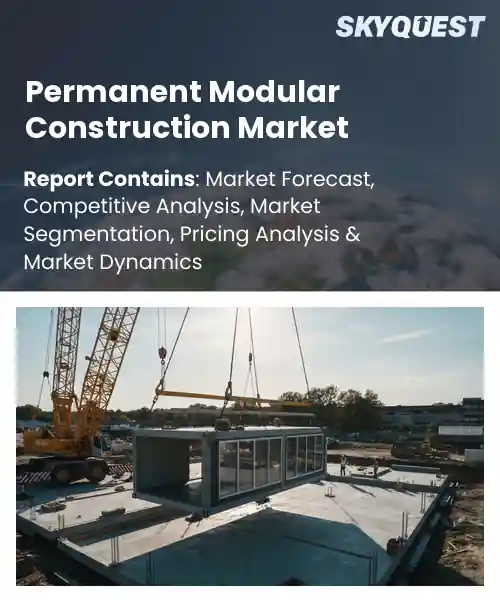
Permanent Modular Construction Market
Report ID: SQMIG20C2292
Report ID: SQMIG20C2292
[email protected]
USA +1 351-333-4748
Report ID:
SQMIG20C2292 |
Region:
Global |
Published Date: July, 2026
Pages:
157
|Tables:
66
|Figures:
75


Global Permanent Modular Construction Market size was valued at USD 81.05 Billion in 2024 and is poised to grow from USD 85.51 Billion in 2025 to USD 131.23 Billion by 2033, growing at a CAGR of 5.5% during the forecast period (2026-2033).
The permanent modular construction (PMC) market comprises building modules that are transported to a site and assembled into structures such as residential towers, hospitals and schools. Its relevance stems from the ability to shorten schedules, reduce waste and meet density demands. The primary driver is the escalating shortage of skilled labor in traditional construction, which forces owners to adopt processes that rely on automation rather than craftsmanship. Over the past decade, projects like 2022 30‑storey modular tower in Shanghai and the 2020 London hospital wing show how acceptance and incentives have turned PMC from a niche solution into a method.
Key trend driving the global permanent modular construction sector is the rising demand for sustainable building solutions, which compels developers to prioritize efficient designs and material flows. Because modular factories can integrate insulated panels, renewable‑energy systems and recycled steel, projects achieve up to 30 % lower embodied carbon compared with conventional sites, prompting mandates such as the EU’s Green Public Procurement criteria. This regulatory push has opened opportunities in the student‑housing segment, where universities like Arizona State have deployed modular dormitories to meet enrollment spikes while adhering to pledges. Consequently, manufacturers are expanding capacity and forming joint ventures with local contractors to capture this green‑building wave.
How is AI-Driven Automation Influencing Cost Efficiency in the Permanent Modular Construction Market?
AI driven automation reshapes cost efficiency in permanent modular construction by streamlining design, material handling and onsite assembly. Machine learning models generate optimized module layouts that reduce waste and shorten engineering cycles. Robotics and computer vision guide cutting equipment, delivering precise component dimensions and lowering labor intensity. Integrated scheduling platforms synchronize factory output with project timelines, which cuts idle time and improves cash flow. As manufacturers adopt digital twins, they can forecast resource needs and adjust production in real time, further trimming overhead. The result is a tighter margin structure that makes modular projects more competitive against traditional building methods.
In February 2025, Laing O'Rourke expanded its AI-enabled manufacturing capabilities by opening a fully automated modular construction factory in the UK. The facility integrates artificial intelligence, robotics, and digital manufacturing to optimize production planning, quality control, and material utilization, accelerating permanent modular building delivery while reducing waste and construction costs.
Market snapshot - (2026-2033)
Global Market Size
USD 81.05 Billion
Largest Segment
Steel Framework Modules
Fastest Growth
Wood Timber Modules
Growth Rate
5.5% CAGR
To get more insights on this market click here to Request a Free Sample Report
Global permanent modular construction market is segmented by core structural material, end-use application vertical and region. Based on core structural material, the market is segmented into steel framework modules, wood timber modules and concrete pre-cast modules. Based on end-use application vertical, the market is segmented into residential buildings, commercial office spaces, healthcare medical facilities, educational institutional buildings, hospitality infrastructure and others. Based on region, the market is segmented into North America, Europe, Asia Pacific, Latin America and Middle East & Africa.
Based on the global permanent modular construction market growth, steel framework modules segment dominates because of its inherent strength, predictability, and ease of integration with mechanical systems. The rigidity of steel allows designers to push larger spans, reducing the need for onsite support structures and accelerating assembly cycles. Its recyclability aligns with sustainability goals, encouraging developers to choose steel as the primary material for permanent modular projects. This material also facilitates standardized connections, which streamline logistics and reduce error rates during installation.
Meanwhile, wood timber modules are witnessing the strongest growth momentum as architects embrace biophilic design and regulatory incentives favor low carbon construction. Innovative engineered wood products enable high dimensional stability, opening new project types and expanding market acceptance. This rise fuels broader adoption of permanent modular construction and creates fresh opportunities for sustainable building solutions.
Residential buildings segment stands out because permanent modular units address housing shortages while delivering consistent quality and faster delivery. Modular homes can be produced in controlled factories, ensuring uniform finish and reducing weather related delays. Their flexibility allows customization for diverse living styles, attracting developers seeking cost efficient, scalable solutions in dense urban and suburban markets. Moreover, the predictability of modular construction aligns with financing timelines, enabling smoother project cash flows and investor confidence.
Conversely, healthcare medical facilities are emerging as the key high growth area because hospitals need rapid expansion with stringent infection control. Modular patient rooms and surgical suites provide sterile plug and play infrastructure that can be commissioned quickly, meeting urgent capacity needs. This accelerates market expansion as providers view permanent modular construction as a strategic solution for resilient, adaptable care environments.
To get detailed segments analysis, Request a Free Sample Report
As per the global permanent modular construction market share, North America leads due to a mature construction ecosystem that embraces technology and innovation. The region benefits from strong engineering capabilities, extensive supply chain networks, and a regulatory environment that supports prefabrication standards. High demand for rapid project delivery in both commercial and infrastructure sectors drives adoption, while large-scale investment in sustainable building practices encourages the use of modular solutions. Collaborative partnerships between developers, manufacturers, and academic institutions further reinforce knowledge transfer and continuous improvement, solidifying the region’s leadership.
Permanent modular construction market in the United States is propelled by a robust corporate sector that prioritizes speed, cost efficiency, and quality. The presence of leading modular manufacturers and a well‑developed logistics infrastructure enables large projects to be delivered on tight schedules. Advanced research institutions and a culture of innovation support the integration of digital design tools, enhancing precision and reducing waste across the construction lifecycle.
Permanent modular construction market in Canada gains momentum from a strong emphasis on environmental responsibility and energy‑efficient building practices. Government incentives for low‑carbon construction and a collaborative approach among provinces foster the adoption of modular techniques. The availability of skilled labor combined with expertise in cold‑climate engineering ensures that modular solutions meet stringent performance requirements, positioning Canada as a key contributor to the regional market.
Based on global permanent modular construction regional forecast, Asia Pacific region experiences rapid expansion as urbanization and population growth intensify the need for affordable, high‑quality housing and infrastructure. Governments are actively promoting prefabrication to address labor shortages and shorten construction timelines. Cultural openness to innovative building methods, coupled with rising investment in technology and automation, accelerates the deployment of modular systems. Collaborative efforts between local firms and multinational partners enhance the transfer of best practices, while a focus on sustainability aligns modular construction with regional environmental objectives.
Permanent modular construction market in Japan is shaped by a tradition of precision engineering and a pressing demand for resilient structures in a seismically active environment. Manufacturers leverage advanced robotics and high‑performance materials to deliver modules that meet rigorous safety standards. Government policies encouraging off‑site construction to alleviate housing shortages further stimulate market activity, creating a supportive ecosystem for modular adoption.
Permanent modular construction market in South Korea benefits from a strong industrial base and a proactive stance on smart city development. The integration of digital twins and Building Information Modeling streamlines design coordination and construction efficiency. Public‑private initiatives focused on rapid urban redevelopment encourage the use of modular techniques, while investments in automation reinforce the country’s capacity to produce high‑quality prefabricated components at scale.
As per global permanent modular construction regional outlook, Europe strengthens its position through a concerted focus on sustainability, policy alignment, and collaborative research across borders. The region’s commitment to carbon‑neutral construction drives regulatory frameworks that favor off‑site manufacturing and modular solutions. Strong academic networks and industry consortia promote innovation in material science and modular design, enhancing competitiveness. Integration of modular construction into large‑scale public projects demonstrates confidence in the methodology, while cross‑border supply chains and standardization efforts facilitate broader market access and growth.
Permanent modular construction market in Germany is underpinned by a reputation for engineering excellence and a robust manufacturing sector. Emphasis on energy‑efficient building standards and modular integration into renewable infrastructure projects propels adoption. Collaborative research institutions focus on advancing modular technologies, while a mature regulatory environment provides clear guidelines that accelerate project approvals.
Permanent modular construction market in the United Kingdom is driven by government initiatives aimed at addressing housing shortages and improving construction productivity. The sector benefits from a strong consultancy landscape that promotes modular best practices, and from partnerships that bring together architects, engineers, and off‑site manufacturers. Emphasis on reducing carbon footprints aligns modular methods with national sustainability targets.
Permanent modular construction market in France gains support from progressive urban planning policies and a growing emphasis on circular economy principles. Modular construction is increasingly integrated into public infrastructure projects, benefitting from France’s skilled labor pool and advanced prefabrication facilities. Industry collaboration and research funding encourage the development of innovative modular solutions that meet high aesthetic and performance standards.
To know more about the market opportunities by region and country, click here to
Buy The Complete Report
Accelerated Urbanization Drives Adoption
Urban growth creates demand for rapid, scalable housing solutions, prompting developers to adopt permanent modular construction for its speed and flexibility. This approach enables quicker project delivery, reduces on‑site disruption, and aligns with municipal objectives for efficient land use. By offering customizable designs that meet dense city requirements, modular methods become attractive to stakeholders seeking to address housing shortages while managing limited construction windows, thereby propelling market expansion through sustained demand for faster, cost‑effective building alternatives.
Sustainable Building Policies Favor Modularity
Governments worldwide implement stricter sustainability regulations, encouraging construction methods that minimize waste and energy consumption. Permanent modular systems generate precise factory‑produced components, reducing material excess and enabling better recycling of off‑cuts. Energy‑efficient assembly processes lower carbon footprints, helping projects meet green certification standards. As developers aim to comply with these policies and to market environmentally responsible projects, modular construction gains preference, driving market growth through alignment with regulatory and consumer expectations for sustainable built environments.
High Initial Capital Investment Limits Entry
The upfront cost of establishing modular production facilities and acquiring specialized equipment can be substantial, deterring smaller firms and new entrants. Capital outlays for tooling, automation, and quality control systems require significant financial resources, which may not be readily available in emerging markets. This financial barrier restricts the number of competitors able to offer modular solutions, slowing broader market adoption and confining growth to well‑capitalized players with the ability to absorb initial expenditures.
Regulatory Variability Hinders Standardization
Divergent building codes and approval processes across regions create uncertainty for modular projects, as designs must often be customized to meet local requirements. This need for region‑specific compliance increases design complexity and prolongs permitting timelines, discouraging developers from fully embracing modular methods. The lack of harmonized regulations hampers the ability to achieve economies of scale and consistent quality assurance, thereby constraining market expansion through added procedural challenges.
Request Free Customization of this report to help us to meet your business objectives.
The competitive landscape in the global permanent modular construction market outlook is shaped by aggressive consolidation and strategic partnerships, with firms leveraging mergers and acquisitions to expand supply chains and strengthen market positioning, as exemplified by Skyline’s recent M&A activities. Technology-driven innovations aimed at reducing construction costs and accelerating timelines further intensify competition, prompting players to adopt collaborative approaches and invest in advanced modular solutions.
Top Player’s Company Profile
Recent Developments
SkyQuest’s ABIRAW (Advanced Business Intelligence, Research & Analysis Wing) is our Business Information Services team that Collects, Collates, Correlates, and Analyses the Data collected by means of Primary Exploratory Research backed by robust Secondary Desk research.
As per SkyQuest analysis the global permanent modular construction industry is being propelled primarily by accelerated urbanization, which creates urgent demand for fast, scalable housing and commercial projects, while a second driver of stringent sustainable‑building policies further fuels adoption by rewarding low‑waste, low‑carbon modular solutions. The market is led by North America, where mature supply chains and strong technology adoption give it a clear edge, and within the sector steel‑framework modules dominate because of their strength, recyclability and speed of installation. However, the high initial capital investment required to set up automated factories remains a significant restraint, limiting entry for smaller players and tempering overall growth.
| Report Metric | Details |
|---|---|
| Market size value in 2024 | USD 81.05 Billion |
| Market size value in 2033 | USD 131.23 Billion |
| Growth Rate | 5.5% |
| Base year | 2024 |
| Forecast period | (2026-2033) |
| Forecast Unit (Value) | USD Billion |
| Segments covered |
|
| Regions covered | North America (US, Canada), Europe (Germany, France, United Kingdom, Italy, Spain, Rest of Europe), Asia Pacific (China, India, Japan, Rest of Asia-Pacific), Latin America (Brazil, Rest of Latin America), Middle East & Africa (South Africa, GCC Countries, Rest of MEA) |
| Companies covered |
|
| Customization scope | Free report customization with purchase. Customization includes:-
|
To get a free trial access to our platform which is a one stop solution for all your data requirements for quicker decision making. This platform allows you to compare markets, competitors who are prominent in the market, and mega trends that are influencing the dynamics in the market. Also, get access to detailed SkyQuest exclusive matrix.
Table Of Content
Executive Summary
Market overview
Parent Market Analysis
Market overview
Market size
KEY MARKET INSIGHTS
COVID IMPACT
MARKET DYNAMICS & OUTLOOK
Market Size by Region
KEY COMPANY PROFILES
Methodology
For the Permanent Modular Construction Market, our research methodology involved a mixture of primary and secondary data sources. Key steps involved in the research process are listed below:
1. Information Procurement: This stage involved the procurement of Market data or related information via primary and secondary sources. The various secondary sources used included various company websites, annual reports, trade databases, and paid databases such as Hoover's, Bloomberg Business, Factiva, and Avention. Our team did 45 primary interactions Globally which included several stakeholders such as manufacturers, customers, key opinion leaders, etc. Overall, information procurement was one of the most extensive stages in our research process.
2. Information Analysis: This step involved triangulation of data through bottom-up and top-down approaches to estimate and validate the total size and future estimate of the Permanent Modular Construction Market.
3. Report Formulation: The final step entailed the placement of data points in appropriate Market spaces in an attempt to deduce viable conclusions.
4. Validation & Publishing: Validation is the most important step in the process. Validation & re-validation via an intricately designed process helped us finalize data points to be used for final calculations. The final Market estimates and forecasts were then aligned and sent to our panel of industry experts for validation of data. Once the validation was done the report was sent to our Quality Assurance team to ensure adherence to style guides, consistency & design.
Analyst Support
Customization Options
With the given market data, our dedicated team of analysts can offer you the following customization options are available for the Permanent Modular Construction Market:
Product Analysis: Product matrix, which offers a detailed comparison of the product portfolio of companies.
Regional Analysis: Further analysis of the Permanent Modular Construction Market for additional countries.
Competitive Analysis: Detailed analysis and profiling of additional Market players & comparative analysis of competitive products.
Go to Market Strategy: Find the high-growth channels to invest your marketing efforts and increase your customer base.
Innovation Mapping: Identify racial solutions and innovation, connected to deep ecosystems of innovators, start-ups, academics, and strategic partners.
Category Intelligence: Customized intelligence that is relevant to their supply Markets will enable them to make smarter sourcing decisions and improve their category management.
Public Company Transcript Analysis: To improve the investment performance by generating new alpha and making better-informed decisions.
Social Media Listening: To analyze the conversations and trends happening not just around your brand, but around your industry as a whole, and use those insights to make better Marketing decisions.
REQUEST FOR SAMPLE
 REQUEST FREE CUSTOMIZATION
Global Permanent Modular Construction Market size was valued at USD 81.05 Billion in 2024 and is poised to grow from USD 85.51 Billion in 2025 to USD 131.23 Billion by 2033, growing at a CAGR of 5.5% during the forecast period (2026-2033).
The competitive landscape of the global permanent modular construction market is shaped by aggressive consolidation and strategic partnerships, with firms leveraging mergers and acquisitions to expand supply chains and strengthen market positioning, as exemplified by Skyline’s recent M&A activities. Technology-driven innovations aimed at reducing construction costs and accelerating timelines further intensify competition, prompting players to adopt collaborative approaches and invest in advanced modular solutions. 'Bouygues Group', 'Vinci SA', 'ACS Group', 'Skanska AB', 'Lendlease Group', 'Balfour Beatty', 'Laing O'Rourke', 'Kajima Corporation', 'Obayashi Corporation', 'Taisei Corporation', 'Shimizu Corporation', 'Takenaka Corporation', 'China State Construction Engineering', 'Daiwa House Industry', 'Sekisui House', 'Fluor Corporation', 'Jacobs Solutions', 'Aecom', 'KBR Inc', 'Sterling Infrastructure'
Sustainability Integration Drives Adoption: Clients increasingly prioritize environmentally responsible building practices, prompting developers to adopt permanent modular construction as a means to reduce material waste, lower carbon emissions, and improve energy efficiency throughout the building lifecycle, while enabling faster de‑construction and reuse of components, thereby aligning projects with green certification standards and corporate sustainability pledges, which in turn enhances market reputation and meets rising stakeholder expectations for climate‑positive outcomes. The trend also encourages investors to allocate capital toward projects that demonstrate environmental performance improvements.
Why does North America Dominate the Global Permanent Modular Construction Market? |@12


Want to customize this report? This report can be personalized according to your needs. Our analysts and industry experts will work directly with you to understand your requirements and provide you with customized data in a short amount of time. We offer $1000 worth of FREE customization at the time of purchase.
Feedback From Our Clients


 USA (+1) 351-333-4748

