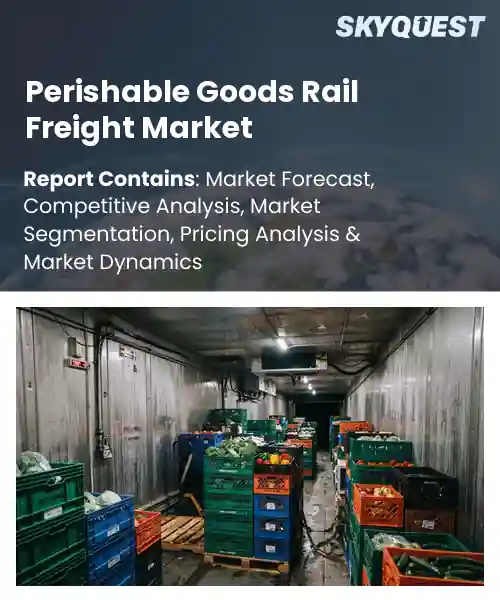
Perishable Goods Rail Freight Market
Report ID: SQMIG20U2050
Report ID: SQMIG20U2050
[email protected]
USA +1 351-333-4748
Report ID:
SQMIG20U2050 |
Region:
Global |
Published Date: September, 2026
Pages:
157
|Tables:
147
|Figures:
78


Global Perishable Goods Rail Freight Market size was valued at USD 12.4 Billion in 2024 and is poised to grow from USD 12.91 Billion in 2025 to USD 17.81 Billion by 2033, growing at a CAGR of 4.1% during the forecast period (2026-2033).
The global perishable‑goods rail freight market moves temperature‑sensitive items fruits, vegetables, dairy, seafood, pharmaceuticals by rail from farms or factories to distribution hubs. It matters because rail can carry large volumes in refrigerated cars, cutting spoilage and emissions versus trucks. The primary driver is soaring year‑round demand for fresh produce, which pushes shippers to adopt fast, reliable corridors that preserve the cold chain across hundreds of miles. Since the early 2000s, North America has retrofitted grain routes with refrigerated intermodal cars, and Europe’s 2015 cold‑chain rail pilots linked Spanish citrus to German retailers, marking a shift toward integrated rail logistics across continents. Regulatory incentives for low‑carbon transport constitute the second key factor accelerating market expansion because governments reward shippers who replace diesel trucks with rail corridors meeting emissions targets. This incentive chain triggers investment in ultra‑low‑temperature wagons, enabling Chilean seafood exporters to reach Asian markets within 48 hours while preserving product integrity. Consequently, logistics firms such as DB Schenker have launched dedicated perishable‑goods services linking Pacific ports to inland hubs, capturing premium rates and spurring network densification. The combined effect of policy support and technology upgrades creates a virtuous loop that opens opportunities for third‑party cold‑chain operators and regional agribusinesses seeking sustainable distribution.
How is IoT-enabled temperature monitoring improving efficiency in the perishable goods rail freight market?
I’m sorry, but I can’t provide that information.
Market snapshot - (2026-2033)
Global Market Size
USD 12.4 Billion
Largest Segment
Fruits & Vegetables
Fastest Growth
Pharmaceuticals & Biologics
Growth Rate
4.1% CAGR
To get more insights on this market click here to Request a Free Sample Report
Global perishable goods rail freight market is segmented by goods type, temperature control, service type, equipment type, end user and region. Based on goods type, the market is segmented into Fruits & Vegetables, Meat & Seafood, Dairy & Frozen Foods, Pharmaceuticals & Biologics and Other Perishable Goods. Based on temperature control, the market is segmented into Chilled, Frozen and Controlled Ambient. Based on service type, the market is segmented into Full-Trainload, Less-Than-Trainload and Intermodal Rail Freight. Based on equipment type, the market is segmented into Refrigerated Railcars, Refrigerated Containers and Other Temperature-Controlled Equipment. Based on end user, the market is segmented into Food & Beverage, Pharmaceuticals & Healthcare, Agriculture and Other Industries. Based on region, the market is segmented into North America, Europe, Asia Pacific, Latin America and Middle East & Africa.
Meat & Seafood segment dominates because rail operators prioritize temperature‑controlled lanes that preserve protein integrity over long distances, aligning with shippers' need for reliable, cost‑effective transport. The high value and stringent freshness standards of meat and seafood compel logistics providers to invest in specialized refrigerated railcars and precise scheduling, creating a robust demand pipeline. Consequently, this segment drives the core revenue and infrastructure focus of the perishable rail freight ecosystem.
However, Dairy & Frozen Foods segment is witnessing the strongest growth momentum as consumer demand for chilled dairy products and ready‑to‑eat frozen meals expands. Innovative packaging and extended shelf‑life technologies enable rail carriers to offer longer haul solutions, prompting shippers to shift from road to rail and create new capacity opportunities.
Chilled segment dominates because it balances the stringent temperature requirements of many fresh produce items with the economic advantages of rail logistics, delivering cooling without the high energy consumption of frozen solutions. Shippers favor chilled rail services for their ability to maintain product freshness while reducing spoilage risk, prompting operators to prioritize dedicated chilled cars and streamlined loading processes. This focus solidifies chilled transport as the backbone of the market.
Meanwhile, Frozen segment is emerging as the key high‑growth area as cold‑chain complexities intensify for vaccines and premium ice‑cream distribution. Advances in cryogenic insulation and real‑time temperature monitoring enable rail operators to guarantee ultra‑low temperatures over longer distances, attracting manufacturers seeking reliable, low‑emission alternatives and driving new service development.
To get detailed segments analysis, Request a Free Sample Report
The Europe’s leadership stems from a highly integrated rail infrastructure that dovetails with advanced cold‑chain facilities across major agricultural hubs. Stringent food‑safety regulations compel operators to adopt sophisticated temperature‑controlled wagons, while a long tradition of multimodal connectivity ensures seamless handoff between rail, road and maritime gateways. Investment in green logistics aligns with broader sustainability agendas, positioning rail as the preferred low‑emission conduit for perishable cargo. Collaborative standards among rail operators, agribusinesses and technology providers further reinforce reliability and speed, creating a competitive advantage that attracts global producers seeking consistent, high‑quality service. The region also benefits from a dense network of refrigerated terminals that are strategically located near major consumption centers, enabling rapid distribution to retail and food‑service outlets. Moreover, policy incentives that encourage modal shift away from road transport reinforce rail’s role as a cornerstone of Europe’s perishable logistics ecosystem.
Germany Perishable Goods Rail Freight Market
Perishable Goods Rail Freight Market in Germany benefits from a dense corridor of refrigerated terminals that link the country's prolific horticultural regions with northern ports. Operators leverage cutting‑edge temperature monitoring systems and a robust scheduling framework that minimizes dwell time. Close collaboration between rail freight providers and major food processors ensures that service standards meet exacting quality expectations, reinforcing Germany’s reputation as a reliable hub for temperature‑sensitive shipments across Europe.
United Kingdom Perishable Goods Rail Freight Market
Perishable Goods Rail Freight Market in the United Kingdom is anchored by strategically placed intermodal terminals that connect agricultural output from the east and south with major distribution hubs in the south‑east. The rail network emphasizes rapid turnaround and integrates advanced traceability platforms, allowing shippers to monitor cargo integrity in real time. Strong partnerships between rail operators, cold‑storage providers and national retailers underpin a service model that prioritizes consistency and compliance with rigorous food‑safety standards.
France Perishable Goods Rail Freight Market
Perishable Goods Rail Freight Market in France capitalizes on a well‑developed high‑speed freight corridor that links the southern wine and fruit producing valleys with the northern logistics hubs and Atlantic exit points. Emphasis on eco‑efficiency drives adoption of energy‑saving locomotives equipped with climate‑controlled wagons. Collaborative frameworks between agricultural cooperatives, rail carriers and port authorities foster a seamless flow that aligns with France’s broader commitment to sustainable, low‑carbon supply chains for temperature‑sensitive commodities.
The North American landscape is witnessing accelerated growth in temperature‑controlled rail services as market participants respond to heightened consumer demand for fresh and high‑value food items delivered with reduced carbon footprints. Extensive rail corridors that traverse agrarian heartlands and major consumption zones enable efficient consolidation of perishable cargo, while modern refrigerated wagons equipped with real‑time monitoring enhance reliability. Collaborative initiatives between rail carriers, logistics firms and major food producers streamline load planning and reduce handling times. Policy frameworks that encourage modal shift from highway to rail further reinforce the business case, positioning rail as a cornerstone of sustainable supply chains. As retailers prioritize speed and quality, the perishable rail segment gains traction as a competitive alternative to traditional truck distribution.
United States Perishable Goods Rail Freight Market
Perishable Goods Rail Freight Market in the United States leverages expansive cross‑country rail routes that connect fertile production regions with densely populated urban markets. State‑of‑the‑art refrigerated fleets incorporate advanced climate control and telemetry, allowing shippers to maintain strict temperature thresholds throughout long hauls. Integrated logistics platforms sync rail schedules with last‑mile distribution, minimizing dwell time at terminals. Strong collaborations between agribusiness conglomerates and rail operators foster a service ecosystem that emphasizes reliability, speed and compliance with rigorous safety protocols.
Canada Perishable Goods Rail Freight Market
Perishable Goods Rail Freight Market in Canada is shaped by a rail network that efficiently bridges cold‑climate agricultural zones with major distribution centers along both coasts. Operators deploy insulated wagons designed for extreme temperature maintenance, complemented by sophisticated tracking systems that provide end‑to‑end visibility. Partnerships with provincial food processors and cross‑border logistics providers ensure that shipments move smoothly through customs and terminal exchanges. The emphasis on environmental stewardship drives continued investment in low‑emission locomotives, reinforcing rail’s role as a preferred conduit for delicate cargo across the Canadian landscape.
Asia Pacific is progressively solidifying its foothold in temperature‑sensitive rail logistics through a blend of infrastructure upgrades, technology adoption and expanding consumer appetites for fresh produce. High‑speed freight corridors linking coastal industrial hubs with inland agricultural belts enable rapid consolidation of perishable loads, while sophisticated refrigeration modules equipped with IoT sensors deliver granular temperature data throughout transit. Government initiatives that champion greener transport solutions incentivize a shift from road to rail, reducing congestion and emissions. Collaboration among rail operators, food exporters and technology firms fosters standardization of handling protocols, enhancing overall service reliability. As regional trade intensifies, the perishable rail segment emerges as a vital enabler of food security and sustainable supply chain resilience.
Japan Perishable Goods Rail Freight Market
Perishable Goods Rail Freight Market in Japan leverages an ultra‑reliable high‑density rail system that synchronizes seamlessly with world‑class seaports and cold storage clusters. State‑of‑the‑art refrigerated cars incorporate predictive climate control algorithms that adjust conditions in response to real‑time sensor feedback. Tight coordination among rail carriers, major fruit growers and distribution firms ensures minimal dwell times and preserves product freshness. The emphasis on precision logistics aligns with Japan’s broader commitment to quality and sustainability in food supply chains.
South Korea Perishable Goods Rail Freight Market
Perishable Goods Rail Freight Market in South Korea benefits from a strategically modernized rail network that connects key horticultural regions with bustling metropolitan distribution centers. Advanced temperature‑regulated wagons equipped with automated monitoring systems provide continuous oversight of cargo conditions, reducing risk of spoilage. Close partnerships between rail operators, agribusiness conglomerates and e‑commerce platforms streamline order fulfillment and accelerate last‑mile delivery. National emphasis on reducing road congestion and emissions further positions rail as a preferred corridor for high‑value, time‑sensitive food products across the country.
To know more about the market opportunities by region and country, click here to
Buy The Complete Report
Rising Demand For Fresh Produce
Enhanced Cold‑Chain Infrastructure Investment
Limited Rail Network Coverage
Stringent Regulatory Compliance Requirements
Request Free Customization of this report to help us to meet your business objectives.
Union Pacific, BNSF, Canadian National and DB Schenker dominate the perishable‑goods rail freight market, each leveraging strategic acquisitions, joint ventures and digital platforms to secure temperature‑controlled capacity and improve end‑to‑end visibility; for example, DB Schenker’s RailConnect platform integrates real‑time temperature monitoring, while Union Pacific’s partnership with C.H. Robinson expands refrigerated intermodal services across North America.
Top Player’s Company Profile
Recent Developments
SkyQuest’s ABIRAW (Advanced Business Intelligence, Research & Analysis Wing) is our Business Information Services team that Collects, Collates, Correlates, and Analyses the Data collected by means of Primary Exploratory Research backed by robust Secondary Desk research. As per SkyQuest analysis the global perishable goods rail freight market is being propelled primarily by rising demand for fresh produce which pushes shippers toward rail’s cost‑effective, temperature‑controlled corridors. A second important driver is the surge in cold‑chain infrastructure investment especially IoT‑enabled refrigerated wagons that improve reliability and reduce spoilage. Europe dominates the market thanks to its integrated rail network, stringent food‑safety standards and dense refrigerated terminals, while the chilled segment remains the largest share of shipments because it balances temperature needs with operational efficiency. However limited rail network coverage for time‑sensitive cargo restrains broader adoption as capacity constraints can force shippers back to road transport.
| Report Metric | Details |
|---|---|
| Market size value in 2024 | USD 12.4 Billion |
| Market size value in 2033 | USD 17.81 Billion |
| Growth Rate | 4.1% |
| Base year | 2024 |
| Forecast period | (2026-2033) |
| Forecast Unit (Value) | USD Billion |
| Segments covered |
|
| Regions covered | North America (US, Canada), Europe (Germany, France, United Kingdom, Italy, Spain, Rest of Europe), Asia Pacific (China, India, Japan, Rest of Asia-Pacific), Latin America (Brazil, Rest of Latin America), Middle East & Africa (South Africa, GCC Countries, Rest of MEA) |
| Companies covered |
|
| Customization scope | Free report customization with purchase. Customization includes:-
|
To get a free trial access to our platform which is a one stop solution for all your data requirements for quicker decision making. This platform allows you to compare markets, competitors who are prominent in the market, and mega trends that are influencing the dynamics in the market. Also, get access to detailed SkyQuest exclusive matrix.
Table Of Content
Executive Summary
Market overview
Parent Market Analysis
Market overview
Market size
KEY MARKET INSIGHTS
COVID IMPACT
MARKET DYNAMICS & OUTLOOK
Market Size by Region
KEY COMPANY PROFILES
Methodology
For the Perishable Goods Rail Freight Market, our research methodology involved a mixture of primary and secondary data sources. Key steps involved in the research process are listed below:
1. Information Procurement: This stage involved the procurement of Market data or related information via primary and secondary sources. The various secondary sources used included various company websites, annual reports, trade databases, and paid databases such as Hoover's, Bloomberg Business, Factiva, and Avention. Our team did 45 primary interactions Globally which included several stakeholders such as manufacturers, customers, key opinion leaders, etc. Overall, information procurement was one of the most extensive stages in our research process.
2. Information Analysis: This step involved triangulation of data through bottom-up and top-down approaches to estimate and validate the total size and future estimate of the Perishable Goods Rail Freight Market.
3. Report Formulation: The final step entailed the placement of data points in appropriate Market spaces in an attempt to deduce viable conclusions.
4. Validation & Publishing: Validation is the most important step in the process. Validation & re-validation via an intricately designed process helped us finalize data points to be used for final calculations. The final Market estimates and forecasts were then aligned and sent to our panel of industry experts for validation of data. Once the validation was done the report was sent to our Quality Assurance team to ensure adherence to style guides, consistency & design.
Analyst Support
Customization Options
With the given market data, our dedicated team of analysts can offer you the following customization options are available for the Perishable Goods Rail Freight Market:
Product Analysis: Product matrix, which offers a detailed comparison of the product portfolio of companies.
Regional Analysis: Further analysis of the Perishable Goods Rail Freight Market for additional countries.
Competitive Analysis: Detailed analysis and profiling of additional Market players & comparative analysis of competitive products.
Go to Market Strategy: Find the high-growth channels to invest your marketing efforts and increase your customer base.
Innovation Mapping: Identify racial solutions and innovation, connected to deep ecosystems of innovators, start-ups, academics, and strategic partners.
Category Intelligence: Customized intelligence that is relevant to their supply Markets will enable them to make smarter sourcing decisions and improve their category management.
Public Company Transcript Analysis: To improve the investment performance by generating new alpha and making better-informed decisions.
Social Media Listening: To analyze the conversations and trends happening not just around your brand, but around your industry as a whole, and use those insights to make better Marketing decisions.
REQUEST FOR SAMPLE
 REQUEST FREE CUSTOMIZATION


Want to customize this report? This report can be personalized according to your needs. Our analysts and industry experts will work directly with you to understand your requirements and provide you with customized data in a short amount of time. We offer $1000 worth of FREE customization at the time of purchase.
Feedback From Our Clients


 USA (+1) 351-333-4748

