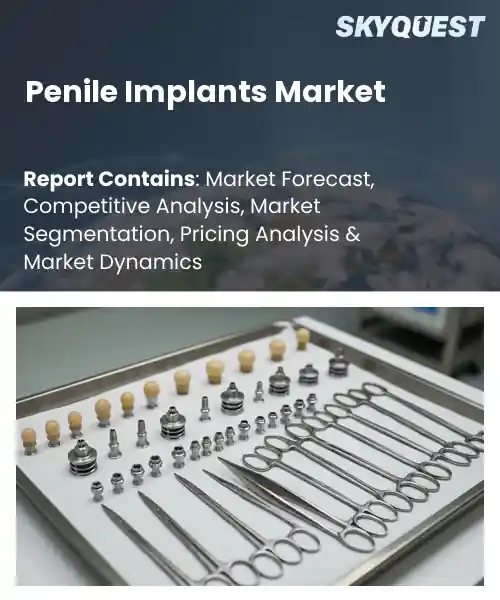
Penile Implants Market
Report ID: SQMIG35A3489
Report ID: SQMIG35A3489
[email protected]
USA +1 351-333-4748
Report ID:
SQMIG35A3489 |
Region:
Global |
Published Date: May, 2026
Pages:
157
|Tables:
172
|Figures:
79


Global Penile Implants Market size was valued at USD 545.8 Billion in 2024 and is poised to grow from USD 584.55 Billion in 2025 to USD 1011.9 Billion by 2033, growing at a CAGR of 7.1% during the forecast period (2026-2033).
The primary driver for the global penile implants market growth is the rising prevalence of erectile dysfunction maybe partly tied to aging populations and long-term chronic diseases; the market is basically surgical prostheses and supporting services that restore sexual function, and it matters because outcomes ripple into quality of life, and also healthcare costs. Over time, the penile implants market outlook evolved from simple malleable rods into more elaborate three-piece inflatable systems that mimic physiological erections to incremental design tweaks like biocompatible polymers and infection-reducing coating layers. More physician training, guideline endorsements, and increasing patient acceptance have nudged implants from a niche option into a mainstream route when pharmacotherapy doesn’t work, which keeps demand steady and also pushes faster product refinement.
In addition, a key factor for the penile implants market penetration is the rising burden of diseases that lead to irreversible erectile dysfunction, and that directly lifts demand for surgical approaches. As diabetes keeps growing and prostate cancer survivorship increases, more patients end up exhausting medical therapy, so clinicians recommend implants sooner; urology centers often offer three-piece inflatable devices to men after prostatectomy, with Peyronie disease, or after phalloplasty when they want reliable sexual function. Improvements like antibiotic-impregnated components and refined surgical techniques help cut infection and revision events, which can reduce payer reluctance and expand reimbursement pathways. So, manufacturers tend to invest in emerging markets, surgeon education, and bundled services to reach a wider patient base.
AI is optimizing surgical outcomes in the penile implants market by tightening up three connected areas at once: patient selection and preoperative planning, intraoperative precision, and postoperative care. Machine learning models can blend imaging data and clinical records together, which helps surgeons in choosing the proper implant profile and also planning for more accurate placement. During the procedure, AI-assisted image interpretation and navigation can reinforce surgeon performance and can reduce avoidable tissue trauma. After surgery, AI-enabled follow-up and device monitoring supports earlier detection of complications. These tools typically act as adjuncts to clinical judgment, and the adoption feels gradual, since established urology companies and newer surgical tech firms are integrating AI into planning and robotic support.
Market snapshot - (2026-2033)
Global Market Size
USD 545.8 Billion
Largest Segment
Inflatable Penile Implants
Fastest Growth
Inflatable Penile Implants
Growth Rate
7.1% CAGR
To get more insights on this market click here to Request a Free Sample Report
The global penile implants market is segmented by product type, material type, application, end user, procedure type, patient type, and region. Based on product type, the market is segmented into Inflatable Penile Implants, Malleable Penile Implants, and Semi-rigid Penile Implants. Based on material type, the market is segmented into Silicone-based Implants, Bioflex-based implants, and Others. Based on application, the market is segmented into Erectile Dysfunction Treatment, Peyronie’s Disease Treatment, Gender Affirmation Procedures, and Others. Based on end user, the market is segmented into Hospitals, Urology Clinics, Ambulatory Surgical Centers, Specialty Clinics and Others. Based on procedure type, the market is segmented into Minimally Invasive Procedures and Conventional Surgical Procedures. Based on patient type, the market is segmented into Adult and Geriatric. Based on region, the market is segmented into North America, Europe, Asia Pacific, Latin America and Middle East & Africa.
As per the penile implants market analysis, the Inflatable Penile Implants segment dominates a bit because its ability to give something more natural in both the flaccid and erect state seems to push clinician preference and overall patient satisfaction, which then allows wider adoption, especially in difficult erectile dysfunction situations. Recent design refinements have helped lower mechanical failure and infection risk, so surgeons feel more confident, and reimbursement alignment becomes steadier, which in turn encourages hospitals to procure them and run proper training. The general feeling of better functional outcomes, and how adaptable they are for different anatomical needs helps keep demand steady across Penile Implants Market clinical pathways.
However, malleable penile implants are showing up as the fastest growing area in this market, mainly due to their straightforward approach, shorter procedural time, and lower total cost. They also fit well with outpatient environments, and they work for resource-constrained practices where options can be limited. Small material innovations, paired with wider surgeon familiarity, are moving adoption forward among patients who want a long-lasting, low-maintenance type of solution, which opens additional access points and expands the market footprint.
According to the penile implants market forecast, the Erectile Dysfunction Treatment segment stays in the lead because it’s the primary clinical reason people end up using these implants, so device design and surgeon know-how can match well with existing treatment algorithms. Chronic erectile disorders and post-surgical erectile problems create consistent procedural demand. That persistence motivates investment in device performance, training, and reimbursement pathways, and those factors keep reinforcing hospital and clinic adoption. Clinical guidelines that mention implants as durable options for refractory cases also make their role feel even more central, so they keep guiding Penile Implants Market priorities and device development decisions.
However, the gender affirmation procedures category is predicted to have the largest penile implants market share. Broader acceptance and expanded surgical protocols are increasing the demand for tailored implants. Specialized implant modifications, and training programs that are more focused, help adoption inside gender affirming services, and that creates new procurement pathways, as well as niche market opportunities. Those openings then fuel innovation, and they also support dedicated product development for this emerging application.
To get detailed segments analysis, Request a Free Sample Report
As per the penile implants market regional forecast, North America dominates, mostly because clinical expertise is concentrated, healthcare infrastructure is more advanced, reimbursement frameworks are solid, surgeon training is extensive, and they were early to adopt new implant technologies. There’s also really high awareness among clinicians and patients, and strong research networks, and some solid collaboration between device manufacturers and major medical centers, which just keeps adoption moving. Market consolidation among specialist suppliers also helps by streamlining product availability and the post-market support side, too. Regulatory clarity and easier access to advanced diagnostic and surgical services lower the hurdles for more complex urological interventions. Then, established referral routes and comprehensive training efforts for urologists raise procedural volumes and improve outcomes, which basically lock the region into being the main hub for product innovation, evidence creation, and commercialization in the global penile implants market. After the procedure, stronger care pathways and patient education programs increase satisfaction, so demand stays sustained, and targeted investment in durability and minimally invasive design helps support ongoing clinical uptake.
United States Penile Implants Market
The Penile Implants sector in the United States benefits from a lot of hands-on surgical know-how, wide availability of specialized centers, and tight partnerships between clinicians and manufacturers. A mature regulatory setup and established reimbursement routes make it easier to bring products in and handle postmarket surveillance, too. Concentrated academic research programs generate clinical evidence that then shapes day-to-day practice. Focused training initiatives, along with multidisciplinary care teams, help with patient selection and outcomes, so demand keeps steady for advanced implant solutions and incremental device improvements.
Canada Penile Implants Market
The Penile Implants industry in Canada is mostly defined by concentrated centers of excellence, networks among urology specialists, and an ongoing emphasis on patient care. Access to centralized referral pathways and coordinated postprocedural support improves continuity. There’s a clear focus on clinical training initiatives and quality registries that back the adoption of established implant technologies. Market behavior tends to reward evidence-based decisions and partnerships that prioritize long-term durability, patient satisfaction, and the smoother integration with other urological service offerings.
Europe is seeing rapid expansion as clinical capability improves, regulatory pathways become more harmonized, and clinician familiarity with implant procedures keeps rising. Some leading markets push innovation via academic centers and collaborative clinical research that generates evidence that actually fits the region. Payers are increasingly starting to recognize clinical value, and they structure pathways that allow appropriate patient access within specialized centers. Local manufacturers and international companies also expand distribution networks, and they widen service offerings to support training and aftercare commitments. Cross-border knowledge transfer, professional society guidance, and targeted quality and outcomes initiatives speed up uptake. At the same time, clinician engagement and patient awareness are growing, which increases visibility across very different healthcare systems. Investments in clinician education, center accreditation, and postmarket registries lift standards and reduce variation in practice. And tailored service models and multilingual patient materials further support adoption across heterogeneous national systems.
Germany Penile Implants Market
The Penile Implants Market in Germany benefits from concentrated clinical research, specialized urology centers, and strong involvement from academic institutions, alongside industry. Clinician networks and high surgical training standards support the uptake of advanced implant technologies and the fine-tuning of techniques. Hospital infrastructure is robust, and there’s a heavier emphasis on measuring outcomes, which helps build confidence in device performance. Collaborative efforts between manufacturers and key opinion leaders also help generate localized evidence, and training programs, and follow-up pathways.
United Kingdom Penile Implants Market
Penile Implants Market in the United Kingdom is gaining momentum because specialist capacity is expanding, clinician training is improving, and multidisciplinary collaboration is strengthening. Initiatives meant to standardize care pathways, and reinforce referral networks, reduce access barriers, without slowing down clinical flow. Manufacturers are investing in local training and service support so they align better with clinical requirements. Patient education is also getting more emphasis, and that encourages informed decision-making. Taken together, these drivers accelerate adoption within specialized centers and spread clinical familiarity across urology communities nationally.
France Penile Implants Market
The Penile Implants Market in France is starting to emerge as specialist networks strengthen, and clinician interest in advanced prosthetic options grows. There are efforts to build clinical evidence through centers of excellence, which support adoption decisions that are more informed. Investment in training initiatives and patient education improves procedural readiness and follow-up care. Collaboration between device suppliers and regional clinical leaders helps tailor service models, and it also builds a foundation for wider integration into urological treatment pathways over time.
Asia Pacific is strengthening its role via focused investments on clinical capability, and also by growing specialist training programs and doing selective adoption of implant technologies that are internationally validated but adapted to regional needs. At the same time, increasing collaboration between global manufacturers and local hospitals expands training, distribution, and postprocedural support in a way that feels more hands-on. Also, emerging research activity and participation in multinational clinical studies improve the evidence base that is relevant to local populations. Improvements in healthcare infrastructure and the expansion of specialized urology centers allow more complex procedures too, and then cultural shifts in patient awareness and targeted education campaigns keep supporting acceptance. Tailored service models help cover diverse healthcare system requirements across the region, while local manufacturing partnerships and supply chain optimization enhance availability for those specialized centers.
Japan Penile Implants Market
The penile Implants Market in Japan benefits from advanced surgical training, strong hospital infrastructure, and collaboration between medical centers and device companies. There is a focus on quality clinical research and surgeon education programs, which encourage patient selection and procedural refinement. Manufacturers support localized training and aftercare style models to meet clinical expectations. There is also a cultural emphasis on clinical excellence and durability, which drives technology evaluation, while expanding specialized centers enables broader availability of implant procedures within urological services.
South Korea Penile Implants Market
The penile implants Market in South Korea is moving forward through investments in specialist training and integrating minimally invasive surgical approaches, and stronger clinical networks. Collaboration between hospitals and device manufacturers supports hands on surgeon education, and also aftercare pathways. Local research initiatives and participation in regional studies build an evidence base that actually sticks with real practice. Focus on patient communication and tailored service offerings enhances acceptance of implant procedures, and this supports the development of specialized centers within the healthcare systems in general.
To know more about the market opportunities by region and country, click here to
Buy The Complete Report
Preference For Advanced Therapies
Technological Innovations In Implants
High Procedure Costs Affect Adoption
Risk Of Postoperative Complications
Request Free Customization of this report to help us to meet your business objectives.
The competitive landscape for global penile implants is defined by intensified product-led rivalry, and also consolidation too, pushed by new device innovators entering the space and strategic M&A; for instance Boston Scientific’s Tactra launch and Rigicon’s Infla10 introduction in 2019 boosted product differentiation, while Coloplast’s more recent buys like Uromedica in 2026 show consolidation is happening to lock in distribution and broaden complementary urology portfolios.
Top Player’s Company Profile
Recent Developments in the Penile Implants Market
SkyQuest’s ABIRAW (Advanced Business Intelligence, Research & Analysis Wing) is our Business Information Services team that Collects, Collates, Correlates, and Analyses the Data collected by means of Primary Exploratory Research backed by robust Secondary Desk research.
As per SkyQuest analysis, the global penile implants market is propelled mainly by the rising prevalence of erectile dysfunction, driven by aging populations and chronic diseases, and it’s further supported by continuous technological innovations in implant design and surgical techniques that tend to improve outcomes and overall acceptance. Still, adoption is tempered by high procedure costs and perioperative resource needs, which can reduce access and reimbursement in some places. North America remains the leading region because of advanced clinical expertise, reimbursement frameworks, and specialist centers that are concentrated in key areas. Inflatable penile implants lead product adoption, largely because they best replicate natural function and influence both surgeon and patient preferences. Manufacturers focus on training, infection mitigation, and value-based support to expand uptake.
| Report Metric | Details |
|---|---|
| Market size value in 2024 | USD 545.8 Billion |
| Market size value in 2033 | USD 1011.9 Billion |
| Growth Rate | 7.1% |
| Base year | 2024 |
| Forecast period | (2026-2033) |
| Forecast Unit (Value) | USD Billion |
| Segments covered |
|
| Regions covered | North America (US, Canada), Europe (Germany, France, United Kingdom, Italy, Spain, Rest of Europe), Asia Pacific (China, India, Japan, Rest of Asia-Pacific), Latin America (Brazil, Rest of Latin America), Middle East & Africa (South Africa, GCC Countries, Rest of MEA) |
| Companies covered |
|
| Customization scope | Free report customization with purchase. Customization includes:-
|
To get a free trial access to our platform which is a one stop solution for all your data requirements for quicker decision making. This platform allows you to compare markets, competitors who are prominent in the market, and mega trends that are influencing the dynamics in the market. Also, get access to detailed SkyQuest exclusive matrix.
Table Of Content
Executive Summary
Market overview
Parent Market Analysis
Market overview
Market size
KEY MARKET INSIGHTS
COVID IMPACT
MARKET DYNAMICS & OUTLOOK
Market Size by Region
KEY COMPANY PROFILES
Methodology
For the Penile Implants Market, our research methodology involved a mixture of primary and secondary data sources. Key steps involved in the research process are listed below:
1. Information Procurement: This stage involved the procurement of Market data or related information via primary and secondary sources. The various secondary sources used included various company websites, annual reports, trade databases, and paid databases such as Hoover's, Bloomberg Business, Factiva, and Avention. Our team did 45 primary interactions Globally which included several stakeholders such as manufacturers, customers, key opinion leaders, etc. Overall, information procurement was one of the most extensive stages in our research process.
2. Information Analysis: This step involved triangulation of data through bottom-up and top-down approaches to estimate and validate the total size and future estimate of the Penile Implants Market.
3. Report Formulation: The final step entailed the placement of data points in appropriate Market spaces in an attempt to deduce viable conclusions.
4. Validation & Publishing: Validation is the most important step in the process. Validation & re-validation via an intricately designed process helped us finalize data points to be used for final calculations. The final Market estimates and forecasts were then aligned and sent to our panel of industry experts for validation of data. Once the validation was done the report was sent to our Quality Assurance team to ensure adherence to style guides, consistency & design.
Analyst Support
Customization Options
With the given market data, our dedicated team of analysts can offer you the following customization options are available for the Penile Implants Market:
Product Analysis: Product matrix, which offers a detailed comparison of the product portfolio of companies.
Regional Analysis: Further analysis of the Penile Implants Market for additional countries.
Competitive Analysis: Detailed analysis and profiling of additional Market players & comparative analysis of competitive products.
Go to Market Strategy: Find the high-growth channels to invest your marketing efforts and increase your customer base.
Innovation Mapping: Identify racial solutions and innovation, connected to deep ecosystems of innovators, start-ups, academics, and strategic partners.
Category Intelligence: Customized intelligence that is relevant to their supply Markets will enable them to make smarter sourcing decisions and improve their category management.
Public Company Transcript Analysis: To improve the investment performance by generating new alpha and making better-informed decisions.
Social Media Listening: To analyze the conversations and trends happening not just around your brand, but around your industry as a whole, and use those insights to make better Marketing decisions.
REQUEST FOR SAMPLE
 REQUEST FREE CUSTOMIZATION
Global Penile Implants Market size was valued at USD 545.8 Billion in 2024 and is poised to grow from USD 584.55 Billion in 2025 to USD 1011.9 Billion by 2033, growing at a CAGR of 7.1% during the forecast period (2026-2033).
The competitive landscape for global penile implants is defined by intensified product-led rivalry and consolidation, driven by entry of new device innovators and strategic M&A; for example Boston Scientific’s Tactra launch and Rigicon’s Infla10 introduction in 2019 raised product differentiation, while Coloplast’s recent acquisitions such as Uromedica in 2026 show consolidation to secure distribution and complementary urology portfolios. 'Boston Scientific', 'Coloplast', 'Rigicon', 'Zephyr Surgical Implants', 'Promedon', 'Timm Medical Technologies', 'GT Urological', 'SurgiWear', 'Silimed', 'MedSil', 'Uromedica', 'Mayo Clinic Urology Devices', 'Becton Dickinson', 'Cook Medical', 'Teleflex', 'Johnson & Johnson', 'B. Braun', 'Medtronic', 'Pfm Medical', 'Rti Surgical'
Clinical and patient familiarity with implantable solutions has shifted treatment pathways toward definitive therapies that restore function and quality of life. This preference encourages manufacturers to expand product portfolios and invest in distribution channels, training, and postprocedure support, making devices more accessible to clinicians and patients. As adoption increases among urologists, procurement by hospitals becomes more routine and market visibility improves, which in turn supports research collaborations and commercial initiatives that further reinforce uptake and broaden therapeutic availability across care settings.
Minimally Invasive Devices: Advances in device design and implantation techniques are driving a shift toward minimally invasive penile implants that reduce operative time and recovery, increase patient acceptance, and enable outpatient management. Device miniaturization, simplified activation mechanisms, and integration with intraoperative imaging support gentler procedures and wider surgeon adoption. Manufacturers are prioritizing user-friendly instrumentation and training solutions to lower procedural complexity, expand settings beyond tertiary centers, accelerate uptake, and create opportunities for development, investment, and differentiation based on efficiency and patient-centered clinical outcomes.
Why does North America Dominate the Global Penile Implants Market? |@12


Want to customize this report? This report can be personalized according to your needs. Our analysts and industry experts will work directly with you to understand your requirements and provide you with customized data in a short amount of time. We offer $1000 worth of FREE customization at the time of purchase.
Feedback From Our Clients


 USA (+1) 351-333-4748

