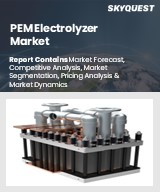
PEM Electrolyzer Market
Report ID: SQMIG20I2450
Report ID: SQMIG20I2450
[email protected]
USA +1 351-333-4748
Report ID:
SQMIG20I2450 |
Region:
Global |
Published Date: December, 2025
Pages:
176
|Tables:
90
|Figures:
71


Global PEM Electrolyzer Market Size was valued at USD 659.93 Million in 2024 poised to grow from USD 860.67 Million in 2025 to USD 7204.31 Million by 2033, growing at a CAGR of 30.42% in the forecast period (2026–2033).
The global PEM electrolyzer market is driven by the rising demand for green hydrogen production across various end‑use sectors. Companies are investing heavily in proton exchange membrane (PEM) technologies to meet stringent emission reduction targets, as these systems can help optimize hydrogen output and purity. This focus has led to improvements in catalyst materials and membrane durability, enhancing overall system efficiency. Collaborations between electrolyzer manufacturers and renewable power providers rapidly accelerated scalable deployment, integrating PEM systems with diverse renewable energy sources. Such developments underscore the market’s momentum and its role in cleaner energy transitions.
One of the key trends driving the global PEM electrolyzer market is the adoption of digital monitoring technologies. Leading companies are integrating sensors and IoT platforms in order to monitor performance metrics in real-time to help predict maintenance and reduce downtime. This transformation has allowed for remote diagnostics and data-driven decisions to be made to allow operators to maximize asset availability. Also, the formation of collaborative arrangements between electrolyzer providers and software companies has brought about the development of analytics tools for furthering performance optimization with new analytics. A pilot project showed how data could be used to extend stack life, highlighting this trend's ability to reduce operating friction and reduce lifecycle costs.
How Is AI‑Powered Predictive Maintenance Revolutionizing Efficiency and Durability in the Global PEM Electrolyzer Market?
Artificial intelligence (AI) is transforming the global PEM electrolyzer industry by automating predictive maintenance and improving operational parameters. AI algorithms can analyze sensor data on cell stacks, and identify potential faults before they happen, so that vendors can reduce unforeseen downtime and costly maintenance. Vendors have begun deploying ML models that can automatically adjust current densities and water flow rates or similar in order to reduce overall efficiency changes caused by changing power inputs. One of the notable product development examples was a major electrolyzer provider partnering with an AI startup to implement digital twins, and the digital twins project forced an extensive condition monitoring that resulted in an impressive amount of additional stack lifespan in field trials. All of the digital twin projects greatly improved reliability, but ultimately gave many operators insights on performance trends and ways to make hydrogen production more resilient and cost effective.
Market snapshot - 2026-2033
Global Market Size
USD 506 Million
Largest Segment
Green Hydrogen Production
Fastest Growth
Power-to-Gas
Growth Rate
30.42% CAGR
To get more insights on this market click here to Request a Free Sample Report
The global PEM electrolyzer market is segmented based on application, capacity range, installation, and region. In terms of application, the market is divided into green hydrogen production, power-to-gas, grid stabilization, and others. Based on capacity range, the market is grouped into below 1 MW, 1-5 MW, 5-10 MW, and above 10 MW. Based on installation, the market is bifurcated into centralized and decentralized. Based on region, the market is segmented into North America, Europe, Asia-Pacific, Central & South America and the Middle East & Africa.
How Is Sustainability Imperative Cementing Green Hydrogen Production’s Leadership in Global PEM Electrolyzer Market?
Green hydrogen production drives the global PEM electrolyzer market by aligning directly with decarbonization goals in industrial and energy sectors. Producers favor PEM systems due to their rapid start‑stop capability and high purity output, which can help optimize processes in refineries and chemical plants. Recent partnerships between electrolyzer manufacturers and renewable‑powered hydrogen suppliers have further reinforced this sub‑segment’s position by demonstrating scalable, low‑emission hydrogen supply chains. As demand intensifies, PEM electrolyzers tailored for green hydrogen continue to capture the bulk of project pipelines worldwide.
According to our global PEM electrolyzer market analysis, Power‑to‑Gas applications are expanding swiftly as grid operators seek solutions to store excess renewable energy. By converting intermittent solar or wind power into hydrogen and injecting it into gas networks, this approach can help balance supply fluctuations. Pilot initiatives in Europe and North America have shown how PEM electrolyzers integrated within gas infrastructure can enhance system flexibility. These successes underscore why the Power‑to‑Gas sub‑segment is enjoying rapid uptake and investment, outpacing other applications in recent project announcements.
How Is Modularity Amplifying Below 1 MW Systems’ Dominance in Global PEM Electrolyzer Market?
The global PEM electrolyzer market is dominated by below 1 MW capacity systems because they provide unparalleled operational flexibility. Their compact design facilitates seamless integration with local renewable sources, allowing industrial sites and remote facilities to utilize the hydrogen they generate. Recent technological advances related to membrane durability, stack designs and other elements have only enhanced the appeal of these systems. That’s because operators can modulate their output to be commensurate with variable power input.
Systems Above 10 MW are seeing rapid growth in the global PEM electrolyzer market. This growth is driven primarily by large-scale green-hydrogen projects and utility-grade installations. As manufacturers maximize production and manufacturers begin to standardize stack components, the economies of scale related to high-capacity generated hydrogen become increasingly available. The capital funding of several renewable-hydrogen hubs announced in the past year have to led to several of them selecting PEM electrolyzers over 10 MW, which suggests stakeholders recognize the systems' ability to perform at scale. The trend trends towards centralized or utility-scale hydrogen production that can be shared to multiple off-takers.
To get detailed segments analysis, Request a Free Sample Report
How Does Europe’s Renewable Integration Strategy Solidify Its Lead in the Global PEM Electrolyzer Market?
Europe’s emphasis on integrating large‑scale renewable energy sources has underpinned its dominance in the global PEM electrolyzer market. Policymakers have crafted supportive frameworks that incentivize green hydrogen projects, enabling electrolyzer deployments at unparalleled scale. Furthermore, investments in hydrogen corridors and port‑based hydrogen hubs have bolstered cross‑border supply chains, making Europe the most mature market globally. Industry consortia are now collaborating on standardized stack designs, which can help streamline manufacturing and reduce lead times. As a result, Europe remains the focal point for both technology innovators and end users seeking reliable, high‑capacity PEM electrolyzer solutions.
Germany’s proactive regulatory environment and robust renewable portfolio have cemented its leadership in the European PEM electrolyzer market. Recently, a consortium launched a 100‑MW electrolyzer pilot at the Port of Hamburg, revealing advanced stack modularity and grid‑balancing functionalities. This project showed how PEM systems can maximize peak renewable output and achieve high purity hydrogen quality for industrial comprise. Along with national hydrogen strategies, Germany continues to set the pace for large‑scale technology validation and deployment.
France is expanding rapidly in the European PEM electrolyzer market by leveraging state‑backed initiatives and industrial partnerships. Recently, a partnership between a significant energy company and a premium electrolyzer manufacturer has seen the commissioning of a 50‑MW plant in the Loire Valley. It has incorporated advanced digital monitoring to regulate water flow and current density to optimize uptime for the system. Consequently, with our support through France’s hydrogen roadmap, France is closing the gap on its European counterparts.
Spain is emerging in the European PEM electrolyzer market by capitalizing on its abundant solar and wind resources. In a landmark project, Spain began operations with a 30‑MW floating electrolyzer, and started production off the coast of Andalusia with a new, truly offshore integration. This project showed how PEM systems can respond to variable inputs from power generation and still maintain stable hydrogen output. Because of Spain’s interest in all coastal and island applications, it has attracted a significant amount of investment and is a very visible growth area within Europe’s hydrogen ecosystem.
Asia Pacific’s rapid industrial electrification and commitment to low‑carbon pathways have fueled its position as the fastest growing region in the global PEM electrolyzers market. Heavy industries in Japan and South Korea are exploring hydrogen not only as a fuel but also as a feedstock for chemicals production. Government incentives for fuel‑cell vehicle fleets and industrial hydrogen hubs have accelerated project approvals. At the same time, technology transfer agreements with global electrolyzer leaders have brought advanced PEM designs into the region. As a result, Asia Pacific is witnessing a surge in mid‑to‑large‑scale electrolyzer roll‑outs, reflecting both corporate decarbonization goals and national energy strategies.
Japan's dominance in the Asia Pacific PEM electrolyzer market can be attributed to its vision to develop a "hydrogen society". This commitment has helped accelerate its large‑scale investment into electrolyzers, most recently through commissioning a 20‑MW electrolyzer plant in Hokkaido, which was directly connected to offshore wind turbines. This commissioning indicated how Japan is moving towards integrated renewable‑hydrogen systems providing energy both for the industrial and mobility sectors. Japan continues to finance production of green hydrogen, along with strong co‑operation between utilities and technology companies on R&D, which will help maintain its dominance.
South Korea is rapidly growing in the Asia Pacific PEM electrolyzers market due to its successful national green‑growth strategy, which focused on industrial clusters as well as port hubs. In a recent project, a consortium finalized the commissioning of a 25‑MW PEM electrolyzer adjacent to the Port of Ulsan. This project is supposed to deliver hydrogen to steel and chemical producers. The PEM electrolyzers, when applied with more advanced stack cooling and digital controls here, led to improved stack efficiencies during continuous operation.
According to our global PEM electrolyzer market regional analysis, North America’s emergence can be attributed to its blend of federal incentives and private‑sector infrastructure development. The passage of hydrogen‑focused legislation at both national and state levels has unlocked grants and tax credits, spurring electrolyzer deployments. Meanwhile, utilities and pipeline operators are trialing hydrogen blending and storage solutions to enhance grid resilience. Collaborations between technology providers and major energy firms have resulted in pilot projects that demonstrate seamless integration with existing gas networks. As investment continues to flow, North America is primed to translate policy momentum into scalable PEM electrolyzer capacity.
The United States is dominating the North American PEM electrolyzer market by utilizing its 45V tax credit to launch a number of PEM electrolyzer projects. Recently, a federal grant funded a 50-MW facility in Central California’s Central Valley that paired solar generation with on-site PEM systems. This project showcased the role of public-private partnerships in mitigating project risk and shortening development timelines. Moreover, utilities are also considering hydrogen blending experiments in natural gas pipelines, which may give large-scale hydrogen a pathway to large scale adoption.
Canada is growing rapidly in the North American PEM electrolyzer market, by utilizing its abundant hydropower resources and provincial policies. In fact, a recent pilot experience in Quebec demonstrated a 10-MW PEM electrolyzer that was powered by reservoir hydropower, which also operated consistently without experiencing curtailment, or the need to reduce electricity generation output. This pilot experience clearly demonstrated that Canada was able to deliver the electricity at a stable price, with a long-term renewable provider to deliver the necessary energy for hydrogen production. With ongoing investments from both federal and provincial agencies, Canada has clearly established itself as both a testbed for developing electrolyzer applications.
To know more about the market opportunities by region and country, click here to
Buy The Complete Report
Growing Demand for Green Hydrogen Across Industrial Sectors
Strategic Support Through Public and Private Investment Initiatives
High Capital Costs and Limited Economies of Scale
Dependency on Stable Renewable Power Availability
Request Free Customization of this report to help us to meet your business objectives.
The competitive landscape of the global PEM electrolyzer industry is characterized by its leaders adopting targeted global PEM electrolyzer market strategies to maintain an edge. Nel ASA emphasizes large‑scale turnkey projects, collaborating with utilities to deliver multi‑megawatt systems. ITM Power focuses on standardized stack manufacturing, forging partnerships with automotive and industrial giants to secure long‑term off‑take. Thyssenkrupp invests in modular designs that simplify site installation. Across the industry, digital monitoring and hydrogen‑hub development drive rapid innovation, while collaboration among technology providers and energy companies accelerates commercialization.
The global PEM electrolyzer market is experiencing dynamic growth through the emergence of specialized startups which are creating new architectures and business models, so as to ensure global PEM electrolyzer market penetration. They are also utilizing combinations of internal R&D and venture-based funding to experiment with designing next generation electrolyzer cells. Their lean startup model allows them to iterate quickly around a given product, creating shifts in efficiency and costs. In turn, established companies are starting to adopt the technologies behind these startups through licensing or joint development, increasing the complete market's dynamism, assuring continued technical innovations and potential, lucrative future opportunities.
SkyQuest’s ABIRAW (Advanced Business Intelligence, Research & Analysis Wing) is our Business Information Services team that Collects, Collates, Correlates, and Analyses the Data collected by means of Primary Exploratory Research backed by robust Secondary Desk research.
As per SkyQuest analysis, the global PEM electrolyzer market is growing with the growing demand for green hydrogen across industrial sectors, which promotes adoption of PEM systems that can optimize purity and ramp‑up flexibility. A significant restraint is the high capital cost associated with catalyst materials and membrane components, which can hinder large‑scale deployment where production volumes remain limited.
Europe emerges as the dominating region, driven by integrated renewable energy strategies and supportive policy frameworks that foster large‑scale electrolyzer installations. When examining the segment states of the market, green hydrogen production is in the top position as a result of PEM designs tailored towards non-interim applications and substantial multi-dimensional collaboration to deliver high purity and low impurities products for refineries and chemical manufacturing. These elements highlight the importance of PEM electrolyzers in the context of global decarbonization and energy transitions.
| Report Metric | Details |
|---|---|
| Market size value in 2024 | USD 659.93 Million |
| Market size value in 2033 | USD 7204.31 Million |
| Growth Rate | 30.42% |
| Base year | 2024 |
| Forecast period | 2026-2033 |
| Forecast Unit (Value) | USD Million |
| Segments covered |
|
| Regions covered | North America (US, Canada), Europe (Germany, France, United Kingdom, Italy, Spain, Rest of Europe), Asia Pacific (China, India, Japan, Rest of Asia-Pacific), Latin America (Brazil, Rest of Latin America), Middle East & Africa (South Africa, GCC Countries, Rest of MEA) |
| Companies covered |
|
| Customization scope | Free report customization with purchase. Customization includes:-
|
To get a free trial access to our platform which is a one stop solution for all your data requirements for quicker decision making. This platform allows you to compare markets, competitors who are prominent in the market, and mega trends that are influencing the dynamics in the market. Also, get access to detailed SkyQuest exclusive matrix.
Table Of Content
Executive Summary
Market overview
Parent Market Analysis
Market overview
Market size
KEY MARKET INSIGHTS
COVID IMPACT
MARKET DYNAMICS & OUTLOOK
Market Size by Region
KEY COMPANY PROFILES
Methodology
For the PEM Electrolyzer Market, our research methodology involved a mixture of primary and secondary data sources. Key steps involved in the research process are listed below:
1. Information Procurement: This stage involved the procurement of Market data or related information via primary and secondary sources. The various secondary sources used included various company websites, annual reports, trade databases, and paid databases such as Hoover's, Bloomberg Business, Factiva, and Avention. Our team did 45 primary interactions Globally which included several stakeholders such as manufacturers, customers, key opinion leaders, etc. Overall, information procurement was one of the most extensive stages in our research process.
2. Information Analysis: This step involved triangulation of data through bottom-up and top-down approaches to estimate and validate the total size and future estimate of the PEM Electrolyzer Market.
3. Report Formulation: The final step entailed the placement of data points in appropriate Market spaces in an attempt to deduce viable conclusions.
4. Validation & Publishing: Validation is the most important step in the process. Validation & re-validation via an intricately designed process helped us finalize data points to be used for final calculations. The final Market estimates and forecasts were then aligned and sent to our panel of industry experts for validation of data. Once the validation was done the report was sent to our Quality Assurance team to ensure adherence to style guides, consistency & design.
Analyst Support
Customization Options
With the given market data, our dedicated team of analysts can offer you the following customization options are available for the PEM Electrolyzer Market:
Product Analysis: Product matrix, which offers a detailed comparison of the product portfolio of companies.
Regional Analysis: Further analysis of the PEM Electrolyzer Market for additional countries.
Competitive Analysis: Detailed analysis and profiling of additional Market players & comparative analysis of competitive products.
Go to Market Strategy: Find the high-growth channels to invest your marketing efforts and increase your customer base.
Innovation Mapping: Identify racial solutions and innovation, connected to deep ecosystems of innovators, start-ups, academics, and strategic partners.
Category Intelligence: Customized intelligence that is relevant to their supply Markets will enable them to make smarter sourcing decisions and improve their category management.
Public Company Transcript Analysis: To improve the investment performance by generating new alpha and making better-informed decisions.
Social Media Listening: To analyze the conversations and trends happening not just around your brand, but around your industry as a whole, and use those insights to make better Marketing decisions.
REQUEST FOR SAMPLE
 REQUEST FREE CUSTOMIZATION


Want to customize this report? This report can be personalized according to your needs. Our analysts and industry experts will work directly with you to understand your requirements and provide you with customized data in a short amount of time. We offer $1000 worth of FREE customization at the time of purchase.
Feedback From Our Clients


 USA (+1) 351-333-4748

