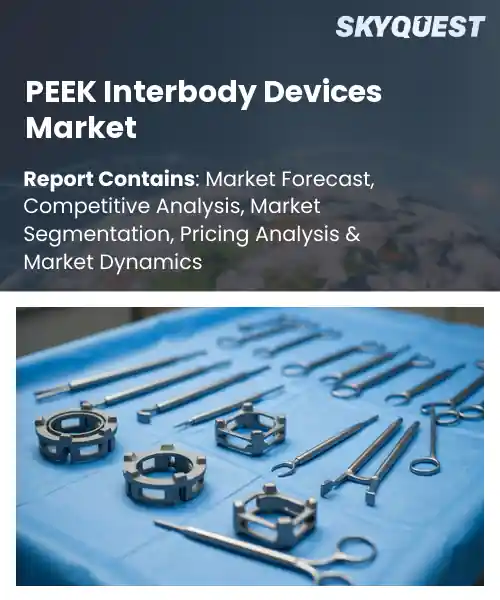
PEEK Interbody Devices Market
Report ID: SQMIG35A4085
Report ID: SQMIG35A4085
[email protected]
USA +1 351-333-4748
Report ID:
SQMIG35A4085 |
Region:
Global |
Published Date: July, 2026
Pages:
157
|Tables:
142
|Figures:
78


Global Peek Interbody Devices Market size was valued at USD 1.82 Billion in 2024 and is poised to grow from USD 1.96 Billion in 2025 to USD 3.52 Billion by 2033, growing at a CAGR of 7.62% during the forecast period (2026-2033).
The global PEEK interbody devices industry comprises polymer‑based spinal implants that replace damaged vertebral discs, offering radiolucency, fatigue resistance, and a modulus similar to bone. Its relevance stems from an aging population and increasing prevalence of degenerative disc disease, which drive demand for minimally invasive surgical solutions.
Over the past two decades, adoption accelerated as clinical studies demonstrated lower adjacent‑segment degeneration rates, prompting hospitals in Europe and North America to transition toward PEEK implants for patients. Regulatory endorsement of PEEK’s biocompatibility acts as the principal growth catalyst because streamlined approval reduces time‑to‑market, prompting manufacturers to invest in advanced cage geometries and additive‑manufacturing, and enables finer control over porosity, which enhances osseointegration. Consequently, suppliers can tailor implants to patient anatomy, and improves load distribution significantly, a decisive factor for surgeons handling complex lumbar reconstructions. Improved outcomes, illustrated by lower re‑operation rates at a spine center in Singapore, increase insurer willingness to reimburse PEEK solutions, broadening the addressable market. This reimbursement feedback, paired with growing surgeon familiarity, creates a virtuous cycle that amplifies global demand for the technology.
How is AI-driven automation influencing the adoption of Peek interbody devices?
AI‑driven automation is reshaping how surgeons select and place PEEK interbody devices. Machine‑learning algorithms analyze patient imaging to suggest optimal cage size, lordosis angle and placement trajectory, reducing reliance on manual measurements. Real‑time navigation integrates these recommendations with robotic arms, speeding up procedures and lowering the risk of misalignment. Hospitals report smoother workflow because pre‑operative planning can be completed in minutes rather than hours, freeing operating rooms for more cases. The technology also supports post‑operative monitoring, feeding outcomes back into the AI to refine future suggestions, creating a feedback loop that continuously improves device adoption and patient results.
In June 2026, a leading US supplier introduced AI‑enabled surgical planning software, accelerating case preparation and boosting confidence in PEEK cages, which in turn fuels broader market uptake.
Market snapshot - (2026-2033)
Global Market Size
USD 1.82 Billion
Largest Segment
PEEK Lumbar Cages
Fastest Growth
PEEK Cervical Cages
Growth Rate
7.62% CAGR
To get more insights on this market click here to Request a Free Sample Report
Global PEEK interbody devices market is segmented by product type, design, application, end-user, distribution and region. Based on product type, the market is segmented into PEEK Cervical Cages, PEEK Lumbar Cages and PEEK Thoracic Cages. Based on design, the market is segmented into Standalone, Zero-Profile and Expandable. Based on application, the market is segmented into ACDF (Anterior Cervical Discectomy), TLIF/PLIF and XLIF/LLIF. Based on end-user, the market is segmented into Hospitals and Spine Surgery Centers. Based on distribution, the market is segmented into Direct Sales and Distributors. Based on region, the market is segmented into North America, Europe, Asia Pacific, Latin America and Middle East & Africa.
PEEK cervical cages segment dominates with large PEEK interbody devices market share because surgeons prioritize anatomical conformity and radiolucency for cervical procedures, which drives consistent selection of these implants. The cervical spine’s complex biomechanics require devices that preserve motion while providing stable support, and PEEK’s elastic modulus closely matches bone, reducing stress shielding. Clinicians also value imaging compatibility that enables clear postoperative assessment, reinforcing strong preference for cervical cages in anterior cervical discectomy procedures worldwide overall today.
As per PEEK interbody devices market outlook, PEEK lumbar cages are witnessing the strongest growth momentum because minimally invasive lumbar fusion techniques are expanding rapidly, and the material’s load sharing characteristics align well with lumbar biomechanics. Surgeons are adopting these cages to achieve robust stabilization while preserving adjacent segment health, creating fresh opportunities for product innovation and market penetration.
As per PEEK interbody devices market forecast, expandable design segment leads because it offers intra operative size adaptability, allowing surgeons to achieve optimal endplate contact without extensive retraction, which reduces operative time and tissue trauma. The mechanism enables fine tuned restoration of disc height and alignment, improving neurological outcomes. Its versatility also supports use across multiple spinal levels, making it attractive for complex cases and driving strong adoption among spine specialists worldwide over the past decade as evidence accumulates.
On the other hand, zero profile design is emerging as the key high growth area because it eliminates anterior hardware prominence, reducing dysphagia risk and postoperative discomfort. The streamlined profile facilitates quicker recovery and aligns with enhanced recovery pathways, prompting hospitals and surgery centers to favor these implants, thereby accelerating market expansion.
To get detailed segments analysis, Request a Free Sample Report
North America leads the market through a combination of advanced clinical adoption, robust research infrastructure, and strong reimbursement frameworks that encourage innovation. Leading medical institutions and interdisciplinary collaborations accelerate the development and acceptance of PEEK interbody solutions, while a mature regulatory environment ensures swift product approvals. The region benefits from a deep pool of skilled surgeons who prioritize minimally invasive techniques, fostering demand for high‑performance polymer implants. Additionally, established supply chains and strategic partnerships with material manufacturers reinforce the market’s resilience and capacity for sustained growth.
As per PEEK interbody devices market regional outlook, United States reflects a high degree of clinical integration, supported by extensive academic research and a proactive approach to technology adoption. Healthcare providers emphasize outcomes‑driven care, promoting the use of PEEK implants for their radiolucency and biomechanical compatibility. Collaboration between universities, hospitals, and industry accelerates product refinement, while reimbursement policies align with value‑based care models, reinforcing market leadership.
As per PEEK interbody devices market regional forecast, Canada benefits from a collaborative health ecosystem that prioritizes evidence‑based practice and patient‑centered solutions. Strong academic‑clinical partnerships facilitate early adoption of innovative polymer technologies, while provincial health plans endorse cost‑effective alternatives to metallic implants. The regulatory framework supports timely market entry, and a focus on interdisciplinary training ensures that surgeons are adept at leveraging the advantages of PEEK for spinal interventions.
Europe’s expansion is propelled by a well‑established network of research centers, stringent yet facilitative regulatory standards, and a growing emphasis on patient quality of life across its health systems. The region’s commitment to sustainable medical solutions encourages the shift toward polymer‑based implants, which offer reduced imaging artifacts and favorable biomechanical properties. Collaborative initiatives among manufacturers, clinicians, and policy makers foster continuous innovation, while reimbursement structures increasingly recognize the long‑term benefits of PEEK devices. This synergy of scientific rigor and health‑economic considerations underpins Europe’s accelerating market trajectory.
Germany is anchored by leading orthopedic research institutions and a tradition of precision engineering. National health insurers endorse advanced polymer implants for their durability and patient comfort, creating a receptive environment for widespread clinical use. Partnerships between device manufacturers and university hospitals accelerate product development, while a rigorous certification process ensures high safety and performance standards, reinforcing Germany’s dominant market position.
United Kingdom experiences rapid uptake driven by a proactive NHS strategy that highlights innovative, cost‑effective solutions. Clinical networks promote early adoption of PEEK implants, emphasizing their radiolucent properties and compatibility with minimally invasive procedures. Collaboration between academia and industry accelerates evidence generation, and policy frameworks encourage reimbursement for technologies that demonstrate improved patient outcomes, positioning the United Kingdom as a fast‑growing market hub.
France is emerging amidst a supportive healthcare landscape that values technological advancement. National health agencies increasingly recognize the clinical benefits of polymer implants, fostering early adoption in specialized spinal centers. Research consortia and university hospitals drive clinical trials that highlight the safety and efficacy of PEEK solutions, while reimbursement pathways evolve to accommodate innovative devices, nurturing an emerging market environment.
Asia Pacific advances its position through expanding surgical expertise, heightened investment in medical research, and evolving healthcare policies that favor advanced implant technologies. Regional manufacturers are scaling up capabilities in high‑performance polymer processing, aligning with global quality standards. Growing awareness of minimally invasive spine surgery drives clinician interest in PEEK options, while emerging reimbursement models begin to reflect the long‑term value of these devices. Collaborative initiatives across countries bolster knowledge exchange, positioning the region as an increasingly influential market participant.
Japan benefits from a sophisticated healthcare system that prioritizes precision and patient safety. Leading academic hospitals drive early clinical adoption of PEEK implants, emphasizing their compatibility with advanced imaging techniques. Strong emphasis on research and development encourages domestic manufacturers to refine polymer technologies, while national guidelines support reimbursement for evidence‑based spine solutions, reinforcing Japan’s strengthening market role.
South Korea reflects a dynamic blend of rapid clinical adoption and innovative manufacturing. Government health programs increasingly endorse polymer implants for their reduced artifact profile and patient‑centric benefits. Partnerships between leading medical universities and device firms accelerate technology transfer, while a focus on minimally invasive surgery drives demand for PEEK solutions, solidifying South Korea’s growing contribution to the regional market.
To know more about the market opportunities by region and country, click here to
Buy The Complete Report
Growing Demand for Minimally Invasive Surgery
Enhanced Imaging and Navigation Technologies
High Cost of PEEK Materials
Stringent Regulatory Approval Processes
Request Free Customization of this report to help us to meet your business objectives.
The competitive landscape of the global PEEK interbody devices industry is shaped by intense rivalry among established manufacturers and aggressive moves such as Stryker’s acquisition of a niche spinal‑implant portfolio, Globus Medical’s partnership with a polymer‑technology firm to co‑develop next‑generation cages, and Xtant Medical’s launch of a 3‑D‑printed PEEK cage line, all aimed at securing differentiation and market share.
SkyQuest’s ABIRAW (Advanced Business Intelligence, Research & Analysis Wing) is our Business Information Services team that Collects, Collates, Correlates, and Analyses the Data collected by means of Primary Exploratory Research backed by robust Secondary Desk research.
As per SkyQuest analysis, the market is propelled by the growing demand for minimally invasive surgery, which favors PEEK cages for their radiolucency and strength; a second catalyst is AI‑driven automation that streamlines pre‑op planning and improves placement accuracy, boosting surgeon confidence which also supports customized solutions and enable personalized implant design. The high cost of PEEK material remains a notable restraint, limiting uptake in cost‑sensitive settings. North America continues to dominate the market due to advanced clinical adoption, strong reimbursement, and robust supply chains. Within the product mix, PEEK cervical cages lead the segment, driven by surgeons’ preference for anatomical conformity and clear imaging.
| Report Metric | Details |
|---|---|
| Market size value in 2024 | USD 1.82 Billion |
| Market size value in 2033 | USD 3.52 Billion |
| Growth Rate | 7.62% |
| Base year | 2024 |
| Forecast period | (2026-2033) |
| Forecast Unit (Value) | USD Billion |
| Segments covered |
|
| Regions covered | North America (US, Canada), Europe (Germany, France, United Kingdom, Italy, Spain, Rest of Europe), Asia Pacific (China, India, Japan, Rest of Asia-Pacific), Latin America (Brazil, Rest of Latin America), Middle East & Africa (South Africa, GCC Countries, Rest of MEA) |
| Companies covered |
|
| Customization scope | Free report customization with purchase. Customization includes:-
|
To get a free trial access to our platform which is a one stop solution for all your data requirements for quicker decision making. This platform allows you to compare markets, competitors who are prominent in the market, and mega trends that are influencing the dynamics in the market. Also, get access to detailed SkyQuest exclusive matrix.
Table Of Content
Executive Summary
Market overview
Parent Market Analysis
Market overview
Market size
KEY MARKET INSIGHTS
COVID IMPACT
MARKET DYNAMICS & OUTLOOK
Market Size by Region
KEY COMPANY PROFILES
Methodology
For the PEEK Interbody Devices Market, our research methodology involved a mixture of primary and secondary data sources. Key steps involved in the research process are listed below:
1. Information Procurement: This stage involved the procurement of Market data or related information via primary and secondary sources. The various secondary sources used included various company websites, annual reports, trade databases, and paid databases such as Hoover's, Bloomberg Business, Factiva, and Avention. Our team did 45 primary interactions Globally which included several stakeholders such as manufacturers, customers, key opinion leaders, etc. Overall, information procurement was one of the most extensive stages in our research process.
2. Information Analysis: This step involved triangulation of data through bottom-up and top-down approaches to estimate and validate the total size and future estimate of the PEEK Interbody Devices Market.
3. Report Formulation: The final step entailed the placement of data points in appropriate Market spaces in an attempt to deduce viable conclusions.
4. Validation & Publishing: Validation is the most important step in the process. Validation & re-validation via an intricately designed process helped us finalize data points to be used for final calculations. The final Market estimates and forecasts were then aligned and sent to our panel of industry experts for validation of data. Once the validation was done the report was sent to our Quality Assurance team to ensure adherence to style guides, consistency & design.
Analyst Support
Customization Options
With the given market data, our dedicated team of analysts can offer you the following customization options are available for the PEEK Interbody Devices Market:
Product Analysis: Product matrix, which offers a detailed comparison of the product portfolio of companies.
Regional Analysis: Further analysis of the PEEK Interbody Devices Market for additional countries.
Competitive Analysis: Detailed analysis and profiling of additional Market players & comparative analysis of competitive products.
Go to Market Strategy: Find the high-growth channels to invest your marketing efforts and increase your customer base.
Innovation Mapping: Identify racial solutions and innovation, connected to deep ecosystems of innovators, start-ups, academics, and strategic partners.
Category Intelligence: Customized intelligence that is relevant to their supply Markets will enable them to make smarter sourcing decisions and improve their category management.
Public Company Transcript Analysis: To improve the investment performance by generating new alpha and making better-informed decisions.
Social Media Listening: To analyze the conversations and trends happening not just around your brand, but around your industry as a whole, and use those insights to make better Marketing decisions.
REQUEST FOR SAMPLE
 REQUEST FREE CUSTOMIZATION
Global Peek Interbody Devices Market size was valued at USD 1.82 Billion in 2024 and is poised to grow from USD 1.96 Billion in 2025 to USD 3.52 Billion by 2033, growing at a CAGR of 7.62% during the forecast period (2026-2033).
The competitive landscape of the global PEEK interbody devices market is shaped by intense rivalry among established manufacturers and aggressive moves such as Stryker’s acquisition of a niche spinal‑implant portfolio, Globus Medical’s partnership with a polymer‑technology firm to co‑develop next‑generation cages, and Xtant Medical’s launch of a 3‑D‑printed PEEK cage line, all aimed at securing differentiation and market share. 'Medtronic plc', 'DePuy Synthes (J&J)', 'Stryker Corporation', 'NuVasive Inc.', 'Globus Medical', 'Zimmer Biomet', 'Alphatec Holdings', 'Orthofix Medical', 'SpineGuard', 'Xtant Medical', 'SeaSpine Holdings', 'Amendia Inc.', 'Benvenue Medical', 'Centinel Spine', 'CoreLink LLC', 'LifeSpine', 'Wenzel Spine', 'Precision Spine', 'Alliance Spine', 'Vexim SA (Stryker)'
The clinical community values procedures that reduce tissue disruption, blood loss, and postoperative discomfort, leading surgeons to prefer devices that facilitate smaller incisions. PEEK interbody cages are compatible with these minimally invasive approaches, allowing precise placement through narrow corridors while maintaining structural integrity. This alignment with surgeon priorities accelerates adoption across orthopedic and spinal specialties, prompting hospitals to invest in compatible instrumentation and training programs. Consequently, the market experiences sustained expansion as patient outcomes improve and demand for less invasive treatment options rises.
Minimally Invasive Adoption Surge: Surge in minimally invasive spinal surgeries is driving demand for PEEK interbody devices that combine radiolucency with high strength, enabling surgeons to visualize hardware placement without artifact while preserving tissue integrity. Manufacturers are tailoring product lines to support percutaneous insertion techniques, integrating low‑profile designs and modular configurations that accommodate varied patient anatomies. This shift enhances procedural efficiency, reduces operating time, and aligns with hospital initiatives to improve patient outcomes and shorten hospital stays, reinforcing market growth and expanding global adoption.
Why does North America Dominate the Global PEEK Interbody Devices Market? |@12


Want to customize this report? This report can be personalized according to your needs. Our analysts and industry experts will work directly with you to understand your requirements and provide you with customized data in a short amount of time. We offer $1000 worth of FREE customization at the time of purchase.
Feedback From Our Clients


 USA (+1) 351-333-4748

