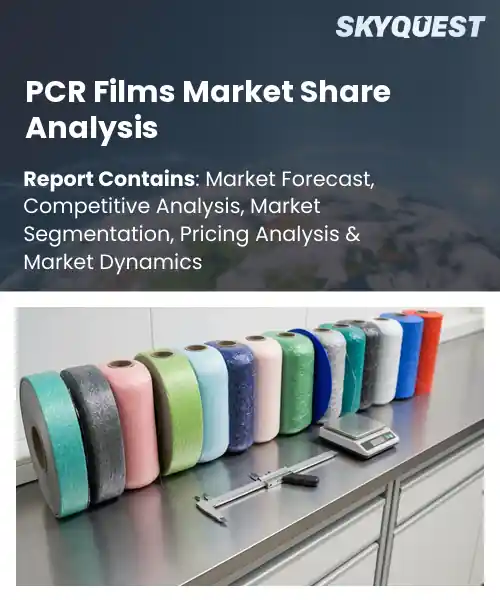
PCR Films Market
Report ID: SQMIG35J2733
Report ID: SQMIG35J2733
[email protected]
USA +1 351-333-4748
Report ID:
SQMIG35J2733 |
Region:
Global |
Published Date: August, 2026
Pages:
157
|Tables:
149
|Figures:
78


Global Pcr Films Market Share Analysis size was valued at USD 347.2 Million in 2024 and is poised to grow from USD 372.89 Million in 2025 to USD 660.12 Million by 2033, growing at a CAGR of 7.4% during the forecast period (2026-2033).
The global PCR films market trends refers to the manufacturing and distribution of lightweight and impact-resistant polymer sheets used in packaging, automotive interiors, and display technologies. Its importance lies in the improved optical clarity and durability of the material, which allows manufacturers to replace glass or plastics with lower weight and energy consumption. In 2010, PCR film was adopted by consumer electronics companies for foldable smartphones, a development that witnessed a shift from rigid glass to flexible substrates, resulting in a demand surge. Automotive OEMs incorporating the film into instrument panels to meet safety-weight regulations accelerated growth, demonstrating how technology adoption has expanded the market’s footprint.
The key driver of PCR films market share is the rising number of sustainability mandates that are compelling brands to move away from petro-based films and toward recyclable options. When governments announce plastic bans, manufacturers switch to PCR film because the polymer can be easily reclaimed and remolded, without much loss of performance, which drives down costs all along the value chain. This regulatory push has spurred collaborations between resin makers and consumer-goods companies, as seen in 2023, when 200,000 metric tons of PCR film were used for dairy cartons, reducing carbon emissions by 12 %. Companies are chasing eco-minded contracts, adoption is accelerating, reach is widening and competition is heating up.
How is AI-driven Automation Influencing PCR Films Market Share Globally?
AI-led automation is transforming the PCR films market growth by linking robotic handling with intelligent software. The technology tracks every step of the film preparation, predicts optimal volumes of the reagents and adjusts temperature cycles in real time. This reduces the human error and increases the speed of production, enabling manufacturers to meet the growing demand for quick diagnostic kits. Companies that integrate AI into their workflows are gaining a competitive edge, while traditional players are under pressure to upgrade. The change also paves the way for new competitors focused on cloud based analytics and machine learning algorithms for quality control. Market share shifts to companies that can promise consistency and scalability as labs adopt faster and more reliable films.
Thermo Fisher Scientific launched an AI-enabled automated PCR film production line in March 2024, which utilizes vision inspection and predictive maintenance to reduce cycle time and improve yield. This innovation demonstrates how AI-powered automation enhances market growth and operational efficiency.
Market snapshot - (2026-2033)
Global Market Size
USD 347.2 Million
Largest Segment
PCR Adhesive Films
Fastest Growth
Optical PCR Films
Growth Rate
7.4% CAGR
To get more insights on this market click here to Request a Free Sample Report
Global PCR films market share analysis is segmented by film type, material, format, application, end user and region. Based on film type, the market is segmented into PCR adhesive films, PCR sealing films, optical PCR films, heat-sealing films and other PCR films. Based on material, the market is segmented into polypropylene, polyester, polyethylene and other polymer materials. Based on format, the market is segmented into roll films and pre-cut films. Based on application, the market is segmented into conventional PCR, real-time PCR, digital PCR and other molecular diagnostics. Based on end user, the market is segmented into academic & research institutes, clinical laboratories, pharmaceutical & biotechnology companies, diagnostic laboratories and other end users. Based on region, the market is segmented into North America, Europe, Asia Pacific, Latin America and Middle East & Africa.
Polyester material segment leads because it offers superior chemical resistance and dimensional stability, essential for maintaining film integrity under harsh thermal cycling conditions. Its inherent barrier properties protect reagents from moisture ingress, enhancing assay reliability. Manufacturers favor polyester for its consistent performance across diverse PCR formats, and ongoing enhancements in polymer blends further strengthen its appeal, solidifying its position as the material of choice in the market.
On the other hand, pre cut films are witnessing the strongest growth momentum because they streamline workflow automation, reducing preparation time and minimizing handling errors in high throughput settings. Their ready to use format aligns with laboratories seeking efficiency, prompting increased adoption and stimulating market expansion as developers integrate them into emerging diagnostic platforms.
Pre cut films segment dominates because they eliminate manual cutting steps, delivering precise dimensions that ensure uniform seal integrity across experiments. This reliability reduces variability, fostering confidence among end users and encouraging widespread implementation in both research and clinical environments. The convenience of pre sized products also supports rapid scaling of operations, reinforcing their pivotal role in market adoption.
Meanwhile, optical PCR films emerge as the most rapidly expanding area because their enhanced transparency and low autofluorescence enable superior signal detection in real time assays, driving adoption among developers of high sensitivity diagnostics. Innovation in coating technologies is unlocking assay designs, propelling growth and creating revenue opportunities across the market.
To get detailed segments analysis, Request a Free Sample Report
North America dominates the PCR films market owing to the presence of a mature manufacturing ecosystem, robust research and development capabilities, and a large number of collaborations between film producers and downstream converters. Strong supply chains and a high degree of adoption of advanced packaging standards support leadership in the market. With a large talent pool and investment in sustainable polymer technologies, the region enables companies to produce high-performance, recyclable films that meet demanding regulatory expectations. Moreover, the strategic alliances with key brand owners reduce the innovation cycle, consolidating North America as a reference of quality and reliability at a global level.
PCR films market outlook in the United States is driven by widespread implementation of circular economy principles and a proactive regulatory environment that encourages recyclable packaging solutions. Leading film manufacturers leverage cutting‑edge extrusion technologies to produce high‑clarity, barrier‑enhanced products that address consumer demand for sustainability. Collaboration with major consumer goods companies fosters rapid product iteration, while a well‑established distribution network ensures efficient market penetration across diverse end‑use sectors.
PCR films market forecast in Canada reflects strong alignment with national sustainability goals and a collaborative industry landscape that emphasizes innovation. Canadian producers prioritize the integration of post‑consumer material streams, resulting in films that combine performance with reduced environmental impact. Partnerships with research institutions accelerate the development of advanced polymer blends, and a supportive policy framework encourages adoption across food packaging and medical applications, reinforcing the country’s role as a key contributor to the regional market dynamic.
Stringent environmental legislation, increased consumer awareness and a network of innovation clusters, which are connected across the continent, are driving the rapid growth of Europe. The region’s focus on closed loop recycling systems encourages manufacturers to increase the amount of post-consumer content used to make film. Collaborative platforms connecting material suppliers, converters and brand owners speed up best practice diffusion and technology transfer. Furthermore, a strong focus on the circular economy will encourage investment in scalable recycling infrastructure, making Europe a driver for growth in the market and transformation toward sustainable packaging.
PCR films market regional outlook in Germany is anchored by a tradition of engineering excellence and a robust industrial base that emphasizes high‑performance packaging solutions. German firms excel at integrating advanced barrier layers with recycled polymers, delivering films that meet stringent safety and quality standards. Close cooperation with research institutes accelerates material innovation, while a proactive regulatory climate drives continuous improvement in recyclability and carbon footprint reduction, sustaining the country’s dominant market presence.
PCR films market regional forecast in the United Kingdom is characterized by dynamic market entry strategies and a vibrant ecosystem of startups focused on sustainable packaging. The UK’s fast‑moving consumer goods sector embraces recycled film technologies, encouraging rapid adoption across retail and foodservice channels. Collaborative initiatives between industry bodies and academic centers foster knowledge exchange, while policy incentives support the scaling of recycling operations, positioning the United Kingdom as a leading growth engine in the European landscape.
PCR films market analysis in France reflects an emerging yet increasingly influential market segment driven by strong governmental support for eco‑design. French manufacturers are investing in adaptable film formulations that combine performance with high recycled content, catering to a market that values environmental stewardship. Partnerships with multinational brands accelerate market entry, and dedicated research programmes focus on enhancing film barrier properties, solidifying France’s emerging role within the broader European market.
The region has also witnessed a rapid adoption of advanced polymer processing techniques and a growing emphasis on sustainable packaging across a range of economies, further reinforcing the region’s position. The region's large manufacturing base provides the capability to produce high quality PCR films at low cost to world standards. Consumer awareness is increasing and government policies are driving the adoption of recycled content. Cross-border partnerships are facilitating technology transfer. The convergence of operational scale, innovation and policy alignment is driving Asia Pacific to greater relevance in the global market story.
PCR films market penetration in Japan is distinguished by meticulous quality control and a deep commitment to environmental responsibility. Japanese producers leverage precision extrusion processes to create films that combine high clarity with superior barrier performance, utilizing recycled feedstock that aligns with strict sustainability criteria. Strong ties between packaging manufacturers and consumer brands facilitate swift market adoption, while ongoing research initiatives aim to further enhance recyclability and reduce material waste.
PCR films industry in South Korea thrives on a culture of rapid technological adoption and strategic industry partnerships. Korean companies focus on integrating post‑consumer materials into high‑performance films that serve electronics, food, and medical packaging sectors. Government encouragement of circular economy practices, coupled with robust R&D investment, drives continuous improvement in film durability and environmental impact, solidifying South Korea’s emerging influence within the regional and global marketplace.
To know more about the market opportunities by region and country, click here to
Buy The Complete Report
Rising Demand for Flexible Electronics
Adoption Of High‑Resolution Imaging
High Production Cost Of Specialty Films
Environmental Regulations On Polymer Waste
Request Free Customization of this report to help us to meet your business objectives.
The global PCR films market is becoming increasingly competitive as packaging manufacturers invest in recycled-content technologies, film downgauging, recyclable mono-material structures and improved barrier performance. Leading companies are focusing on overcoming the technical challenges associated with incorporating post-consumer recycled (PCR) material while maintaining strength, machinability, seal integrity and food-contact requirements. Amcor, Berry Global, Mondi, Sealed Air, Coveris, ProAmpac and other major flexible-film producers are expanding recycled-content offerings and working with brand owners to increase the use of recycled polymers. For example, Amcor has developed flexible packaging and film solutions incorporating PCR and certified recycled content, while Berry Global has introduced PCR-containing films that maintain required mechanical and processing performance.
Top Player’s Company Profile
Recent Developments in the PCR Films Market
SkyQuest’s ABIRAW (Advanced Business Intelligence, Research & Analysis Wing) is our Business Information Services team that Collects, Collates, Correlates, and Analyses the Data collected by means of Primary Exploratory Research backed by robust Secondary Desk research. As per SkyQuest analysis the global PCR films market is being propelled mainly by the rising demand for flexible electronics which require thin, durable substrates, while AI‑driven automation that optimises production cycles serves as a second strong driver accelerating adoption. The market faces a restraint in the high production cost of specialty films that can limit price‑sensitive buyers. North America emerges as the dominating region thanks to its mature manufacturing ecosystem and strong sustainability initiatives. Within the segment landscape polyester‑based films hold the lead because of their superior chemical resistance and dimensional stability, cementing their position as the top‑performing segment worldwide.
| Report Metric | Details |
|---|---|
| Market size value in 2024 | USD 347.2 Million |
| Market size value in 2033 | USD 660.12 Million |
| Growth Rate | 7.4% |
| Base year | 2024 |
| Forecast period | (2026-2033) |
| Forecast Unit (Value) | USD Million |
| Segments covered |
|
| Regions covered | North America (US, Canada), Europe (Germany, France, United Kingdom, Italy, Spain, Rest of Europe), Asia Pacific (China, India, Japan, Rest of Asia-Pacific), Latin America (Brazil, Rest of Latin America), Middle East & Africa (South Africa, GCC Countries, Rest of MEA) |
| Companies covered |
|
| Customization scope | Free report customization with purchase. Customization includes:-
|
To get a free trial access to our platform which is a one stop solution for all your data requirements for quicker decision making. This platform allows you to compare markets, competitors who are prominent in the market, and mega trends that are influencing the dynamics in the market. Also, get access to detailed SkyQuest exclusive matrix.
Table Of Content
Executive Summary
Market overview
Parent Market Analysis
Market overview
Market size
KEY MARKET INSIGHTS
COVID IMPACT
MARKET DYNAMICS & OUTLOOK
Market Size by Region
KEY COMPANY PROFILES
Methodology
For the PCR Films Market, our research methodology involved a mixture of primary and secondary data sources. Key steps involved in the research process are listed below:
1. Information Procurement: This stage involved the procurement of Market data or related information via primary and secondary sources. The various secondary sources used included various company websites, annual reports, trade databases, and paid databases such as Hoover's, Bloomberg Business, Factiva, and Avention. Our team did 45 primary interactions Globally which included several stakeholders such as manufacturers, customers, key opinion leaders, etc. Overall, information procurement was one of the most extensive stages in our research process.
2. Information Analysis: This step involved triangulation of data through bottom-up and top-down approaches to estimate and validate the total size and future estimate of the PCR Films Market.
3. Report Formulation: The final step entailed the placement of data points in appropriate Market spaces in an attempt to deduce viable conclusions.
4. Validation & Publishing: Validation is the most important step in the process. Validation & re-validation via an intricately designed process helped us finalize data points to be used for final calculations. The final Market estimates and forecasts were then aligned and sent to our panel of industry experts for validation of data. Once the validation was done the report was sent to our Quality Assurance team to ensure adherence to style guides, consistency & design.
Analyst Support
Customization Options
With the given market data, our dedicated team of analysts can offer you the following customization options are available for the PCR Films Market:
Product Analysis: Product matrix, which offers a detailed comparison of the product portfolio of companies.
Regional Analysis: Further analysis of the PCR Films Market for additional countries.
Competitive Analysis: Detailed analysis and profiling of additional Market players & comparative analysis of competitive products.
Go to Market Strategy: Find the high-growth channels to invest your marketing efforts and increase your customer base.
Innovation Mapping: Identify racial solutions and innovation, connected to deep ecosystems of innovators, start-ups, academics, and strategic partners.
Category Intelligence: Customized intelligence that is relevant to their supply Markets will enable them to make smarter sourcing decisions and improve their category management.
Public Company Transcript Analysis: To improve the investment performance by generating new alpha and making better-informed decisions.
Social Media Listening: To analyze the conversations and trends happening not just around your brand, but around your industry as a whole, and use those insights to make better Marketing decisions.
REQUEST FOR SAMPLE
 REQUEST FREE CUSTOMIZATION
Global Pcr Films Market Share Analysis size was valued at USD 347.2 Million in 2024 and is poised to grow from USD 372.89 Million in 2025 to USD 660.12 Million by 2033, growing at a CAGR of 7.4% during the forecast period (2026-2033).
The PCR films market is shaped by intense competition among incumbents leveraging M&A, strategic alliances, and rapid tech innovation. 3M’s acquisition of a specialty barrier‑film unit in 2023 bolstered its high‑performance portfolio, while Eastman’s partnership with a leading food‑packaging group accelerated rollout of bio‑based films. DuPont’s launch of a nanocoated, ultra‑thin film platform underscores the drive to capture premium segments. 'Amcor plc', 'Berry Global Group, Inc.', 'Mondi plc', 'Sealed Air Corporation', 'Constantia Flexibles Group GmbH', 'Coveris Management GmbH', 'ProAmpac Holdings Inc.', 'Novolex Holdings, LLC', 'Inteplast Group Corporation', 'Pregis LLC', 'UFlex Limited', 'Cosmo First Limited', 'Jindal Poly Films Limited', 'Polyplex Corporation Limited', 'Taghleef Industries S.p.A.', 'Klöckner Pentaplast Group', 'Plastipak Holdings, Inc.', 'ALPLA Werke Alwin Lehner GmbH & Co KG', 'Huhtamäki Oyj', 'Winpak Ltd.'
The expanding adoption of flexible electronics across consumer wearables, medical devices, and automotive interfaces creates a strong need for thin, durable substrates that can withstand repeated bending. PCR films provide the necessary optical clarity and barrier performance while remaining lightweight and cost‑effective. Manufacturers therefore prioritize these films to meet product reliability requirements, accelerating production volumes and encouraging suppliers to innovate new formulations. This alignment of material capabilities with market expectations fuels sustained growth in the global PCR film sector overall.
Sustainable Packaging Integration: Manufacturers are increasingly adopting PCR films to meet consumer demand for environmentally responsible packaging, leveraging the material’s ability to reduce virgin resin usage while maintaining performance attributes such as barrier protection and flexibility. This shift is driven by brand initiatives emphasizing circular economy principles, pressure from large retailers to lower carbon footprints, and the growing availability of high‑quality recycled feedstock. As a result, companies are repositioning PCR films as core components of sustainability strategies rather than niche offerings in today.
Why does North America Dominate the Global PCR Films Market Share Analysis? |@12


Want to customize this report? This report can be personalized according to your needs. Our analysts and industry experts will work directly with you to understand your requirements and provide you with customized data in a short amount of time. We offer $1000 worth of FREE customization at the time of purchase.
Feedback From Our Clients


 USA (+1) 351-333-4748

