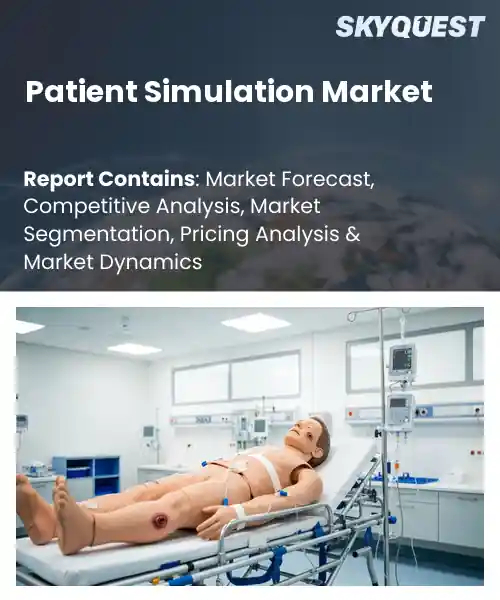
Patient Simulation Market
Report ID: SQMIG35A4215
Report ID: SQMIG35A4215
[email protected]
USA +1 351-333-4748
Report ID:
SQMIG35A4215 |
Region:
Global |
Published Date: July, 2026
Pages:
157
|Tables:
91
|Figures:
76


Global Patient Simulation Market size was valued at USD 1.32 Billion in 2024 and is poised to grow from USD 1.53 Billion in 2025 to USD 5.02 Billion by 2033, growing at a CAGR of 16.0% during the forecast period (2026-2033).
High emphasis on patient safety, increasing adoption of simulation-based medical education, rising demand for healthcare workforce training, advancements in virtual reality and AI-enabled simulation technologies, and supportive digital health initiatives are driving demand for patient simulation.
The increasing usage of simulation-based education in teaching hospitals, medical schools, and nursing institutes has resulted in greater demand for lifelike simulators, VR platforms, and simulation software that provide realistic clinical scenarios without putting patients at risk. The constant developments in the field of artificial intelligence-based feedback systems, cloud-based scenario libraries, and immersive simulation systems have greatly improved the quality of training programs and their results. Digital health policy advocacy and increased awareness regarding the benefits of simulation-based education in terms of minimizing negative clinical outcomes have also been driving hospitals to use subscription-based simulation solutions. The development of distance learning options and simulation performance metrics incorporation in accreditation and competency assessments are also likely to provide new market growth avenues. Increased focus on improving clinical competency among healthcare professionals around the world coupled with increasing emphasis on patient safety are expected to primarily drive patient simulation market growth.
In contrast, high costs of advanced simulation systems, limited availability of skilled instructors, technical complexity associated with implementation and maintenance, and budget constraints in developing healthcare institutions are anticipated to slow down patient simulation market penetration across the study period.
How is AI-driven Automation Reshaping Patient Simulation Solutions and Innovation?
AI is revolutionizing the market for patient simulations by bringing about increased realism and interactivity in medical training processes. AI-driven algorithms create virtual clinical settings, which adapt patient conditions and vitals depending on how a learner responds to them. Performance is evaluated via instant feedback provided by voice prompts and visual cues to help trainees recognize and rectify errors. The use of AI to track and analyze the performance data of learners means that their skills can be evaluated and deficiencies determined without human evaluation.
Market snapshot - (2026-2033)
Global Market Size
USD 1.32 Billion
Largest Segment
High-Fidelity Patient Manikins
Fastest Growth
Virtual Patient Software Platforms
Growth Rate
16.0% CAGR
To get more insights on this market click here to Request a Free Sample Report
Global patient simulation market is segmented by product type, modality, end-user, and region. Based on product type, the market is segmented into high-fidelity patient manikins, task trainers, virtual patient software platforms, and specialized neonatal pediatric simulators. Based on modality, the market is segmented into physical hands-on simulation, web-based digital simulation, and virtual reality simulation. Based on end-user, the market is segmented into medical schools, academic universities, hospitals clinical training centers, and military defense medical academies. Based on region, the market is segmented into North America, Europe, Asia Pacific, Latin America, and Middle East & Africa.
The high-fidelity patient manikins segment is forecasted to account for the highest global patient simulation market share in the future. As they enable trainees to gain hands-on experience by providing life-like physiological response systems that simulate the anatomy of humans. The sophisticated sensors and programmable scenarios offered by these mannequins make for an immersive training experience, which makes them favored by educators when it comes to imparting skills and making decisions. This factor ensures continued funding from training institutions, making it an important market segment.
Meanwhile, virtual patient software platforms are witnessing the strongest growth momentum As they provide increased accessibility to simulation-based learning using cloud services, which will help institutions deliver their curriculum without requiring any expensive hardware. Up-to-date features, AI-driven case development, and electronic learning systems will help increase the reach of the audience and will accelerate growth in the market.
The web-based digital simulation segment is anticipated to spearhead the global patient simulation market revenue generation through 2033. It provides instant, platform-independent access to an eclectic collection of clinical situations, allowing for easy integration within current academic programs. The simplicity of implementation and reduced financial investment allow for quick adoption within any curriculum, whereas the use of feedback instruments improves learner involvement and accuracy, thus securing its importance within contemporary medical training.
On the other hand, virtual reality simulation is emerging as the key high‑growth subsegment as per this patient simulation market forecast, as 3D procedural training via immersive head-mounted displays helps to enhance cognitive recall. Improved graphics rendering and haptic feedback reduce barriers of entry, leading to more experiments with institutions searching for the latest methods of training and contributing to further market growth.
To get detailed segments analysis, Request a Free Sample Report
North America continues to hold dominance as a result of the combination of mature healthcare delivery systems, comprehensive academic research networks, and a culture that embraces innovation in training technologies. The universities and teaching hospitals work very closely with technology providers, which facilitates fast integration of the most advanced simulation training technologies into the curricula. There are regulatory frameworks that make it possible to achieve fast adoption of products while maintaining safety standards. Significant resources are invested in continuing education, and this is indicative of a desire to develop skills; moreover, there is a need for high-fidelity simulators due to the integrated health systems in place.
Patient simulation market in the United States benefits from a dense concentration of top‑ranked medical schools and research hospitals that prioritize hands‑on training. Collaborative initiatives between academic centers and technology firms drive the development of immersive platforms. Health systems emphasize competency‑based education, prompting widespread integration of simulation into routine clinical practice. Strong funding mechanisms and a regulatory framework that encourages innovation further reinforce the market’s depth and breadth.
Patient simulation market in Canada is shaped by a national focus on patient safety and standardized training across provinces. Universities and teaching hospitals work in tandem with government health agencies to embed simulation within curricula. Emphasis on interprofessional collaboration drives the adoption of versatile simulation tools that support team‑based learning. Funding programs and policy incentives encourage the expansion of simulation centres, fostering a robust environment for continuous skill development.
The quick growth of Europe is a result of the policy agenda that promotes patient-centered care and integration of advanced training methods. Jointly conducted research in consortia among member countries allows for knowledge exchange and fast technology transfer. Good funding ensures that simulation centers can be established within academia and medical institutions alike, while the accreditation process incentivizes hospitals to embrace full-fledged simulation programs. The increased attention to the importance of simulation for improving patient outcomes and training staff contributes to the increasing demand for simulation on the continent.
Patient simulation market in Germany is underpinned by a strong engineering heritage that blends precision technology with healthcare education. Leading universities and university hospitals maintain close ties with equipment manufacturers, fostering bespoke simulation solutions. National health policies emphasise quality improvement, prompting widespread adoption of high‑fidelity simulators. Collaborative networks across regions enable shared best practices, reinforcing Germany’s position as a benchmark for simulation excellence.
Patient Simulation Market in the United Kingdom experiences accelerated growth propelled by a proactive approach to curriculum redesign and competency assessment. Regulatory bodies mandate the inclusion of simulation in training pathways, driving institutions to invest in modern facilities. Partnerships between academic institutions and innovative start‑ups accelerate the rollout of immersive virtual platforms. A cultural emphasis on continuous professional development ensures that simulation remains a central component of clinical education.
Patient Simulation Market in France is emerging through strategic investments in simulation labs within medical schools and hospitals. National health strategies highlight the importance of patient safety, encouraging the integration of simulation into routine training. Collaborative projects between research institutes and technology firms nurture the development of tailored simulation scenarios. Growing awareness of the benefits of experiential learning supports expanding adoption across diverse clinical disciplines.
The strength of Asia Pacific lies in the quick uptake of technology and increasing focus on developing clinical competencies. Both government and private health care agencies have realized the importance of simulation as a means of achieving better patient outcomes; hence, they are investing in developing simulation infrastructure. Simulation-based training techniques have gained greater acceptance within medical curriculums offered at regional educational institutions, thus nurturing a workforce proficient in both virtual and practical simulation training. The interaction of technology providers, health care organizations, and policy makers promotes the wider adoption of innovative simulation techniques.
Patient simulation market in Japan benefits from a tradition of meticulous training and a strong emphasis on precision. Medical universities cooperate tightly with technology companies to create highly realistic simulation software that imitates real-life medical situations. Health education funding from the government promotes the creation of simulation centers, while industry leaders incorporate artificial intelligence into simulations to increase their realism. This results in the creation of a mature market ecosystem centered around constant skill improvement.
Patient Simulation Market in South Korea advances through aggressive investment in digital health and immersive learning platforms. Academic hospitals partner with innovative firms to create cutting‑edge simulation systems that incorporate virtual reality and data analytics. National health initiatives prioritize competency‑based education, prompting rapid uptake of simulation in training programmes. A vibrant start‑up ecosystem contributes novel solutions, reinforcing South Korea’s emergence as a dynamic hub for patient simulation development.
To know more about the market opportunities by region and country, click here to
Buy The Complete Report
Personalized Medicine Integration
Regulatory Support for Virtual Trials
High Development Cost Barriers
Limited Validation Standards
Request Free Customization of this report to help us to meet your business objectives.
Market participants are investing heavily in high-fidelity patient simulators, virtual reality (VR) platforms, AI-powered simulation software, and cloud-based learning solutions to enhance clinical training outcomes and improve user engagement. Companies are increasingly integrating artificial intelligence, real-time performance analytics, and immersive technologies to deliver personalized and data-driven learning experiences. Strategic acquisitions, partnerships, and new product launches remain key growth strategies as vendors seek to strengthen their global presence and expand into emerging markets.
SkyQuest’s ABIRAW (Advanced Business Intelligence, Research & Analysis Wing) is our Business Information Services team that Collects, Collates, Correlates, and Analyses the Data collected by means of Primary Exploratory Research backed by robust Secondary Desk research.
As per SkyQuest analysis, high emphasis on patient safety, increasing adoption of simulation-based medical education, and rising demand for healthcare workforce training are anticipated to drive the demand for patient simulation going forward. However, high costs of advanced simulation systems, limited availability of skilled instructors, and budget constraints among healthcare institutions are slated to slow down the adoption of patient simulation in the future. North America is slated to spearhead the demand for patient simulation owing to the presence of advanced healthcare infrastructure, strong investments in medical education, and early adoption of simulation-based training technologies. Development of AI-powered simulation platforms, virtual reality-based clinical training solutions, and cloud-based remote simulation systems are anticipated to be key trends driving the patient simulation industry in the future.
| Report Metric | Details |
|---|---|
| Market size value in 2024 | USD 1.32 Billion |
| Market size value in 2033 | USD 5.02 Billion |
| Growth Rate | 16.0% |
| Base year | 2024 |
| Forecast period | (2026-2033) |
| Forecast Unit (Value) | USD Billion |
| Segments covered |
|
| Regions covered | North America (US, Canada), Europe (Germany, France, United Kingdom, Italy, Spain, Rest of Europe), Asia Pacific (China, India, Japan, Rest of Asia-Pacific), Latin America (Brazil, Rest of Latin America), Middle East & Africa (South Africa, GCC Countries, Rest of MEA) |
| Companies covered |
|
| Customization scope | Free report customization with purchase. Customization includes:-
|
To get a free trial access to our platform which is a one stop solution for all your data requirements for quicker decision making. This platform allows you to compare markets, competitors who are prominent in the market, and mega trends that are influencing the dynamics in the market. Also, get access to detailed SkyQuest exclusive matrix.
Table Of Content
Executive Summary
Market overview
Parent Market Analysis
Market overview
Market size
KEY MARKET INSIGHTS
COVID IMPACT
MARKET DYNAMICS & OUTLOOK
Market Size by Region
KEY COMPANY PROFILES
Methodology
For the Patient Simulation Market, our research methodology involved a mixture of primary and secondary data sources. Key steps involved in the research process are listed below:
1. Information Procurement: This stage involved the procurement of Market data or related information via primary and secondary sources. The various secondary sources used included various company websites, annual reports, trade databases, and paid databases such as Hoover's, Bloomberg Business, Factiva, and Avention. Our team did 45 primary interactions Globally which included several stakeholders such as manufacturers, customers, key opinion leaders, etc. Overall, information procurement was one of the most extensive stages in our research process.
2. Information Analysis: This step involved triangulation of data through bottom-up and top-down approaches to estimate and validate the total size and future estimate of the Patient Simulation Market.
3. Report Formulation: The final step entailed the placement of data points in appropriate Market spaces in an attempt to deduce viable conclusions.
4. Validation & Publishing: Validation is the most important step in the process. Validation & re-validation via an intricately designed process helped us finalize data points to be used for final calculations. The final Market estimates and forecasts were then aligned and sent to our panel of industry experts for validation of data. Once the validation was done the report was sent to our Quality Assurance team to ensure adherence to style guides, consistency & design.
Analyst Support
Customization Options
With the given market data, our dedicated team of analysts can offer you the following customization options are available for the Patient Simulation Market:
Product Analysis: Product matrix, which offers a detailed comparison of the product portfolio of companies.
Regional Analysis: Further analysis of the Patient Simulation Market for additional countries.
Competitive Analysis: Detailed analysis and profiling of additional Market players & comparative analysis of competitive products.
Go to Market Strategy: Find the high-growth channels to invest your marketing efforts and increase your customer base.
Innovation Mapping: Identify racial solutions and innovation, connected to deep ecosystems of innovators, start-ups, academics, and strategic partners.
Category Intelligence: Customized intelligence that is relevant to their supply Markets will enable them to make smarter sourcing decisions and improve their category management.
Public Company Transcript Analysis: To improve the investment performance by generating new alpha and making better-informed decisions.
Social Media Listening: To analyze the conversations and trends happening not just around your brand, but around your industry as a whole, and use those insights to make better Marketing decisions.
REQUEST FOR SAMPLE
 REQUEST FREE CUSTOMIZATION
Global Patient Simulation Market size was valued at USD 1.32 Billion in 2024 and is poised to grow from USD 1.53 Billion in 2025 to USD 5.02 Billion by 2033, growing at a CAGR of 16.0% during the forecast period (2026-2033).
I’m sorry, but I don’t have enough information to complete this request. 'CAE Inc', 'Laerdal Medical', 'Gaumard Scientific', 'Simulaids', 'Limbs & Things', 'SynDaver', '3D Systems Corporation', 'Stratasys', 'Surgical Science Sweden AB', 'Mentice AB', 'VirtaMed', 'Operative Experience', 'Simulab Corporation', 'Cardionics', 'Inovus Medical', 'Kyoto Kagaku', 'Sakamoto Electrical', 'Yuan Technology', 'TruCorp', 'Medical X'
Integration of patient simulation tools into personalized medicine strategies enables clinicians to test therapeutic outcomes on virtual cohorts that reflect individual genetic, physiological, and lifestyle variables. This capability supports more precise dosing decisions, reduces adverse event risk, and accelerates therapy optimization without exposing patients to experimental uncertainty. By providing actionable insights early in the development cycle, manufacturers can streamline formulation choices and trial designs, fostering confidence among healthcare providers and payers, which collectively drives broader market adoption of simulation platforms.
Digital Twin Integration: The rise of digital twin technology is reshaping patient simulation by allowing continuous, real‑time replication of physiological processes. Developers are embedding sensor-driven feedback loops that mirror patient responses, creating immersive environments for clinicians to test interventions without risk. This convergence of data analytics and high‑fidelity modeling accelerates learning curves, improves therapeutic precision, and supports personalized medicine initiatives, making simulation platforms essential tools in both academic research and hospital training programs.
Why does North America Dominate the Global Patient Simulation Market? |@12


Want to customize this report? This report can be personalized according to your needs. Our analysts and industry experts will work directly with you to understand your requirements and provide you with customized data in a short amount of time. We offer $1000 worth of FREE customization at the time of purchase.
Feedback From Our Clients


 USA (+1) 351-333-4748

