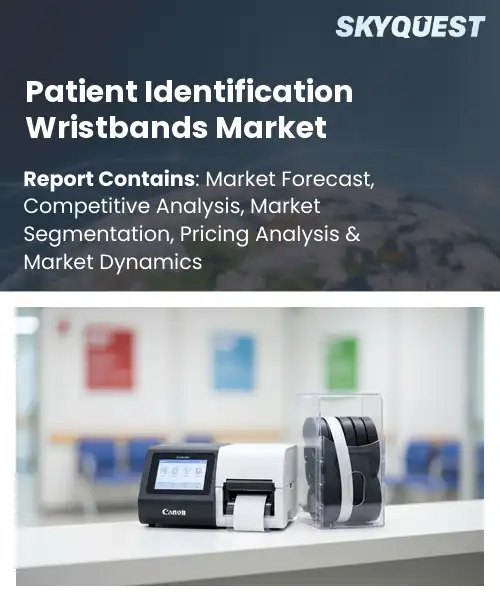
Patient Identification Wristbands Market
Report ID: SQMIG35B2402
Report ID: SQMIG35B2402
[email protected]
USA +1 351-333-4748
Report ID:
SQMIG35B2402 |
Region:
Global |
Published Date: July, 2026
Pages:
157
|Tables:
122
|Figures:
77


Global Patient Identification Wristbands Market size was valued at USD 700.0 Million in 2024 and is poised to grow from USD 772.8 Million in 2025 to USD 1705.37 Million by 2033, growing at a CAGR of 10.4% during the forecast period (2026-2033).
The global patient identification wristband market revolves around the production and supply of bar‑coded, RFID‑enabled, and smart wristbands that uniquely tag each hospital patient. Its importance stems from the need to prevent medical errors, ensure correct medication administration, and streamline workflow in increasingly complex care settings. Over the past decade the market has expanded as hospitals adopt electronic health records and regulatory bodies such as The Joint Commission tighten patient‑safety standards. For example, a 2015 study in a major U.S. health system showed a 30 % reduction in specimen‑labeling errors after implementing RFID wristbands, illustrating how safety mandates have driven demand. A second critical factor shaping the market is the integration of wearable technology with patient monitoring, which creates new revenue streams for device manufacturers and hospitals alike. When wristbands embed sensors that track temperature, heart rate, or mobility, clinicians can intervene earlier, reducing length of stay and associated costs; this logic encourages procurement of advanced bands. In Europe, a multicenter trial demonstrated that smart wristbands decreased postoperative infection rates by 15 % through temperature alerts, prompting insurers to reimburse such devices. Consequently, manufacturers are expanding modular designs and software platforms, opening opportunities for partnerships with telehealth providers and fostering market acceleration.
How is AI improving safety in the patient identification wristbands market?
AI is reshaping patient identification wristbands by embedding real time data validation, predictive alerts, and seamless integration with electronic health records. Machine learning algorithms compare barcode or RFID scans against medication orders, allergy lists and procedural schedules, instantly flagging mismatches before treatment begins. Voice activated verification lets clinicians confirm identity hands free, reducing human error. Continuous learning improves accuracy as the system ingests thousands of encounters, adapting to new drug names or procedural codes. Hospitals are adopting these smart bands to tighten safety nets, streamline workflows and meet rising regulatory expectations, turning a simple identifier into an active decision support tool.Zebra Technologies announced an AI enhanced patient identification wristband platform in March 2024, integrating predictive analytics with RFID tags to automatically verify patient medication matches and alert staff to potential errors. This rollout accelerates adoption of intelligent wristbands and demonstrates how AI can directly boost safety and operational efficiency.
Market snapshot - (2026-2033)
Global Market Size
USD 700.0 Million
Largest Segment
Barcoded Wristbands
Fastest Growth
RFID Wristbands
Growth Rate
10.4% CAGR
To get more insights on this market click here to Request a Free Sample Report
Global patient identification wristbands market is segmented by type, material, patient age cohort, end user and region. Based on type, the market is segmented into Barcoded Wristbands, RFID Wristbands, Laser Printed Wristbands, Thermal Printed Wristbands and Write-on Wristbands. Based on material, the market is segmented into Vinyl, Plastic, Tyvek, Foam and Paper. Based on patient age cohort, the market is segmented into Adult, Pediatric and Infant. Based on end user, the market is segmented into Hospitals, Specialty Clinics, Long-term Care Facilities and Ambulatory Surgical Centers. Based on region, the market is segmented into North America, Europe, Asia Pacific, Latin America and Middle East & Africa.
RFID wristbands segment dominates because they embed electronic tags that enable real time, non contact verification of patient identity throughout clinical workflows. The ability to integrate with electronic health record systems reduces manual transcription errors and supports automated medication administration checks. Hospitals prioritize this technology to meet accreditation standards, and clinicians value the speed and accuracy that wireless identification provides, driving widespread institutional adoption and reinforcing market leadership.
However, laser printed wristbands segment is witnessing the strongest growth momentum because advances in high resolution printing produce durable, water resistant codes on substrates. This meets rising demand for cost effective, single use identification in fast paced settings, and the ease of on site customization encourages facilities to adopt them for procedures, expanding market breadth.
Vinyl material segment dominates because it offers a combination of flexibility and resistance to moisture that satisfies the rigorous hygiene standards of healthcare environments. The material’s toughness enables repeated handling without tearing, while its smooth surface facilitates clear label adhesion and barcode readability. Clinicians value its ability to withstand frequent disinfection cycles, and procurement teams favor its cost efficiency, reinforcing its preferential selection across patient identification applications.
On the other hand, Tyvek material segment is emerging as the key high growth area because its lightweight, breathable properties meet the rising preference for hypoallergenic, single use wristbands in pediatric and infant care. The material’s ability to maintain integrity after sterilization encourages adoption in high turnover settings, and its recyclable nature aligns with sustainability initiatives, accelerating market expansion and opening new procurement opportunities.
To get detailed segments analysis, Request a Free Sample Report
North America leads the market owing to advanced healthcare infrastructure, early adoption of digital identification technologies, and strong regulatory frameworks that prioritize patient safety. Robust hospital networks and extensive investment in electronic medical record integration create a fertile environment for sophisticated wristband solutions. Healthcare providers in the region emphasize accuracy and traceability, driving demand for RFID and bar‑code enabled bands. Collaborative ecosystems among device manufacturers, software developers, and clinical institutions foster continuous innovation, reinforcing the region’s leadership. Additionally, a culture of compliance and quality assurance ensures that hospitals implement the latest identification standards, further cementing North America’s dominant position.
Patient Identification Wristbands Market in the United States benefits from a mature hospital ecosystem that actively embraces interoperable technologies. Integration with national health information exchanges encourages seamless data capture, while large academic medical centers champion research‑driven improvements. Industry alliances between suppliers and health systems accelerate adoption of smart wristbands, supporting higher accuracy in patient verification and medication administration.
Patient Identification Wristbands Market in Canada is shaped by a publicly funded health system that values uniform safety protocols across provinces. Provincial health authorities promote standardized identification practices, leading to widespread deployment of barcode and RFID wristbands. Collaborative initiatives between government health agencies and technology firms enhance compatibility with electronic health records, ensuring reliable patient tracking throughout the care continuum.
Europe’s expansion is propelled by stringent patient safety regulations, a strong emphasis on digital health transformation, and a collaborative research environment among leading medical institutions. The region’s commitment to harmonized standards encourages cross‑border compatibility of wristband technologies, while public‑private partnerships fund the development of innovative materials and smart sensor integration. Healthcare providers prioritize seamless workflow integration, driving demand for solutions that link directly to electronic health records. Moreover, an increasing focus on reducing medical errors aligns with the adoption of advanced identification bands, positioning Europe as a fast‑growing market hub.
Patient Identification Wristbands Market in Germany is anchored by a robust network of university hospitals that set benchmarks for safety and technology adoption. National standards mandate precise patient verification, prompting widespread implementation of bar‑code enabled wristbands. Strong engineering expertise supports the creation of durable, high‑performance bands suitable for varied clinical environments.
Patient Identification Wristbands Market in the United Kingdom accelerates through national health service initiatives that embed digital identification into routine care pathways. Emphasis on reducing medication errors and enhancing traceability drives hospitals to upgrade to RFID‑enabled wristbands. Collaborative pilots between NHS trusts and technology innovators foster rapid diffusion of smart band solutions.
Patient Identification Wristbands Market in France emerges from early adoption of electronic health record mandates and a proactive approach to patient safety. Hospital groups prioritize bar‑code solutions that integrate with existing clinical workflows, while research collaborations explore biodegradable wristband materials to meet sustainability goals.
Asia Pacific advances its position through rapid healthcare system modernization, heightened focus on patient safety, and growing manufacturing capabilities that reduce cost barriers. Governments across the region are implementing digital health strategies that incorporate advanced identification tools, encouraging hospitals to replace traditional methods with smart wristbands. The presence of leading electronics manufacturers facilitates local production of sophisticated RFID and NFC enabled bands, supporting faster delivery and customization. Collaborative efforts between tech firms and medical institutions drive innovation in material science and sensor integration, aligning with regional priorities for efficient, high‑quality patient care.
Patient Identification Wristbands Market in Japan benefits from a high‑tech healthcare landscape where precision and reliability are paramount. Integration with sophisticated hospital information systems encourages adoption of RFID wristbands that support real‑time patient monitoring. Strong regulatory guidance ensures consistent quality standards across manufacturers.
Patient Identification Wristbands Market in South Korea is propelled by a digitally savvy medical sector that readily embraces smart technologies. Close ties between leading electronics companies and healthcare providers enable rapid development of NFC‑enabled wristbands, enhancing patient verification and workflow efficiency.
To know more about the market opportunities by region and country, click here to
Buy The Complete Report
Increasing Patient Safety Initiatives
Adoption Of RFID Technology
High Implementation Cost Concerns
Data Privacy And Security Issues
Request Free Customization of this report to help us to meet your business objectives.
The competitive landscape is dominated by established manufacturers such as Zebra Technologies, PDC Healthcare and SATO, each leveraging advanced printing and RFID capabilities to differentiate their wristband solutions. Market pressure from rising medical error concerns drives these firms to pursue technology‑focused product enhancements and strategic collaborations with hospital networks, reinforcing their leadership while intensifying rivalry across the global patient identification wristband sector.
Top Player’s Company Profile
Recent Developments
SkyQuest’s ABIRAW (Advanced Business Intelligence, Research & Analysis Wing) is our Business Information Services team that Collects, Collates, Correlates, and Analyses the Data collected by means of Primary Exploratory Research backed by robust Secondary Desk research. As per SkyQuest analysis, the global patient identification wristbands market is being propelled primarily by rising patient‑safety initiatives that push hospitals to adopt reliable identification tools, while the second strong driver is the rapid uptake of RFID technology which streamlines real‑time tracking and electronic‑record integration. The RFID wristband segment leads the market thanks to its speed, accuracy and compliance benefits, and North America remains the dominant region due to its advanced healthcare infrastructure and stringent safety regulations. However, high implementation costs and the need for extensive system upgrades act as a notable restraint, tempering the pace of adoption in budget‑constrained facilities.
| Report Metric | Details |
|---|---|
| Market size value in 2024 | USD 700.0 Million |
| Market size value in 2033 | USD 1705.37 Million |
| Growth Rate | 10.4% |
| Base year | 2024 |
| Forecast period | (2026-2033) |
| Forecast Unit (Value) | USD Million |
| Segments covered |
|
| Regions covered | North America (US, Canada), Europe (Germany, France, United Kingdom, Italy, Spain, Rest of Europe), Asia Pacific (China, India, Japan, Rest of Asia-Pacific), Latin America (Brazil, Rest of Latin America), Middle East & Africa (South Africa, GCC Countries, Rest of MEA) |
| Companies covered |
|
| Customization scope | Free report customization with purchase. Customization includes:-
|
To get a free trial access to our platform which is a one stop solution for all your data requirements for quicker decision making. This platform allows you to compare markets, competitors who are prominent in the market, and mega trends that are influencing the dynamics in the market. Also, get access to detailed SkyQuest exclusive matrix.
Table Of Content
Executive Summary
Market overview
Parent Market Analysis
Market overview
Market size
KEY MARKET INSIGHTS
COVID IMPACT
MARKET DYNAMICS & OUTLOOK
Market Size by Region
KEY COMPANY PROFILES
Methodology
For the Patient Identification Wristbands Market, our research methodology involved a mixture of primary and secondary data sources. Key steps involved in the research process are listed below:
1. Information Procurement: This stage involved the procurement of Market data or related information via primary and secondary sources. The various secondary sources used included various company websites, annual reports, trade databases, and paid databases such as Hoover's, Bloomberg Business, Factiva, and Avention. Our team did 45 primary interactions Globally which included several stakeholders such as manufacturers, customers, key opinion leaders, etc. Overall, information procurement was one of the most extensive stages in our research process.
2. Information Analysis: This step involved triangulation of data through bottom-up and top-down approaches to estimate and validate the total size and future estimate of the Patient Identification Wristbands Market.
3. Report Formulation: The final step entailed the placement of data points in appropriate Market spaces in an attempt to deduce viable conclusions.
4. Validation & Publishing: Validation is the most important step in the process. Validation & re-validation via an intricately designed process helped us finalize data points to be used for final calculations. The final Market estimates and forecasts were then aligned and sent to our panel of industry experts for validation of data. Once the validation was done the report was sent to our Quality Assurance team to ensure adherence to style guides, consistency & design.
Analyst Support
Customization Options
With the given market data, our dedicated team of analysts can offer you the following customization options are available for the Patient Identification Wristbands Market:
Product Analysis: Product matrix, which offers a detailed comparison of the product portfolio of companies.
Regional Analysis: Further analysis of the Patient Identification Wristbands Market for additional countries.
Competitive Analysis: Detailed analysis and profiling of additional Market players & comparative analysis of competitive products.
Go to Market Strategy: Find the high-growth channels to invest your marketing efforts and increase your customer base.
Innovation Mapping: Identify racial solutions and innovation, connected to deep ecosystems of innovators, start-ups, academics, and strategic partners.
Category Intelligence: Customized intelligence that is relevant to their supply Markets will enable them to make smarter sourcing decisions and improve their category management.
Public Company Transcript Analysis: To improve the investment performance by generating new alpha and making better-informed decisions.
Social Media Listening: To analyze the conversations and trends happening not just around your brand, but around your industry as a whole, and use those insights to make better Marketing decisions.
REQUEST FOR SAMPLE
 REQUEST FREE CUSTOMIZATION


Want to customize this report? This report can be personalized according to your needs. Our analysts and industry experts will work directly with you to understand your requirements and provide you with customized data in a short amount of time. We offer $1000 worth of FREE customization at the time of purchase.
Feedback From Our Clients


 USA (+1) 351-333-4748

