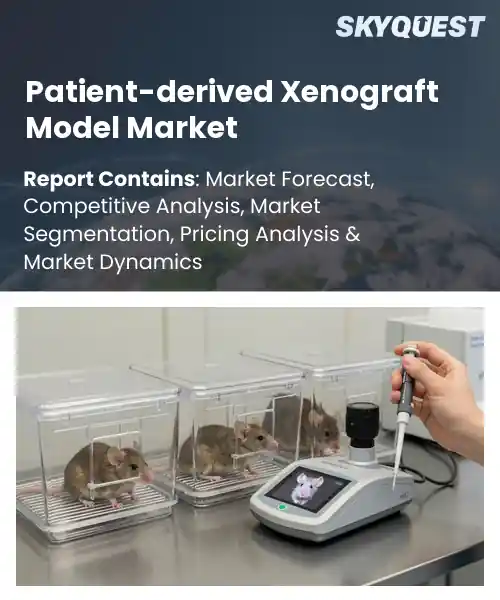
Patient-derived Xenograft Model Market
Report ID: SQMIG35H2493
Report ID: SQMIG35H2493
[email protected]
USA +1 351-333-4748
Report ID:
SQMIG35H2493 |
Region:
Global |
Published Date: May, 2026
Pages:
157
|Tables:
181
|Figures:
79


Global Patient-Derived Xenograft Model Market size was valued at USD 1.7 Billion in 2024 and is poised to grow from USD 1.89 Billion in 2025 to USD 4.46 Billion by 2033, growing at a CAGR of 11.3% during the forecast period (2026-2033).
The patient-derived xenograft (PDX) model industry is mostly about building and commercializing immunodeficient animal systems where human tumor material is implanted, so researchers can mirror patient-specific cancer behavior, more or less accurately. A big push here is the rising need for translationally reliable preclinical platforms, which are supposed to help cut down clinical trial drop-offs in oncology drug development. PDX models stand out because they allow pharmacodynamic, efficacy, and resistance work that can look a lot like how human tumors react, unlike the older cell line approach, so it also supports precision medicine in a more real-world way.
Another factor driving the global patient-derived xenograft model market growth is how PDX models are getting woven into oncology development pipelines more. Since targeted therapies and biomarker-centered treatments keep expanding, pharma and biotech firms need models that represent actual patients to validate biomarkers, test therapeutic impact, and anticipate resistance patterns. Due to that, companies are picking up characterized PDX cohorts and also leaning into advanced humanized PDX options.
So, sponsors increasingly hand off work to CROs or team up with biobanks for co-clinical trials. In those setups, PDX models are used to explore combination treatments and resistance routes. For instance, BRCA mutant PDX models are used a lot to check PARP inhibitor sensitivity, while humanized models help examine immune checkpoint inhibitor combinations. This steady evolution is opening up chances in preclinical services, data licensing, repository expansion, and broader global market growth. It also links to tangible clinical progress in precision oncology.
On top of that, AI is speeding up drug screening inside the patient-derived xenograft model sector by automating the routine parts and tightening candidate selection. The main points involve automated image evaluation of tumor growth and histology, and the fusion of genomics and imaging into predictive frameworks. AI also guides compound prioritization for in vivo evaluation, so teams don’t waste time on weak leads. In practice the current setup mixes machine learning trained on multimodal preclinical information with curated PDX repositories, which makes studies feel more translational and also easier to scale. Providers then use these capabilities to put resources toward the more promising therapies, limit repetitive animal experiments, and raise the odds that early preclinical findings will actually carry over to patients.
Market snapshot - (2026-2033)
Global Market Size
USD 1.7 Billion
Largest Segment
Mice-Based PDX Models
Fastest Growth
Humanized PDX Models
Growth Rate
11.3% CAGR
To get more insights on this market click here to Request a Free Sample Report
The global patient-derived xenograft model market is segmented by model type, tumor type, service type, application, end user, hosting type, and region. Based on model type, the market is segmented into Mice-Based PDX Models, Rat-Based PDX Models and Humanized PDX Models. Based on tumor type, the market is segmented into Gastrointestinal Cancer, Lung Cancer, Breast Cancer, Gynecological Cancer, Hematological Cancer, Prostate Cancer, Melanoma and Other Solid Tumors. Based on service type, the market is segmented into Model Establishment, Model Characterization, Drug Efficacy Testing, Biomarker Analysis, Cryopreservation & Biobanking and Custom PDX Services. Based on application, the market is segmented into Oncology Drug Development, Biomarker Discovery, Precision Medicine Research, Preclinical Testing and Translational Research. Based on end user, the market is segmented into Pharmaceutical Companies, Biotechnology Companies, Academic & Research Institutes and Contract Research Organizations (CROs). Based on hosting type, the market is segmented into Immunodeficient Mouse Models and Humanized Immune System Models. Based on region, the market is segmented into North America, Europe, Asia Pacific, Latin America and Middle East & Africa.
As per the patient-derived xenograft model market analysis, Mice-Based PDX Models lead the market because they mesh established engraftment protocols with the already well known immunodeficient strains. That combination helps a lot with consistent tumor take rate, and it also stays compatible across many cancer indications. On top of that, they tend to be more cost efficient, feel familiar to most researchers, and they slot right into existing preclinical workflows, so the technical and operational hurdles are lower. As a result, high-throughput drug screening and side by side comparative studies become easier, which is why adoption is broad among different service providers. This standardization also supports cleaner data generation and gives more regulatory confidence for translational oncology programs, even when teams are moving fast.
However, Humanized PDX Models are expanding the fastest, since bringing in human immune elements allows more predictive immunotherapy testing and faster biomarker discovery. Improvements in immune reconstitution methods and the increasing need for clinically relevant immuno-oncology platforms are pushing adoption forward. Due to that momentum, new service offerings and partnerships are popping up, which broaden the available choices for combined approaches and individualized therapy development.
According to the patient-derived xenograft model market forecast, Contract Research Organizations (CROs) dominate largely because they can bundle specialized PDX capabilities into a single setup, from model establishment all the way through efficacy testing, usually with regulated operating standards. Their scalable infrastructure helps a lot, and their project management know-how is a real advantage. They can also fold in biobanking, tissue characterization, and GLP-compliant workflows without sponsors having to coordinate everything separately. This centralized service approach shortens timelines, reduces sponsor risk, and makes outsourcing more attractive for many different developers. So CROs end up acting as principal enablers in translational oncology pipelines.
However, the biotechnology companies category is predicted to have the largest patient-derived xenograft model market share, mainly because they are chasing new targets and precision therapies. That creates demand for tailored PDX model setups and quicker in vivo validation cycles. These companies often team up for bespoke model development and biomarker programs, which in turn sparks more innovation in customized services and supports new translational collaborations.
To get detailed segments analysis, Request a Free Sample Report
As per the patient-derived xeniograft model market regional forecast, North America gets a boost from synergistic mix of mature biopharmaceutical ecosystems, deep clinical research infrastructure, and well-established preclinical model providers, and it all pushes market leadership in patient-derived xenograft models. There are also high levels of back and forth between academic centers, contract research organizations, and industry which speeds up model creation, validation, and actual uptake for translational oncology programs. Regulatory know-how and payer engagement then help translate those complicated preclinical datasets into the bigger development plans. You also see a concentration of specialized service providers, and experienced scientific talent, which helps teams customize and iterate the models quickly, for different research needs and use cases. On top of that, venture and strategic investment activity keeps commercialization moving and encourages platform expansion , while being close to major oncology centers means there’s ongoing feedback from clinical findings to PDX model refinements. Overall it’s like an integrated setup that keeps methodical model advancement going and drives translational impact.
United States Patient-derived Xenograft Model Market
The Patient-derived Xenograft Model sector in the United States tends to show up as concentrated research capacity, extensive clinical oncology networks, and a broad lineup of specialized CROs, along with academic providers. Strong institutional collaborations help move tumor biology from idea to refined PDX models that are built for therapeutic testing, quickly. Access to experienced scientific talent and also commercialization pathways support more sophisticated service catalogs, so even complex study setups and partnership efforts can align preclinical evidence with clinical development priorities.
Canada Patient-derived Xenograft Model Market
The Patient-derived Xenograft Model Market in Canada benefits from concentrated translational research hubs, strong university hospital involvement, and collaborative networks that make advanced preclinical models easier to adopt. The focus on cross-institutional partnerships and translational oncology programs encourages tailored PDX development for domestic work, and also for international studies. Meanwhile, service capabilities among specialized providers keep growing, and close coordination with clinical investigators helps maintain model relevance, so preclinical evaluation stays aligned with therapeutic research objectives and the priorities behind them.
Europe is witnessing rapid expansion in patient-derived xenograft model adoption due to a dense network of major oncology research institutions, proactive public and private research collaboration, and strong translational pipelines that connect academic discovery with clinical development. In key European markets, health technology ecosystems help create partnerships between universities, specialized service providers, and industry players, which speeds up model customization and technology transfer. Policy environments that encourage clinical trial integration and collaborative funding structures also support model validation and broader uptake.
Germany Patient-derived Xenograft Model Market
In Germany, the Patient-derived Xenograft Model Market is backed by long-standing cancer research centers, dependable biobanking know-how, and a manufacturing discipline that keeps model production fairly standardized. There are also cooperation efforts between universities and specialized service providers, which help make model creation more reproducible and keep quality control routines consistent, even when expectations are high in typical research environments. Industrial partnerships, and a clear focus on translational validation, help Germany supply high-quality PDX solutions for multinational studies, while domestic expertise helps guide methodological harmonization across projects.
United Kingdom Patient-derived Xenograft Model Market
The Patient-derived Xenograft Model Market in the United Kingdom is powered by dynamic academic entrepreneurship, a very active translational research culture, and strong spin-out momentum that accelerates fresh model platforms. Agile collaboration between startups, CROs, and university centers supports rapid prototyping and faster commercialization of PDX technologies. Regulatory engagement, along with clinically focused research networks, helps insert these models into therapeutic validation pathways. This positions the United Kingdom as a developing center for inventive PDX services.
France Patient-derived Xenograft Model Market
In France, the patient-derived xenograft model market is emerging as more people put focused money into translational oncology, biobank networks, and those cross-institutional programs that put clinical relevance first. There are centers of excellence and cooperative consortia getting involved, they back bespoke model development, and they also pull in molecular profiling know-how so the models get deeper characterization. There’s also more day-to-day engagement between academic researchers and industry partners, which tends to increase capacity for multicenter studies and supports better method standardization. Overall, the ecosystem in France keeps shifting and adding complementary strengths to the wider regional landscape, so innovation moves along and practical PDX solutions become easier to deliver.
Asia Pacific is strengthening its position in the patient-derived xenograft model market, via strategic investments into biotechnology infrastructure, expanding translational research know-how, and also enhanced industry academic collaboration. The idea is that global best practices get adapted to regional priorities, even if it sounds a bit broad in places. Emerging centers of excellence are now focusing on tumor biology, molecular characterization, and biobanking. That focus is meant to boost model fidelity and relevance for local patient groups, rather than just following a template. At the same time, growing domestic service providers and international partnerships are making technology transfer and capacity building feel more routine. There is also emphasis on regulatory dialogue, targeted training programs, and integration with precision medicine initiatives, which is accelerating adoption while national innovation agendas and cross-border collaborations add momentum to Asia Pacific's role in multinational preclinical programs. Specialized scientific talent pools, along with advanced laboratory platforms, support high-quality model generation and characterization. And on top of that, more venture funding and institutional backing are catalyzing commercialization pathways. Increased participation in global consortia further pulls Asia Pacific into international research networks.
Japan Patient-derived Xenograft Model Market
Japan’s patient-derived xenograft model market leans on advanced molecular research and well-equipped laboratory infrastructure to support high-fidelity model development. Strong academic industrial linkages and a clear focus on precision oncology push rigorous model characterization and translational relevance, like keeping the bar high by default. Domestic providers tend to emphasize reproducibility and integration with diagnostic platforms. That makes it easier to form partnerships for therapeutic evaluation. There is also cultural attention to meticulous validation and cross-institutional collaboration. It reinforces Japan as a contributor to regional PDX activities, not just a passive participant.
South Korea Patient-derived Xenograft Model Market
South Korea’s patient-derived xenograft model market is moving forward through targeted translational oncology efforts, strong molecular profiling capabilities, and agile biotech firms that adopt innovative model technologies. Collaborative networks among hospitals, research institutes, and commercial laboratories help enable tailored PDX generation aligned with therapeutic research needs. Quality assurance is treated as essential, and data integration and strategic partnerships are also front and center. As a result, South Korea’s role in multinational studies strengthens, while regional contribution to preclinical oncology research efforts also grows steadily.
To know more about the market opportunities by region and country, click here to
Buy The Complete Report
Increasing Demand For Personalized Therapies
Expansion Of Preclinical Research Collaborations
High Operational and Maintenance Costs
Limited Standardization and Reproducibility
Request Free Customization of this report to help us to meet your business objectives.
Competitive landscape is shaped by consolidation and service differentiation, where CROs and platform companies seem to pursue partnerships, acquisitions, and integrated PDX and organoid workflows to push more clinically predictive models forward. For instance, Crown Bioscience rolled out a PDX-derived organoid platform and also went into strategic PDX partnerships, so they could commercialize matched model libraries. Meanwhile, strategic deals and translational validation from drug developers are getting louder, basically intensifying competition around exclusive model banks and one package in vitro and in vivo solutions.
Top Player’s Company Profile
Recent Developments in the Patient-Derived Xenograft Model Market
SkyQuest’s ABIRAW (Advanced Business Intelligence, Research & Analysis Wing) is our Business Information Services team that Collects, Collates, Correlates, and Analyses the Data collected by means of Primary Exploratory Research backed by robust Secondary Desk research.
As per SkyQuest analysis, the global patient-derived xenograft model market is primarily powered by rising demand for personalized therapies that depend on patient-representative preclinical platforms. This is reinforced by the growing integration of PDX models into oncology development pipelines, which tends to speed biomarker validation and combination testing. Even so, high operational and maintenance costs act as a restraint, and that can restrict uptake at smaller institutions. North America remains the leading region, mostly because of its mature biopharma ecosystem and lots of concentrated service providers. And Mice-Based PDX Models still lead the way, largely due to established protocols, cost efficiency, and the broad familiarity researchers already have. At the same time, continued expansion of preclinical collaborations keeps opening development options and encourages service outsourcing among the various stakeholders.
| Report Metric | Details |
|---|---|
| Market size value in 2024 | USD 1.7 Billion |
| Market size value in 2033 | USD 4.46 Billion |
| Growth Rate | 11.3% |
| Base year | 2024 |
| Forecast period | (2026-2033) |
| Forecast Unit (Value) | USD Billion |
| Segments covered |
|
| Regions covered | North America (US, Canada), Europe (Germany, France, United Kingdom, Italy, Spain, Rest of Europe), Asia Pacific (China, India, Japan, Rest of Asia-Pacific), Latin America (Brazil, Rest of Latin America), Middle East & Africa (South Africa, GCC Countries, Rest of MEA) |
| Companies covered |
|
| Customization scope | Free report customization with purchase. Customization includes:-
|
To get a free trial access to our platform which is a one stop solution for all your data requirements for quicker decision making. This platform allows you to compare markets, competitors who are prominent in the market, and mega trends that are influencing the dynamics in the market. Also, get access to detailed SkyQuest exclusive matrix.
Table Of Content
Executive Summary
Market overview
Parent Market Analysis
Market overview
Market size
KEY MARKET INSIGHTS
COVID IMPACT
MARKET DYNAMICS & OUTLOOK
Market Size by Region
KEY COMPANY PROFILES
Methodology
For the Patient-derived Xenograft Model Market, our research methodology involved a mixture of primary and secondary data sources. Key steps involved in the research process are listed below:
1. Information Procurement: This stage involved the procurement of Market data or related information via primary and secondary sources. The various secondary sources used included various company websites, annual reports, trade databases, and paid databases such as Hoover's, Bloomberg Business, Factiva, and Avention. Our team did 45 primary interactions Globally which included several stakeholders such as manufacturers, customers, key opinion leaders, etc. Overall, information procurement was one of the most extensive stages in our research process.
2. Information Analysis: This step involved triangulation of data through bottom-up and top-down approaches to estimate and validate the total size and future estimate of the Patient-derived Xenograft Model Market.
3. Report Formulation: The final step entailed the placement of data points in appropriate Market spaces in an attempt to deduce viable conclusions.
4. Validation & Publishing: Validation is the most important step in the process. Validation & re-validation via an intricately designed process helped us finalize data points to be used for final calculations. The final Market estimates and forecasts were then aligned and sent to our panel of industry experts for validation of data. Once the validation was done the report was sent to our Quality Assurance team to ensure adherence to style guides, consistency & design.
Analyst Support
Customization Options
With the given market data, our dedicated team of analysts can offer you the following customization options are available for the Patient-derived Xenograft Model Market:
Product Analysis: Product matrix, which offers a detailed comparison of the product portfolio of companies.
Regional Analysis: Further analysis of the Patient-derived Xenograft Model Market for additional countries.
Competitive Analysis: Detailed analysis and profiling of additional Market players & comparative analysis of competitive products.
Go to Market Strategy: Find the high-growth channels to invest your marketing efforts and increase your customer base.
Innovation Mapping: Identify racial solutions and innovation, connected to deep ecosystems of innovators, start-ups, academics, and strategic partners.
Category Intelligence: Customized intelligence that is relevant to their supply Markets will enable them to make smarter sourcing decisions and improve their category management.
Public Company Transcript Analysis: To improve the investment performance by generating new alpha and making better-informed decisions.
Social Media Listening: To analyze the conversations and trends happening not just around your brand, but around your industry as a whole, and use those insights to make better Marketing decisions.
REQUEST FOR SAMPLE
 REQUEST FREE CUSTOMIZATION
Global Patient-Derived Xenograft Model Market size was valued at USD 1.7 Billion in 2024 and is poised to grow from USD 1.89 Billion in 2025 to USD 4.46 Billion by 2033, growing at a CAGR of 11.3% during the forecast period (2026-2033).
Competitive landscape is defined by consolidation and service differentiation as CROs and platform companies pursue partnerships acquisitions and integrated PDX and organoid workflows to deliver more clinically predictive models; for example Crown Bioscience launched a PDX derived organoid platform and entered strategic PDX partnerships to commercialize matched model libraries. Strategic deals and translational validation by drug developers are intensifying competition around exclusive model banks and integrated in vitro and in vivo solutions. 'The Jackson Laboratory', 'Charles River Laboratories International, Inc.', 'Crown Bioscience Inc.', 'Champions Oncology, Inc.', 'Inotiv, Inc.', 'Taconic Biosciences, Inc.', 'Hera BioLabs', 'Wuxi AppTec Co., Ltd.', 'Pharmatest Services Ltd.', 'Oncodesign Services', 'EPO Berlin-Buch GmbH', 'Urosphere SAS', 'Xentech', 'Shanghai LIDE Biotech Co., Ltd.', 'Creative Animodel LLC', 'BioDuro-Sundia', 'Living Tumor Laboratory', 'Horizon Discovery Group plc', 'Murine Trials in Europe AB', 'Shanghai Model Organisms Center, Inc.'
Patient derived xenograft models provide a biologically relevant platform that mirrors individual tumor heterogeneity and treatment response, enabling researchers to evaluate therapeutic efficacy within a patient specific context. This alignment with personalized medicine priorities motivates biopharma and academic stakeholders to integrate PDX studies into early and translational research workflows, as they support identification of predictive biomarkers and tailoring of therapeutic strategies. As a result, demand for robust PDX resources and related services grows because they enhance confidence in preclinical findings and help bridge laboratory results to clinical decision making.
Enhanced Translational Research Integration: Pharmaceutical and academic stakeholders increasingly integrate patient derived xenograft models into translational workflows to bridge preclinical and clinical research. This trend emphasizes closer collaboration for target validation, biomarker identification, and therapeutic profiling, enhancing the relevance of preclinical evidence for clinical decision making. Adoption drives demand for interoperable data platforms, standardized model characterization, and shared biorepositories that accelerate candidate selection and support regulatory engagement, ultimately aiming to improve clinical predictability and reduce the likelihood of late stage clinical attrition across portfolios.
Why does North America Dominate the Global Patient-derived Xenograft Model Market? |@12


Want to customize this report? This report can be personalized according to your needs. Our analysts and industry experts will work directly with you to understand your requirements and provide you with customized data in a short amount of time. We offer $1000 worth of FREE customization at the time of purchase.
Feedback From Our Clients


 USA (+1) 351-333-4748

