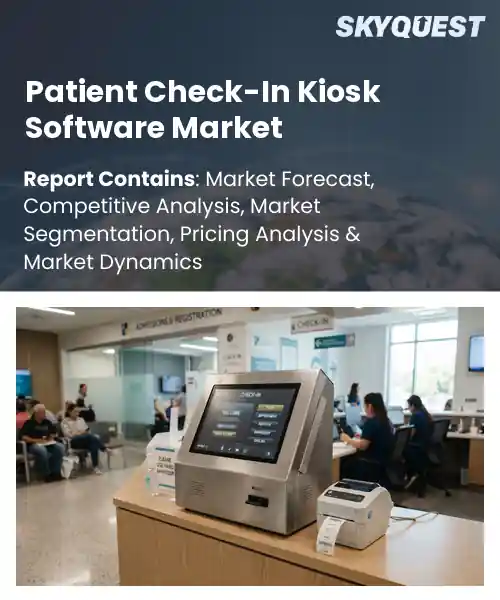
Patient Check-In Kiosk Software Market
Report ID: SQMIG35G2562
Report ID: SQMIG35G2562
[email protected]
USA +1 351-333-4748
Report ID:
SQMIG35G2562 |
Region:
Global |
Published Date: August, 2026
Pages:
157
|Tables:
118
|Figures:
77


Global Patient Check-In Kiosk Software Market size was valued at USD 1.89 Billion in 2024 and is poised to grow from USD 2.15 Billion in 2025 to USD 5.91 Billion by 2033, growing at a CAGR of 13.5% during the forecast period (2026-2033).
Interoperability with hospital information systems drives market growth because seamless data exchange lets staff retrieve verified patient profiles without manual entry. When kiosks pull insurance eligibility, lab orders, and prior visit history directly from the EHR, appointment scheduling speeds up and error rates fall, prompting facilities to invest in software. A regional Texas health network integrated its kiosk platform with Epic, achieving a 22 % cut in registration time and freeing clerical staff for patient education. Vendors that offer open APIs and cloud‑based modules therefore win contracts from academic centers and expanding telehealth providers, creating a path to sustained revenue growth.
How is AI-driven automation shaping the patient check-in kiosk software market?
AI-driven automation is reshaping patient check‑in kiosks by enabling real‑time data capture, predictive scheduling and seamless integration with electronic health records. Modern solutions learn from each interaction, automatically pre‑populating forms and routing patients based on urgency. This reduces manual entry, shortens wait times and frees staff to focus on care. The result is a smoother front‑desk experience that meets privacy standards while scaling to busy clinics. As providers seek efficiency, AI becomes a core differentiator in new releases.
In April 2026, Medical Check In introduced AI‑driven workflow automation that streamlines patient registration and eases front‑desk workload, illustrating how intelligent automation fuels market growth by reducing paperwork and enabling instant insurance verification, supporting faster throughput.
Market snapshot - (2026-2033)
Global Market Size
USD 1.89 Billion
Largest Segment
Cloud-Based
Fastest Growth
Cloud-Based
Growth Rate
13.5% CAGR
To get more insights on this market click here to Request a Free Sample Report
Global patient check-in kiosk software market is segmented by deployment mode, functionality, end user, integration and region. Based on deployment mode, the market is segmented into Cloud-Based and On-Premises. Based on functionality, the market is segmented into Patient Registration, Appointment Management, Insurance Verification, Payment Processing and Consent & Document Management. Based on end user, the market is segmented into Hospitals, Clinics, Diagnostic Centers and Ambulatory Surgical Centers. Based on integration, the market is segmented into Standalone and Integrated with EHR/HIS. Based on region, the market is segmented into North America, Europe, Asia Pacific, Latin America and Middle East & Africa.
Cloud-Based segment dominates because healthcare providers prioritize flexible access and rapid scalability that eliminate the need for extensive on‑site infrastructure. This model enables seamless software updates, centralized data management, and reduced IT overhead, aligning with the fast‑paced digital transformation agenda of modern facilities. Consequently, organizations favor cloud solutions to accelerate patient onboarding, improve data security through managed services, and support integration with emerging health‑tech ecosystems and enabling continuous innovation across clinical processes.
Conversely, On-Premises segment is witnessing the strongest growth momentum as data‑sensitive institutions seek tighter control over patient information and regulatory compliance. Investments in local servers and clouds are accelerating, driven by heightened privacy concerns and the desire for customized workflows. This surge fuels broader market expansion by opening opportunities in regulated environments.
Insurance Verification segment dominates because it directly addresses one of the most time‑consuming hurdles in outpatient care, linking patient identity with payer eligibility in real time. By automating credential checks and reducing manual entry errors, kiosks expedite the registration flow and lower denial rates. Healthcare operators view this capability as essential for revenue cycle efficiency, patient satisfaction, and compliance with payer mandates, making it a core differentiator in solution selection.
Meanwhile, Consent & Document Management segment is emerging as a growth area as providers increasingly require capture of signatures and forms at the point of entry. Advances in e‑signature technology, integration with privacy regulations, and patient expectations for paper‑less experiences are accelerating adoption. This momentum expands the market by unlocking use cases in telehealth onboarding.
To get detailed segments analysis, Request a Free Sample Report
North America leads the market through a combination of mature healthcare delivery systems, strong investment in digital transformation, and a regulatory environment that encourages interoperability. Health providers in the region prioritize seamless patient experiences, driving rapid adoption of self‑service technologies. A dense network of technology vendors and system integrators offers robust, customizable solutions that integrate tightly with electronic health records. High consumer familiarity with self‑check‑in processes in other sectors reinforces acceptance, while reimbursement models that reward efficiency further accelerate deployment across hospitals and outpatient clinics.
Patient Check-In Kiosk Software Market in the United States benefits from extensive hospital networks that seek to streamline front‑desk operations and reduce wait times. Providers value solutions that can capture insurance information, verify identities, and route patients to appropriate care pathways without manual intervention. The ecosystem of software developers, hardware manufacturers, and consulting firms creates a competitive environment that fuels continuous innovation, ensuring that kiosks remain adaptable to evolving clinical workflows and patient expectations.
Patient Check-In Kiosk Software Market in Canada is shaped by a publicly funded health system that emphasizes accessibility and efficiency. Provincial health authorities support initiatives that reduce administrative burdens, making self‑service kiosks an attractive option for clinics and community health centers. Integration with national health identifiers and bilingual user interfaces enhances usability across diverse populations. Collaborative partnerships between government agencies and technology providers help align solutions with policy goals, fostering steady growth in kiosk deployments.
Europe’s expansion is propelled by a strong focus on patient‑centred care, coupled with regulatory frameworks that promote digital health standards across member states. Health systems are investing in technologies that reduce administrative friction and improve data accuracy, encouraging widespread kiosk adoption. Cross‑border collaboration among technology firms and research institutions accelerates the development of multilingual, privacy‑compliant platforms. Additionally, the emphasis on sustainable operations leads facilities to replace paper‑based processes with electronic check‑in, reinforcing the market’s momentum throughout the continent.
Patient Check-In Kiosk Software Market in Germany is anchored by a robust healthcare infrastructure that values precision and data security. Hospitals and clinics prioritize solutions that integrate seamlessly with national health insurance databases, ensuring accurate patient identification and billing. The presence of leading software engineering hubs supports the creation of highly customizable kiosk applications that meet stringent regulatory requirements. Continuous investment in digital health initiatives sustains demand for advanced self‑service technologies across urban and regional facilities.
Patient Check-In Kiosk Software Market in the United Kingdom experiences rapid growth as NHS trusts pursue efficiency gains and enhanced patient flow. Emphasis on reducing waiting room congestion drives adoption of kiosks that capture registration details and triage information before clinical contact. Interoperability with national electronic health record systems enables real‑time data exchange, supporting smoother care pathways. Collaborative pilots between public health bodies and private vendors accelerate refinement of user‑friendly interfaces tailored to diverse patient demographics.
Patient Check-In Kiosk Software Market in France is emerging as health providers seek to modernize front‑office operations while adhering to strict data protection standards. Kiosk solutions that offer multilingual support and intuitive navigation align with the country’s focus on patient accessibility. Integration with regional health information exchanges facilitates seamless transfer of registration data to clinical teams. Government incentives for digital health adoption encourage hospitals and private clinics alike to explore self‑service options, fostering a growing ecosystem of kiosk deployments.
Asia Pacific is advancing its market position through a convergence of rising healthcare demand, urbanization, and governmental encouragement of technology‑enabled services. Hospitals in the region are adopting kiosks to manage high patient volumes and improve operational efficiency. Local software firms are tailoring solutions to cultural preferences, language diversity, and mobile‑first user behaviours, enhancing acceptance. Partnerships between multinational vendors and regional distributors accelerate knowledge transfer, while investments in smart hospital initiatives embed kiosks within broader digital ecosystems, reinforcing the region’s competitive edge.
Patient Check-In Kiosk Software Market in Japan benefits from a healthcare system that emphasizes precision, patient safety, and streamlined workflows. Kiosk platforms are designed to capture detailed insurance information and support seamless integration with national health data repositories. Manufacturers focus on high‑quality hardware that meets rigorous reliability standards, while software providers incorporate advanced language processing to accommodate elderly users. Collaborative efforts between hospitals and technology partners drive continuous improvement of self‑service experiences across both urban and suburban facilities.
Patient Check-In Kiosk Software Market in South Korea is propelled by a tech‑savvy population and a national agenda that prioritizes digital health innovation. Kiosks are deployed to reduce administrative bottlenecks in busy metropolitan hospitals, offering rapid registration and real‑time queue management. Integration with mobile health platforms enables patients to pre‑populate information via smartphones, enhancing convenience. Strong government support for smart hospital projects encourages the adoption of interoperable kiosk solutions that align with broader efforts to modernize the healthcare delivery model.
To know more about the market opportunities by region and country, click here to
Buy The Complete Report
Increasing Patient Expectations for Efficiency
Regulatory Push Toward Digital Records
High Initial Implementation Costs
Data Privacy And Security Concerns
Request Free Customization of this report to help us to meet your business objectives.
The competitive landscape is shaped by a wave of consolidation and collaborative innovation, as established vendors acquire niche technology firms and form alliances with electronic health record providers to embed seamless check‑in flows. Recent moves include strategic M&A to broaden AI‑driven patient routing capabilities and partnerships that integrate biometric verification, positioning firms to capture rising demand for frictionless, secure intake experiences.
Top Player’s Company Profile
SkyQuest’s ABIRAW (Advanced Business Intelligence, Research & Analysis Wing) is our Business Information Services team that Collects, Collates, Correlates, and Analyses the Data collected by means of Primary Exploratory Research backed by robust Secondary Desk research.
As per SkyQuest analysis, the global patient check‑in kiosk software market is being propelled primarily by rising patient expectations for faster self‑service registration, which pushes providers to adopt intuitive kiosks that cut wait times and boost satisfaction. A second driver is AI‑driven automation that pre‑populates forms, predicts queues and integrates real‑time insurance verification, further enhancing efficiency and supporting telehealth workflows. North America remains the dominant region, benefitting from mature health systems and strong interoperability mandates. Cloud‑based deployment is the leading segment because it offers rapid scalability, easy updates and lower IT overhead. However, high initial implementation costs pose a notable restraint, slowing uptake especially in smaller facilities.
| Report Metric | Details |
|---|---|
| Market size value in 2024 | USD 1.89 Billion |
| Market size value in 2033 | USD 5.91 Billion |
| Growth Rate | 13.5% |
| Base year | 2024 |
| Forecast period | (2026-2033) |
| Forecast Unit (Value) | USD Billion |
| Segments covered |
|
| Regions covered | North America (US, Canada), Europe (Germany, France, United Kingdom, Italy, Spain, Rest of Europe), Asia Pacific (China, India, Japan, Rest of Asia-Pacific), Latin America (Brazil, Rest of Latin America), Middle East & Africa (South Africa, GCC Countries, Rest of MEA) |
| Companies covered |
|
| Customization scope | Free report customization with purchase. Customization includes:-
|
To get a free trial access to our platform which is a one stop solution for all your data requirements for quicker decision making. This platform allows you to compare markets, competitors who are prominent in the market, and mega trends that are influencing the dynamics in the market. Also, get access to detailed SkyQuest exclusive matrix.
Table Of Content
Executive Summary
Market overview
Parent Market Analysis
Market overview
Market size
KEY MARKET INSIGHTS
COVID IMPACT
MARKET DYNAMICS & OUTLOOK
Market Size by Region
KEY COMPANY PROFILES
Methodology
For the Patient Check-In Kiosk Software Market, our research methodology involved a mixture of primary and secondary data sources. Key steps involved in the research process are listed below:
1. Information Procurement: This stage involved the procurement of Market data or related information via primary and secondary sources. The various secondary sources used included various company websites, annual reports, trade databases, and paid databases such as Hoover's, Bloomberg Business, Factiva, and Avention. Our team did 45 primary interactions Globally which included several stakeholders such as manufacturers, customers, key opinion leaders, etc. Overall, information procurement was one of the most extensive stages in our research process.
2. Information Analysis: This step involved triangulation of data through bottom-up and top-down approaches to estimate and validate the total size and future estimate of the Patient Check-In Kiosk Software Market.
3. Report Formulation: The final step entailed the placement of data points in appropriate Market spaces in an attempt to deduce viable conclusions.
4. Validation & Publishing: Validation is the most important step in the process. Validation & re-validation via an intricately designed process helped us finalize data points to be used for final calculations. The final Market estimates and forecasts were then aligned and sent to our panel of industry experts for validation of data. Once the validation was done the report was sent to our Quality Assurance team to ensure adherence to style guides, consistency & design.
Analyst Support
Customization Options
With the given market data, our dedicated team of analysts can offer you the following customization options are available for the Patient Check-In Kiosk Software Market:
Product Analysis: Product matrix, which offers a detailed comparison of the product portfolio of companies.
Regional Analysis: Further analysis of the Patient Check-In Kiosk Software Market for additional countries.
Competitive Analysis: Detailed analysis and profiling of additional Market players & comparative analysis of competitive products.
Go to Market Strategy: Find the high-growth channels to invest your marketing efforts and increase your customer base.
Innovation Mapping: Identify racial solutions and innovation, connected to deep ecosystems of innovators, start-ups, academics, and strategic partners.
Category Intelligence: Customized intelligence that is relevant to their supply Markets will enable them to make smarter sourcing decisions and improve their category management.
Public Company Transcript Analysis: To improve the investment performance by generating new alpha and making better-informed decisions.
Social Media Listening: To analyze the conversations and trends happening not just around your brand, but around your industry as a whole, and use those insights to make better Marketing decisions.
REQUEST FOR SAMPLE
 REQUEST FREE CUSTOMIZATION
Global Patient Check-In Kiosk Software Market size was valued at USD 1.89 Billion in 2024 and is poised to grow from USD 2.15 Billion in 2025 to USD 5.91 Billion by 2033, growing at a CAGR of 13.5% during the forecast period (2026-2033).
The competitive landscape is shaped by a wave of consolidation and collaborative innovation, as established vendors acquire niche technology firms and form alliances with electronic health record providers to embed seamless check‑in flows. Recent moves include strategic M&A to broaden AI‑driven patient routing capabilities and partnerships that integrate biometric verification, positioning firms to capture rising demand for frictionless, secure intake experiences. 'Epic Systems Corporation', 'Oracle Health', 'Veradigm LLC', 'NextGen Healthcare, Inc.', 'eClinicalWorks, LLC', 'athenahealth, Inc.', 'AdvancedMD, Inc.', 'Phreesia, Inc.', 'Clearwave Corporation', 'PatientWorks, Inc.', 'Q-nomy Inc.', 'WellSky Corporation', 'Experian Health', 'InteliChart, Inc.', 'Kiosk Information Systems, Inc.', 'Nanonation, Inc.', 'TouchPoint Medical, Inc.', 'ClinicSense Software Inc.', 'MEDHOST, Inc.', 'Solutionreach, Inc.'
Healthcare facilities are adopting self‑service kiosks to meet rising patient expectations for faster check‑in processes, reducing perceived wait times and improving overall satisfaction. By enabling patients to input personal data, verify insurance, and complete forms independently, these systems streamline front‑desk operations and free staff for higher‑value activities. The enhanced experience fosters loyalty, encourages repeat visits, and supports positive word‑of‑mouth referrals, which collectively drive broader acceptance of kiosk solutions across hospitals, clinics, and ambulatory care centers and contribute to ongoing digital transformation initiatives within the healthcare ecosystem.
Integrated Telehealth Enablement: Healthcare providers are embedding telehealth modules directly into patient check‑in kiosks, allowing real‑time virtual consultations, remote triage, and instant specialist referrals without leaving the reception area. This seamless integration reduces wait times, expands access for rural and mobility‑limited patients, and creates a unified digital front‑door experience that aligns with post‑pandemic expectations for continuous, remote care delivery while preserving in‑person service efficiency and supports compliance with emerging telehealth reimbursement policies, fostering broader adoption across hospital networks and outpatient clinics nationwide today.
Why does North America Dominate the Global Patient Check-In Kiosk Software Market? |@12


Want to customize this report? This report can be personalized according to your needs. Our analysts and industry experts will work directly with you to understand your requirements and provide you with customized data in a short amount of time. We offer $1000 worth of FREE customization at the time of purchase.
Feedback From Our Clients


 USA (+1) 351-333-4748

