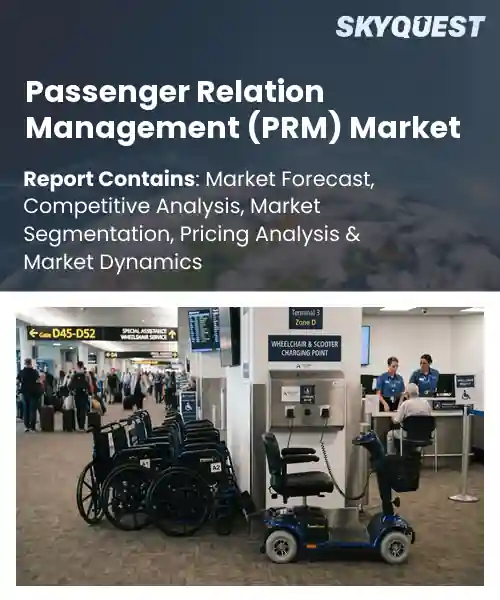
Passenger Relation Management (PRM) Market
Report ID: SQMIG45E3185
Report ID: SQMIG45E3185
[email protected]
USA +1 351-333-4748
Report ID:
SQMIG45E3185 |
Region:
Global |
Published Date: August, 2026
Pages:
157
|Tables:
145
|Figures:
78


Global Passenger Relation Management (Prm) Market size was valued at USD 3.08 Billion in 2024 and is poised to grow from USD 3.4 Billion in 2025 to USD 7.51 Billion by 2033, growing at a CAGR of 10.4% during the forecast period (2026-2033).
The Global Passenger Relation Management (PRM) market encompasses software platforms that unify airline, airport, and ground‑service data to personalize traveler experiences and streamline operational workflows. Its primary driver is the rising demand for seamless, data‑rich customer journeys, a trend amplified by post‑pandemic travel recovery and the proliferation of mobile booking channels. Historically, PRM solutions emerged from legacy reservation systems, evolving through the integration of analytics, AI‑driven personalization, and omnichannel communication. Airlines such as Delta and Emirates have adopted PRM suites to reduce call‑center volume and improve loyalty metrics, illustrating how the market has transitioned from contact‑center tools to revenue‑enhancing ecosystems. An pivotal factor propelling the PRM market forward is the integration of analytics into revenue management, which creates a feedback loop that converts passenger sentiment into pricing strategies. When airlines capture feedback through mobile apps or in‑flight Wi‑Fi, the data feeds predictive models that adjust seat‑allocation and ancillary‑service offers, thereby boosting ancillary revenue and reducing churn. For example, Lufthansa's use of AI‑enhanced PRM to push personalized upgrade offers after a delayed flight has generated an increase in conversion rates. This cause‑and‑effect relationship encourages further investment in open‑API ecosystems, expanding opportunities for third‑party developers and fostering a collaborative, data‑driven travel ecosystem.
How is AI-driven automation reshaping the Passenger Relation Management market?
AI‑driven automation is turning passenger relation management into a real‑time, personalized service engine. Intelligent chatbots handle routine inquiries, freeing staff to focus on complex issues, while predictive analytics anticipate travel disruptions and proactively notify passengers. Integration of voice assistants and sentiment‑analysis tools refines communication tone, creating smoother interactions across channels. These capabilities are reshaping the market by reducing response times, cutting operational costs, and boosting traveler satisfaction, positioning PRM solutions as essential components of modern transit ecosystems.In June 2024, a major PRM provider rolled out an AI‑driven automation suite that streamlines ticketing and passenger communications, accelerating market efficiency.
Market snapshot - (2026-2033)
Global Market Size
USD 3.08 Billion
Largest Segment
Software
Fastest Growth
Services
Growth Rate
10.4% CAGR
To get more insights on this market click here to Request a Free Sample Report
Global passenger relation management (prm) market is segmented by offering, deployment mode, functionality, transportation mode, end user and region. Based on offering, the market is segmented into Software and Services. Based on deployment mode, the market is segmented into Cloud-Based and On-Premises. Based on functionality, the market is segmented into Passenger Information Management, Customer Engagement & Communication, Loyalty & Personalization, Complaint & Feedback Management and Analytics & Reporting. Based on transportation mode, the market is segmented into Airlines, Railways, Public Transit and Cruise & Ferry Operators. Based on end user, the market is segmented into Transportation Operators, Airport & Station Authorities and Travel Service Providers. Based on region, the market is segmented into North America, Europe, Asia Pacific, Latin America and Middle East & Africa.
Software segment dominates because it provides the core digital infrastructure that enables real‑time passenger data capture, personalized communication, and seamless integration with existing operational systems. Its flexibility allows transportation operators to customize workflows, automate routine interactions, and scale functionalities as demand fluctuates. Consequently, providers can deliver end‑to‑end solutions that address both operational efficiency and passenger experience, making software the foundational pillar of the PRM market today globally for all stakeholders.
However, Services segment is witnessing the strongest growth momentum as operators increasingly outsource passenger engagement, analytics, and support functions to specialized providers. This shift is driven by the desire to access expert talent, reduce capital expenditure, and accelerate innovation cycles, thereby expanding market reach and creating new revenue streams for.
Cloud‑Based segment leads because it offers scalable, always‑available infrastructure that eliminates the need for costly on‑site hardware and reduces time‑to‑value for PRM solutions. By leveraging multi‑tenant architectures, providers can deliver frequent updates, integrate emerging data sources, and ensure business continuity through robust disaster recovery. This agility empowers transportation operators to respond swiftly to fluctuating passenger volumes and evolving regulatory requirements across global networks and enhance service reliability for all stakeholders.
Meanwhile, On‑Premises segment is emerging as the key growth area as organizations with stringent data sovereignty and security policies seek dedicated infrastructure. The need for localized control, compliance with regulations, and integration with legacy systems fuels investment, prompting vendors to innovate hybrid models that broaden market adoption and unlock deployment opportunities.
To get detailed segments analysis, Request a Free Sample Report
North America maintains a leadership position in the Passenger Relation Management market due to a confluence of advanced technological infrastructure, mature airline ecosystems, and strong regulatory frameworks that encourage digital customer engagement. The region benefits from high passenger density and a culture of innovation where carriers rapidly adopt AI‑driven analytics, omnichannel communication tools, and personalized service platforms. Robust investment from both private technology firms and airline operators fuels continuous development of integrated PRM solutions. Additionally, partnerships between airlines and technology providers create scalable ecosystems that enhance operational efficiency and elevate the traveler experience, reinforcing the region’s dominance on the global stage. The presence of leading aerospace manufacturers and research institutions further accelerates innovation, while consumer expectations for seamless, real‑time assistance drive airlines to expand PRM capabilities across mobile, web, and in‑flight interfaces.
Passenger Relation Management (PRM) Market in the United States is propelled by a competitive airline landscape that prioritizes customer loyalty through digital platforms. Major carriers invest in AI‑enabled personalization, delivering real‑time assistance across channels. Collaborative ecosystems linking technology startups, data analytics firms, and airport operators foster innovation, while regulatory support encourages seamless data exchange. This focus on enhancing the passenger journey positions the United States as a benchmark for PRM excellence.
Passenger Relation Management (PRM) Market in Canada benefits from a strong emphasis on passenger experience within a regulatory environment that promotes data interoperability. Canadian airlines leverage cloud‑based solutions and multilingual support to accommodate a diverse traveler base. Partnerships with technology incubators and government‑backed innovation programs accelerate the deployment of predictive analytics and proactive service alerts. This collaborative approach reinforces Canada’s reputation for delivering reliable, personalized assistance throughout the travel journey.
Europe’s Passenger Relation Management market is expanding rapidly due to a combination of regulatory harmonization, high traveler expectations, and a vibrant ecosystem of tech innovators. The European Union’s emphasis on passenger rights and data protection creates a supportive framework for airlines to adopt advanced CRM and PRM tools. Airlines across the continent are investing in omnichannel platforms that integrate mobile apps, social media, and in‑flight connectivity, delivering personalized experiences. Collaboration between legacy carriers and startups accelerates the rollout of AI‑driven forecasting and proactive service recovery. Additionally, the focus on sustainability and seamless cross‑border travel encourages the development of unified PRM solutions that cater to a diverse, mobile customer base, propelling market growth throughout the region.
Passenger Relation Management (PRM) Market in Germany is characterized by strong integration of digital ticketing systems and a robust data infrastructure that supports real‑time passenger communication. German carriers prioritize predictive analytics to anticipate traveler needs and streamline service recovery. Collaborative initiatives with technology hubs in Berlin and Munich foster prototyping of AI‑based assistance tools. This focus on efficiency and personalization reinforces Germany’s position as a leading European hub for PRM capabilities.
Passenger Relation Management (PRM) Market in the United Kingdom is accelerating through adoption of cloud‑native platforms that enable seamless multi‑channel engagement. UK airlines leverage open APIs to integrate passenger data across travel partners, enhancing itinerary management and proactive notifications. Collaboration with fintech and mobility startups drives innovative payment and journey‑tracking solutions. The regulatory emphasis on consumer protection and demand for personalized travel experiences position the United Kingdom as a fast‑growing leader in European PRM development.
Passenger Relation Management (PRM) Market in France is emerging as airlines embrace digital concierge services to differentiate the travel experience. French carriers focus on integrating AI‑driven chatbots within mobile applications, providing real‑time assistance in multiple languages. Partnerships with local tech incubators accelerate the development of predictive analytics for flight disruption management. Government initiatives promoting open data and cross‑border collaboration further support the rollout of interoperable PRM platforms, positioning France as a growing contributor to the European market.
The Asia Pacific region is strengthening its position in the Passenger Relation Management market by leveraging rapid digital adoption, extensive mobile penetration, and a cultural emphasis on personalized service. Airlines across Japan and South Korea invest heavily in AI‑enabled chat interfaces and real‑time notification systems that integrate seamlessly with popular messaging platforms. Strong government support for smart transportation initiatives encourages the development of interoperable data standards, facilitating cross‑carrier collaboration. The region’s focus on enhancing the passenger journey through multimodal connectivity, predictive disruption management, and localized language support drives competitive differentiation. Collaborative ecosystems involving telecom operators, technology firms, and airport authorities accelerate innovation, positioning Asia Pacific as an emerging hub for advanced PRM solutions that meet the expectations of a tech‑savvy traveler base.
Passenger Relation Management (PRM) Market in Japan is distinguished by the integration of high‑resolution data analytics with traditional service excellence. Japanese airlines prioritize proactive communication, employing AI‑driven alerts that align with the nation’s punctuality standards. Partnerships with leading robotics and sensor technology firms enable real‑time monitoring of passenger flow within airports, enhancing personalized assistance. Government initiatives promoting a digital society reinforce the adoption of interoperable PRM platforms, positioning Japan as a leader in delivering seamless, tech‑rich travel experiences.
Passenger Relation Management (PRM) Market in South Korea focuses on integrating AI chatbots with social media channels to deliver instant assistance. Korean carriers leverage broadband infrastructure to provide real‑time updates on flight status, gate changes, and localized service offers. Collaboration with fintech startups introduces seamless payment options within PRM platforms, enhancing the travel experience. Government support for smart mobility and open data standards accelerates the creation of interoperable solutions, positioning South Korea as a contributor to the Asia Pacific PRM landscape.
To know more about the market opportunities by region and country, click here to
Buy The Complete Report
Increasing Passenger Personalization Demand
Adoption Of Cloud Based PRM Solutions
Data Privacy Regulations Challenge
High Integration Complexity Limits
Request Free Customization of this report to help us to meet your business objectives.
The competitive landscape in the Passenger Relation Management market is shaped by airlines and technology providers racing to integrate real‑time passenger data, personalize travel experiences, and streamline service recovery. Recent strategies include airlines forming joint ventures with AI‑driven analytics firms to enhance on‑board communication, and major carriers acquiring niche PRM startups to broaden their digital service suites, driving differentiation through seamless omnichannel engagement.
Top Player’s Company Profile
Recent Developments
SkyQuest’s ABIRAW (Advanced Business Intelligence, Research & Analysis Wing) is our Business Information Services team that Collects, Collates, Correlates, and Analyses the Data collected by means of Primary Exploratory Research backed by robust Secondary Desk research. As per SkyQuest analysis, the global Passenger Relation Management market is being propelled primarily by the surge in passenger personalization demand, as airlines seek AI‑driven tools to tailor offers and real‑time assistance, while a second strong catalyst is the rapid adoption of cloud‑based PRM solutions that deliver scalable, low‑cost infrastructure and faster upgrades. However, stringent data‑privacy regulations pose a notable restraint, complicating data sharing and increasing compliance costs. North America remains the dominant region, benefiting from advanced tech ecosystems and high traveler expectations, and the software segment continues to lead the market by providing the core digital platform that underpins real‑time data capture, integration and personalized communication.
| Report Metric | Details |
|---|---|
| Market size value in 2024 | USD 3.08 Billion |
| Market size value in 2033 | USD 7.51 Billion |
| Growth Rate | 10.4% |
| Base year | 2024 |
| Forecast period | (2026-2033) |
| Forecast Unit (Value) | USD Billion |
| Segments covered |
|
| Regions covered | North America (US, Canada), Europe (Germany, France, United Kingdom, Italy, Spain, Rest of Europe), Asia Pacific (China, India, Japan, Rest of Asia-Pacific), Latin America (Brazil, Rest of Latin America), Middle East & Africa (South Africa, GCC Countries, Rest of MEA) |
| Companies covered |
|
| Customization scope | Free report customization with purchase. Customization includes:-
|
To get a free trial access to our platform which is a one stop solution for all your data requirements for quicker decision making. This platform allows you to compare markets, competitors who are prominent in the market, and mega trends that are influencing the dynamics in the market. Also, get access to detailed SkyQuest exclusive matrix.
Table Of Content
Executive Summary
Market overview
Parent Market Analysis
Market overview
Market size
KEY MARKET INSIGHTS
COVID IMPACT
MARKET DYNAMICS & OUTLOOK
Market Size by Region
KEY COMPANY PROFILES
Methodology
For the Passenger Relation Management (PRM) Market, our research methodology involved a mixture of primary and secondary data sources. Key steps involved in the research process are listed below:
1. Information Procurement: This stage involved the procurement of Market data or related information via primary and secondary sources. The various secondary sources used included various company websites, annual reports, trade databases, and paid databases such as Hoover's, Bloomberg Business, Factiva, and Avention. Our team did 45 primary interactions Globally which included several stakeholders such as manufacturers, customers, key opinion leaders, etc. Overall, information procurement was one of the most extensive stages in our research process.
2. Information Analysis: This step involved triangulation of data through bottom-up and top-down approaches to estimate and validate the total size and future estimate of the Passenger Relation Management (PRM) Market.
3. Report Formulation: The final step entailed the placement of data points in appropriate Market spaces in an attempt to deduce viable conclusions.
4. Validation & Publishing: Validation is the most important step in the process. Validation & re-validation via an intricately designed process helped us finalize data points to be used for final calculations. The final Market estimates and forecasts were then aligned and sent to our panel of industry experts for validation of data. Once the validation was done the report was sent to our Quality Assurance team to ensure adherence to style guides, consistency & design.
Analyst Support
Customization Options
With the given market data, our dedicated team of analysts can offer you the following customization options are available for the Passenger Relation Management (PRM) Market:
Product Analysis: Product matrix, which offers a detailed comparison of the product portfolio of companies.
Regional Analysis: Further analysis of the Passenger Relation Management (PRM) Market for additional countries.
Competitive Analysis: Detailed analysis and profiling of additional Market players & comparative analysis of competitive products.
Go to Market Strategy: Find the high-growth channels to invest your marketing efforts and increase your customer base.
Innovation Mapping: Identify racial solutions and innovation, connected to deep ecosystems of innovators, start-ups, academics, and strategic partners.
Category Intelligence: Customized intelligence that is relevant to their supply Markets will enable them to make smarter sourcing decisions and improve their category management.
Public Company Transcript Analysis: To improve the investment performance by generating new alpha and making better-informed decisions.
Social Media Listening: To analyze the conversations and trends happening not just around your brand, but around your industry as a whole, and use those insights to make better Marketing decisions.
REQUEST FOR SAMPLE
 REQUEST FREE CUSTOMIZATION


Want to customize this report? This report can be personalized according to your needs. Our analysts and industry experts will work directly with you to understand your requirements and provide you with customized data in a short amount of time. We offer $1000 worth of FREE customization at the time of purchase.
Feedback From Our Clients


 USA (+1) 351-333-4748

