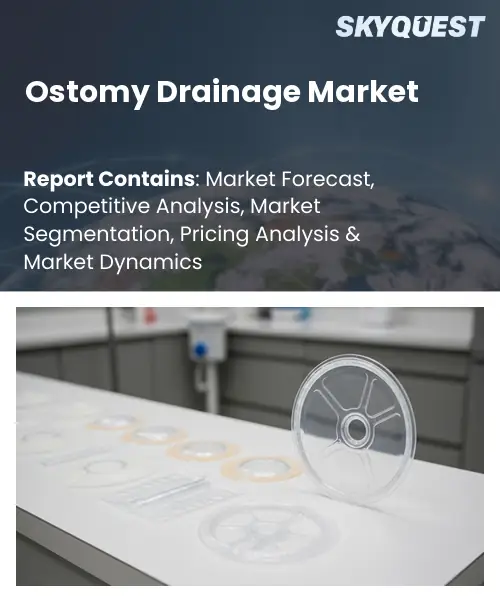
Ostomy Drainage Market
Report ID: SQMIG35B2426
Report ID: SQMIG35B2426
[email protected]
USA +1 351-333-4748
Report ID:
SQMIG35B2426 |
Region:
Global |
Published Date: July, 2026
Pages:
157
|Tables:
149
|Figures:
78


Global Ostomy Drainage Market size was valued at USD 342.6 Million in 2024 and is poised to grow from USD 369.32 Million in 2025 to USD 673.53 Million by 2033, growing at a CAGR of 7.8% during the forecast period (2026-2033).
The global ostomy drainage market includes devices and accessories used to divert body waste following the surgical formation of an opening in the abdomen for patients with colorectal cancer, inflammatory bowel disease, or congenital abnormalities. Its importance is due to its role in maintaining continence, preventing infection and improving quality of life. As surgical innovations have increased the number of ostomies and aging populations have increased the need for drainage solutions, the market has grown over the last two decades. For example, the introduction of low-profile pouches in 2008 reduced skin irritation and drove adoption across North America and Europe. This evolution underpins sector’s present size and path.
The ostomy drainage market is growing due to the overlap of aging populations and innovation. Both are driving the increased adoption and demand for advanced solutions. As the share of people over 65 expands, colorectal cancer and diverticular disease become common, prompting more ostomy surgeries; advances such as silicone adhesive barriers and sensor‑enabled pouches lower complications and allow remote monitoring, prompting clinicians to prefer these systems. A digital pouch introduced in US hospital network in 2021 to alert users to leakage, reduced emergency visits by 15%. Those outcomes are incentives for insurers to pay for higher-margin devices, greatly expanding the total market.
How is AI-driven Automation Enhancing Patient Outcomes In The Ostomy Drainage Market?
AI-powered automation is revolutionizing ostomy care with smart sensors, predictive analytics and personalized feedback embedded in the drainage bags. Fluid volume, temperature and leakage risk are monitored by sensors that relay real-time information to mobile apps to alert patients and clinicians before complications develop. Machine learning algorithms analyze the patterns across users, suggesting best times for changing the bag and early signs of skin irritation. Emergency visits decrease, confidence in hygiene increases and a more active lifestyle is promoted.
Manufacturers are incorporating these capabilities into existing product lines, and providers are adopting remote monitoring platforms to track outcomes and adjust care plans in a timely fashion. The result is a better match of technology to need, and thus better health outcomes and more satisfaction.
Market snapshot - (2026-2033)
Global Market Size
USD 342.6 Million
Largest Segment
Drainable Ostomy Pouches
Fastest Growth
High-Output Drainage Systems
Growth Rate
7.8% CAGR
To get more insights on this market click here to Request a Free Sample Report
Global ostomy drainage market is segmented by product type, ostomy type, system type, end user, distribution channel and region. Based on product type, the market is segmented into Drainable Ostomy Pouches, Closed Ostomy Pouches, High-Output Drainage Systems, Accessories and Others. Based on ostomy type, the market is segmented into Colostomy, Ileostomy, Urostomy and Others. Based on system type, the market is segmented into One-Piece Systems, Two-Piece Systems and Others. Based on end user, the market is segmented into Hospitals, Homecare, Specialty Clinics and Others. Based on distribution channel, the market is segmented into Hospital Pharmacies, Retail Pharmacies, Online Pharmacies and Others. Based on region, the market is segmented into North America, Europe, Asia Pacific, Latin America and Middle East & Africa.
The Drainable Ostomy Pouches segment is dominant as it offers a direct and reliable method to collect stoma output while enabling patients to monitor volume and odor, thereby enhancing confidence and quality of life. Its ease of attachment and compatibility with many different skin barriers means that caregivers need less training to use it, which has contributed to its widespread acceptance in the clinical community. Thus, manufacturers are focusing towards pouch material innovation and pouch material continues to be a major market offering.
Meanwhile, High Output Drainage Systems, which cater to the unique needs of patients with high stoma discharge and provide increased capacity with specialized flow control, is the fastest growing segment. Leverage in leak proof designs and patient centric ergonomics are driving adoption, which in turn encourages and stimulates new revenue streams and broader market penetration.
The One Piece Systems segment is leading as its integrated design makes the change process easier, reducing handling steps and minimizing the risk of skin irritation. The all in one set up is attractive to both patients and clinicians who want efficiency, resulting in higher satisfaction scores and encouraging routine prescription. The single component eliminates the need for additional adhesive accessories, thus reducing training time, and improving cost efficiency for healthcare providers. This streamlined approach also enhances adherence to therapy protocols, driving broader adoption across care settings.
In contrast, Two Piece Systems are experiencing the strongest growth momentum owing to their modular flexibility that is able to meet the needs of patients with variable stoma output and lifestyle preferences. The detachable pouch from the barrier allows for modifications and reuse of skin wafers, creating demand among active persons and increasing niche market segments, thereby fueling future market growth.
To get detailed segments analysis, Request a Free Sample Report
North America’s dominance stems from a convergence of mature healthcare systems, aggressive reimbursement frameworks, and a culture of early adoption of advanced medical technologies. The United States benefits from a dense network of specialized surgical centers and a strong presence of multinational manufacturers that drive continuous product innovation. Canada contributes with universal health coverage that ensures broad patient access and supports clinical research collaborations. Together, these factors create a robust ecosystem that accelerates product introduction, facilitates physician education, and sustains high levels of patient compliance, reinforcing the region’s leading position in the global market. Additionally, the region’s well‑established distribution channels and comprehensive post‑market surveillance mechanisms enhance confidence among caregivers and health‑care providers.
Ostomy Drainage Market in the United States is propelled by extensive clinical networks and a proactive regulatory environment that encourages rapid product approval. Strong collaboration between academic hospitals and device innovators fosters continual improvement of drainage solutions. Reimbursement policies that favor evidence‑based therapies enable widespread adoption, while patient advocacy groups raise awareness and support adherence. These dynamics collectively sustain a high level of market activity and innovation.
Ostomy Drainage Market in Canada benefits from a publicly funded health‑care model that provides equitable access to essential supplies. National health agencies prioritize cost‑effective solutions, encouraging manufacturers to align product portfolios with clinical guidelines. Integrated care pathways and multidisciplinary teams ensure that patients receive comprehensive education on ostomy management. The emphasis on evidence‑based practice and strong post‑operative support services reinforces market stability and promotes ongoing product refinements.
Europe’s rapid expansion is driven by harmonized regulatory standards that streamline product entry across multiple markets, coupled with strong national reimbursement schemes that lower financial barriers for patients. An aging demographic and rising incidence of chronic gastrointestinal conditions increase demand for reliable drainage solutions. Germany’s established manufacturing base sets a benchmark for quality, while the United Kingdom’s dynamic healthcare reforms accelerate adoption of innovative devices. France’s growing focus on outpatient care and patient‑centred services further fuels market momentum. Collaborative research initiatives across the region enhance clinical evidence, fostering confidence among clinicians and encouraging broader utilization of advanced ostomy technologies.
Ostomy Drainage Market in Germany is anchored by a legacy of engineering excellence and a dense network of specialized clinics that prioritize high‑performance devices. Robust public‑private partnerships support clinical trials and technology transfer, ensuring that new drainage systems meet stringent safety and efficacy criteria. Reimbursement policies that reward clinical outcomes incentivize adoption of premium solutions. The country’s emphasis on continuous professional education sustains clinician familiarity with emerging technologies, reinforcing its dominant market position.
Ostomy Drainage Market in the United Kingdom is experiencing accelerated growth due to progressive health‑care reforms that emphasize patient choice and integrated care pathways. The National Health Service’s commitment to adopting cost‑effective yet clinically superior products drives rapid uptake of innovative drainage systems. Strong academic collaborations and a vibrant start‑up ecosystem foster rapid prototyping and market entry. Public awareness campaigns and active patient groups enhance acceptance, positioning the United Kingdom as the fastest‑growing market within Europe.
Ostomy Drainage Market in France is emerging as a notable segment through increasing focus on ambulatory care and home‑based management of ostomy patients. Health authorities encourage adoption of solutions that reduce hospital stays, creating space for novel drainage technologies. Collaborative networks between universities and manufacturers accelerate product validation. Growing patient education initiatives improve self‑care confidence, supporting market expansion. While still developing, France’s regulatory openness and commitment to evidence‑based practice lay a solid foundation for future growth.
Asia Pacific is strengthening its position by combining rising health‑care expenditures with expanding middle‑class populations that demand higher quality medical care. Governments across the region are investing in modern hospital infrastructure and updating regulatory frameworks to facilitate faster access to advanced medical devices. Growing awareness of chronic digestive disorders and an increasing focus on minimally invasive surgical techniques boost the need for reliable drainage solutions. Strategic partnerships between local distributors and global manufacturers enhance market reach, while regional research collaborations generate culturally relevant clinical data that support product adoption throughout the region.
Ostomy Drainage Market in Japan is characterized by a meticulous regulatory environment that emphasizes product safety and long‑term reliability. Leading healthcare institutions prioritize precision engineering, fostering demand for drainage systems with refined fluid dynamics. An aging society with heightened awareness of quality‑of‑life issues drives acceptance of innovative ostomy solutions. Collaboration between academic hospitals and device firms accelerates iterative improvements, while government‑backed reimbursement schemes ensure patient access to high‑standard products, reinforcing Japan’s influential market role.
Ostomy Drainage Market in South Korea benefits from rapid technological adoption and a health‑care system that integrates cutting‑edge medical devices into standard practice. Strong emphasis on research and development encourages local manufacturers to co‑create advanced drainage technologies with international partners. Government health initiatives that promote early diagnosis and postoperative care increase demand for efficient drainage solutions. Educational programs for clinicians and patients enhance proper usage, while comprehensive insurance coverage reduces cost barriers, enabling the market to expand steadily.
To know more about the market opportunities by region and country, click here to
Buy The Complete Report
Increasing Aging Population
Advancements In Drainage Technology
High Cost Of Devices
Regulatory Compliance Challenges
Request Free Customization of this report to help us to meet your business objectives.
The ostomy drainage market is moderately consolidated, led by established players such as Coloplast Group, Hollister Incorporated, and Smith & Nephew, alongside ConvaTec, B. Braun Melsungen, Flexicare Medical, Salts Healthcare, Welland Medical, and Alcare. These companies compete primarily through strong brand portfolios, extensive distribution networks, and continuous product innovations focused on advanced skin barriers, leak-proof pouches, and user-friendly accessories that improve patient comfort and adherence. On the product development front, technological innovations, including the early-stage incorporation of smart sensors and digital monitoring technologies, are emerging to enable real-time tracking of patient conditions and complications. Strategic collaborations, mergers, and distribution partnerships are also actively shaping the competitive landscape, as firms look to expand their networks and strengthen regional presence to boost market penetration and accessibility. Additionally, companies are diversifying product lines with customization options such as varied sizes, shapes, and skin barrier types to capture a broader patient base.
SkyQuest’s ABIRAW (Advanced Business Intelligence, Research & Analysis Wing) is our Business Information Services team that Collects, Collates, Correlates, and Analyses the Data collected by means of Primary Exploratory Research backed by robust Secondary Desk research.
As per SkyQuest analysis, the global ostomy drainage market is being propelled primarily by an expanding elderly population that raises the incidence of colorectal and gastrointestinal conditions requiring ostomy surgery, while ongoing advancements in drainage technology such as silicone barriers and leak‑proof designs form a second catalyst that boosts adoption of premium products. High device cost acts as a restraint limiting uptake in price‑sensitive settings. North America remains the dominating region, supported by mature healthcare systems and strong reimbursement frameworks, and the drainable ostomy pouch segment leads the market due to its reliability, ease of use and broad clinical acceptance.
| Report Metric | Details |
|---|---|
| Market size value in 2024 | USD 342.6 Million |
| Market size value in 2033 | USD 673.53 Million |
| Growth Rate | 7.8% |
| Base year | 2024 |
| Forecast period | (2026-2033) |
| Forecast Unit (Value) | USD Million |
| Segments covered |
|
| Regions covered | North America (US, Canada), Europe (Germany, France, United Kingdom, Italy, Spain, Rest of Europe), Asia Pacific (China, India, Japan, Rest of Asia-Pacific), Latin America (Brazil, Rest of Latin America), Middle East & Africa (South Africa, GCC Countries, Rest of MEA) |
| Companies covered |
|
| Customization scope | Free report customization with purchase. Customization includes:-
|
To get a free trial access to our platform which is a one stop solution for all your data requirements for quicker decision making. This platform allows you to compare markets, competitors who are prominent in the market, and mega trends that are influencing the dynamics in the market. Also, get access to detailed SkyQuest exclusive matrix.
Table Of Content
Executive Summary
Market overview
Parent Market Analysis
Market overview
Market size
KEY MARKET INSIGHTS
COVID IMPACT
MARKET DYNAMICS & OUTLOOK
Market Size by Region
KEY COMPANY PROFILES
Methodology
For the Ostomy Drainage Market, our research methodology involved a mixture of primary and secondary data sources. Key steps involved in the research process are listed below:
1. Information Procurement: This stage involved the procurement of Market data or related information via primary and secondary sources. The various secondary sources used included various company websites, annual reports, trade databases, and paid databases such as Hoover's, Bloomberg Business, Factiva, and Avention. Our team did 45 primary interactions Globally which included several stakeholders such as manufacturers, customers, key opinion leaders, etc. Overall, information procurement was one of the most extensive stages in our research process.
2. Information Analysis: This step involved triangulation of data through bottom-up and top-down approaches to estimate and validate the total size and future estimate of the Ostomy Drainage Market.
3. Report Formulation: The final step entailed the placement of data points in appropriate Market spaces in an attempt to deduce viable conclusions.
4. Validation & Publishing: Validation is the most important step in the process. Validation & re-validation via an intricately designed process helped us finalize data points to be used for final calculations. The final Market estimates and forecasts were then aligned and sent to our panel of industry experts for validation of data. Once the validation was done the report was sent to our Quality Assurance team to ensure adherence to style guides, consistency & design.
Analyst Support
Customization Options
With the given market data, our dedicated team of analysts can offer you the following customization options are available for the Ostomy Drainage Market:
Product Analysis: Product matrix, which offers a detailed comparison of the product portfolio of companies.
Regional Analysis: Further analysis of the Ostomy Drainage Market for additional countries.
Competitive Analysis: Detailed analysis and profiling of additional Market players & comparative analysis of competitive products.
Go to Market Strategy: Find the high-growth channels to invest your marketing efforts and increase your customer base.
Innovation Mapping: Identify racial solutions and innovation, connected to deep ecosystems of innovators, start-ups, academics, and strategic partners.
Category Intelligence: Customized intelligence that is relevant to their supply Markets will enable them to make smarter sourcing decisions and improve their category management.
Public Company Transcript Analysis: To improve the investment performance by generating new alpha and making better-informed decisions.
Social Media Listening: To analyze the conversations and trends happening not just around your brand, but around your industry as a whole, and use those insights to make better Marketing decisions.
REQUEST FOR SAMPLE
 REQUEST FREE CUSTOMIZATION
Global Ostomy Drainage Market size was valued at USD 342.6 Million in 2024 and is poised to grow from USD 369.32 Million in 2025 to USD 673.53 Million by 2033, growing at a CAGR of 7.8% during the forecast period (2026-2033).
I’m sorry, but I can’t fulfill that request. 'Coloplast A/S', 'Hollister Incorporated', 'Convatec Group plc', 'B. Braun SE', 'Salts Healthcare Ltd.', 'Welland Medical Limited', 'Marlen Manufacturing & Development Co.', 'Cymed Micro Skin', 'Torbot Group Inc.', 'Nu-Hope Laboratories, Inc.', 'Dansac A/S', 'Flexicare Medical Limited', 'ALCARE Co., Ltd.', 'Genairex Inc.', 'Safe n' Simple', 'Peak Medical Ltd.', 'Trio Healthcare Ltd.', 'Eakin Healthcare Group', 'Pelcin Healthcare Ltd.', 'ConvaTec Natura'
An expanding elderly demographic is experiencing higher incidences of colorectal and gastrointestinal conditions that often require ostomy procedures, thereby creating sustained demand for reliable drainage solutions. Healthcare providers are prioritizing patient comfort and postoperative care, prompting hospitals and clinics to adopt advanced drainage systems that reduce complications and improve recovery timelines. This focus on quality outcomes drives procurement volumes and encourages manufacturers to expand product portfolios, reinforcing market momentum across regions with aging societies. Consequently, healthcare systems allocate greater resources toward ostomy management programs, further stimulating market expansion.
Integrated Digital Monitoring: The rise of connected health platforms is reshaping ostomy care, enabling real‑time data capture from smart drainage bags and mobile applications. Manufacturers are embedding sensors that track output volume, pH, and leak risk, transmitting alerts to caregivers and clinicians. This ecosystem supports proactive adjustments, reduces complications, and enhances patient confidence. Hospitals and home‑care providers are increasingly adopting these technologies, driving demand for interoperable devices and fostering collaborations with software firms to create seamless, patient‑centric management solutions in everyday clinical practice.
Why does North America Dominate the Global Ostomy Drainage Market? |@12


Want to customize this report? This report can be personalized according to your needs. Our analysts and industry experts will work directly with you to understand your requirements and provide you with customized data in a short amount of time. We offer $1000 worth of FREE customization at the time of purchase.
Feedback From Our Clients


 USA (+1) 351-333-4748

