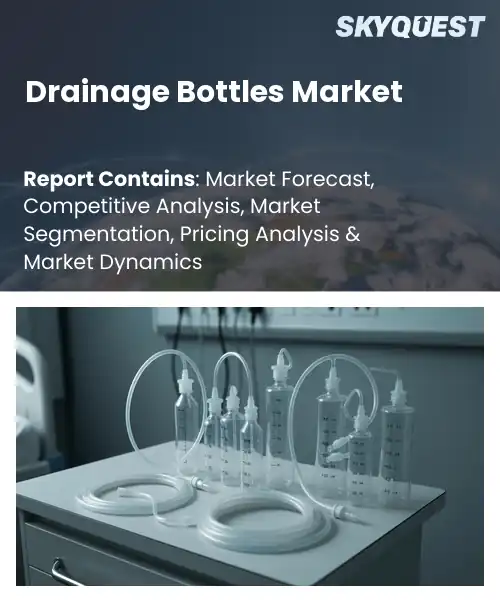
Drainage Bottles Market
Report ID: SQMIG35A3623
Report ID: SQMIG35A3623
[email protected]
USA +1 351-333-4748
Report ID:
SQMIG35A3623 |
Region:
Global |
Published Date: June, 2026
Pages:
157
|Tables:
176
|Figures:
79


Global Drainage Bottles Market size was valued at USD 423.6 Million in 2024 and is poised to grow from USD 448.17 Million in 2025 to USD 703.6 Million by 2033, growing at a CAGR of 5.8% during the forecast period (2026-2033).
Due to the continued increase in the amount of surgery being performed and infections being controlled more effectively, the drainage bottles market in healthcare procurement has become critically important. Closed suction drainage bottles help collect bodily fluids that are produced after surgical procedures or during wound care and therefore impact significantly on patient recovery time and infection rates in patients that develop infections after having been discharged from the hospital.
The drainage bottles market has transitioned from glass, which are reusable to disposable standards and are primarily made from polymer; a prime example being the evolution of the Jackson Pratt bulb into the new technology of integrated closed suction canisters. The evolution of the drainage bottle industry has also been influenced by stricter regulations and the growing use of outpatient procedures globally throughout developed and developing countries. A major influence on the global drainage bottles market displacing reusable closed systems with single-use closed systems at the hospitals is the need for infection control. As the focus of hospitals' procurement policies shifts toward disposable products, manufacturers respond by increasing the scale of production and investing into new materials and processes giving rise to new technologies such as biodegradable plastic polymers and integrated flow sensors that provide monitoring of drainage volumes.
In addition to the overall transition from reusable to single-use closed systems, many of the established post-surgical protocols that are utilized in orthopedic and cardiothoracic surgery now include disposal closed canisters as a method to reduce surgical site infections or seromas; consequently decreasing readmissions or length of stay in the hospital. That cascade creates opportunities in regional manufacturing, value-based procurement, and bundled device-plus-service offerings.
How is IoT Enhancing Supply Chain Visibility In The Drainage Bottles Market?
The Internet of Things (IoT) is enhancing the practicality and accessibility of supply chain visibility in the drainage bottle (DB) market by linking devices and packaging to logistics and clinical systems. Key elements of this development involve item level tracking of product movement through distribution systems, condition monitoring for maintaining sterility during product transport, and usage telemetry that provides real-time reports of consumption rates at point of care facilities. Hospitals and manufacturers in the drainage bottle and related markets are experiencing a market shift toward connected disposable products (CDPs) and digital drainage systems (DDS) that provide inventory management and quality metrics to manufacturers and hospitals. The end result of this is a more efficient process for replacing products in inventory, quicker response time to product recalls, and improved demand forecasting capabilities by utilizing the regulated medical supply chain system.
As noted in the case of Medela in February 2026, the award of the Vizient contract for the Thopaz plus digital chest drainage device illustrates the advancement towards using connected drainage devices in supply chains. Enabled by the connectivity of these devices, information about both the use and status of the devices as they relate to supply chain management has been transformed into intelligence that enhances procurement efficiency and fosters continued growth of the drainage bottle market.
Market snapshot - (2026-2033)
Global Market Size
USD 423.6 Million
Largest Segment
Surgical Drainage Bottles
Fastest Growth
Vacuum Drainage Bottles
Growth Rate
5.8% CAGR
To get more insights on this market click here to Request a Free Sample Report
Global drainage bottles market is segmented by product type, capacity, application, usage type, end user, material type and region. Based on product type, the market is segmented into Chest Drainage Bottles, Wound Drainage Bottles, Surgical Drainage Bottles, Vacuum Drainage Bottles and Others. Based on capacity, the market is segmented into Below 500 mL, 500–1,000 mL and Above 1,000 mL. Based on application, the market is segmented into Thoracic Surgery, General Surgery, Orthopedic Surgery, Cardiovascular Surgery and Others. Based on usage type, the market is segmented into Disposable Drainage Bottles and Reusable Drainage Bottles. Based on end user, the market is segmented into Hospitals, Ambulatory Surgical Centers, Specialty Clinics and Homecare Settings. Based on material type, the market is segmented into Plastic and Glass. Based on region, the market is segmented into North America, Europe, Asia Pacific, Latin America and Middle East & Africa.
As per drainage bottles market analysis, Chest Drainage Bottles are the most dominant product category because they provide solutions to essential and important postoperative thoracic problems, such as effective evacuating of air and fluid, which reduces respiratory complications. Their standardized product design and established, credible clinical results lead to clinician preference and hospital buying decisions. Additionally, they are compatible with the most common suction systems and have full recognition by regulatory agencies, which leads to improved operational efficiencies and minimizes risk associated with procedures, thus reinforcing their primary role in clinical pathways.
As per drainage bottles market forecast, Wound Drainage Bottles are becoming the fastest growing product category due to the high demand for successful fluid management of complex wound care and the rise in outpatient procedures. The innovation of low-profile, user-friendly products and the growing use of wound drainage systems in ambulatory and home environments is increasing the need for these products, creating new product evaluation opportunities and expanding the addressable market for these products beyond inpatient usage.
The Reusable Drainage Bottles product group continues to grow quickly as healthcare providers look for ways to manage their overall costs and reduce waste. Durable, sterilizable products that fit into existing sterilization workflows enable healthcare providers to be cost-effective while using high volumes of Reusable Drainage Bottles; additionally, the use of established cleaning processes and the long-term purchasing relationships with suppliers provides further support for Reusable Drainage Bottles by reinforcing institutional preferences and operational consistency in the surgical department.
As per drainage bottles market outlook, Disposable Drainage Bottles will grow more quickly due to the rapidly increasing number of healthcare systems adopting single-use products due to the prevalence of infection control and convenience considerations across all healthcare sectors. Advancements in lightweight material applications and sterile packaging techniques along with a growing demand for Disposable Drainage Bottles within both ambulatory care and homecare markets is leading to increased product innovation and broadened product distribution resulting in both greater market accessibility and new revenue streams to manufacturers specializing in disposable Drainage Bottles based on their convenience and safety characteristics.
To get detailed segments analysis, Request a Free Sample Report
North America dominates the global market with its advanced healthcare infrastructure, concentrated purchasing power and an established regulatory climate, which encourages rapid commercialization of medical disposables. In addition to robust regulatory support for rapid commercialization, large hospital networks and integrated health systems also establish standards for procurement of all medical supplies. The development of a mature medical device industry ensures that there is continuous product innovation and a robust supply chain for newly developed products. Furthermore, the clinical focus on preventing infections and ensuring the safety of patients has created a trend toward using single-use and high-quality drainage products. The development of strong relationships between manufacturers and providers, as well as extensive post-market support and clinician training programs, have created strong market penetration. Furthermore, the existence of centralized distribution channels and an environment that favors reimbursement will result in continued broad adoption of products in both the acute care and ambulatory care settings, thus solidifying the existing regional leadership and attracting further investment in the development of new products.
The Drainage Bottles Market in the United States has unique features due to the sophisticated hospital purchasing habits and also because of clinician expectations with respect to results and safety. Major regional health systems as well as other major hospital centers exhibit an early adopter mentality towards new products and therefore often set the standard for new products and best practices in the hospital setting. The availability of a strong domestic medical device manufacturing industry allows for fast tracking of innovation while the quality of distribution and vendor supported services make it easy for hospitals to get the product regardless of their current location. Infection prevention along with the continued engagement of clinicians will keep up demand for new drainage products and ultimately ensure their success in the market.
The Drainage Bottles Market in Canada exhibits all of the same characteristics that are seen in the United States. The majority of hospitals in Canada purchase products that are available through the regional provincial health centre procurement processes. In Canada, the majority of hospitals and community service providers utilize products that match national quality standards for use and are developed to minimize the risk of patients contracting an infection. The establishment of cooperative working relationships between suppliers and clinical leaders strongly supports training and evidence based adoption of products by clinicians. A strong emphasis on maintaining durable supply chains and offering extensive post market support along with relatively slow acceptance of new technologies has contributed toward a marketplace that is oriented towards reliability, quality and regulatory compliance.
Rapid expansion in Europe is driven by harmonized regulatory frameworks, strong hospital procurement networks, and growing clinical emphasis on infection control and patient safety. Countries with advanced manufacturing capability and clinical research ecosystems support accelerated product introduction and clinician training. Cross border collaboration among health systems and centralized tendering processes enable efficient distribution and scale. The shift toward outpatient surgery and enhanced recovery pathways increases demand for convenient, reliable drainage solutions. In addition, sustainability considerations and interest in lifecycle cost assessments are influencing product selection. Growing partnerships between local manufacturers and multinational firms further strengthen market capacity and facilitate technology transfer, positioning the region as both a major user and innovator in drainage bottle technologies.
Drainage Bottles Market in Germany is anchored by strong medical manufacturing expertise and established hospital procurement networks. Clinical institutions in Germany maintain high expectations for device quality and regulatory compliance, driving supplier investment in innovation and testing. Local production capabilities and export orientation support a competitive supplier base, while clinical societies and hospital networks influence adoption through guidelines and training initiatives. Emphasis on engineering precision and process reliability guides purchasing decisions toward proven, high performance drainage solutions.
Drainage Bottles Market in United Kingdom is experiencing rapid uptake driven by large scale procurement frameworks and a strong focus on patient safety and infection prevention. Healthcare providers actively evaluate devices for clinical effectiveness and cost efficiency, creating opportunities for innovative solutions that demonstrate clear value. Collaboration between suppliers and clinical leaders, alongside pilot programs in acute and community settings, accelerates adoption. Emphasis on standardized protocols and training supports consistent use and integration within care pathways.
Drainage Bottles Market in France is emerging through modernization of hospital infrastructure and growing attention to device standardization and clinical outcomes. Healthcare purchasers increasingly seek solutions that balance performance with cost and environmental considerations. Local manufacturers and distributors are expanding partnerships with clinical centers to support evaluation and training. Focused efforts on improving postoperative care pathways and infection control are encouraging gradual uptake of advanced drainage products across both public and private care providers.
Asia Pacific is strengthening its market position through expanding healthcare infrastructure, growing local manufacturing capacity, and strategic collaborations with global device firms. Regional healthcare systems are investing in modern facility upgrades and clinical training, increasing demand for reliable drainage solutions. Domestic manufacturers are scaling production while aligning with international quality standards, enabling competitive pricing and broader geographic reach. Regulatory frameworks are evolving to facilitate market entry while maintaining safety oversight. Technology transfer and joint ventures accelerate innovation, and a focus on cost effective, user friendly designs meets the needs of diverse care settings. These dynamics, combined with targeted export strategies, are elevating the region from a cost base to a source of innovation and supply.
Drainage Bottles Market in Japan emphasizes high quality standards and rigorous regulatory assessment, shaping a preference for reliable, finely engineered products. Hospitals and specialist clinics prioritize devices that integrate smoothly with clinical workflows and support patient safety initiatives. Domestic manufacturers maintain strong reputation for precision and consistent performance, while collaboration with clinical researchers fosters incremental innovation. Conservative procurement practices favor long term reliability and proven outcomes, ensuring steady demand for premium drainage solutions.
Drainage Bottles Market in South Korea benefits from agile manufacturing and close collaboration between industry and clinical stakeholders. Rapid adoption of new devices is supported by active clinical evaluation and efficient supply chains. Local companies emphasize design driven value and export competitiveness, while hospitals seek solutions that balance performance with cost efficiency. Government and industry initiatives to promote medtech innovation further reinforce capacity to scale production and introduce advanced drainage products across regional and global markets.
To know more about the market opportunities by region and country, click here to
Buy The Complete Report
Increasing Demand For Single Use Bottles
Advances In Material Science
Stringent Regulatory Compliance Requirements
Limited Recycling Infrastructure Availability
Request Free Customization of this report to help us to meet your business objectives.
Competitive dynamics in the global drainage bottles market center on consolidation, tech driven differentiation, and commercial partnerships. Acquisitions and rollups such as Lion Street Medical acquiring Pensar Medical have reshaped supplier mixes, while strategic supply contracts and distribution deals accelerate hospital adoption. Innovation examples include implantable continuous effusion shunts from Pleural Dynamics and handheld digital pumps like Bearpac Passio, both changing outpatient care models.
SkyQuest’s ABIRAW (Advanced Business Intelligence, Research & Analysis Wing) is our Business Information Services team that Collects, Collates, Correlates, and Analyses the Data collected by means of Primary Exploratory Research backed by robust Secondary Desk research.
As per SkyQuest analysis, a key driver of the global drainage bottles market is rising surgical volumes and heightened infection control priorities that favor closed, single-use systems, and a second driver is advances in material science enabling lighter, more durable disposable designs. A major restraint remains stringent and variable regulatory compliance that slows product launches and complicates global rollouts. North America remains the dominating region due to advanced healthcare infrastructure and consolidated procurement. The chest drainage bottles segment is the dominating product category because of its critical role in thoracic postoperative care. Manufacturers prioritizing sustainability and connectivity are best positioned for growth.
| Report Metric | Details |
|---|---|
| Market size value in 2024 | USD 423.6 Million |
| Market size value in 2033 | USD 703.6 Million |
| Growth Rate | 5.8% |
| Base year | 2024 |
| Forecast period | (2026-2033) |
| Forecast Unit (Value) | USD Million |
| Segments covered |
|
| Regions covered | North America (US, Canada), Europe (Germany, France, United Kingdom, Italy, Spain, Rest of Europe), Asia Pacific (China, India, Japan, Rest of Asia-Pacific), Latin America (Brazil, Rest of Latin America), Middle East & Africa (South Africa, GCC Countries, Rest of MEA) |
| Companies covered |
|
| Customization scope | Free report customization with purchase. Customization includes:-
|
To get a free trial access to our platform which is a one stop solution for all your data requirements for quicker decision making. This platform allows you to compare markets, competitors who are prominent in the market, and mega trends that are influencing the dynamics in the market. Also, get access to detailed SkyQuest exclusive matrix.
Table Of Content
Executive Summary
Market overview
Parent Market Analysis
Market overview
Market size
KEY MARKET INSIGHTS
COVID IMPACT
MARKET DYNAMICS & OUTLOOK
Market Size by Region
KEY COMPANY PROFILES
Methodology
For the Drainage Bottles Market, our research methodology involved a mixture of primary and secondary data sources. Key steps involved in the research process are listed below:
1. Information Procurement: This stage involved the procurement of Market data or related information via primary and secondary sources. The various secondary sources used included various company websites, annual reports, trade databases, and paid databases such as Hoover's, Bloomberg Business, Factiva, and Avention. Our team did 45 primary interactions Globally which included several stakeholders such as manufacturers, customers, key opinion leaders, etc. Overall, information procurement was one of the most extensive stages in our research process.
2. Information Analysis: This step involved triangulation of data through bottom-up and top-down approaches to estimate and validate the total size and future estimate of the Drainage Bottles Market.
3. Report Formulation: The final step entailed the placement of data points in appropriate Market spaces in an attempt to deduce viable conclusions.
4. Validation & Publishing: Validation is the most important step in the process. Validation & re-validation via an intricately designed process helped us finalize data points to be used for final calculations. The final Market estimates and forecasts were then aligned and sent to our panel of industry experts for validation of data. Once the validation was done the report was sent to our Quality Assurance team to ensure adherence to style guides, consistency & design.
Analyst Support
Customization Options
With the given market data, our dedicated team of analysts can offer you the following customization options are available for the Drainage Bottles Market:
Product Analysis: Product matrix, which offers a detailed comparison of the product portfolio of companies.
Regional Analysis: Further analysis of the Drainage Bottles Market for additional countries.
Competitive Analysis: Detailed analysis and profiling of additional Market players & comparative analysis of competitive products.
Go to Market Strategy: Find the high-growth channels to invest your marketing efforts and increase your customer base.
Innovation Mapping: Identify racial solutions and innovation, connected to deep ecosystems of innovators, start-ups, academics, and strategic partners.
Category Intelligence: Customized intelligence that is relevant to their supply Markets will enable them to make smarter sourcing decisions and improve their category management.
Public Company Transcript Analysis: To improve the investment performance by generating new alpha and making better-informed decisions.
Social Media Listening: To analyze the conversations and trends happening not just around your brand, but around your industry as a whole, and use those insights to make better Marketing decisions.
REQUEST FOR SAMPLE
 REQUEST FREE CUSTOMIZATION
Global Drainage Bottles Market size was valued at USD 423.6 Million in 2024 and is poised to grow from USD 448.17 Million in 2025 to USD 703.6 Million by 2033, growing at a CAGR of 5.8% during the forecast period (2026-2033).
Competitive dynamics in the global drainage bottles market center on consolidation, tech driven differentiation, and commercial partnerships. Acquisitions and rollups such as Lion Street Medical acquiring Pensar Medical have reshaped supplier mixes, while strategic supply contracts and distribution deals accelerate hospital adoption. Innovation examples include implantable continuous effusion shunts from Pleural Dynamics and handheld digital pumps like Bearpac Passio, both changing outpatient care models. 'Teleflex Incorporated', 'Getinge', 'Medela', 'Rocket Medical', 'Redax', 'ICU Medical', 'Cardinal Health', 'Cook Medical', 'Romsons', 'B. Braun Melsungen', 'Argon Medical Devices', 'Merit Medical Systems', 'Vygon', 'Fuji Systems Corporation', 'Grena', 'LivaNova', 'Poly Medicure', 'Pacific Hospital Supply', 'Bıçakcılar', 'Dispomedica GmbH'
Hospitals, clinics, and home healthcare providers increasingly favor single use drainage bottles because they reduce the risk of cross contamination and simplify infection control practices, creating stronger procurement preference for disposable options. The perceived convenience for staff and patients, simplified post procedure handling, and reduced need for reprocessing drive institutional adoption. Manufacturers respond with packaging and distribution models that support rapid replacement and consistent supply. This alignment between clinical priorities and supplier capabilities supports steady market expansion through broader acceptance and routine incorporation into care pathways.
Sustainable Product Innovation: Manufacturers are focusing on eco-friendly materials and reusable designs to meet growing environmental expectations and reduce lifecycle impact. Product development emphasizes compatibility with existing equipment, improved sealing and durability, and easier end-user handling to enhance perceived value. Innovation also targets compact, modular formats and tube or cartridge options that reduce waste and storage burdens. Collaboration with service providers and original equipment manufacturers accelerates market adoption, positioning companies that prioritize sustainability and convenience to capture stakeholder preference and strengthen brand differentiation.
Why does North America Dominate the Global Drainage Bottles Market? |@12


Want to customize this report? This report can be personalized according to your needs. Our analysts and industry experts will work directly with you to understand your requirements and provide you with customized data in a short amount of time. We offer $1000 worth of FREE customization at the time of purchase.
Feedback From Our Clients


 USA (+1) 351-333-4748

