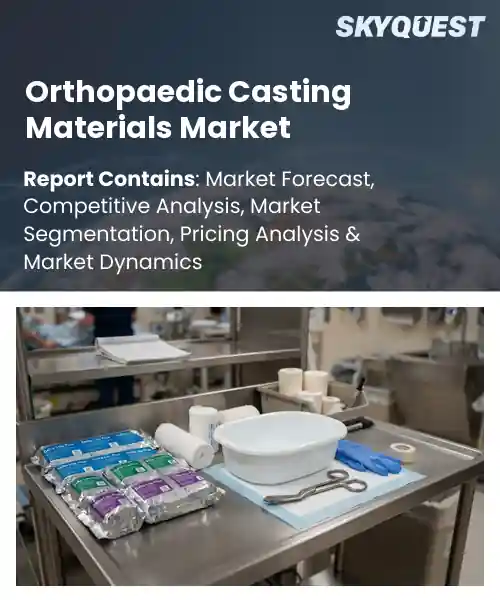
Orthopaedic Casting Materials Market
Report ID: SQMIG35B2507
Report ID: SQMIG35B2507
[email protected]
USA +1 351-333-4748
Report ID:
SQMIG35B2507 |
Region:
Global |
Published Date: August, 2026
Pages:
157
|Tables:
144
|Figures:
78


Global Orthopaedic Casting Materials Market size was valued at USD 184.8 Million in 2024 and is poised to grow from USD 196.44 Million in 2025 to USD 320.26 Million by 2033, growing at a CAGR of 6.3% during the forecast period (2026-2033).
The global orthopaedic casting materials market comprises polymers, plaster, and composite systems used to immobilize fractures and support musculoskeletal healing. Its significance stems from the essential role casts play in reducing morbidity and enabling early rehabilitation across hospitals, outpatient clinics, and sports medicine facilities. Historically, plaster‑of‑Paris dominated until the late 1990s when lightweight fiberglass and thermoplastic options emerged, driven by demands for faster drying times and increased patient comfort. For example, a 2005 study showed fiberglass reduced immobilization time by 30 percent compared with traditional plaster, prompting manufacturers to expand production capacity and invest in advanced fiber reinforcement technologies globally. Rising demand for minimally invasive orthopaedic procedures fuels the market by encouraging casting systems that are strong and breathable. When surgeons employ percutaneous fixation, patients need semi‑rigid immobilisation that guards hardware while allowing joint movement, prompting hospitals to swap bulky plaster for thermoplastic or silicone‑based liners that can be trimmed on site. Suppliers respond by developing digital printing of patient‑specific casts, illustrated by a 2022 partnership between a material producer and a imaging firm that cut fabrication time from days to hours. These innovations raise manufacturer margins and create export avenues in emerging regions where orthopaedic trauma rates are climbing.
How is AI-driven automation reshaping the orthopaedic casting materials market?
AI-driven automation is redefining how orthopaedic casting materials are designed, produced, and applied. Machine‑learning algorithms analyze patient anatomy to suggest optimal cast geometry, reducing trial‑and‑error in fitting. Robotics streamline the mixing and molding of cement and padding, ensuring consistent quality and faster turnaround. Real‑time sensors embedded in casts feed data back to AI platforms, enabling predictive adjustments that improve comfort and healing outcomes. These capabilities are attracting manufacturers seeking to differentiate their product lines and clinicians looking for more efficient workflows, thereby accelerating market adoption. The shift also lowers material waste and shortens supply chains, making the sector more resilient.In June 2024, a major orthopaedic casting supplier announced an AI‑controlled production line that customizes cast padding on demand, cutting lead times and supporting the market’s growth by delivering tailored solutions faster. The system integrates imaging data and predictive analytics to adjust material composition in real time, enhancing patient comfort and reducing revision rates.
Market snapshot - (2026-2033)
Global Market Size
USD 184.8 Million
Largest Segment
Fiberglass
Fastest Growth
Synthetic Casting Materials
Growth Rate
6.3% CAGR
To get more insights on this market click here to Request a Free Sample Report
Global orthopaedic casting materials market is segmented by material type, product type, application, end user, patient type and region. Based on material type, the market is segmented into Plaster of Paris, Fiberglass, Polyester and Synthetic Casting Materials. Based on product type, the market is segmented into Casting Rolls, Casting Splints and Casting Tapes. Based on application, the market is segmented into Fracture Management, Orthopedic Surgery and Sports Injury Management. Based on end user, the market is segmented into Hospitals, Orthopedic Clinics and Ambulatory Surgical Centers. Based on patient type, the market is segmented into Adult and Pediatric. Based on region, the market is segmented into North America, Europe, Asia Pacific, Latin America and Middle East & Africa.
Plaster of Paris segment dominates because it has long been the traditional choice for clinicians seeking reliable immobilization. Its ease of manipulation, rapid setting, and familiar handling characteristics foster confidence across a wide range of injuries. The material’s inherent affordability and compatibility with standard hospital supplies further reinforce its preferential use. These attributes collectively sustain its preeminent position within the orthopaedic casting materials market for orthopedic care teams throughout the industry.
However, Fiberglass segment is witnessing rapid growth as clinicians favor lightweight durability. Its high strength to weight ratio and moisture resistance allow comfortable patient mobility while preserving immobilization integrity. Emerging material advances broaden its use for complex fractures, and its compatibility with modern splinting techniques encourages wider adoption, fueling future market expansion.
Fracture Management segment dominates because it underpins the core clinical need for immobilization across the majority of orthopedic cases. The prevalence of acute bone injuries and the reliance on definitive casting for stabilization create sustained demand. Clinicians prioritize proven reliability, ease of application, and predictable healing outcomes, reinforcing the central role of casting solutions. Consequently, this segment anchors market volume and directs product development priorities within the industry for long term.
Meanwhile, Sports Injury Management segment is emerging as the fastest growing area as active lifestyles increase demand for rapid return to function. Innovative casting materials that combine flexibility with support enable clinicians to address ligament and tendon injuries effectively. This expanding application scope stimulates product innovation and accelerates market expansion.
To get detailed segments analysis, Request a Free Sample Report
North America’s dominance stems from a confluence of advanced healthcare infrastructure, deep research and development capabilities, and a well‑established supply chain that supports rapid innovation. Leading manufacturers headquartered in the region invest heavily in next‑generation casting technologies, fostering early adoption across hospital systems and specialty clinics. Reimbursement frameworks encourage the use of high‑performance materials, while a skilled clinical workforce drives preference for products that improve patient outcomes. Collaborative networks among academic institutions, regulatory bodies, and industry accelerate product validation, reinforcing a cycle of continuous improvement and market leadership that sustains North America’s pre‑eminent position.
Orthopaedic Casting Materials Market in the United States benefits from extensive research ecosystems and a dense network of specialty providers that prioritize cutting‑edge solutions. Domestic manufacturers leverage sophisticated production facilities to deliver high‑quality composites and thermoplastic systems. Strong collaboration between clinical institutions and suppliers accelerates product refinement, while insurance structures reward efficient treatment pathways, reinforcing widespread adoption across trauma and orthopedic practices.
Orthopaedic Casting Materials Market in Canada is supported by a universal health framework that emphasizes cost‑effective and clinically validated solutions. Government investment in medical technology research fosters partnerships with academic centers, encouraging the development of innovative casting products. A growing community of orthopedic specialists adopts materials that balance performance with patient safety, while local manufacturers benefit from a collaborative ecosystem that streamlines regulatory approval and market entry.
Europe’s rapid expansion is driven by a cohesive regulatory environment that simplifies cross‑border product deployment, coupled with strong clinical research institutions that generate robust evidence for new materials. Health systems across the region prioritize patient mobility and reduced hospital stays, encouraging the adoption of lightweight, high‑strength casting solutions. Collaborative networks among manufacturers, universities, and hospitals accelerate technology transfer, while sustainability considerations push the industry toward environmentally friendly composites. Reimbursement policies that reward effective treatment reinforce market uptake, establishing Europe as a vibrant hub for innovative casting materials.
Orthopaedic Casting Materials Market in Germany is anchored by a world‑renowned engineering tradition and a dense manufacturing base that excels in precision composites. Strong partnerships between research universities and industry accelerate material advancements, while rigorous certification processes ensure consistent quality for healthcare providers. High demand from a network of well‑equipped hospitals sustains extensive use of advanced casting systems, reinforcing Germany’s leadership within the European landscape.
Orthopaedic Casting Materials Market in the United Kingdom benefits from a dynamic combination of academic research and national health service initiatives aimed at streamlining patient recovery. Emphasis on lightweight, adaptable materials aligns with efforts to improve treatment efficiency and reduce inpatient durations. Collaborative projects between universities and commercial firms foster rapid prototyping, while policy incentives encourage the integration of digital casting technologies, positioning the United Kingdom as a rapidly expanding market within Europe.
Orthopaedic Casting Materials Market in France is emerging through supportive regulatory pathways and growing clinical interest in innovative treatment options. Focus on patient‑centered outcomes drives hospitals to explore advanced casting materials that enhance comfort and mobility. Partnerships with multinational suppliers introduce cutting‑edge products, while French research institutions contribute valuable clinical data that underpins broader market acceptance.
Asia Pacific is strengthening its position by leveraging expanding surgical volumes and a strategic shift toward locally produced, cost‑efficient casting solutions. Government policies that encourage domestic manufacturing and joint ventures with global leaders accelerate technology transfer and capacity building. Increasing health awareness drives demand for materials that support quicker rehabilitation, while advances in hybrid casting techniques combine traditional and novel components for enhanced performance. The region’s focus on integrating digital health platforms further amplifies market growth and positions Asia Pacific as an emerging center for orthopaedic casting innovation.
Orthopaedic Casting Materials Market in Japan is characterized by a commitment to high‑quality standards and integration with advanced surgical technologies. Strong R&D institutions collaborate with manufacturers to develop composites that meet rigorous performance criteria. The convergence of robotic assistance and precise casting materials improves procedural accuracy, while a mature healthcare system ensures broad accessibility of these advanced solutions across orthopedic practices.
Orthopaedic Casting Materials Market in South Korea thrives on rapid adoption of innovative composites and strong governmental support for medical technology development. A vibrant biotech sector fuels the creation of lightweight, high‑strength materials tailored for modern orthopedic care. Incentives for research collaboration stimulate partnerships between local firms and international experts, driving swift market entry for cutting‑edge casting products.
To know more about the market opportunities by region and country, click here to
Buy The Complete Report
Increasing Demand for Lightweight Casts
Advancements in Biocompatible Polymers
Higher Cost of Advanced Materials
Regulatory Hurdles for New Materials
Request Free Customization of this report to help us to meet your business objectives.
The orthopaedic casting materials market is intensely competitive, driven by rapid product innovation and strategic consolidation. Johnson & Johnson leverages its DePuy acquisition to expand its cement and casting portfolio, while 3M Health Care pursues partnerships to integrate advanced polymer technologies. Emerging players such as CustoMED accelerate growth through AI‑driven 3D‑printed solutions funded by a recent $6 million round, and Nanochon advances biotech‑enhanced casting materials after securing seed and planned Series A financing, intensifying pressure on incumbents to innovate and diversify.
Top Player’s Company Profile
Recent Developments
SkyQuest’s ABIRAW (Advanced Business Intelligence, Research & Analysis Wing) is our Business Information Services team that Collects, Collates, Correlates, and Analyses the Data collected by means of Primary Exploratory Research backed by robust Secondary Desk research. As per SkyQuest analysis, the global orthopaedic casting materials market is propelled primarily by the rising demand for lightweight casts which improve patient comfort and mobility, while advancements in biocompatible polymers further expand product performance and clinician confidence. Growth is tempered by the higher cost of advanced materials that limits adoption in cost‑sensitive settings. North America remains the dominant region thanks to its advanced healthcare infrastructure and strong R&D ecosystem, and the plaster of Paris segment continues to lead the market because of its affordability and familiar handling. Together these forces shape a market that balances innovation with practical constraints.
| Report Metric | Details |
|---|---|
| Market size value in 2024 | USD 184.8 Million |
| Market size value in 2033 | USD 320.26 Million |
| Growth Rate | 6.3% |
| Base year | 2024 |
| Forecast period | (2026-2033) |
| Forecast Unit (Value) | USD Million |
| Segments covered |
|
| Regions covered | North America (US, Canada), Europe (Germany, France, United Kingdom, Italy, Spain, Rest of Europe), Asia Pacific (China, India, Japan, Rest of Asia-Pacific), Latin America (Brazil, Rest of Latin America), Middle East & Africa (South Africa, GCC Countries, Rest of MEA) |
| Companies covered |
|
| Customization scope | Free report customization with purchase. Customization includes:-
|
To get a free trial access to our platform which is a one stop solution for all your data requirements for quicker decision making. This platform allows you to compare markets, competitors who are prominent in the market, and mega trends that are influencing the dynamics in the market. Also, get access to detailed SkyQuest exclusive matrix.
Table Of Content
Executive Summary
Market overview
Parent Market Analysis
Market overview
Market size
KEY MARKET INSIGHTS
COVID IMPACT
MARKET DYNAMICS & OUTLOOK
Market Size by Region
KEY COMPANY PROFILES
Methodology
For the Orthopaedic Casting Materials Market, our research methodology involved a mixture of primary and secondary data sources. Key steps involved in the research process are listed below:
1. Information Procurement: This stage involved the procurement of Market data or related information via primary and secondary sources. The various secondary sources used included various company websites, annual reports, trade databases, and paid databases such as Hoover's, Bloomberg Business, Factiva, and Avention. Our team did 45 primary interactions Globally which included several stakeholders such as manufacturers, customers, key opinion leaders, etc. Overall, information procurement was one of the most extensive stages in our research process.
2. Information Analysis: This step involved triangulation of data through bottom-up and top-down approaches to estimate and validate the total size and future estimate of the Orthopaedic Casting Materials Market.
3. Report Formulation: The final step entailed the placement of data points in appropriate Market spaces in an attempt to deduce viable conclusions.
4. Validation & Publishing: Validation is the most important step in the process. Validation & re-validation via an intricately designed process helped us finalize data points to be used for final calculations. The final Market estimates and forecasts were then aligned and sent to our panel of industry experts for validation of data. Once the validation was done the report was sent to our Quality Assurance team to ensure adherence to style guides, consistency & design.
Analyst Support
Customization Options
With the given market data, our dedicated team of analysts can offer you the following customization options are available for the Orthopaedic Casting Materials Market:
Product Analysis: Product matrix, which offers a detailed comparison of the product portfolio of companies.
Regional Analysis: Further analysis of the Orthopaedic Casting Materials Market for additional countries.
Competitive Analysis: Detailed analysis and profiling of additional Market players & comparative analysis of competitive products.
Go to Market Strategy: Find the high-growth channels to invest your marketing efforts and increase your customer base.
Innovation Mapping: Identify racial solutions and innovation, connected to deep ecosystems of innovators, start-ups, academics, and strategic partners.
Category Intelligence: Customized intelligence that is relevant to their supply Markets will enable them to make smarter sourcing decisions and improve their category management.
Public Company Transcript Analysis: To improve the investment performance by generating new alpha and making better-informed decisions.
Social Media Listening: To analyze the conversations and trends happening not just around your brand, but around your industry as a whole, and use those insights to make better Marketing decisions.
REQUEST FOR SAMPLE
 REQUEST FREE CUSTOMIZATION


Want to customize this report? This report can be personalized according to your needs. Our analysts and industry experts will work directly with you to understand your requirements and provide you with customized data in a short amount of time. We offer $1000 worth of FREE customization at the time of purchase.
Feedback From Our Clients


 USA (+1) 351-333-4748

