
Organic Rankine Cycle Market
Report ID: SQMIG55F2082
Report ID: SQMIG55F2082
[email protected]
USA +1 351-333-4748
Report ID:
SQMIG55F2082 |
Region:
Global |
Published Date: July, 2025
Pages:
198
|Tables:
94
|Figures:
71


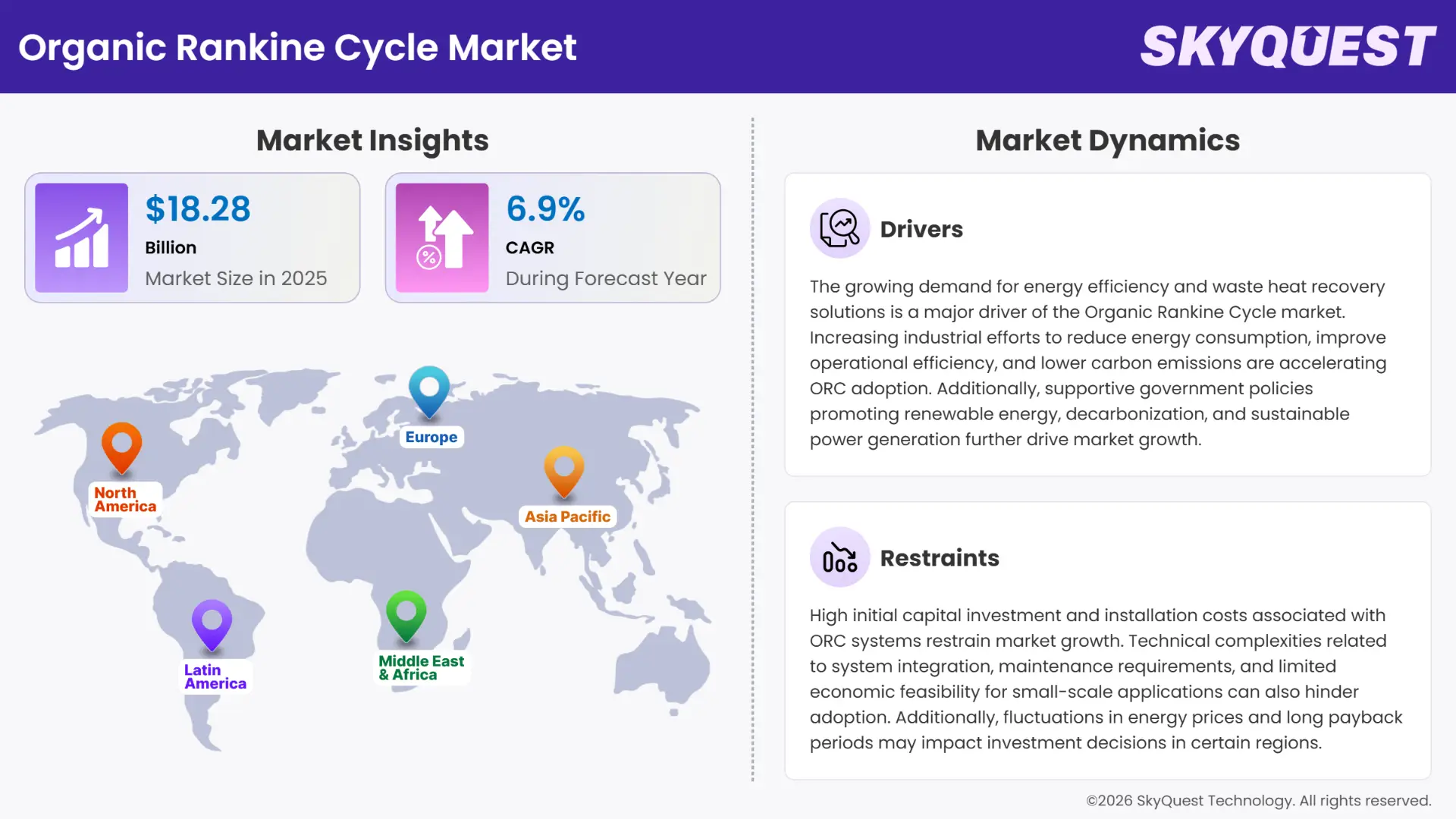
Global Organic Rankine Cycle Market size was valued at USD 17.1 Billion in 2024 and is poised to grow from USD 18.28 Billion in 2025 to USD 31.18 Billion by 2033, growing at a CAGR of 6.9% during the forecast period (2026–2033).
Key Takeaways: Market Trends & Insights
The global push for energy efficiency and sustainability is driving the adoption of organic rankine cycle technology in waste heat recovery. Industries such as manufacturing, oil & gas, and power generation produce significant amounts of low-grade heat, which is typically lost. Organic rankine cycle systems convert this waste heat into usable electricity, improving overall energy efficiency while reducing carbon emissions. As governments enforce stricter energy regulations and industries seek cost-effective solutions to lower operational expenses, the demand for organic rankine cycle -based waste heat recovery solutions grows, fueling market expansion.
The development of advanced working fluids and high-efficiency components has significantly improved organic rankine cycle system performance. Innovations in low-boiling-point organic fluids enhance thermal efficiency, allowing organic rankine cycle systems to operate effectively at lower temperatures. Additionally, improved turbine and heat exchanger designs maximize energy conversion efficiency, making organic rankine cycle technology more viable across diverse applications. These advancements reduce maintenance costs, increase lifespan, and improve scalability, making organic rankine cycle systems an attractive solution for industries seeking sustainable energy alternatives. As R&D efforts continue, enhanced system efficiency further solidifies organic rankine cycle technology’s role in the global renewable energy landscape.
How does AI Enhance Heat Exchange and Fluid Flow in ORC Systems?
AI is revolutionizing organic rankine cycle systems by enhancing operational efficiency and predictive maintenance. AI-driven algorithms analyze real-time data from sensors to optimize heat exchange, fluid flow, and turbine performance, ensuring maximum energy conversion efficiency. Predictive maintenance powered by AI prevents costly downtimes by identifying potential failures before they occur, extending system lifespan and reducing operational costs. Additionally, AI aids in grid integration by dynamically adjusting organic rankine cycle output based on energy demand fluctuations. A key development is AI-powered digital twins, which simulate organic rankine cycle performance under various conditions, enabling optimized designs and smarter deployment in waste heat recovery and renewable energy applications.
How are Startups Innovating ORC Systems for Waste Heat Recovery?
The global organic rankine cycle market outlook is witnessing rapid growth due to rising industrial demand for energy efficiency and sustainability. Startups play a crucial role by introducing compact, modular organic rankine cycle systems for waste heat recovery, geothermal, and biomass applications. Their innovations focus on improving system efficiency, reducing costs, and expanding organic rankine cycle applications into new sectors such as maritime, decentralized energy, and AI-driven performance optimization, accelerating global adoption.
To get more insights on this market click here to Request a Free Sample Report
Global Organic Rankine Cycle Market is segmented by Component, Power Generation, Heat Source, Application, End User Industry and region. Based on Component, the market is segmented into Turbine, Expander, Heat Exchanger and Controls and Instrumentation. Based on Power Generation, the market is segmented into 1 MW, 1-10 MW, 10-50 MW and >50 MW.
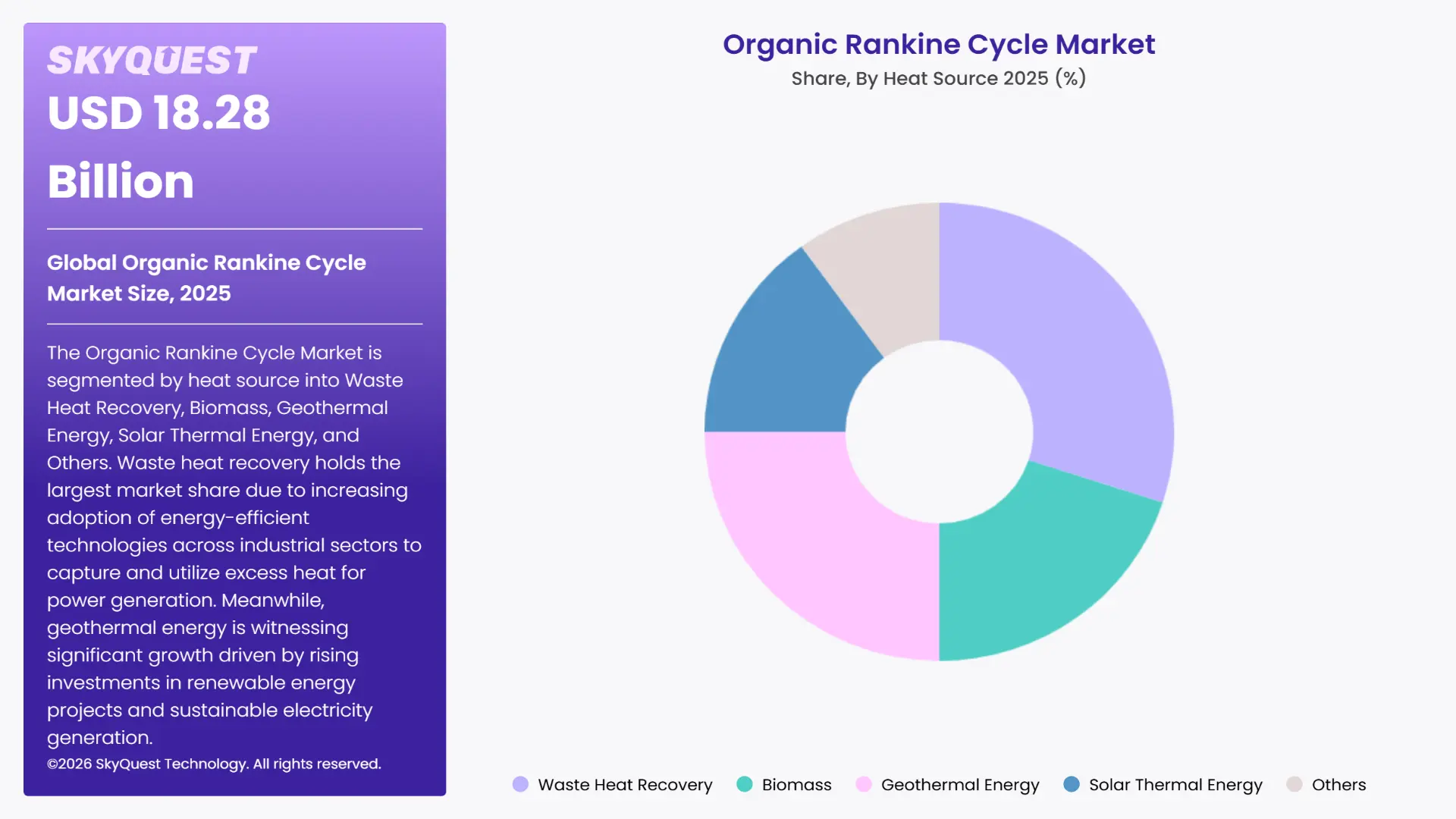
Based on Heat Source, the market is segmented into Waste Heat Recovery, Geothermal Energy, Solar Energy and Biomass Energy. Based on Application, the market is segmented into Power Generation, Cogeneration, District Heating and Industrial Process Heat. Based on End User Industry, the market is segmented into Oil and Gas, Manufacturing, Mining, Power Utilities and Others. Based on region, the market is segmented into North America, Europe, Asia Pacific, Latin America and Middle East & Africa.
Geothermal energy is driving innovation in the global organic rankine cycle market due to its reliability, sustainability, and ability to provide continuous baseload power. Advances in organic rankine cycle technology, such as improved working fluids and AI-driven efficiency optimization, are enhancing geothermal power plant performance. Geothermal dominates the market because it offers a stable, low-emission heat source, unlike intermittent renewables, making it ideal for organic rankine cycle applications in power generation and industrial heating.
Waste heat recovery is the fastest-growing segment in the organic rankine cycle market due to rising industrial energy efficiency initiatives and stricter emission regulations. Industries are adopting organic rankine cycle systems to convert excess heat into electricity, reducing costs and carbon footprints. Advances in compact, modular organic rankine cycle solutions further accelerate this growth.
Power generation dominates the organic rankine cycle market due to its ability to efficiently convert low-grade heat from geothermal, biomass, and waste heat sources into electricity. Innovations in working fluids, turbine design, and AI-driven performance optimization enhance efficiency and scalability. Organic rankine cycle’s ability to provide sustainable, decentralized power solutions, especially in remote and industrial areas, makes it the preferred application, driving its dominance in the global market.
Cogeneration is the fastest-growing application in the organic rankine cycle market due to its dual benefit of generating electricity while utilizing waste heat for industrial or district heating. Rising energy efficiency mandates, cost-saving incentives, and advancements in organic rankine cycle system integration are driving adoption, making cogeneration a key growth driver.
To get detailed segments analysis, Request a Free Sample Report
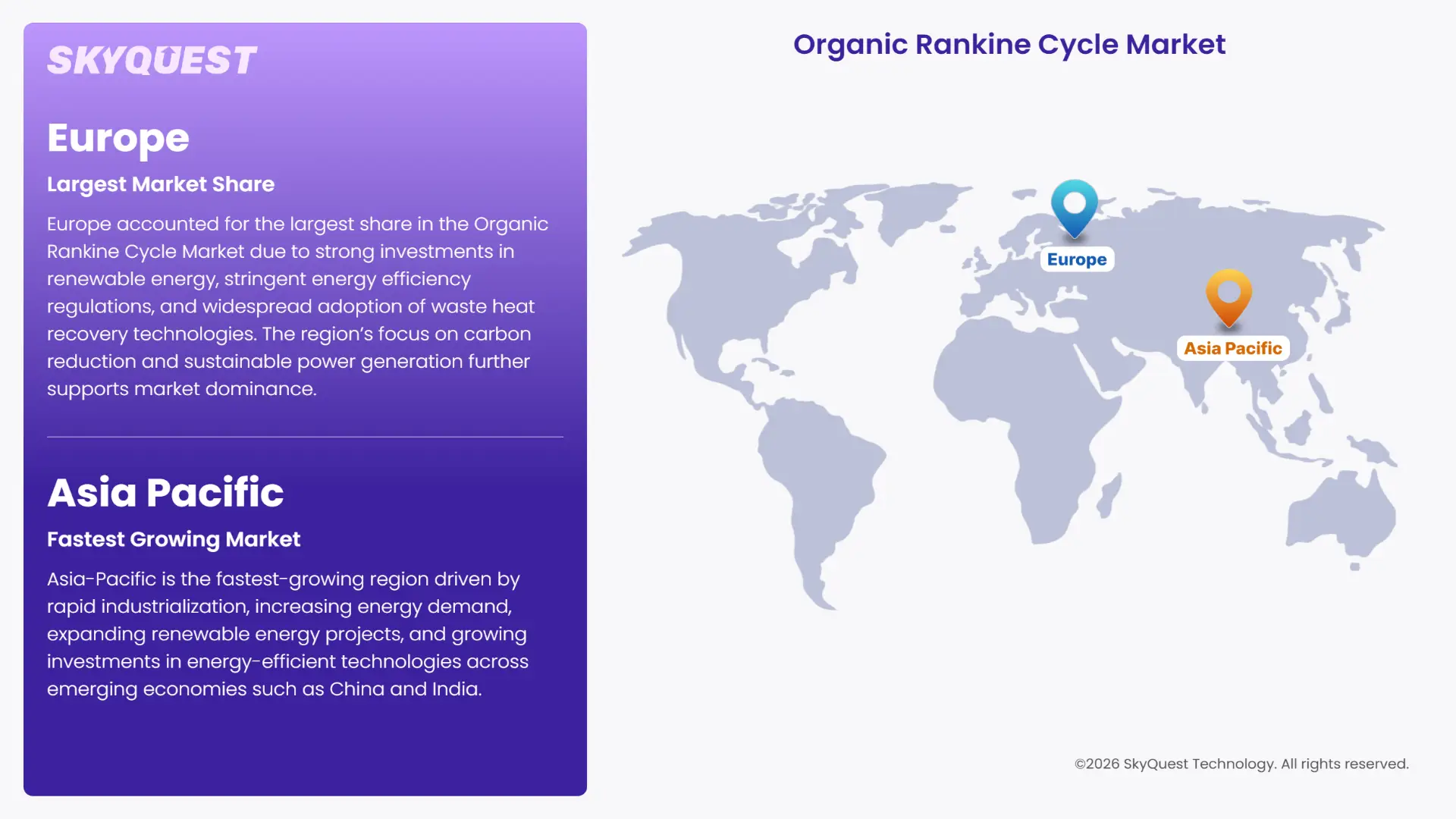
As per the global organic rankine cycle market analysis, Europe is dominating the industry, driven by stringent carbon reduction targets, strong government incentives, and advanced renewable energy adoption. Countries like Italy, Germany, and France lead in geothermal and waste heat recovery applications. The EU’s Green Deal and energy efficiency policies accelerate organic rankine cycle deployment in industrial sectors. Growing investments in AI-driven organic rankine cycle optimization further enhance system performance, supporting widespread market expansion.
Italy Organic Rankine Cycle Market
Italy is a global leader in organic rankine cycle technology, with companies like Turboden pioneering innovative solutions for geothermal, biomass, and waste heat recovery. The country benefits from extensive geothermal resources and strong governmental incentives promoting sustainable energy. Italy’s expertise in high-efficiency organic rankine cycle turbines, combined with AI-driven system optimization, strengthens its role in advancing organic rankine cycle technology worldwide, making it a hub for research and deployment in the global market.
France Organic Rankine Cycle Market
France’s organic rankine cycle market is growing due to its commitment to carbon neutrality and strong geothermal energy development. The country integrates organic rankine cycle technology into district heating, industrial energy recovery, and biomass power plants. Government programs like ADEME’s energy transition support organic rankine cycle adoption. France’s focus on AI-powered efficiency improvements and hybrid renewable solutions is accelerating organic rankine cycle deployment across industrial and commercial sectors, enhancing sustainable power generation.
North America is the fastest growing region in the global organic rankine cycle market, driven by growing investments in renewable energy, waste heat recovery, and industrial efficiency. The U.S. leads with geothermal and biomass-based organic rankine cycle projects, supported by favorable government policies and tax incentives. Technological advancements, including AI-driven organic rankine cycle optimization, are further boosting adoption. The region’s strong focus on decarbonization and energy efficiency continues to drive organic rankine cycle market growth.
US Organic Rankine Cycle Market
The U.S. leads North America's organic rankine cycle market, driven by extensive geothermal resources, industrial waste heat recovery projects, and government incentives promoting clean energy. The Department of Energy (DOE) supports organic rankine cycle innovation through research grants and tax credits. Major industries, including manufacturing and oil & gas, are integrating organic rankine cycle for energy efficiency, while AI-driven optimizations enhance organic rankine cycle plant performance, boosting adoption across various sectors.
Canada Organic Rankine Cycle Market
Canada’s organic rankine cycle market is expanding due to its strong focus on renewable energy, particularly biomass and waste heat recovery. Government programs, such as the Clean Energy Fund, support organic rankine cycle adoption in industrial sectors. Cold climate regions benefit from organic rankine cycle -powered district heating. Mining and remote communities are key adopters, leveraging organic rankine cycle for off-grid power generation, reducing reliance on diesel and lowering emissions.
Asia-Pacific is emerging as a rapidly growing region in the organic rankine cycle market, driven by increasing industrialization, waste heat recovery projects, and renewable energy investments. Countries like China, Japan, and Australia lead in geothermal and biomass-based organic rankine cycle adoption. Government policies promoting energy efficiency and carbon reduction accelerate market growth. Advancements in AI-driven organic rankine cycle optimization and rising demand for decentralized power solutions further enhance regional organic rankine cycle deployment.
Japan Organic Rankine Cycle Market
Japan is a key player in the organic rankine cycle market, leveraging its geothermal potential and industrial waste heat recovery initiatives. Government policies, such as the Strategic Energy Plan, support organic rankine cycle integration in renewable power generation. Leading companies are advancing organic rankine cycle efficiency through AI-driven system optimization. Japan’s focus on sustainable energy and industrial decarbonization continues to drive organic rankine cycle adoption in geothermal plants and manufacturing sectors.
South Korea Organic Rankine Cycle Market
South Korea’s organic rankine cycle market is growing due to its commitment to energy efficiency and industrial sustainability. The country integrates organic rankine cycle technology into waste heat recovery systems in steel, petrochemical, and power generation industries. Government initiatives under the Green New Deal support organic rankine cycle deployment. AI-enhanced performance monitoring and automation are further improving organic rankine cycle efficiency, positioning South Korea as a leader in advanced energy recovery technologies.
To know more about the market opportunities by region and country, click here to
Buy The Complete Report
Growing Industrial Waste Heat Recovery Initiatives
Expansion of Geothermal Energy Projects
Technical Challenges and Efficiency Limitations
Lack of Awareness and Technical Expertise
Request Free Customization of this report to help us to meet your business objectives.
The global organic rankine cycle market is highly competitive, with key players focusing on technological advancements, strategic partnerships, and market expansion. Leading companies include Turboden (Italy), Ormat Technologies (U.S.), Exergy (Italy), Kaishan Group (China), and Enertime (France). Turboden invests in AI-driven organic rankine cycle optimization, while Ormat Technologies expands its geothermal organic rankine cycle projects globally. Exergy focuses on modular organic rankine cycle solutions, enhancing flexibility in waste heat recovery applications.
Rising Adoption of ORC in Waste Heat Recovery
AI and IoT-Driven ORC System Optimization
SkyQuest’s ABIRAW (Advanced Business Intelligence, Research & Analysis Wing) is our Business Information Services team that Collects, Collates, Correlates, and Analyses the Data collected by means of Primary Exploratory Research backed by robust Secondary Desk research.
As per SkyQuest analysis, the global organic rankine cycle industry is playing a pivotal role in advancing energy efficiency and sustainability, particularly through waste heat recovery applications in industries such as manufacturing, oil & gas, and power generation. With the growing adoption of geothermal and biomass energy, along with innovations in AI-driven optimizations, organic rankine cycle systems are becoming increasingly effective at converting low-grade heat into electricity.
Government policies and incentives, coupled with advancements in working fluids and system components, are driving further market growth. Additionally, startups and key players are accelerating organic rankine cycle deployment across diverse sectors, reinforcing its potential in decentralized power solutions. As global energy demands evolve, organic rankine cycle continues to emerge as a vital technology in the transition to a more sustainable energy future.
| Report Metric | Details |
|---|---|
| Market size value in 2024 | USD 17.1 Billion |
| Market size value in 2033 | USD 31.18 Billion |
| Growth Rate | 6.9% |
| Base year | 2024 |
| Forecast period | 2026–2033 |
| Forecast Unit (Value) | USD Billion |
| Segments covered |
|
| Regions covered | North America (US, Canada), Europe (Germany, France, United Kingdom, Italy, Spain, Rest of Europe), Asia Pacific (China, India, Japan, Rest of Asia-Pacific), Latin America (Brazil, Rest of Latin America), Middle East & Africa (South Africa, GCC Countries, Rest of MEA) |
| Companies covered |
|
| Customization scope | Free report customization with purchase. Customization includes:-
|
To get a free trial access to our platform which is a one stop solution for all your data requirements for quicker decision making. This platform allows you to compare markets, competitors who are prominent in the market, and mega trends that are influencing the dynamics in the market. Also, get access to detailed SkyQuest exclusive matrix.
Table Of Content
Executive Summary
Market overview
Parent Market Analysis
Market overview
Market size
KEY MARKET INSIGHTS
COVID IMPACT
MARKET DYNAMICS & OUTLOOK
Market Size by Region
KEY COMPANY PROFILES
Methodology
For the Organic Rankine Cycle Market, our research methodology involved a mixture of primary and secondary data sources. Key steps involved in the research process are listed below:
1. Information Procurement: This stage involved the procurement of Market data or related information via primary and secondary sources. The various secondary sources used included various company websites, annual reports, trade databases, and paid databases such as Hoover's, Bloomberg Business, Factiva, and Avention. Our team did 45 primary interactions Globally which included several stakeholders such as manufacturers, customers, key opinion leaders, etc. Overall, information procurement was one of the most extensive stages in our research process.
2. Information Analysis: This step involved triangulation of data through bottom-up and top-down approaches to estimate and validate the total size and future estimate of the Organic Rankine Cycle Market.
3. Report Formulation: The final step entailed the placement of data points in appropriate Market spaces in an attempt to deduce viable conclusions.
4. Validation & Publishing: Validation is the most important step in the process. Validation & re-validation via an intricately designed process helped us finalize data points to be used for final calculations. The final Market estimates and forecasts were then aligned and sent to our panel of industry experts for validation of data. Once the validation was done the report was sent to our Quality Assurance team to ensure adherence to style guides, consistency & design.
Analyst Support
Customization Options
With the given market data, our dedicated team of analysts can offer you the following customization options are available for the Organic Rankine Cycle Market:
Product Analysis: Product matrix, which offers a detailed comparison of the product portfolio of companies.
Regional Analysis: Further analysis of the Organic Rankine Cycle Market for additional countries.
Competitive Analysis: Detailed analysis and profiling of additional Market players & comparative analysis of competitive products.
Go to Market Strategy: Find the high-growth channels to invest your marketing efforts and increase your customer base.
Innovation Mapping: Identify racial solutions and innovation, connected to deep ecosystems of innovators, start-ups, academics, and strategic partners.
Category Intelligence: Customized intelligence that is relevant to their supply Markets will enable them to make smarter sourcing decisions and improve their category management.
Public Company Transcript Analysis: To improve the investment performance by generating new alpha and making better-informed decisions.
Social Media Listening: To analyze the conversations and trends happening not just around your brand, but around your industry as a whole, and use those insights to make better Marketing decisions.
REQUEST FOR SAMPLE
 REQUEST FREE CUSTOMIZATION
Challenges to the volume commercial scaling of ORC systems are limited efficiency in converting low-grade heat, the technical complexity of combining systems into a fully functional entity, lack of general knowledge/awareness of ORCs, a lack of designers and maintenance skilled workforce, and general mistrust of a new technology.
ORC systems will typically have a lower operational cost and may also have a lower maintenance cost because they are likely built on fewer simpler components, and optimized operationally by AI. That said, capital expenditure of ORCs may be higher at first, especially with more complicated or modular installations that relate to a specific heat source.
The North America and Asia-Pacific regions will likely show the fastest ORC growth, due to an increasing investment towards renewable energy sources, waste heat recovery projects, regulatory policies that support ORC installations, and further adoption of ORCs in decentralized power generation and in industrial applications.
ORC pairing with geothermal, biomass, and solar sources allows for efficient generation of low temperature power, which is ideal uses for hybrid renewable energy systems. This broadens ORC's role in clean energy transitions and decentralized power systems.
AI and IoT enable real-time monitoring, provide predictive maintenance, and utilize digital twins to better model system performance. All these contribute to improving heat exchange, fluid flow, energy efficiency and enhancing operational uptime with the goal of smarter ORC implementations.
Global Organic Rankine Cycle Market size was valued at USD 17.1 Billion in 2024 and is poised to grow from USD 18.28 Billion in 2025 to USD 31.18 Billion by 2033, growing at a CAGR of 6.9% during the forecast period (2026–2033).
Key vendors in the Organic Rankine Cycle Market include Ormat Technologies Inc., Turboden S.p.A., Exergy International Srl, Siemens Energy AG, General Electric Company, Mitsubishi Heavy Industries Ltd., Kaishan Group Co. Ltd., Enogia SAS, ABB Ltd., and ElectraTherm Inc.. These companies provide Organic Rankine Cycle systems and technologies for waste heat recovery, geothermal power generation, biomass energy, and industrial energy efficiency applications.
The key driver of the Organic Rankine Cycle Market is the growing demand for energy efficiency and waste heat recovery solutions across industrial sectors. Increasing emphasis on reducing energy consumption, lowering carbon emissions, and improving power generation from low- and medium-temperature heat sources is driving the adoption of Organic Rankine Cycle systems. Additionally, supportive government policies promoting renewable energy and sustainable industrial practices further support market growth.
The key market trend in the Organic Rankine Cycle Market is the increasing integration of ORC systems with renewable energy and industrial waste heat recovery applications. Companies are focusing on advanced, modular, and high-efficiency ORC technologies that can convert low-temperature heat from geothermal, biomass, solar thermal, and industrial processes into electricity. Growing investments in decarbonization, energy optimization, and sustainable power generation are further driving innovation and market expansion.
Europe accounted for the largest share in the Organic Rankine Cycle Market due to strong investments in renewable energy, stringent energy efficiency regulations, and widespread adoption of waste heat recovery technologies across industrial sectors. The region’s focus on carbon emission reduction, supportive government policies, and the presence of leading ORC technology providers further support its market dominance.


Want to customize this report? This report can be personalized according to your needs. Our analysts and industry experts will work directly with you to understand your requirements and provide you with customized data in a short amount of time. We offer $1000 worth of FREE customization at the time of purchase.
Feedback From Our Clients


 USA (+1) 351-333-4748

