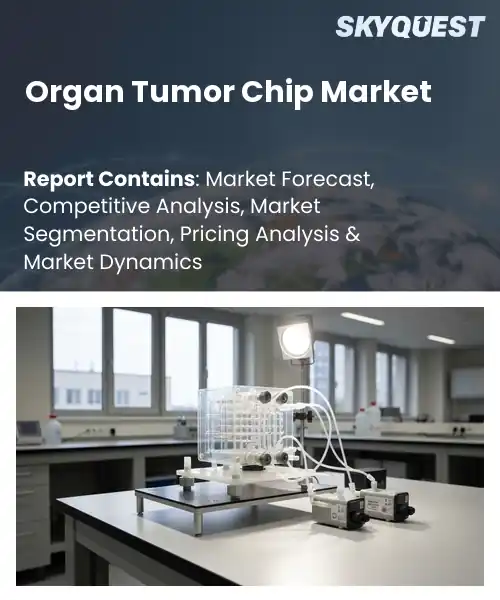
Organ Tumor Chip Market
Report ID: SQMIG35J2243
Report ID: SQMIG35J2243
[email protected]
USA +1 351-333-4748
Report ID:
SQMIG35J2243 |
Region:
Global |
Published Date: March, 2026
Pages:
157
|Tables:
143
|Figures:
78


Global Organ Tumor Chip Market size was valued at USD 99.9 Million in 2024 and is poised to grow from USD 115.38 Million in 2025 to USD 365.43 Million by 2033, growing at a CAGR of 15.5% during the forecast period (2026-2033).
Organ tumor chips are microengineered platforms that recreate the tumor microenvironment to enable more predictive in vitro oncology research, and the primary driver of this market is the pharmaceutical industry's need to de-risk and accelerate drug development. Due to the shortcomings of traditional animal or two-dimensional cell culture systems in replicating human tumor behavior, there has been a push toward tumor biology models that accurately reflect the physical and physiological characteristics of real tumors. As a result, over the last ten years, there has been a rapid growth of commercial products based upon previously developed academic devices that have been validated through proven clinical efficacy by various manufacturers of peripheral technologies (companies like Emulate, Hurel and MIMETAS).
Building on commercial momentum, a key trend driving the global organ tumor chip sector is the convergence of microfluidics, 3D bioprinting, and patient-derived tumor models because these technologies enable more physiologically relevant assays that inform clinical decision making. As a result pharmaceutical companies and CROs can prioritize lead compounds earlier, which reduces costs and shortens timelines. For example, tumor chips have been used to predict immunotherapy response and model metastatic invasion, guiding dose selection and combination strategies. Regulatory openness and partnerships between biotech and academia create opportunities for standardized platforms that support companion diagnostics and reduce reliance on animal studies.
How is AI Improving Drug Testing Accuracy in the Organ Tumor Chip Market?
Organ tumor chips recreate the tumor microenvironment on microfluidic devices and AI improves drug testing accuracy by turning complex image streams and sensor data into actionable readouts. Key aspects include automated image analysis for cell morphology, fusion of molecular profiling with functional signals, and predictive models that anticipate drug response across linked organ models. The current market is moving from proof of concept to adoption as pharmaceutical developers and testing labs look for human relevant alternatives to animal studies. For instance, AI can detect subtle viability shifts and relate those signals to metabolism patterns so teams prioritize more promising candidates sooner.
In January 2026, Emulate announced an advanced platform that integrates AI for toxicity prediction and tumor modeling and this real world development shows how AI improves assay consistency and data interpretation, accelerates testing workflows, and supports wider adoption by increasing confidence in preclinical decisions.
Market snapshot - (2026-2033)
Global Market Size
USD 99.9 Million
Largest Segment
Single-channel Chips
Fastest Growth
Multi-channel/Integrated Organ Systems
Growth Rate
15.5% CAGR
To get more insights on this market click here to Request a Free Sample Report
Global organ tumor chip market is segmented by chip architecture, tumor model type, component material, application domain, end-user and region. Based on chip architecture, the market is segmented into single-channel chips and multi-channel/integrated organ systems. Based on tumor model type, the market is segmented into lung cancer-on-a-chip, breast cancer-on-a-chip and colorectal/liver cancer models. Based on component material, the market is segmented into PDMS (polydimethylsiloxane) based and thermoplastic/hydrogel platforms. Based on application domain, the market is segmented into drug discovery & efficacy testing, personalized cancer medicine (patient-derived cells), toxicology & safety assessment and basic cancer research & metastasis studies. Based on end-user, the market is segmented into pharmaceutical & biotech R&D, academic research institutes and contract research organizations (CROs). Based on region, the market is segmented into North America, Europe, Asia Pacific, Latin America and Middle East & Africa.
Based on the global organ tumor chip market growth, multi-channel/integrated organ systems segment dominates because these platforms replicate inter-organ communication and vascularized microenvironments that drive clinically relevant tumor behavior, enabling mechanistic insights into metastasis and drug response. Integrating sensors, controlling fluid movement, and using different types of tissues are all areas where they excel. Their ability to produce results that more closely mimic what happens in living systems increases the chance they will receive long-term financial support from those creating technologies who are looking for models that translate to humans and provide guidance on follow-up dosing.
However, single-channel chips are emerging as the most rapidly expanding area due to their lower complexity, ease of adoption, and compatibility with standardized laboratory workflows. With their modular design, they can be easily integrated into both contract research and academic labs. In addition, they facilitate rapid assay development/scalability, and they offer numerous short-term commercial opportunities. As a result, these devices reduce the technical barriers to entry and enhance user access to high-throughput screening.
Personalized cancer medicine (Patient-derived cells) segment dominates because patient-specific tumor and stromal cultures recreate individual heterogeneity and therapeutic sensitivity, offering directly actionable evidence for treatment planning. By enabling the examination of several agents in matched tumor microenvironments, the ability to assess many agents simultaneously will improve the clinical relevance of emerging therapies, cultivate partnerships with oncology facilities and create increased demand for precision tools by stakeholders who want to use them to improve patient outcomes and to assist with developing companion diagnostics.
However, drug discovery & efficacy testing is emerging as the fastest-growing application area as pharmaceutical developers integrate organ tumor chips to validate targets and prioritize leads with greater physiological relevance. Growing adoption is driven by the need to reduce late-stage failures, streamline translational pipelines, and incorporate more predictive preclinical models, thereby expanding commercial demand and stimulating platform innovation and service offerings.
To get detailed segments analysis, Request a Free Sample Report
As per the global organ tumor chip market share, North America dominates the global market through a combination of deep scientific expertise, a well established biomedical infrastructure, and concentration of leading commercial developers. Robust translational ecosystems provide an avenue by which academic breakthroughs can be linked and validated by industry and through clinical trials facilitated through rigorous Proof of Concept (POC) and iterative design. Strong intellectual property frameworks and an established culture of venture funding allow for companies to grow and commercialize their products. Collaborative relationships among pharma, CROs, and microfluidic component manufacturers speed the time to market for drug screening and personalized medicine. Engaging with regulators to clarify POC, access to sophisticated clinical and laboratory facilities, enhance both the regional superiority of and the sustained innovativeness within the region.
Organ tumor chip market in United States benefits from concentration of leading research institutions, integrated clinical networks, and a mature industrial base focused on translational innovation. High levels of private and institutional engagement drive adoption by pharmaceutical developers and contract research providers. The nation's position as a major technology development and early product launch has been enhanced via partnerships between universities and industries to validate and establish prototypes.
Organ tumor chip market in Canada benefits from collaborative research networks, specialized clinical centers, and translational initiatives that connect laboratory innovation with industry needs. A constructive regulatory environment and emphasis on public private partnerships support pilot validation efforts. Through local manufacturing capabilities and talent development programs, we can enhance supply chain resilience and partner with international manufacturers to create a center of adaptation and clinical use for organ tumor chip technologies as a regional center.
Based on global organ tumor chip market regional forecast, Europe is experiencing rapid expansion in the organ tumor chip market driven by an integrated life sciences ecosystem, strong pharmaceutical and biotechnology presence, and increasing emphasis on translational research that bridges laboratory innovation with clinical needs. Consortia for research across borders and collaborative funding structures support the maturation of technologies and the validation of multiple centres. A dense network of specialist testing facilities and contract research organisations provides the basis for efficient outsourcing of chips to screen drugs and discover biomarkers. The commercialisation of organ tumor chips and the ability to scale up production is supported through the presence in Europe of regional manufacturing capability and a talented workforce that has advanced manufacturing skills. Hence, Europe is a very dynamic marketplace to advance the development of organ tumor chips.
Organ tumor chip market in Germany benefits from a dense cluster of engineering and life science expertise, strong manufacturing capabilities for microfluidic components, and established partnerships between universities and industry. The presence of large drug companies and biopharmaceutical distributors contributes to building drug development pathways through inserting themselves into the process. Development and commercialisation of these products will be accelerated through cooperation between the public and private sectors in developing frameworks to facilitate their implementation and continuing development of these technologies.
Organ Tumor Chip Market in United Kingdom draws on renowned academic centers, energetic startup activity, and focused translational hubs that emphasize clinical applicability. Collaborations between the healthcare systems lead to the creation of real-world pilot programs and fast-tracked clinical feedback. Since an investment climate and people experienced in contract research have the potential to result in faster commercialization and scaling as well; the ability to develop strong industry/public research partnerships and multidisciplinary talent will allow the country to continue to be a fast-evolving center for organ/tumorchip research.
Organ tumor chip market in France is emerging through concentrated academic expertise, clinical translational programs, and biotech entrepreneurship developing disease models. Through linkage with pharmaceutical partners, pilot validation is encouraged through strategic research initiatives and collaborative innovation clusters. The support for clinical relevance and promoter development relates to an emphasis on biomarker research, providing evidence for adoption in drug development processes. Developing existing domestic capacity through manufacturing capability and talent pipelines are critical to developing an ability to contribute to regional innovation through organ-tumorchip technology commercialisation.
As per global organ tumor chip market regional outlook, Asia Pacific is strengthening its position in the market through focused investment in microfabrication capabilities, increasing biotechnology research capacity, and strategic collaborations between academic institutions and industry players. Regional strengths in precision engineering and advanced materials support cost effective device production, while growing translational research networks enable application of chips in drug screening and toxicity testing. The advancement of life science innovation on a national scale through collaborative contract research organizations and partnerships with leading international pharmaceutical companies accelerates the transfer and validation of new technologies. Building skilled technical workforces and fostering productive interactions with regulatory bodies also enhance clinical relevance and integrate the region’s advanced technologies into the marketplace by providing the region with the ability to evolve from an early adopter to a major contributor to platform development and commercialization.
Organ tumor chip market in Japan draws on precision engineering, advanced materials expertise, and established biomedical institutes. The partnership developed by universities, hospitals, and industry help to expedite the transition from prototype to reliable, validated tools for drug testing and for safety assessment. Quality of manufacturing is used to create consistent microfluidic production, while innovative initiatives for the use of new techniques and good clinical research on the part of investigators facilitate thorough testing and implementation of the prototype into common use.
Organ tumor chip market in South Korea benefits from strong microelectronics and precision manufacturing capabilities, a growing biotechnology sector, and collaborative research hubs that link universities with industry. Contract research organizations provide support for validation and screening applications. National innovation programs and corporate investment encourage prototype scaling and international partnerships. Technical talent and manufacturing capacity reinforce country role in regional supply chains and technology commercialization for organ tumor chip platforms.
To know more about the market opportunities by region and country, click here to
Buy The Complete Report
Advances In Microfluidic Modeling
Advances in microfluidic tumor chip engineering have enabled more faithful replication of native tissue architecture and fluid dynamics, which increases user confidence in preclinical models. The enhanced level of integrated sensor/imaging systems or installation capabilities for additional cell types will provide space for various types (e.g., academic and pharmaceutical) of multi-centre research programs and collaborative projects. As such, companies will make investments and enter partnerships to utilize these additional capabilities to develop drug screening tools, conduct mechanistic studies and biosensor discovery and development-ultimately creating market opportunities.
Increased Demand For Personalized Therapies
The proliferation of personalized cancer care is driving clinicians to develop organ tumor chips that enable researchers to simulate the biology of individual patient tumors and their responses to treatment, thereby allowing for the evaluation of therapeutic effectiveness in a personalised manner. Pharmaceutical developers see these platforms as providing tools for improved patient stratification strategies and supporting companion diagnostics development, thereby making clinically-targeted translational work more precise. Clinical and academic researchers are using patient-derived constructs to look at mechanisms of resistance and determine the most effective combination therapies.
High Development And Validation Costs
The initial costs of developing organ tumor chip platforms, verifying their use through a standard setup and scaling them for use, may create barriers for their wider use. The need for special facilities to fabricate and control for quality the chips, as well as staff with specialized skills will increase upfront investments in addition to operational complexity, decreasing the speed at which institutions are willing to make new technology commitments. The extended internal evaluation required by modifying existing practices in procurement will delay deployment even further. The cumulative effect of all of these financial or operational prohibitions limits market penetration and slows adoption of organ tumor chip technology despite there being clear scientific advantages to using the technology.
Regulatory Uncertainty And Standardization
Unclear regulatory pathways and lack of harmonized standards for organ tumor chip data create uncertainty that constrains market growth by limiting confidence among developers and end users. Because there is no generally agreed-upon set of validation criteria, acceptance of data, or standardized reporting format among all stakeholders, the stakeholders will have difficulty demonstrating to regulators and clinical partner the translational relevance of the data used in this work. This uncertainty results in conservative investment actions, extended discussions with oversight authorities, and careful incorporation into drug development processes. Without a sufficiently developed regulatory framework and category-wide standards, the commercialization and broad acceptance of this data in the clinical realm will be slower than anticipated.
Request Free Customization of this report to help us to meet your business objectives.
Competition in the global organ tumor chip market outlook centers on platform validation, pharma collaborations and manufacturing scale; firms pursue partnerships, manufacturing alliances and targeted asset deals to secure integration into preclinical pipelines. Examples include Emulate's manufacturing tie-up with Minifab and pharma collaborations with Roche and AstraZeneca, and MIMETAS's participation in the Oncode Accelerator program to accelerate oncology screening platforms.
SkyQuest’s ABIRAW (Advanced Business Intelligence, Research & Analysis Wing) is our Business Information Services team that Collects, Collates, Correlates, and Analyses the Data collected by means of Primary Exploratory Research backed by robust Secondary Desk research.
As per SkyQuest analysis, the global organ tumor chip industry is gaining momentum with a key driver being the pharmaceutical industry’s push to de-risk and accelerate oncology drug development through more predictive human-relevant models. A second driver is the convergence of microfluidics, 3D bioprinting and patient-derived tumor models that improve physiological fidelity and translational confidence. A significant restraint remains the high development and validation costs associated with platform scale-up and standardization, which can slow adoption. North America is the dominating region due to strong translational ecosystems and commercial leadership, while the multi-channel and integrated organ systems segment is the dominating product type because it delivers inter-organ communication and clinically relevant readouts.
| Report Metric | Details |
|---|---|
| Market size value in 2024 | USD 99.9 Million |
| Market size value in 2033 | USD 365.43 Million |
| Growth Rate | 15.5% |
| Base year | 2024 |
| Forecast period | (2026-2033) |
| Forecast Unit (Value) | USD Million |
| Segments covered |
|
| Regions covered | North America (US, Canada), Europe (Germany, France, United Kingdom, Italy, Spain, Rest of Europe), Asia Pacific (China, India, Japan, Rest of Asia-Pacific), Latin America (Brazil, Rest of Latin America), Middle East & Africa (South Africa, GCC Countries, Rest of MEA) |
| Companies covered |
|
| Customization scope | Free report customization with purchase. Customization includes:-
|
To get a free trial access to our platform which is a one stop solution for all your data requirements for quicker decision making. This platform allows you to compare markets, competitors who are prominent in the market, and mega trends that are influencing the dynamics in the market. Also, get access to detailed SkyQuest exclusive matrix.
Table Of Content
Executive Summary
Market overview
Parent Market Analysis
Market overview
Market size
KEY MARKET INSIGHTS
COVID IMPACT
MARKET DYNAMICS & OUTLOOK
Market Size by Region
KEY COMPANY PROFILES
Methodology
For the Organ Tumor Chip Market, our research methodology involved a mixture of primary and secondary data sources. Key steps involved in the research process are listed below:
1. Information Procurement: This stage involved the procurement of Market data or related information via primary and secondary sources. The various secondary sources used included various company websites, annual reports, trade databases, and paid databases such as Hoover's, Bloomberg Business, Factiva, and Avention. Our team did 45 primary interactions Globally which included several stakeholders such as manufacturers, customers, key opinion leaders, etc. Overall, information procurement was one of the most extensive stages in our research process.
2. Information Analysis: This step involved triangulation of data through bottom-up and top-down approaches to estimate and validate the total size and future estimate of the Organ Tumor Chip Market.
3. Report Formulation: The final step entailed the placement of data points in appropriate Market spaces in an attempt to deduce viable conclusions.
4. Validation & Publishing: Validation is the most important step in the process. Validation & re-validation via an intricately designed process helped us finalize data points to be used for final calculations. The final Market estimates and forecasts were then aligned and sent to our panel of industry experts for validation of data. Once the validation was done the report was sent to our Quality Assurance team to ensure adherence to style guides, consistency & design.
Analyst Support
Customization Options
With the given market data, our dedicated team of analysts can offer you the following customization options are available for the Organ Tumor Chip Market:
Product Analysis: Product matrix, which offers a detailed comparison of the product portfolio of companies.
Regional Analysis: Further analysis of the Organ Tumor Chip Market for additional countries.
Competitive Analysis: Detailed analysis and profiling of additional Market players & comparative analysis of competitive products.
Go to Market Strategy: Find the high-growth channels to invest your marketing efforts and increase your customer base.
Innovation Mapping: Identify racial solutions and innovation, connected to deep ecosystems of innovators, start-ups, academics, and strategic partners.
Category Intelligence: Customized intelligence that is relevant to their supply Markets will enable them to make smarter sourcing decisions and improve their category management.
Public Company Transcript Analysis: To improve the investment performance by generating new alpha and making better-informed decisions.
Social Media Listening: To analyze the conversations and trends happening not just around your brand, but around your industry as a whole, and use those insights to make better Marketing decisions.
REQUEST FOR SAMPLE
 REQUEST FREE CUSTOMIZATION
Global Organ Tumor Chip Market size was valued at USD 99.9 Million in 2024 and is poised to grow from USD 115.38 Million in 2025 to USD 365.43 Million by 2033, growing at a CAGR of 15.5% during the forecast period (2026-2033).
Competition in the organ tumor chip market centers on platform validation, pharma collaborations and manufacturing scale; firms pursue partnerships, manufacturing alliances and targeted asset deals to secure integration into preclinical pipelines. Examples include Emulate's manufacturing tie-up with Minifab and pharma collaborations with Roche and AstraZeneca, and MIMETAS's participation in the Oncode Accelerator program to accelerate oncology screening platforms. 'Emulate Inc.', 'Mimetas', 'InSphero AG', 'TissUse GmbH', 'Organovo', 'Axosim', 'Beonchip', 'BioIVT', 'Nortis Inc.', 'CN Bio Innovations', 'Hesperos Inc.', 'AlveoliX', 'Dynamic42', 'Netri', 'MesoBioTech', 'SynVivo', 'Cherry Biotech', 'BiomimX', 'Elveflow', 'Fluigent'
Advances in microfluidic tumor chip engineering have enabled more faithful replication of native tissue architecture and fluid dynamics, which increases user confidence in preclinical models. This improved physiological relevance encourages adoption by pharmaceutical companies and academic researchers seeking better translational platforms. Enhanced integration with sensors and imaging, modular designs, and compatibility with diverse cell types support varied research applications and collaborative projects. As a result, stakeholders prioritize investment and partnership to leverage these capabilities for drug screening, mechanistic studies, and biomarker identification, thereby supporting market expansion.
Integration Into Pharmaceutical Pipelines: Organ tumor chips are increasingly embedded within drug development workflows to provide more predictive human-relevant models. Their compatibility with existing screening and lead optimization stages encourages adoption by research teams seeking to reduce gaps. As collaborative programs between chip developers and pharmaceutical research groups expand, these platforms enable iterative testing of compound interactions and mechanism studies. This trend strengthens translational confidence, accelerates decision-making for candidate selection, and fosters co-development partnerships that align engineering advances with therapeutic priorities across industry sectors.
Why does North America Dominate the Global Organ Tumor Chip Market? |@12


Want to customize this report? This report can be personalized according to your needs. Our analysts and industry experts will work directly with you to understand your requirements and provide you with customized data in a short amount of time. We offer $1000 worth of FREE customization at the time of purchase.
Feedback From Our Clients


 USA (+1) 351-333-4748

