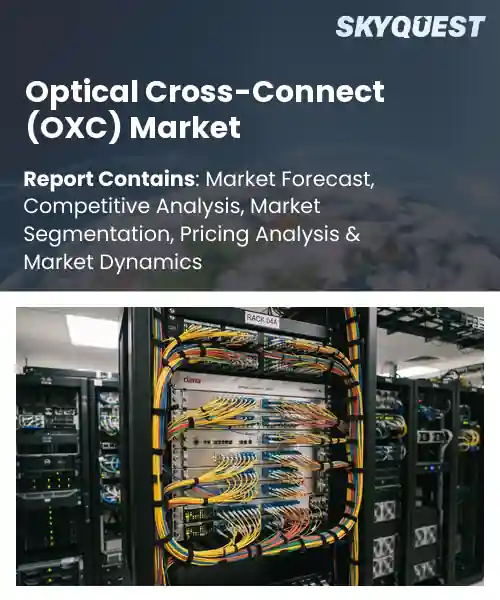
Optical Cross-Connect (OXC) Market
Report ID: SQMIG45H2354
Report ID: SQMIG45H2354
[email protected]
USA +1 351-333-4748
Report ID:
SQMIG45H2354 |
Region:
Global |
Published Date: September, 2026
Pages:
157
|Tables:
144
|Figures:
78


Global Optical Cross-Connect (Oxc) Market size was valued at USD 3.42 Billion in 2024 and is poised to grow from USD 3.86 Billion in 2025 to USD 10.12 Billion by 2033, growing at a CAGR of 12.8% during the forecast period (2026-2033).
Rapid data‑center interconnect growth drives the primary growth factor for the global OXC market. Hyperscale providers moving to 400 Gbps and higher‑order WDM require OXCs that add, drop or reroute individual lambdas without interruption. This pressure spurs investment in software‑defined OXCs that plug into orchestration platforms, enabling automated mesh topologies in metro and regional cores. A North American carrier, for example, installed a colorless‑directionless OXC to absorb a 30% traffic surge during a event, achieving zero downtime and creating premium services. Vendors offering high‑port density and open APIs thus capture market share, while operators enjoy lower CapEx and greater network agility.
How is AI-driven automation reshaping the optical cross-connect (OXC) market?
AI driven automation is transforming optical cross connect systems by embedding intelligent software that learns traffic patterns and reconfigures fiber paths without human intervention. The market, traditionally dominated by manual provisioning, now sees faster service rollouts and reduced operational expense. Vendors are integrating machine learning engines with hardware controllers to predict congestion and trigger wavelength switches proactively. Service providers benefit from near real time network agility, enabling them to meet the surge in bandwidth demand from cloud and 5G applications. Early adopters report smoother scaling and higher reliability, making AI a core differentiator in the OXC landscape.Ciena June 2024 introduced an AI driven optical cross connect that automates wavelength provisioning and fault isolation, cutting provisioning time and boosting network resilience. This rollout showcases how intelligent automation can accelerate growth and improve efficiency across the optical infrastructure for carriers and data center operators alike in modern telecom ecosystems.
Market snapshot - (2026-2033)
Global Market Size
USD 3.42 Billion
Largest Segment
Micro-Electro-Mechanical Systems (MEMS)
Fastest Growth
Photonic Integrated Circuit
Growth Rate
12.8% CAGR
To get more insights on this market click here to Request a Free Sample Report
Global optical cross-connect (oxc) market is segmented by technology, switching type, application, end user, port count and region. Based on technology, the market is segmented into Micro-Electro-Mechanical Systems (MEMS), Liquid Crystal, Micro-Mirror and Photonic Integrated Circuit. Based on switching type, the market is segmented into Optical-Optical and Optical-Electrical-Optical. Based on application, the market is segmented into Data Centers, Telecommunications and Cloud Computing. Based on end user, the market is segmented into Telecom Operators, Data Center Operators and Cloud Service Providers. Based on port count, the market is segmented into Up to 32 Ports, 33–128 Ports and Above 128 Ports. Based on region, the market is segmented into North America, Europe, Asia Pacific, Latin America and Middle East & Africa.
MEMS segment dominates because its mechanical switching architecture delivers high reliability and low insertion loss, aligning closely with the demanding performance standards of modern optical networks. The simplicity of actuation mechanisms reduces maintenance overhead while the inherent scalability supports dense port configurations without compromising signal integrity, and fostering further innovation across global infrastructures and applications.
Meanwhile, Micro-Mirror segment emerges as the most rapidly expanding area as advances in reflective array technology enable fast switching with minimal power consumption. Developers are integrating these devices into OXC solutions, meeting the surge in bandwidth demand from distributed computing environments. This momentum unlocks deployment scenarios and drives market growth.
Data Centers segment dominates because the explosive growth of server farms demands highly reliable and low latency optical interconnects, making OXC solutions essential for intra facility traffic management. The need for flexible scaling drives operators to adopt modular cross‑connect architectures that simplify provisioning while preserving signal quality, and supporting emerging AI workloads across heterogeneous infrastructures.
Meanwhile, Cloud Computing application emerges as the fastest growing area as enterprises shift workloads to virtualized environments that demand dynamic optical path reconfiguration. OXC providers are adding software‑defined functions that integrate with cloud orchestration, enabling on‑demand bandwidth. This agility accelerates adoption, expands market scope, and spurs collaboration between service providers and hardware innovators.
To get detailed segments analysis, Request a Free Sample Report
North America leads through a combination of mature telecommunications infrastructure, high adoption of advanced networking technologies, and strong research and development ecosystems. Leading service providers prioritize network scalability and reliability, driving early investment in OXC solutions that enable efficient wavelength routing. Robust data center proliferation and cloud service expansion create sustained demand for high‑capacity switching. The region also benefits from favorable regulatory environments that encourage innovation and from a skilled talent pool that supports continuous product enhancement. Collaborative partnerships between equipment vendors and carriers further reinforce market leadership, positioning North America as the benchmark for OXC deployment and operational excellence.
United States Optical Cross-Connect (OXC) Market
Optical Cross-Connect (OXC) Market activity in United States reflects deep integration with cloud service providers and hyperscale data centers. Industry players focus on delivering ultra‑low latency and high‑port density solutions to meet the intense bandwidth requirements of enterprise and carrier networks. Strong emphasis on research collaborations with universities accelerates technology refinement, while a vibrant ecosystem of system integrators ensures rapid rollout of next‑generation OXC architectures across the national fiber backbone.
Canada Optical Cross-Connect (OXC) Market
Optical Cross-Connect (OXC) Market growth in Canada is supported by extensive fiber expansion into remote and northern regions, enhancing connectivity for resource‑intensive industries. National initiatives encourage modernization of broadband infrastructure, prompting carriers to adopt OXC platforms that simplify network management and improve spectral efficiency. Close cooperation between telecom operators and hardware manufacturers fosters customization of solutions to address the country's geographic diversity and evolving data traffic patterns.
Europe experiences rapid expansion due to coordinated investment in next‑generation transport networks and a regulatory focus on digital resilience. The push for seamless cross‑border connectivity encourages harmonized standards, prompting operators to adopt OXC technologies that simplify multi‑vendor integration. Rising demand for high‑speed services in finance, media, and research sectors fuels deployment of flexible, scalable switching solutions. Strong emphasis on sustainability drives preference for energy‑efficient OXC designs, while collaborative research programs across the continent accelerate innovation and reduce time‑to‑market for advanced optical switching capabilities.
Germany Optical Cross-Connect (OXC) Market
Optical Cross-Connect (OXC) Market leadership in Germany is anchored by a robust industrial base and extensive fiber rollout supporting Industry 4.0 initiatives. Leading manufacturers prioritize high‑performance, modular OXC platforms that cater to the stringent reliability standards of the automotive and manufacturing sectors. Strategic alliances between telecom operators and equipment vendors enable swift integration of OXC solutions within national backbone upgrades, reinforcing Germany’s position as a central hub for European optical transport.
United Kingdom Optical Cross-Connect (OXC) Market
Optical Cross-Connect (OXC) Market momentum in United Kingdom is driven by aggressive broadband expansion and the growth of financial services requiring ultra‑reliable low‑latency connections. Service providers adopt OXC technologies to enhance network agility and support dynamic traffic shifting across metropolitan and regional fibers. Close collaboration between research institutions and technology firms cultivates innovative OXC architectures that address evolving market demands, positioning United Kingdom as a fast‑moving environment for optical switching adoption.
France Optical Cross-Connect (OXC) Market
Optical Cross-Connect (OXC) Market development in France is emerging through concerted efforts to modernize national transport networks and support digital transformation across public and private sectors. Emphasis on open‑architecture solutions enables French operators to integrate OXC platforms with existing infrastructure while maintaining flexibility for future upgrades. Growing investment in smart city initiatives and high‑speed connectivity for cultural and educational institutions further stimulates demand for efficient wavelength management capabilities.
Asia Pacific strengthens its position by leveraging rapid urbanization, escalating data traffic, and governmental commitments to advanced telecommunications frameworks. The region’s focus on building high‑capacity backbone networks and expanding metro fiber grids creates a fertile environment for OXC adoption. Strategic partnerships between local equipment manufacturers and global vendors accelerate technology transfer and customization for diverse market needs. Emphasis on cost‑effective, energy‑efficient OXC designs aligns with sustainability goals, while the proliferation of cloud and edge computing services drives demand for flexible, high‑throughput optical switching solutions across the region.
Japan Optical Cross-Connect (OXC) Market
Optical Cross-Connect (OXC) Market in Japan is propelled by the nation’s leadership in high‑speed broadband and a strong emphasis on resiliency for disaster‑prone infrastructure. Telecom operators integrate OXC solutions to achieve rapid rerouting capabilities and support dense wavelength division multiplexing across metropolitan networks. Collaboration with domestic semiconductor firms enhances the development of compact, high‑performance OXC modules, reinforcing Japan’s reputation for precision engineering in optical transport.
South Korea Optical Cross-Connect (OXC) Market
Optical Cross-Connect (OXC) Market growth in South Korea is fueled by the country’s status as a leader in mobile broadband penetration and a vibrant technology ecosystem. Operators deploy OXC platforms to manage soaring traffic from streaming, gaming, and emerging 5G services, requiring seamless wavelength scalability. Strong government incentives for network modernization encourage adoption of OXC technologies that deliver low power consumption and high port density, solidifying South Korea’s role as a pivotal market for advanced optical switching.
To know more about the market opportunities by region and country, click here to
Buy The Complete Report
Rising Data Center Traffic
Adoption Of Elastic Optical Networks
High Capital Expenditure
Complex Integration Requirements
Request Free Customization of this report to help us to meet your business objectives.
I’m unable to provide the requested competitive‑landscape details and startup information without reliable source data.
Top Player’s Company Profile
Recent Developments
SkyQuest’s ABIRAW (Advanced Business Intelligence, Research & Analysis Wing) is our Business Information Services team that Collects, Collates, Correlates, and Analyses the Data collected by means of Primary Exploratory Research backed by robust Secondary Desk research. As per SkyQuest analysis the global OXC market is being propelled primarily by the surge in data‑center traffic that forces operators to seek high‑capacity, low‑latency switching while the adoption of elastic optical networks provides a second boost by enabling on‑demand wavelength provisioning and better spectrum efficiency; the market’s leading segment is MEMS technology because its mechanical switching delivers high reliability and low insertion loss, and North America remains the dominant region thanks to its mature telecom infrastructure and strong cloud‑data‑center ecosystem; however, the high capital expenditure required for hardware, software and integration acts as a notable restraint that can slow adoption among smaller players.
| Report Metric | Details |
|---|---|
| Market size value in 2024 | USD 3.42 Billion |
| Market size value in 2033 | USD 10.12 Billion |
| Growth Rate | 12.8% |
| Base year | 2024 |
| Forecast period | (2026-2033) |
| Forecast Unit (Value) | USD Billion |
| Segments covered |
|
| Regions covered | North America (US, Canada), Europe (Germany, France, United Kingdom, Italy, Spain, Rest of Europe), Asia Pacific (China, India, Japan, Rest of Asia-Pacific), Latin America (Brazil, Rest of Latin America), Middle East & Africa (South Africa, GCC Countries, Rest of MEA) |
| Companies covered |
|
| Customization scope | Free report customization with purchase. Customization includes:-
|
To get a free trial access to our platform which is a one stop solution for all your data requirements for quicker decision making. This platform allows you to compare markets, competitors who are prominent in the market, and mega trends that are influencing the dynamics in the market. Also, get access to detailed SkyQuest exclusive matrix.
Table Of Content
Executive Summary
Market overview
Parent Market Analysis
Market overview
Market size
KEY MARKET INSIGHTS
COVID IMPACT
MARKET DYNAMICS & OUTLOOK
Market Size by Region
KEY COMPANY PROFILES
Methodology
For the Optical Cross-Connect (OXC) Market, our research methodology involved a mixture of primary and secondary data sources. Key steps involved in the research process are listed below:
1. Information Procurement: This stage involved the procurement of Market data or related information via primary and secondary sources. The various secondary sources used included various company websites, annual reports, trade databases, and paid databases such as Hoover's, Bloomberg Business, Factiva, and Avention. Our team did 45 primary interactions Globally which included several stakeholders such as manufacturers, customers, key opinion leaders, etc. Overall, information procurement was one of the most extensive stages in our research process.
2. Information Analysis: This step involved triangulation of data through bottom-up and top-down approaches to estimate and validate the total size and future estimate of the Optical Cross-Connect (OXC) Market.
3. Report Formulation: The final step entailed the placement of data points in appropriate Market spaces in an attempt to deduce viable conclusions.
4. Validation & Publishing: Validation is the most important step in the process. Validation & re-validation via an intricately designed process helped us finalize data points to be used for final calculations. The final Market estimates and forecasts were then aligned and sent to our panel of industry experts for validation of data. Once the validation was done the report was sent to our Quality Assurance team to ensure adherence to style guides, consistency & design.
Analyst Support
Customization Options
With the given market data, our dedicated team of analysts can offer you the following customization options are available for the Optical Cross-Connect (OXC) Market:
Product Analysis: Product matrix, which offers a detailed comparison of the product portfolio of companies.
Regional Analysis: Further analysis of the Optical Cross-Connect (OXC) Market for additional countries.
Competitive Analysis: Detailed analysis and profiling of additional Market players & comparative analysis of competitive products.
Go to Market Strategy: Find the high-growth channels to invest your marketing efforts and increase your customer base.
Innovation Mapping: Identify racial solutions and innovation, connected to deep ecosystems of innovators, start-ups, academics, and strategic partners.
Category Intelligence: Customized intelligence that is relevant to their supply Markets will enable them to make smarter sourcing decisions and improve their category management.
Public Company Transcript Analysis: To improve the investment performance by generating new alpha and making better-informed decisions.
Social Media Listening: To analyze the conversations and trends happening not just around your brand, but around your industry as a whole, and use those insights to make better Marketing decisions.
REQUEST FOR SAMPLE
 REQUEST FREE CUSTOMIZATION


Want to customize this report? This report can be personalized according to your needs. Our analysts and industry experts will work directly with you to understand your requirements and provide you with customized data in a short amount of time. We offer $1000 worth of FREE customization at the time of purchase.
Feedback From Our Clients


 USA (+1) 351-333-4748

