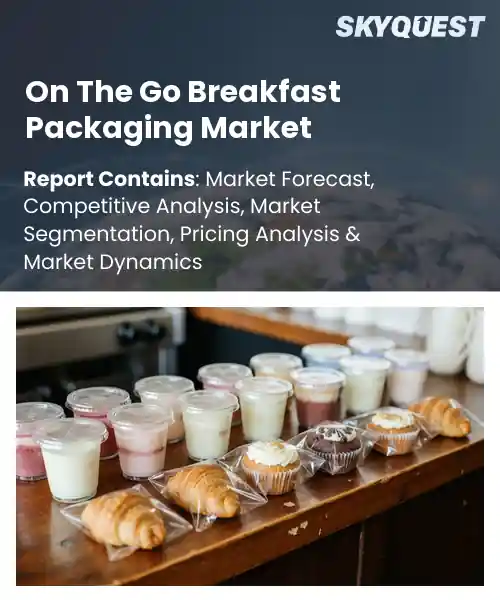
On The Go Breakfast Packaging Market
Report ID: SQMIG15H2216
Report ID: SQMIG15H2216
[email protected]
USA +1 351-333-4748
Report ID:
SQMIG15H2216 |
Region:
Global |
Published Date: June, 2026
Pages:
157
|Tables:
145
|Figures:
78


Global On The Go Breakfast Packaging Market size was valued at USD 28.52 Billion in 2024 and is poised to grow from USD 30.27 Billion in 2025 to USD 48.85 Billion by 2033, growing at a CAGR of 6.12% during the forecast period (2026-2033).
The primary driver of the on the go breakfast packaging market is changing consumer lifestyles prioritizing convenience, reshaping product design and retail strategies worldwide. The market for single-use meal items includes single-serve cereal cups, yogurt containers, and ready-to-eat sandwiches that are packaged in type of barrier pouch to maintain their freshness during transportation. As more people live in urban areas and work longer hours, there is an increased demand for portable nutrition and consequently, the companies that produce these items are having to innovate new materials, portion sizes and branding. In the last 10 years, there has been significant improvement in the use of flexible packaging, microwaveable trays and recyclable plastics for distribution via convenience stores, delivery services and workplace vending throughout the world.
Building on the convenience trend, a key factor driving global growth is the shift to sustainable functional packaging because stricter regulation and greener consumers force manufacturers to redesign packs that preserve shelf life while meeting environmental standards. In order to provide additional freshness and aid in shipping directly to work locations, businesses are investing in compostable fiber trays, recyclable polymers, and barrier coatings. For example, there are companies that have begun using mono-material cups for plastic recycling at curbside locations whereas companies that make sandwiches are starting to use compostable trays for their corporate catering customers. Although these changes increase costs, it also positions companies as premium and creates opportunities for partnering with logistics and recycling companies globally, therefore increasing market access through circular solutions internationally.
How is Automation Improving Efficiency in the On-the-go Breakfast Packaging Market?
Automation is revolutionizing on-the-go breakfast packaging with the integration of robotics, automated dispensing, computer-based quality control and total control systems operating as one combined unit to create higher throughput and consistency in production process. Specific examples include, precise dispensing for bar and/or yogurt products; robotic pick and place of sandwich products; and inline quality checks to reduce reject rates. Current market trends show that companies are modernizing their equipment to employ modular, data-linked lines which allow short product runs and rapid product changes, while also enhancing physical safety through efficient sanitation practices and reducing product waste.
In May 2026, MULTIVAC showcased AI driven Smart Production and automated traysealer solutions that integrate robotics and predictive monitoring to cut downtime and enable faster, more flexible on the go breakfast packaging lines. This innovation supports efficiency by improving line availability and easing changeovers.
Market snapshot - (2026-2033)
Global Market Size
USD 28.52 Billion
Largest Segment
Single-Serve Pouches
Fastest Growth
Stick Packs
Growth Rate
6.12% CAGR
To get more insights on this market click here to Request a Free Sample Report
Global on the go breakfast packaging market is segmented by packaging type, material, product category, end-use, distribution and region. Based on packaging type, the market is segmented into single-serve pouches, cups & bowls, stick packs, bar wrappers and bottles & tetra packs. Based on material, the market is segmented into flexible plastic films, paper/paperboard and aluminum foil laminate. Based on product category, the market is segmented into cereals & granola, protein bars, yogurt & dairy and beverages. Based on end-use, the market is segmented into retail and foodservice. Based on distribution, the market is segmented into fmcg brands and contract packers. Based on region, the market is segmented into North America, Europe, Asia Pacific, Latin America and Middle East & Africa.
Single serve pouches segment dominates because their compact, lightweight format directly aligns with consumer demand for convenience and portion control in on the go breakfasts. Their form accommodates dry and wet formulations, preserves product quality through tailored barrier structures, and supports high-impact branding for impulse purchase. Increased adoption rates across both retail and convenience stores are due to reduced logistical and storage costs, as well as their capacity to be used on automated filling machinery; these factors have all contributed to manufactured complexity.
However, stick packs are witnessing strongest growth as they enable single-portion powders and concentrates ideal for instant breakfasts, use minimal material, and integrate with high-speed filling lines. Their precise dosing, low logistics footprint, and appeal to subscription and vending models accelerate innovation and create new retail and convenience opportunities in on the go breakfasts.
Flexible plastic films segment dominates because their versatility and barrier engineering enable a wide range of on the go breakfast formats while preserving freshness and texture. They easily create bags, stick packs and wrappers, allow for high quality printing to differentiate brands from one another, and reduce the weight of packaging, allowing for greater efficiency in distributing products. Compatibility with high speed filling lines and realability will lower the total cost to manufacturers. Therefore, customers will be more likely to use standardized films throughout their entire product line.
However, paper/paperboard is emerging fastest as sustainability pressures and improved barrier coatings make recyclable formats practical for dry breakfasts. Better printability and structural designs enable premium shelf appeal while letting brands promote environmental claims, aligning with consumer demand and regulatory drivers that accelerate adoption across on the go breakfast packaging applications.
To get detailed segments analysis, Request a Free Sample Report
North America dominates due to a convergence of consumer behavior, industry capability, and distribution sophistication that favors portable breakfast solutions. Consumers are living hectic lives and require innovative packaging for their convenience use products, such as fast food chains and convenience stores. As a result, there is a high demand for flexible film, barrier technology, and automated production capabilities by regional film converters and global flexible packaging companies. Legislators are also making food safety legislation and retailers are making corporate commitments to recyclability and compostability, thus encouraging innovation in materials. Manufacturers, retailers and flexible packaging suppliers have been able to work together through the use of integrated supply chains and omnichannel retailing, creating a very fast time to market for products.
On the go breakfast packaging market in the United States is shaped by advanced retail networks, strong commuter culture, and leading manufacturers driving innovation in recyclable materials. Firms focus on convenience functionalities, resealable closures, and single-serve formats suited to quick consumption. Private label and premium products, along with brand, converter, and retailer collaborations, increase the speed of sustainable material use and create a more diverse product offering on the shelves of grocery and convenience stores, demonstrating real value for practical packaging.
On the go breakfast packaging market in Canada benefits from a diverse retail landscape, strong emphasis on sustainability, and growing consumer preference for convenient meals. Manufacturers and packagers work together to customize serving sizes and barrier performance of breakfast components in chilled or shelf-stable formats for food brands. Using regional distribution relationships, as well as foodservice agreements, demonstrates the ability to experiment with compostable substrates and recyclable structures.
Rapid expansion across Europe is propelled by evolving consumer lifestyles, regulatory emphasis on sustainable packaging, and an increasingly sophisticated retail landscape that rewards portable breakfast formats. Changing lifestyles and urban living have created an increased need for foodservice operators and retailers to provide grab-and-go options that are different from each other. In addition, various policies provide a framework that encourage foodservice operators and retailers to provide recyclable or compostable materials, which requires material innovation and redesign of both primary and secondary packaging to achieve this goal. Foodservice operators and retailers want to provide customers with at least as many convenient options as possible. The large number of converter networks and the increase of cross-border trading will create an environment in which on-the-go breakfast packaging can be expanded into the grocery, convenience, and e-commerce channels.
On the go breakfast packaging market in Germany benefits from a strong industrial base and material science expertise, reinforced by rigorous regulatory standards that emphasize safety and quality. Converters and manufacturers of equipment are placing emphasis on barriers, production efficiency, and recyclable solutions specifically for breakfast items that will be transported. The domestic market and exports require continual refining of formats and improving sustainability so that Germany is the leader in the local market for technical packaging innovations and processing efficiencies.
On the go breakfast packaging market in the United Kingdom is characterized by agile retail channels, a vibrant start up ecosystem, and strong consumer appetite for convenience on the go options. Packaging firms emphasize lightweight solutions, recyclable and compostable substrates, and user friendly closures suited to commuting lifestyles. A cooperative approach between equipment manufacturers, retailers and engineers will speed up the movement of products through product improvement and delivery via various types of packaging offered for breakfast.
On the go breakfast packaging market in France is emerging through a blend of artisanal food culture and increasing demand for convenient options. Stretching paper, using paper packaging instead of plastics, repurposing used containers, using recycled materials, and adding freshness coverings to breakfast items all demonstrate Premium Packaging Strategy. Experimentation with compostable materials and labels encourages cooperation between retailers and boutique food service providers. The packaging of portable breakfast items benefits from a growing number of industry investments and conversations about how to adopt circular design standards.
Asia Pacific is strengthening its role through rapid modernization of retail channels, distinctive convenience habits, and advanced capabilities in packaging technology and automation. The increasing availability of mature convenience store networks, combined with a demand for on-the-go convenience typically associated with portable breakfast foods, has resulted in the need for smaller, sturdier, more effective ways to package these types of foods in a way that preserves freshness and is convenient for commuters. The manufacturing industry has invested in utilizing barrier innovations, implementing lightweight structures, and developing more efficient methods of filling and sealing to extend their shelf life and make the products easier to transport. The greater awareness of sustainability is creating an opportunity for the use of recyclable or biodegradable materials in packaging, while a collaborative approach to food brands and packaging engineers is resulting in a localized approach to implementing globally developed innovative designs.
On the go breakfast packaging market in Japan emphasizes precision, high quality standards, and widespread acceptance of ready to eat morning options. Compact form factors, a strong barrier to air, moisture, odor, and light, and a clear communication of freshness and convenience all influence how packaging is developed today. Sustainable material trials and an efficient distribution network also support continued innovations that provide packaging solutions adaptable to dense urban lifestyles and consumer expectations.
On the go breakfast packaging market in South Korea is driven by dense convenience retail networks and rapid product renewal. The collaborative efforts of food brands, packaging converters and retail stores allows for rapid introduction of new products into the marketplace and encourages material experimentation. Logistics that support efficient distribution of ready to eat breakfast foods across urban and suburban lifestyles also includes compact packaging design so that they can be easily transported.
To know more about the market opportunities by region and country, click here to
Buy The Complete Report
Increasing Consumer Demand For Convenience
Innovation In Sustainable Materials
High Cost Of Advanced Packaging
Complex Regulatory Compliance Requirements
Request Free Customization of this report to help us to meet your business objectives.
Competition in the global on the go breakfast packaging market centers on sustainability driven differentiation, faster retail rollouts, and pack format convenience. Incumbents pursue acquisitions and supply partnerships to secure recyclable and cold chain formats, exemplified by SIG’s recent packaging portfolio moves and Amcor’s recyclable flow pack innovations. Brand product pushes such as Kellogg’s Instabowls and DTC cereal rollouts force rapid packaging redesigns and retailer collaboration.
Top Player’s Company Profile
Recent Developments
SkyQuest’s ABIRAW (Advanced Business Intelligence, Research & Analysis Wing) is our Business Information Services team that Collects, Collates, Correlates, and Analyses the Data collected by means of Primary Exploratory Research backed by robust Secondary Desk research.
As per SkyQuest analysis, a key driver is changing consumer lifestyles that prioritize convenience and portable nutrition, and a second driver is the rapid shift toward sustainable functional packaging driven by regulation and consumer demand. A key restraint is the high cost of advanced materials and specialty closures which can limit adoption among smaller brands. The dominating region is North America thanks to mature retail networks and strong converter capabilities, and the dominating segment is Single-Serve Pouches, favored for portability, barrier performance and compatibility with automated filling lines. Overall, innovation in materials and automation will shape competitive positioning and product rollout.
| Report Metric | Details |
|---|---|
| Market size value in 2024 | USD 28.52 Billion |
| Market size value in 2033 | USD 48.85 Billion |
| Growth Rate | 6.12% |
| Base year | 2024 |
| Forecast period | (2026-2033) |
| Forecast Unit (Value) | USD Billion |
| Segments covered |
|
| Regions covered | North America (US, Canada), Europe (Germany, France, United Kingdom, Italy, Spain, Rest of Europe), Asia Pacific (China, India, Japan, Rest of Asia-Pacific), Latin America (Brazil, Rest of Latin America), Middle East & Africa (South Africa, GCC Countries, Rest of MEA) |
| Companies covered |
|
| Customization scope | Free report customization with purchase. Customization includes:-
|
To get a free trial access to our platform which is a one stop solution for all your data requirements for quicker decision making. This platform allows you to compare markets, competitors who are prominent in the market, and mega trends that are influencing the dynamics in the market. Also, get access to detailed SkyQuest exclusive matrix.
Table Of Content
Executive Summary
Market overview
Parent Market Analysis
Market overview
Market size
KEY MARKET INSIGHTS
COVID IMPACT
MARKET DYNAMICS & OUTLOOK
Market Size by Region
KEY COMPANY PROFILES
Methodology
For the On The Go Breakfast Packaging Market, our research methodology involved a mixture of primary and secondary data sources. Key steps involved in the research process are listed below:
1. Information Procurement: This stage involved the procurement of Market data or related information via primary and secondary sources. The various secondary sources used included various company websites, annual reports, trade databases, and paid databases such as Hoover's, Bloomberg Business, Factiva, and Avention. Our team did 45 primary interactions Globally which included several stakeholders such as manufacturers, customers, key opinion leaders, etc. Overall, information procurement was one of the most extensive stages in our research process.
2. Information Analysis: This step involved triangulation of data through bottom-up and top-down approaches to estimate and validate the total size and future estimate of the On The Go Breakfast Packaging Market.
3. Report Formulation: The final step entailed the placement of data points in appropriate Market spaces in an attempt to deduce viable conclusions.
4. Validation & Publishing: Validation is the most important step in the process. Validation & re-validation via an intricately designed process helped us finalize data points to be used for final calculations. The final Market estimates and forecasts were then aligned and sent to our panel of industry experts for validation of data. Once the validation was done the report was sent to our Quality Assurance team to ensure adherence to style guides, consistency & design.
Analyst Support
Customization Options
With the given market data, our dedicated team of analysts can offer you the following customization options are available for the On The Go Breakfast Packaging Market:
Product Analysis: Product matrix, which offers a detailed comparison of the product portfolio of companies.
Regional Analysis: Further analysis of the On The Go Breakfast Packaging Market for additional countries.
Competitive Analysis: Detailed analysis and profiling of additional Market players & comparative analysis of competitive products.
Go to Market Strategy: Find the high-growth channels to invest your marketing efforts and increase your customer base.
Innovation Mapping: Identify racial solutions and innovation, connected to deep ecosystems of innovators, start-ups, academics, and strategic partners.
Category Intelligence: Customized intelligence that is relevant to their supply Markets will enable them to make smarter sourcing decisions and improve their category management.
Public Company Transcript Analysis: To improve the investment performance by generating new alpha and making better-informed decisions.
Social Media Listening: To analyze the conversations and trends happening not just around your brand, but around your industry as a whole, and use those insights to make better Marketing decisions.
REQUEST FOR SAMPLE
 REQUEST FREE CUSTOMIZATION
Global On The Go Breakfast Packaging Market size was valued at USD 28.52 Billion in 2024 and is poised to grow from USD 30.27 Billion in 2025 to USD 48.85 Billion by 2033, growing at a CAGR of 6.12% during the forecast period (2026-2033).
Competition in the global on the go breakfast packaging market centers on sustainability driven differentiation, faster retail rollouts, and pack format convenience. Incumbents pursue acquisitions and supply partnerships to secure recyclable and cold chain formats, exemplified by SIG’s recent packaging portfolio moves and Amcor’s recyclable flow pack innovations. Brand product pushes such as Kellogg’s Instabowls and DTC cereal rollouts force rapid packaging redesigns and retailer collaboration. 'Amcor plc', 'Sealed Air Corporation', 'Berry Global Group', 'Sonoco Products', 'Mondi Group', 'Smurfit Kappa Group', 'WestRock Company', 'DS Smith', 'Coveris Holdings', 'Constantia Flexibles', 'ProAmpac LLC', 'Huhtamaki Oyj', 'Graphic Packaging International', 'Silgan Holdings', 'Bemis Company (Amcor)', 'Transcontinental Inc.', 'Pactiv Evergreen', 'Novatek International', 'StandUp Pouches', 'Benda-Lutz Werke'
Consumers lead increasingly busy lives and seek breakfast solutions that save time while maintaining freshness and taste, prompting manufacturers to design portable, easy-to-open, and spill-resistant packages. On-the-go formats allow brands to create single-serve offerings that fit consumption occasions outside the home, enhance shelf presence at convenience and retail points, and support distribution across multiple channels. This alignment between lifestyle preferences and packaging capabilities encourages investment in functional materials and formats that improve convenience, thereby expanding product assortments and stimulating market growth.
Sustainable Material Adoption: Brands and converters are prioritizing renewable, compostable, and recyclable substrates for on-the-go breakfast packaging to align with consumer expectations and corporate sustainability goals. Emphasis on easily sourced bio-based polymers, fiber-based solutions, and mono-material designs reduces lifecycle complexity while enhancing end-of-life management. This shift drives collaboration across supply chains, innovation in barrier technologies compatible with recycled streams, and marketing differentiation centered on transparency. Packaging strategies now balance functional performance, tactile experience, and environmental value to maintain convenience without compromising sustainability narratives.
Why does North America Dominate the Global On The Go Breakfast Packaging Market? |@12


Want to customize this report? This report can be personalized according to your needs. Our analysts and industry experts will work directly with you to understand your requirements and provide you with customized data in a short amount of time. We offer $1000 worth of FREE customization at the time of purchase.
Feedback From Our Clients


 USA (+1) 351-333-4748

