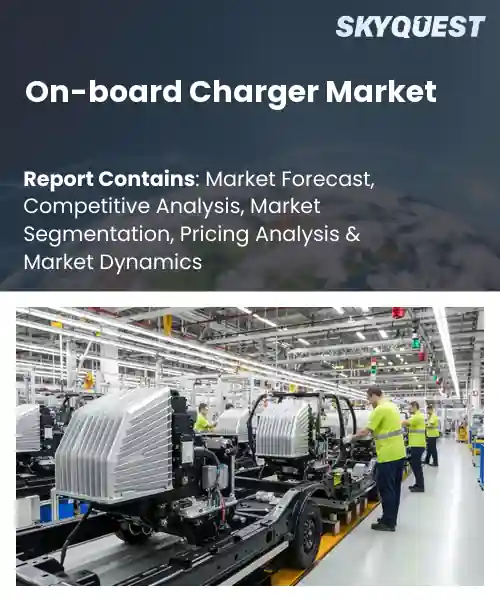
On-board Charger Market
Report ID: SQMIG25A2662
Report ID: SQMIG25A2662
[email protected]
USA +1 351-333-4748
Report ID:
SQMIG25A2662 |
Region:
Global |
Published Date: May, 2026
Pages:
157
|Tables:
202
|Figures:
80


Global On-Board Charger Market size was valued at USD 8.45 Billion in 2024 and is poised to grow from USD 9.9 Billion in 2025 to USD 35.25 Billion by 2033, growing at a CAGR of 17.2% during the forecast period (2026-2033).
On-board chargers are vehicle-integrated power electronics that convert grid alternating current to battery direct current and they form a critical link in the electric mobility value chain as consumers and fleets shift away from internal combustion engines. Its primary driver has been accelerating adoption of electric vehicles worldwide, driven by policy incentives, declining battery costs and growing consumer acceptance, which together expanded demand for more efficient and compact onboard charging solutions. Historically the market moved from simple low-power chargers to compact, higher-power units using silicon carbide semiconductors and smart thermal designs adopted by OEMs across mass-market and commercial segments globally.
Semiconductor advances represent the single most influential factor shaping global on-board charger market growth with silicon carbide and gallium nitride lowering losses and enabling smaller, cooler systems because OEMs increased integration and demand for higher charging rates. This technical progress causes manufacturers to offer chargers with higher kilowatt ratings and bidirectional capabilities, which in turn creates new business models such as vehicle-to-grid aggregation for grid balancing and fleet operators exploiting faster depot charging to increase vehicle utilization. Regulatory incentives and protocol standardization reduce integration friction, enabling suppliers and fleet operators to monetize chargers through services like V2G and faster depot turnaround.
How is AI improving efficiency in the on-board charger market?
AI improves efficiency in the on-board charger industry by enabling smarter power conversion and system level management. The current state shows software driven power electronics stacks that reduce losses extend component life and simplify diagnostics. Market context is supportive as electrification raises demand for compact efficient chargers that must balance charging speed and thermal limits. Examples include AI driven operations platforms and sensor enabled charger modules that feed models for predictive maintenance and optimization.
Infineon February 2026, announced its CoolSiC MOSFETs were adopted in Toyota bZ4X on board charger, a hardware step that paired with AI driven control and sensor data allows chargers to run closer to optimal efficiency while improving thermal management and enabling predictive maintenance.
Market snapshot - (2026-2033)
Global Market Size
USD 8.45 Billion
Largest Segment
3.3–11 kW
Fastest Growth
Above 11 kW
Growth Rate
17.2% CAGR
To get more insights on this market click here to Request a Free Sample Report
Global on-board charger market is segmented by power rating, vehicle type, propulsion type, charging type, application, distribution channel, end user and region. Based on power rating, the market is segmented into Below 3.3 kW, 3.3–11 kW and Above 11 kW. Based on vehicle type, the market is segmented into Battery Electric Vehicles (BEVs), Plug-in Hybrid Electric Vehicles (PHEVs), Commercial Electric Vehicles and Others. Based on propulsion type, the market is segmented into Passenger Vehicles, Commercial Vehicles, Two & Three Wheelers and Others. Based on charging type, the market is segmented into AC On-Board Chargers and DC On-Board Chargers. Based on application, the market is segmented into Residential Charging, Commercial Charging, Public Charging Infrastructure, Fleet Charging and Others. Based on distribution channel, the market is segmented into OEM and Aftermarket. Based on end user, the market is segmented into Automotive Manufacturers, Charging Infrastructure Providers, Fleet Operators, Individual Consumers and Others. Based on region, the market is segmented into North America, Europe, Asia Pacific, Latin America and Middle East & Africa.
As per on-board charger market regional outlook, 3.3 to 11 kW segment dominates the market due to its optimal balance of charging speed, thermal limitations, space restrictions, and cost for the majority of passenger vehicles. Furthermore, its compatibility with most common AC supply infrastructure helps simplify vehicle electrical architecture and reduce the complexity of Original Equipment Manufacturer (OEM) design and therefore promotes standardization of specifications for this power class. This also creates supplier scale and improves availability of components while simultaneously entrenching this power class as the practical power class for residential and commercial onboard charging applications.
As per on-board charger market regional analysis, above 11 kW is rapidly expanding as demand for higher onboard charging power grows with larger battery capacities and tighter vehicle utilization cycles. Advances in cooling, power electronics and high-voltage integration have helped eliminate previous barriers to achieving higher-powered onboard charging, enabling OEMs and fleet operators to better utilize onboard charging technologies, leading to improved charging efficiencies and simplified charging logistics.
AC on board chargers segment dominates because their alignment with ubiquitous AC supply and established residential charging behavior reduces system complexity and cost pressure for manufacturers. The fact that lower thermal and packaging constraints make it easier to integrate across many vehicle platforms means that there will be more opportunities for wide-scale OEM adoption and for suppliers to specialize, which in turn supports standardization, predictable performance and reliable aftermarket support for all onboard charger products.
As per on-board charger market regional forecast, DC on board chargers segment is the fastest growing in the market. Improved converter efficiency and high voltage packaging reduce integration barriers, thereby providing fleets and commercial operators the ability to use onboard DC solutions, thereby decreasing their downtime and creating new value opportunities with respect to using their vehicles as a source of grid services.
To get detailed segments analysis, Request a Free Sample Report
As per global on-board charger market regional outlook, Asia Pacific dominates the market due to a combination of concentrated automotive manufacturing, mature component ecosystems and coordinated industry policies that favor electrified mobility. Regional suppliers benefit from integrated supply chains, proximity to leading battery and semiconductor manufacturers, and strong engagement from original equipment manufacturers that prioritize local sourcing and technical collaboration. Market scale provides manufacturers with learning curves and cost efficiencies, while innovation clusters accelerate development of higher-efficiency and compact charger designs.
Japan on-board charger market is driven by advanced engineering expertise, collaborative partnerships between automakers and their component suppliers, as well as a culture of innovation emphasizing incremental improvements in efficiency & reliability of design. Japanese manufacturers are focusing on developing compact, high density solutions for Vehicles with high-end/luxury applications.
As per global on-board charger market regional forecast, South Korea demonstrates a strong synergy between top-tier electronics suppliers and automotive OEMs culminating in the rapid adoption of state-of-the-art silicon package designs. There is a strong push for on-board chargers to interface with automobile architecture & connectivity, which drives forward development and adoption of modular, scalable charger platforms. Additionally, local electronic supply chains are mature, and a wealth of experience in high-volume production of electronic components has produced collaborative relationships with local research institutions that will support improvements in thermal management and compact packaging of charging systems in both passenger automobile and commercial vehicle applications.
As per global on-board charger industry analysis, rapid expansion in Europe is driven by coordinated policy initiatives, active engagement from established automotive manufacturers, and a concerted push toward interoperability and consumer convenience. The regional market benefits from a cluster of specialized suppliers and testing facilities that accelerate validation of multi-standard on-board charger solutions tailored to diverse vehicle architectures. Public and private investment in charging infrastructure complements OEM strategies, encouraging broader adoption across passenger and commercial fleets. Regulatory emphasis on energy efficiency and emissions reduction motivates innovation toward lighter, more efficient charger topologies and greater integration with vehicle energy management systems. Collaboration between technology providers, utilities and research institutions supports standardization efforts while strong aftermarket channels ensure serviceability and localized customization, reinforcing Europe position in advanced charger solutions.
On-board charger market in Germany is anchored by established automotive OEMs and engineering expertise that prioritize robust, high-quality solutions. Local suppliers focus on scalable architectures, rigorous testing and compliance with safety standards, enabling reliable integration across premium and volume market platforms. Collaborative relationships between manufacturers, universities and test houses drive continual refinement of thermal management and electromagnetic compatibility. Strong industrial clusters support prototyping, industrialization and aftersales support across vehicle segments.
On-board charger market in United Kingdom is shaped by dynamic start-ups, technology suppliers and growing emphasis on flexible, software-enabled charger solutions. Market participants prioritize modular architectures and over-the-air capabilities that align with evolving consumer expectations and fleet electrification strategies. Close collaboration between tier suppliers and mobility providers supports trials of interoperable systems, while research initiatives foster lightweight designs and enhanced power electronics that address urban vehicle performance and serviceability needs.
France is primarily made up of innovative start-up companies and established suppliers that focus on providing compact, high efficiency charging products for many different modes of transportation. The increased focus on incorporating renewable energy and smart grid technologies into the construction of new charging stations, is driving the development of a greater number of products that are designed to facilitate the flow of energy in both directions and for use in intelligent energy management systems. There are a number of pilot programs that are being conducted between energy suppliers, automotive manufacturers and technology suppliers to accelerate testing and validation of interoperable systems and local engineering capability has enabled the adaptation of these new products to be used for urban delivery and commercial vehicle applications and for export.
Through collaborative actions of OEMs, technology providers and utilities, North America is enhancing its ability to deliver high-performance and resilient on-board charging solutions. The market is gaining momentum due to the capabilities of power electronics and semiconductors, expansion of testing infrastructure, and partnerships between vehicle integration and grid services. The industry is focusing on modular and software-defined chargers with bidirectional capabilities that provide greater flexibility for fleet and consumer use cases, as well as ongoing pilot projects between utilities and fleet operators to demonstrate both interoperability and grid responsiveness. Local manufacturing initiatives and supplier diversity are improving supply chain resilience. The region’s active R&D; venture capital investment; and entrepreneurial ecosystem are accelerating the commercialization of innovative topologies, thermal management methods, and compact packaging to put the area in a competitive position to serve both the passenger and commercial vehicle markets. Additionally, regulatory and industry organizations are working together to support standardization and cross-border collaboration to facilitate scalable product deployment and after-sales service ecosystems.
On-board charger market in United States is driven by the collaboration among automakers, power electronics specialists and utilities that prioritize scalable, high-efficiency solutions. Focus on silicon carbide, advanced thermal management and software-defined charging architectures supports development of compact high-power units. Pilot programs with fleets and integration testing facilities enable validation of interoperability and grid services. Ecosystem includes start-ups and established suppliers targeting passenger and commercial electrification pathways and aftermarket service support.
On-board charger market in Canada emphasizes robustness, cold-weather performance and integration with distributed energy resources. Partnerships between vehicle manufacturers, suppliers and utilities focus on chargers that deliver reliable thermal management for varied climates. Research centers and pilots support validation of grid-interactive and bidirectional features while an expanding supplier base and aftermarket networks enable tailored solutions for passenger, commercial and fleet electrification across regional markets and localized customization and lifecycle support.
To know more about the market opportunities by region and country, click here to
Buy The Complete Report
Rising Electric Vehicle Adoption
Demand For Faster Charging
High Component Costs
Grid Infrastructure Limitations
Request Free Customization of this report to help us to meet your business objectives.
Competitive dynamics in the global on-board charger industry are driven by semiconductor innovation and OEM and supplier partnerships that lower size and increase power density, intensifying supplier battles for SiC and GaN IP and vehicle programs. Examples include STMicroelectronics collaborating with innolectric on SiC OBC development, GaN specialists publishing reference designs, and strategic investments into charging service and OBC focused firms.
SkyQuest’s ABIRAW (Advanced Business Intelligence, Research & Analysis Wing) is our Business Information Services team that Collects, Collates, Correlates, and Analyses the Data collected by means of Primary Exploratory Research backed by robust Secondary Desk research.
As per SkyQuest analysis, the global on-board charger market growth is propelled by rising electric vehicle adoption, while high component costs remain a key restraint. Asia Pacific leads the market and the 3.3–11 kW power rating segment dominates due to its balance of speed, cost and packaging, and a second important driver is growing demand for faster charging that pushes OEMs toward higher-power, more efficient designs. Semiconductor advances such as SiC and GaN and software-defined control further enable higher power density and smarter thermal management but suppliers must manage component price pressures and grid readiness to translate technological gains into broader vehicle-level adoption.
| Report Metric | Details |
|---|---|
| Market size value in 2024 | USD 8.45 Billion |
| Market size value in 2033 | USD 35.25 Billion |
| Growth Rate | 17.2% |
| Base year | 2024 |
| Forecast period | (2026-2033) |
| Forecast Unit (Value) | USD Billion |
| Segments covered |
|
| Regions covered | North America (US, Canada), Europe (Germany, France, United Kingdom, Italy, Spain, Rest of Europe), Asia Pacific (China, India, Japan, Rest of Asia-Pacific), Latin America (Brazil, Rest of Latin America), Middle East & Africa (South Africa, GCC Countries, Rest of MEA) |
| Companies covered |
|
| Customization scope | Free report customization with purchase. Customization includes:-
|
To get a free trial access to our platform which is a one stop solution for all your data requirements for quicker decision making. This platform allows you to compare markets, competitors who are prominent in the market, and mega trends that are influencing the dynamics in the market. Also, get access to detailed SkyQuest exclusive matrix.
Table Of Content
Executive Summary
Market overview
Parent Market Analysis
Market overview
Market size
KEY MARKET INSIGHTS
COVID IMPACT
MARKET DYNAMICS & OUTLOOK
Market Size by Region
KEY COMPANY PROFILES
Methodology
For the On-board Charger Market, our research methodology involved a mixture of primary and secondary data sources. Key steps involved in the research process are listed below:
1. Information Procurement: This stage involved the procurement of Market data or related information via primary and secondary sources. The various secondary sources used included various company websites, annual reports, trade databases, and paid databases such as Hoover's, Bloomberg Business, Factiva, and Avention. Our team did 45 primary interactions Globally which included several stakeholders such as manufacturers, customers, key opinion leaders, etc. Overall, information procurement was one of the most extensive stages in our research process.
2. Information Analysis: This step involved triangulation of data through bottom-up and top-down approaches to estimate and validate the total size and future estimate of the On-board Charger Market.
3. Report Formulation: The final step entailed the placement of data points in appropriate Market spaces in an attempt to deduce viable conclusions.
4. Validation & Publishing: Validation is the most important step in the process. Validation & re-validation via an intricately designed process helped us finalize data points to be used for final calculations. The final Market estimates and forecasts were then aligned and sent to our panel of industry experts for validation of data. Once the validation was done the report was sent to our Quality Assurance team to ensure adherence to style guides, consistency & design.
Analyst Support
Customization Options
With the given market data, our dedicated team of analysts can offer you the following customization options are available for the On-board Charger Market:
Product Analysis: Product matrix, which offers a detailed comparison of the product portfolio of companies.
Regional Analysis: Further analysis of the On-board Charger Market for additional countries.
Competitive Analysis: Detailed analysis and profiling of additional Market players & comparative analysis of competitive products.
Go to Market Strategy: Find the high-growth channels to invest your marketing efforts and increase your customer base.
Innovation Mapping: Identify racial solutions and innovation, connected to deep ecosystems of innovators, start-ups, academics, and strategic partners.
Category Intelligence: Customized intelligence that is relevant to their supply Markets will enable them to make smarter sourcing decisions and improve their category management.
Public Company Transcript Analysis: To improve the investment performance by generating new alpha and making better-informed decisions.
Social Media Listening: To analyze the conversations and trends happening not just around your brand, but around your industry as a whole, and use those insights to make better Marketing decisions.
REQUEST FOR SAMPLE
 REQUEST FREE CUSTOMIZATION
Global On-Board Charger Market size was valued at USD 8.45 Billion in 2024 and is poised to grow from USD 9.9 Billion in 2025 to USD 35.25 Billion by 2033, growing at a CAGR of 17.2% during the forecast period (2026-2033).
Competitive dynamics in the global on board charger market are driven by semiconductor innovation and OEM and supplier partnerships that lower size and increase power density, intensifying supplier battles for SiC and GaN IP and vehicle programs. Examples include STMicroelectronics collaborating with innolectric on SiC OBC development, GaN specialists publishing reference designs, and strategic investments into charging service and OBC focused firms. 'Tesla, Inc.', 'BYD Company Limited', 'Delta Electronics, Inc.', 'BorgWarner Inc.', 'Bel Fuse Inc.', 'STMicroelectronics N.V.', 'Toyota Industries Corporation', 'Ficosa International S.A.', 'LG Electronics Inc.', 'Stercom Power Solutions GmbH', 'Kirloskar Electric Company Limited', 'Current Ways Inc.', 'innolectric AG', 'Eberspächer Gruppe GmbH & Co. KG', 'Brusa Elektronik AG', 'Shenzhen VMAX New Energy Co., Ltd.', 'Hyundai Mobis Co., Ltd.', 'Eaton Corporation plc', 'AVID Technology Limited', 'Infineon Technologies AG'
Growing acceptance of electric vehicles across consumer and commercial segments increases demand for integrated charging solutions, since manufacturers prioritize vehicle architectures that support onboard charging capability. As automakers expand model lineups, they design vehicles with space, power electronics, and thermal management optimized for onboard chargers, which encourages supplier investment and product development. Improved vehicle range expectations and convenience preferences motivate OEMs to include higher performance onboard chargers, reinforcing supplier pipelines and accelerating deployment of reliable, compact charging modules across global vehicle portfolios.
Software-Defined Charging Control: The shift toward software-centric on-board chargers enables continuous functional enhancement through over-the-air updates, adaptive control algorithms and interoperability across vehicle platforms. Manufacturers use software layers to optimize power conversion efficiency, thermal management and user experience while supporting multiple charging standards. This trend accelerates feature rollouts, eases integration with broader vehicle energy management systems and elevates aftermarket service models, emphasizing cybersecurity, modular software stacks and frequent functionality evolution as competitive differentiators rather than purely hardware-driven improvements.
Why does Asia Pacific Dominate the Global On-board Charger Market? |@12


Want to customize this report? This report can be personalized according to your needs. Our analysts and industry experts will work directly with you to understand your requirements and provide you with customized data in a short amount of time. We offer $1000 worth of FREE customization at the time of purchase.
Feedback From Our Clients


 USA (+1) 351-333-4748

