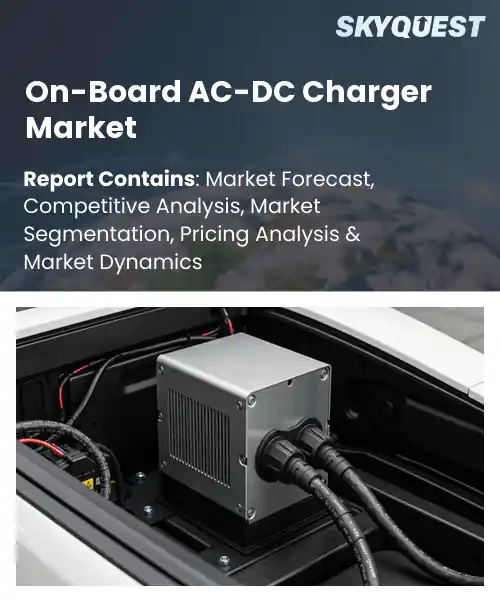
On-Board AC-DC Charger Market
Report ID: SQMIG20I2960
Report ID: SQMIG20I2960
[email protected]
USA +1 351-333-4748
Report ID:
SQMIG20I2960 |
Region:
Global |
Published Date: April, 2026
Pages:
157
|Tables:
90
|Figures:
76


Global On-Board Ac-Dc Charger Market size was valued at USD 6.82 Billion in 2024 and is poised to grow from USD 7.94 Billion in 2025 to USD 6.9 Billion by 2033, growing at a CAGR of 16.4% during the forecast period (2026-2033).
The on board AC to DC charger market focuses on devices inside electric vehicles that convert alternating current into DC for batteries, and its primary driver is the global shift to electrified transport driven by emissions rules and consumer appetite for cleaner vehicles. This market matters because onboard chargers provide predictable home charging and give automakers packaging flexibility; leading manufacturers have increased charger power and conversion efficiency over recent years. Capabilities moved from low power units under three kilowatts to modular higher power designs near eleven kilowatts as advances in power electronics and falling semiconductor prices cut system costs today.Building on falling component costs and onboard charger capability, the key factor is integration of chargers with vehicle electrification strategies to enable smart charging and bidirectional power flow because regulatory incentives and grid flexibility needs create demand for distributed energy resources. As manufacturers adopt higher battery voltages and power semiconductors, onboard chargers can support vehicle to grid services that offer revenue to fleet owners and provide peak shaving for utilities, as seen in Nissan LEAF pilots and fleet trials by Nuvve and Enel X. Consequently, opportunities arise for software driven services, aftermarket upgrades and partnerships between automakers and energy providers.
How is AI optimizing performance in the on-board ac-dc charger market?
AI is optimizing on board ac dc chargers by bringing software driven intelligence to power conversion and system management. Key aspects include adaptive switching strategies that lower electrical losses, model based thermal control that protects components, predictive maintenance that reduces unplanned service, and grid aware scheduling that aligns charging with network conditions. The market is moving from fixed control tables to edge AI in controller hardware and cloud assisted digital twins for testing and tuning. Practical instances are machine learning tuning of inverter timings and cloud feedback that adapts charging profiles to local grid constraints and vehicle needs.STMicroelectronics February 2026, unveiled the Stellar P3E MCU with an integrated Neural ART AI accelerator that consolidates inverter, dc dc and on board charger functions. Edge AI on this chip enables real time adaptive charging and thermal optimization which supports more efficient compact chargers and faster deployment by vehicle makers.
Market snapshot - (2026-2033)
Global Market Size
USD 6.82 Billion
Largest Segment
Sodium Polyacrylate (Dominant Segment)
Fastest Growth
Others (Bio-based/Partially Bio-based SAP)
Growth Rate
16.4% CAGR
To get more insights on this market click here to Request a Free Sample Report
Global on-board ac-dc charger market is segmented by chemical composition, application area, material origin and region. Based on chemical composition, the market is segmented into Sodium Polyacrylate (Dominant Segment), Polyacrylamide Copolymers and Others (Bio-based/Partially Bio-based SAP). Based on application area, the market is segmented into Personal Hygiene (Diapers/Incontinence Products), Agriculture (Water Retention), Medical & Wound Care and Others (Industrial & Cable Wrapping). Based on material origin, the market is segmented into Petrochemical-based SAP and Bio-based SAP. Based on region, the market is segmented into North America, Europe, Asia Pacific, Latin America and Middle East & Africa.
Sodium Polyacrylate segment dominates because its strong moisture-absorbing behavior and stable mechanical profile improve enclosure-level humidity control and connector reliability in on-board AC-DC chargers, reducing corrosion-related failures and maintenance costs. Its compatibility with standard potting and sealing processes and predictable interaction with thermal management materials encourages designers to specify it for durable, compact power modules, shaping procurement choices and design validation pathways across OEMs.
However, Polyacrylamide Copolymers are emerging as the fastest growing area in the On-Board AC-DC Charger Market due to their tunable rheology and crosslinking chemistry that enable thinner, lighter encapsulation with improved heat conduction. Rapid formulation innovation and increasing demand for bespoke material properties from power electronics suppliers accelerate adoption and create new opportunities for compact, serviceable charger architectures.
Petrochemical-based SAP segment dominates because mature manufacturing routes, consistent electrical and thermal behavior, and long-established qualification standards simplify integration into on-board AC-DC charger housings and potting systems, meeting stringent reliability and safety requirements. Reliable supply chains and cost-efficient scale production further reduce adoption friction for OEMs and tier suppliers, making these materials the default choice when optimizing compact power electronics for manufacturability and lifecycle stability.
However, Bio-based SAP is emerging as the fastest growing area in the On-Board AC-DC Charger Market as sustainability requirements and supplier commitments elevate demand. Improvements in bio-derived polymer performance and processing compatibility reduce trade-offs, enabling manufacturers to hit environmental targets while retaining electrical and thermal functionality, unlocking new procurement pathways.
To get detailed segments analysis, Request a Free Sample Report
Asia Pacific dominates the global on-board AC-DC charger market due to a confluence of manufacturing depth, supplier ecosystems, and demand dynamics that favor integrated charging solutions. Established vehicle manufacturers and tier one suppliers in the region prioritize in-house adoption and close collaboration with electronics specialists, enabling rapid incorporation of advanced charger topologies and semiconductor innovations. A strong component manufacturing base supports scale efficiencies and localized supply chains that reduce lead times and cost pressures. Market alignment between regulatory encouragement, urban charging infrastructure growth, and consumer acceptance sustains demand for versatile on-board charging options. Strategic partnerships between automakers, technology providers, and utilities further accelerate product refinement and deployment, reinforcing the region's competitive edge in both technology development and commercial rollout. Local research centers and testing facilities contribute to continuous improvement and validation.
On-Board AC-DC Charger Market in Japan is shaped by a concentration of legacy automakers and precision electronics suppliers that prioritize reliability and compact design. Domestic firms emphasize component quality, validation protocols, and integration with vehicle control systems. Close collaboration between manufacturers and technology providers supports adoption of refined charger architectures. Supply chain depth and a culture of incremental innovation help drive product enhancements and facilitate alignment with regional infrastructure.
On-Board AC-DC Charger Market in South Korea benefits from a robust electronics manufacturing base and close integration between vehicle builders and semiconductor suppliers. Firms emphasize compact, high efficiency designs and advanced power modules. Research institutions and R&D centers drive prototyping and validation of novel topologies. Strategic alliances with international automakers and local system integrators support customization for varied vehicle platforms. Focus on manufacturability and supply chain resilience underpins commercial readiness.
Rapid expansion of the on-board AC-DC charger market in Europe stems from coordinated regulatory frameworks, strong automotive engineering capabilities, and concentrated investment in electrified mobility. European OEMs and supplier networks focus on modular, interoperable charger solutions that align with regional grid standards and consumer expectations for convenience and safety. Cross-border collaboration and common standards facilitate scale for manufacturers and reduce complexity for integrators. The presence of advanced research institutions and a vibrant supplier base fosters continuous improvement in power electronics and thermal management. Strategic partnerships between vehicle makers, utilities, and technology firms accelerate deployment of integrated charging strategies that complement public infrastructure and private charging ecosystems, reinforcing market momentum across major national markets. National market nuances, including a focus on premium performance vehicles and aftermarket solutions, create diverse opportunities for suppliers and integrators.
On-Board AC-DC Charger Market in Germany is anchored by a dense network of established vehicle manufacturers and experienced suppliers that emphasize engineering excellence and validation. German firms prioritize scalable high reliability solutions for premium and commercial segments. Close ties to industrial automation and component manufacturing enable refined production processes. Collaboration with utilities and research centers supports systems integration and adherence to robust standards, reinforcing focus on quality and sustained performance.
On-Board AC-DC Charger Market in United Kingdom is characterized by innovation and a thriving ecosystem of technology start-ups and research centers pushing flexible charger designs and intelligent controls. Emphasis on software enabled energy management and integration with grid services distinguishes supplier strategies. Collaboration between fleet operators, mobility providers, and utilities accelerates deployment in commercial use cases. Investor interest and agile manufacturing support iteration and customization for domestic and export markets.
On-Board AC-DC Charger Market in France is emerging through coordinated efforts between innovative OEMs, electronics specialists, and policy that emphasize urban mobility and accessible charging solutions. French firms focus on integration with battery management systems and user interfaces tailored to city and fleet contexts. Collaboration with energy providers supports vehicle to grid compatibility and smart load management. A supportive industrial ecosystem and design for manufacturability foster advancement of relevant offerings.
North America is strengthening its position in the on-board AC-DC charger market through a blend of industrial innovation, strategic supply chain development, and closer collaboration between vehicle manufacturers and energy stakeholders. Automotive OEMs and emergent technology firms invest in modular charger platforms that emphasize interoperability, software driven energy management, and manufacturability. Grid modernization efforts and utility partnerships enable pilots for smart charging and vehicle to grid concepts, informing product specification. Growth in commercial fleet electrification and electrified vehicle segments stimulates demand for customized charger architectures. Cross border supply relationships and targeted investments in power electronics production create more resilient sourcing pathways and support competitive product rollout across regional markets. Shared focus on research and development, scale manufacturing, and standards alignment across the United States and Canada reinforces supplier capability and accelerates integration into diverse vehicle platforms.
On-Board AC-DC Charger Market in United States is driven by convergence of legacy automakers, technology firms, and start-ups focused on scalable charger platforms and software energy management. Emphasis on modular architectures and integration with fleet telematics supports commercial deployment. Collaboration with utilities and testing centers advances smart charging capabilities. Investments in domestic power electronics manufacturing and strategic supplier partnerships strengthen supply chain resilience and support adaptation to diverse vehicle architectures.
On-Board AC-DC Charger Market in Canada emphasizes collaborative development among manufacturers and research institutions to deliver reliable charging solutions suited to regional grid conditions. Canadian firms focus on power electronics and thermal management and integration with distributed energy resources. Partnerships with North American OEMs and system integrators enable adaptation of charger platforms for climates and fleet requirements. Supportive industrial clusters and manufacturing capabilities reinforce pathways from prototype to scalable products.
To know more about the market opportunities by region and country, click here to
Buy The Complete Report
Increasing Electric Vehicle Adoption
Advances In Power Electronics
High System Development Complexity
Interoperability and Standardization Challenges
Request Free Customization of this report to help us to meet your business objectives.
Competitive dynamics in the global onboard AC DC charger market are driven by semiconductor consolidation, OEM Tier 1 partnerships and specialist spin offs that accelerate SiC and GaN adoption. Infineon’s acquisition of GaN Systems illustrates M&A led scale. Faraday Future’s Meta System deal demonstrates OEM sourcing partnerships. Recent spin offs such as BRUSA HyPower highlight product level innovation and OEM targeted series production.
Top Player’s Company Profile
Recent Developments
SkyQuest’s ABIRAW (Advanced Business Intelligence, Research & Analysis Wing) is our Business Information Services team that Collects, Collates, Correlates, and Analyses the Data collected by means of Primary Exploratory Research backed by robust Secondary Desk research. As per SkyQuest analysis, the on-board AC-DC charger market is being propelled primarily by rising electric vehicle adoption, supported by a second key driver in rapid advances in power electronics that enable higher power density and lower costs. However, high system development complexity remains a material restraint, slowing time to market and favoring larger suppliers. Asia Pacific leads the market thanks to its deep manufacturing base and integrated supply chains, while the sodium polyacrylate segment dominates materials selection because of its moisture management and reliability benefits in charger enclosures. Overall, opportunities center on modular, bidirectional designs and software enabled services that link vehicles to the grid.
| Report Metric | Details |
|---|---|
| Market size value in 2024 | USD 6.82 Billion |
| Market size value in 2033 | USD 6.9 Billion |
| Growth Rate | 16.4% |
| Base year | 2024 |
| Forecast period | (2026-2033) |
| Forecast Unit (Value) | USD Billion |
| Segments covered |
|
| Regions covered | North America (US, Canada), Europe (Germany, France, United Kingdom, Italy, Spain, Rest of Europe), Asia Pacific (China, India, Japan, Rest of Asia-Pacific), Latin America (Brazil, Rest of Latin America), Middle East & Africa (South Africa, GCC Countries, Rest of MEA) |
| Companies covered |
|
| Customization scope | Free report customization with purchase. Customization includes:-
|
To get a free trial access to our platform which is a one stop solution for all your data requirements for quicker decision making. This platform allows you to compare markets, competitors who are prominent in the market, and mega trends that are influencing the dynamics in the market. Also, get access to detailed SkyQuest exclusive matrix.
Table Of Content
Executive Summary
Market overview
Parent Market Analysis
Market overview
Market size
KEY MARKET INSIGHTS
COVID IMPACT
MARKET DYNAMICS & OUTLOOK
Market Size by Region
KEY COMPANY PROFILES
Methodology
For the On-Board AC-DC Charger Market, our research methodology involved a mixture of primary and secondary data sources. Key steps involved in the research process are listed below:
1. Information Procurement: This stage involved the procurement of Market data or related information via primary and secondary sources. The various secondary sources used included various company websites, annual reports, trade databases, and paid databases such as Hoover's, Bloomberg Business, Factiva, and Avention. Our team did 45 primary interactions Globally which included several stakeholders such as manufacturers, customers, key opinion leaders, etc. Overall, information procurement was one of the most extensive stages in our research process.
2. Information Analysis: This step involved triangulation of data through bottom-up and top-down approaches to estimate and validate the total size and future estimate of the On-Board AC-DC Charger Market.
3. Report Formulation: The final step entailed the placement of data points in appropriate Market spaces in an attempt to deduce viable conclusions.
4. Validation & Publishing: Validation is the most important step in the process. Validation & re-validation via an intricately designed process helped us finalize data points to be used for final calculations. The final Market estimates and forecasts were then aligned and sent to our panel of industry experts for validation of data. Once the validation was done the report was sent to our Quality Assurance team to ensure adherence to style guides, consistency & design.
Analyst Support
Customization Options
With the given market data, our dedicated team of analysts can offer you the following customization options are available for the On-Board AC-DC Charger Market:
Product Analysis: Product matrix, which offers a detailed comparison of the product portfolio of companies.
Regional Analysis: Further analysis of the On-Board AC-DC Charger Market for additional countries.
Competitive Analysis: Detailed analysis and profiling of additional Market players & comparative analysis of competitive products.
Go to Market Strategy: Find the high-growth channels to invest your marketing efforts and increase your customer base.
Innovation Mapping: Identify racial solutions and innovation, connected to deep ecosystems of innovators, start-ups, academics, and strategic partners.
Category Intelligence: Customized intelligence that is relevant to their supply Markets will enable them to make smarter sourcing decisions and improve their category management.
Public Company Transcript Analysis: To improve the investment performance by generating new alpha and making better-informed decisions.
Social Media Listening: To analyze the conversations and trends happening not just around your brand, but around your industry as a whole, and use those insights to make better Marketing decisions.
REQUEST FOR SAMPLE
 REQUEST FREE CUSTOMIZATION


Want to customize this report? This report can be personalized according to your needs. Our analysts and industry experts will work directly with you to understand your requirements and provide you with customized data in a short amount of time. We offer $1000 worth of FREE customization at the time of purchase.
Feedback From Our Clients


 USA (+1) 351-333-4748

