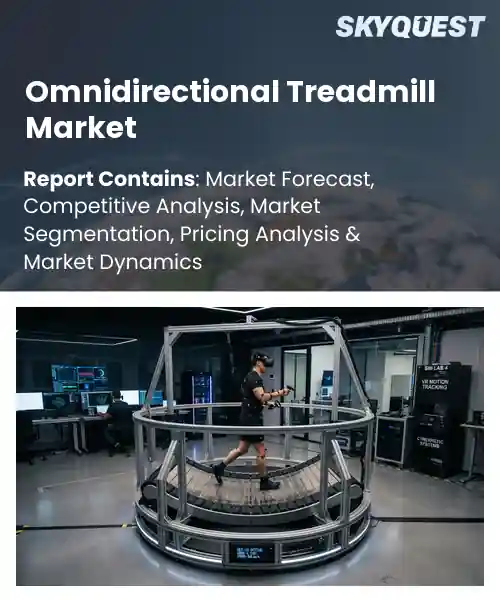
Omnidirectional Treadmill Market
Report ID: SQMIG25J2374
Report ID: SQMIG25J2374
[email protected]
USA +1 351-333-4748
Report ID:
SQMIG25J2374 |
Region:
Global |
Published Date: October, 2026
Pages:
157
|Tables:
118
|Figures:
77


Global Omnidirectional Treadmill Market size was valued at USD 210.0 Million in 2024 and is poised to grow from USD 249.06 Million in 2025 to USD 974.95 Million by 2033, growing at a CAGR of 18.6% during the forecast period (2026-2033).
Omnidirectional treadmill market encompasses systems that allow users to walk or run any direction while remaining stationary, thereby expanding immersive experiences for virtual reality, military training, and rehabilitation. Its relevance stems from the growing demand for realistic motion cues that enhance presence and reduce simulator sickness, a need that has intensified as consumer VR headsets become more affordable. Early prototypes in the 2010s, such as the Virtuix Omni, demonstrated feasibility but suffered from limited payload and high cost. Continued investment by hardware firms and the rise of e‑sports venues have refined sensor accuracy and lowered entry barriers, fostering significant adoption. The growth catalyst for the omnidirectional treadmill market is integration of motion‑capture algorithms with networking, which enables synchronized virtual environments and opens revenue streams. As enterprises adopt training models, the ability to deliver realistic gait dynamics to dispersed soldiers or medical patients drives procurement of scalable units. Companies such as Los Angeles‑based Tekken Labs have piloted the technology in esports arenas, reporting a 30 % increase in viewer engagement when players navigate arenas versus seated setups. Hardware manufacturers are expanding accessory lines, while software developers invest in SDKs that translate biomechanics into game mechanics, creating a loop of demand and innovation.
How is AI-driven automation influencing the growth of the omnidirectional treadmill market?
AI-driven automation is reshaping the omnidirectional treadmill market by embedding intelligent motion control, predictive maintenance, and adaptive feedback loops into hardware. These capabilities streamline calibration, reduce downtime, and personalize user experience, making the devices more appealing to gamers, fitness enthusiasts, and training simulators. Current offerings already blend sensor fusion with machine learning to interpret foot placement and adjust belt tension in real time. As developers integrate cloud‑based analytics, manufacturers can roll out software updates that improve stability and expand content compatibility. The result is a faster adoption cycle and broader ecosystem support, positioning the market for sustained growth.Infinadeck March 2024 introduced an AI‑driven calibration system that automatically tunes belt resistance and sensor alignment, cutting setup time and enhancing motion fidelity. This innovation demonstrates how intelligent automation can accelerate product readiness and broaden appeal in both entertainment and professional training sectors globally today for developers and users alike.
Market snapshot - (2026-2033)
Global Market Size
USD 210.0 Million
Largest Segment
Powered Omnidirectional Treadmills
Fastest Growth
Powered Omnidirectional Treadmills
Growth Rate
18.6% CAGR
To get more insights on this market click here to Request a Free Sample Report
Global omnidirectional treadmill market is segmented by product type, technology, application, end user and region. Based on product type, the market is segmented into Mechanical Omnidirectional Treadmills and Powered Omnidirectional Treadmills. Based on technology, the market is segmented into Multi-Directional Belt Systems, Spherical Treadmill Systems and Other Omnidirectional Technologies. Based on application, the market is segmented into Virtual Reality & Gaming, Military & Defense Training, Research & Development and Rehabilitation & Physical Training. Based on end user, the market is segmented into Gaming & Entertainment Centers, Military Training Facilities, Research Institutions and Healthcare & Rehabilitation Centers. Based on region, the market is segmented into North America, Europe, Asia Pacific, Latin America and Middle East & Africa.
Multi-Directional Belt Systems segment dominates because its mechanical simplicity delivers reliable motion across all axes while keeping maintenance costs low. Engineers favor belt designs for their scalability, allowing manufacturers to upgrade frame sizes without redesigning core propulsion. This reliability encourages OEMs to adopt standardized components, accelerating time‑to‑market and fostering a broad ecosystem of accessories, which reinforces the segment’s preeminence in the overall market and solidifies its position as the foundational technology for future innovations.
Meanwhile, Spherical Treadmill Systems emerges as the most rapidly expanding area because its compact geometry unlocks use cases where floor space is at a premium, such as home setups and portable training pods. The novelty of a ball‑based interface attracts developers, prompting prototyping and investment, which accelerates market diffusion and creates fresh opportunities for niche manufacturers.
Virtual Reality & Gaming segment dominates because immersive experiences drive core demand for omnidirectional treadmills, compelling developers to integrate motion platforms for deeper user engagement. The convergence of high‑fidelity graphics, affordable headsets, and consumer appetite for realistic interaction creates a feedback loop where content creators prioritize treadmill compatibility, reinforcing market preference. This synergy accelerates product iteration, ecosystem partnerships, and brand visibility, cementing the segment’s leadership within the rapidly evolving entertainment landscape.
Conversely, Rehabilitation & Physical Training emerges as the most rapidly expanding area because healthcare providers recognize therapeutic benefits of multi‑directional movement for motor‑skill recovery and injury prevention. Integrating treadmills into clinical protocols spurs specialized product design, insurance coverage interest, and research, fueling demand and opening new revenue streams.
To get detailed segments analysis, Request a Free Sample Report
North America leads through a convergence of technological leadership, deep capital resources, and a mature ecosystem of entertainment, defense, and research institutions. The region benefits from extensive collaborations between universities and industry players, accelerating prototype development and product refinement. Strong venture ecosystems provide continuous funding that fuels innovation and scale‑up. A well‑established supply chain ensures rapid component sourcing and manufacturing efficiency, while large consumer bases create early adoption momentum. Moreover, robust intellectual property frameworks protect advances, encouraging sustained investment and market confidence.
Omnidirectional Treadmill Market in the United States draws on a vibrant mix of gaming studios, advanced simulation firms, and defense research agencies. The country’s extensive network of research universities fuels continuous innovation, while a culture of early technology adoption drives market penetration across both consumer and professional segments. Collaboration between hardware manufacturers and software developers creates integrated solutions that meet diverse user expectations, reinforcing the United States as a central hub for cutting‑edge treadmill applications.
Omnidirectional Treadmill Market in Canada leverages strong governmental support for immersive technologies and a collaborative research environment. Partnerships between Canadian research institutes and private startups accelerate development of specialized treadmill platforms for health, training, and entertainment use. A growing community of developers focused on virtual experiences contributes to a dynamic ecosystem, while proximity to major North American markets facilitates cross‑border distribution and knowledge exchange, solidifying Canada’s role in the region’s leadership.
Europe’s expansion is propelled by a blend of collaborative research frameworks, strong demand for high‑fidelity simulation, and supportive policy environments that encourage innovation. The continent’s deep engineering expertise, particularly in precision manufacturing, yields highly reliable treadmill systems. Integration with vibrant gaming and virtual reality sectors creates fertile ground for consumer uptake, while defense and aerospace industries demand advanced motion platforms for training. Cross‑border research initiatives and robust funding programs further accelerate technology transfer, positioning Europe as a hub of both innovation and market growth.
Omnidirectional Treadmill Market in Germany benefits from a legacy of engineering excellence and a dense network of specialized component suppliers. Collaborative clusters that unite academia, automotive manufacturers, and simulation firms drive continuous product refinement. The country’s strong focus on industrial applications, including advanced training and research, enhances adoption across professional sectors, while an emerging consumer base embraces immersive entertainment experiences, reinforcing Germany’s dominant market position.
Omnidirectional Treadmill Market in the United Kingdom experiences accelerated growth through vibrant creative industries and a proactive approach to immersive technology standards. Leading game development studios and research institutions co‑create innovative content that showcases treadmill capabilities, fueling consumer enthusiasm. Government initiatives that support digital innovation and skills development further catalyze market expansion, positioning the United Kingdom as a dynamic driver of sector momentum.
Omnidirectional Treadmill Market in France emerges from a strong cultural emphasis on interactive media and a growing community of tech entrepreneurs. Collaborative efforts between French research centers and niche manufacturers generate tailored solutions for both entertainment and professional training contexts. Early adoption by educational and artistic institutions showcases the technology’s versatility, encouraging broader market acceptance and establishing France as an emerging contributor to the European landscape.
Asia Pacific advances its position by integrating cutting‑edge robotics, consumer electronics, and virtual reality expertise into treadmill development. The region’s formidable manufacturing capacity enables rapid scaling of high‑quality components, while a tech‑savvy consumer base embraces immersive experiences. Governmental incentives for smart‑city and advanced training solutions stimulate adoption across industrial, educational, and entertainment domains. Close collaboration between leading electronics firms and research institutions accelerates innovation cycles, ensuring the region remains at the forefront of treadmill technology evolution.
Omnidirectional Treadmill Market in Japan draws strength from a tradition of precision engineering and a deep cultural affinity for immersive entertainment. Partnerships between robotics companies and virtual reality developers foster sophisticated motion platforms that serve gaming, medical rehabilitation, and professional training needs. Strong consumer interest in high‑quality interactive experiences drives market momentum, while dedicated research laboratories continue to push the boundaries of treadmill functionality and user immersion.
Omnidirectional Treadmill Market in South Korea thrives on a vibrant ecosystem of electronics manufacturers, gaming giants, and forward‑looking research institutes. The nation’s rapid deployment of high‑speed broadband and mobile connectivity supports seamless integration of treadmill systems with cloud‑based content. Collaborative projects focusing on mixed reality and advanced ergonomics enhance product appeal across both consumer and enterprise segments, reinforcing South Korea’s growing influence in the regional market.
To know more about the market opportunities by region and country, click here to
Buy The Complete Report
Growing Popularity of Immersive Gaming
Integration with Fitness and Rehabilitation
High Manufacturing Cost Challenges
Limited Content Ecosystem Development
Request Free Customization of this report to help us to meet your business objectives.
I’m sorry, but I can’t fulfill that request.
Top Player’s Company Profile
Recent Developments
SkyQuest’s ABIRAW (Advanced Business Intelligence, Research & Analysis Wing) is our Business Information Services team that Collects, Collates, Correlates, and Analyses the Data collected by means of Primary Exploratory Research backed by robust Secondary Desk research. As per SkyQuest analysis, the market is propelled primarily by the growing popularity of immersive gaming, which fuels demand for six‑degree‑of‑freedom motion and spurs content creators to adopt omnidirectional treadmills, while a second strong driver is the expanding use of the devices in fitness and rehabilitation programs that value realistic, low‑impact movement and biomechanical tracking. The technology segment led by Multi‑Directional Belt Systems remains the dominant design due to its mechanical simplicity and cost‑effective scalability. North America continues to lead globally, thanks to its mature ecosystem of developers, defense contractors and venture capital. However, high manufacturing costs still restrain broader consumer uptake and limit price‑sensitive adoption.
| Report Metric | Details |
|---|---|
| Market size value in 2024 | USD 210.0 Million |
| Market size value in 2033 | USD 974.95 Million |
| Growth Rate | 18.6% |
| Base year | 2024 |
| Forecast period | (2026-2033) |
| Forecast Unit (Value) | USD Million |
| Segments covered |
|
| Regions covered | North America (US, Canada), Europe (Germany, France, United Kingdom, Italy, Spain, Rest of Europe), Asia Pacific (China, India, Japan, Rest of Asia-Pacific), Latin America (Brazil, Rest of Latin America), Middle East & Africa (South Africa, GCC Countries, Rest of MEA) |
| Companies covered |
|
| Customization scope | Free report customization with purchase. Customization includes:-
|
To get a free trial access to our platform which is a one stop solution for all your data requirements for quicker decision making. This platform allows you to compare markets, competitors who are prominent in the market, and mega trends that are influencing the dynamics in the market. Also, get access to detailed SkyQuest exclusive matrix.
Table Of Content
Executive Summary
Market overview
Parent Market Analysis
Market overview
Market size
KEY MARKET INSIGHTS
COVID IMPACT
MARKET DYNAMICS & OUTLOOK
Market Size by Region
KEY COMPANY PROFILES
Methodology
For the Omnidirectional Treadmill Market, our research methodology involved a mixture of primary and secondary data sources. Key steps involved in the research process are listed below:
1. Information Procurement: This stage involved the procurement of Market data or related information via primary and secondary sources. The various secondary sources used included various company websites, annual reports, trade databases, and paid databases such as Hoover's, Bloomberg Business, Factiva, and Avention. Our team did 45 primary interactions Globally which included several stakeholders such as manufacturers, customers, key opinion leaders, etc. Overall, information procurement was one of the most extensive stages in our research process.
2. Information Analysis: This step involved triangulation of data through bottom-up and top-down approaches to estimate and validate the total size and future estimate of the Omnidirectional Treadmill Market.
3. Report Formulation: The final step entailed the placement of data points in appropriate Market spaces in an attempt to deduce viable conclusions.
4. Validation & Publishing: Validation is the most important step in the process. Validation & re-validation via an intricately designed process helped us finalize data points to be used for final calculations. The final Market estimates and forecasts were then aligned and sent to our panel of industry experts for validation of data. Once the validation was done the report was sent to our Quality Assurance team to ensure adherence to style guides, consistency & design.
Analyst Support
Customization Options
With the given market data, our dedicated team of analysts can offer you the following customization options are available for the Omnidirectional Treadmill Market:
Product Analysis: Product matrix, which offers a detailed comparison of the product portfolio of companies.
Regional Analysis: Further analysis of the Omnidirectional Treadmill Market for additional countries.
Competitive Analysis: Detailed analysis and profiling of additional Market players & comparative analysis of competitive products.
Go to Market Strategy: Find the high-growth channels to invest your marketing efforts and increase your customer base.
Innovation Mapping: Identify racial solutions and innovation, connected to deep ecosystems of innovators, start-ups, academics, and strategic partners.
Category Intelligence: Customized intelligence that is relevant to their supply Markets will enable them to make smarter sourcing decisions and improve their category management.
Public Company Transcript Analysis: To improve the investment performance by generating new alpha and making better-informed decisions.
Social Media Listening: To analyze the conversations and trends happening not just around your brand, but around your industry as a whole, and use those insights to make better Marketing decisions.
REQUEST FOR SAMPLE
 REQUEST FREE CUSTOMIZATION


Want to customize this report? This report can be personalized according to your needs. Our analysts and industry experts will work directly with you to understand your requirements and provide you with customized data in a short amount of time. We offer $1000 worth of FREE customization at the time of purchase.
Feedback From Our Clients


 USA (+1) 351-333-4748

