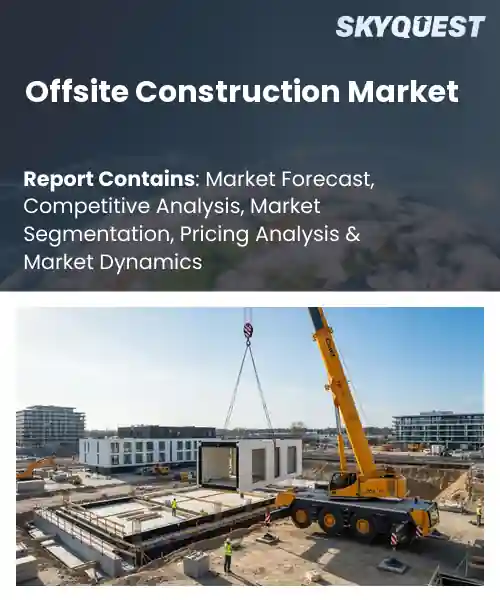
Offsite Construction Market
Report ID: SQMIG20I2846
Report ID: SQMIG20I2846
[email protected]
USA +1 351-333-4748
Report ID:
SQMIG20I2846 |
Region:
Global |
Published Date: April, 2026
Pages:
157
|Tables:
119
|Figures:
77


Global Offsite Construction Market size was valued at USD 164.2 Billion in 2024 and is poised to grow from USD 177.66 Billion in 2025 to USD 165.4 Billion by 2033, growing at a CAGR of 8.2% during the forecast period (2026-2033).
Offsite construction has emerged recently as a systems based approach in which building components are manufactured in controlled facilities and assembled on site; the primary driver is the imperative to deliver projects faster with greater predictability and quality amid labor shortages and housing demand. The market matters because factory production reduces on site disruption, improves worker safety, and enables repeatable delivery for schools, hospitals and multifamily housing. Historically the sector evolved from prefabrication in Japan and Scandinavia to volumetric modular programs in the United Kingdom and bathroom and accommodation pods in the United States, reflecting learning and gradual industrialization.A pivotal factor shaping offsite construction growth is integration of digital design and factory automation, because when BIM and automated manufacturing are combined they enable precise component fit, minimize on site assembly time, and cut rework, which in turn lowers lifecycle costs and raises confidence. As confidence grows, developers commission larger factories and standardized components, producing economies of scale that reduce unit prices and expand use cases from bathroom pods for hotels and student housing to rapid deployment modular hospitals and infrastructure elements; these effects catalyze investment, encourage policy alignment, and create further opportunities for affordable housing and resilient projects.
How is AI driving productivity gains in the offsite construction market?
AI is driving productivity in offsite construction by linking design, factory production and onsite assembly through continuous digital workflows. Key aspects are generative design that standardizes modules, digital twin simulation that validates buildability and logistics before manufacture, computer vision quality checks in factories, and AI scheduling that coordinates materials and transport. The market is shifting from isolated pilots to integrated factory ecosystems where data driven planning reduces rework and smooths labour needs. These shifts make prefabrication faster and more predictable and help firms scale repeatable higher quality units.SLB March 2026, announced a collaboration with NVIDIA to industrialize AI driven modular data center production, showing how AI enabled factory design and generative models speed prefabrication improve quality control through automated inspection and streamline logistics to support faster more reliable offsite construction delivery and help developers meet demand.
Market snapshot - (2026-2033)
Global Market Size
USD 164.2 Billion
Largest Segment
Sub-assemblies & Components
Fastest Growth
Volumetric/3D Modular Construction
Growth Rate
8.2% CAGR
To get more insights on this market click here to Request a Free Sample Report
Global offsite construction market is segmented by construction methodology, material base, application vertical, delivery model and region. Based on construction methodology, the market is segmented into Volumetric/3D Modular Construction, Panelized/2D Systems (Walls, Roofs, Floors), Hybrid Offsite Systems and Sub-assemblies & Components. Based on material base, the market is segmented into Steel-framed Offsite Units, Timber-based Modular Systems and Concrete/Precast Offsite Modules. Based on application vertical, the market is segmented into Residential Housing (Affordable & Luxury), Commercial Offices & Retail Outlets and Institutional Buildings (Schools/Hospitals/Prisons). Based on delivery model, the market is segmented into Permanent Modular Construction (PMC) and Relocatable/Temporary Buildings. Based on region, the market is segmented into North America, Europe, Asia Pacific, Latin America and Middle East & Africa.
Volumetric/3D modular construction segment dominates because its factory-integrated, three dimensional units compress onsite schedule and deliver high repeatable quality, reducing coordination risks and labor exposure. The integrated assembly of structural, mechanical and finish elements enables tighter cost control and faster handover, attracting developers and contractors. Combined with digital design workflows and standardized manufacturing processes, these factors drive adoption across project types and concentrate investment in volumetric production capacity.
However, panelized/2D systems are the fastest-growing area, gaining traction through flexible design adaptation, lower manufacturing complexity and reduced transport constraints. Advances in engineered panels, improved connection technologies and easier onsite integration enable rapid scaling into mid-rise and single family applications, unlocking new market niches and accelerating broader offsite adoption among builders seeking lower capital entry.
Timber-based modular systems segment dominates because engineered wood offers a compelling combination of low embodied carbon, lightweight handling and rapid prefabrication that aligns with sustainability and speed priorities. Manufacturers leverage predictable material properties to streamline fabrication and finish integration, while industry preference for biophilic aesthetics and regulatory incentives for low carbon construction further concentrate demand, creating a robust supply chain and development pipeline favoring timber solutions.
Meanwhile, concrete/precast offsite modules are experiencing the strongest growth driven by demand for durable, fire resistant and acoustically robust structures in institutional and heavy commercial applications. Innovations in lifted connection systems, faster onsite assembly methods and improved precast logistics support larger scale deployments, opening opportunities for long lifecycle projects and investment in high-capacity manufacturing.
To get detailed segments analysis, Request a Free Sample Report
Asia Pacific leads the global offsite construction market due to a convergence of strong manufacturing capabilities, policy support for industrialized building methods, and a deep pipeline of urban development and infrastructure projects. Robust supply chain networks and high levels of technology adoption enable efficient prefabrication and modular delivery. Labor market dynamics encourage manufacturers and developers to pursue factory based approaches that reduce on site labor intensity and improve quality control. Collaborative ecosystems among contractors, component suppliers, and technology vendors accelerate innovation. Regional centers with established expertise in precision manufacturing and materials science support scalable production, while market players benefit from regulatory frameworks that increasingly recognize and incentivize offsite methods. Close proximity between major construction markets also reduces logistics complexity and enables rapid deployment of standardized components across borders.
Offsite Construction Market in Japan reflects a mature manufacturing base and high standards for precision and quality. Strong integration between component fabricators and design firms supports complex modular systems tailored to urban infill and seismic resilience requirements. Emphasis on automation, advanced materials, and rigorous regulation fosters consistent quality and predictable delivery. Collaboration among technology providers, constructors, and government bodies promotes pilot programs that validate performance and encourage adoption across segments.
Offsite Construction Market in South Korea benefits from advanced industrial ecosystems and a strong tradition of industrialized construction methods. Integration of digital design workflows with factory production supports rapid iteration and customization for high density projects. A focus on modular apartment systems, efficient logistics, and collaboration between developers and manufacturers drives deployment. Government and private partnerships foster demonstrator projects that showcase lifecycle benefits and build market confidence for broader application.
Rapid expansion in North America is driven by a combination of labor market pressures, a push for faster delivery timelines, and increasing interest in sustainable, repeatable building solutions. Developers and contractors are seeking methods that reduce on site complexity and improve predictability, while manufacturers scale production of standardized components. Investment in digital design, automation, and integrated supply chains enhances coordination between design, fabrication, and assembly. Public and private initiatives that promote industrialized construction for housing and healthcare infrastructure create visible use cases, encouraging adoption. Mature logistics networks and a diversified project mix enable offsite techniques to be applied across residential, commercial, and institutional sectors, strengthening market momentum and fostering more sophisticated service offerings. Ecosystem players are collaborating on standards and certification pathways that reduce procurement friction and build client confidence.
Offsite Construction Market in the United States shows increasing factory capacity and integration of digital design with manufacturing workflows. Demand from multifamily housing, healthcare, and education supports adoption of standardized components and volumetric modules. Focus on reducing onsite labor and improving safety motivates trials of modular methods. Collaboration among architects, fabricators, and contractors refines design for manufacture, while institutional procurement begins to prefer repeatable, quality controlled construction approaches more widely.
Offsite Construction Market in Canada is shaped by emphasis on energy efficiency, remote site logistics, and scalable factory production to serve dispersed communities. Prefabrication and panelized systems reduce onsite challenges and support procurement for social housing projects. Provincial engagement and procurement pilots help validate technical standards and delivery models. Partnerships between local manufacturers and national developers promote regional capability building and encourage transfer of standardized practices across jurisdictions at scale.
Europe is strengthening its position through harmonized regulatory efforts, a strong focus on energy performance, and increasing collaboration across supply chains. Policymakers and industry bodies are aligning standards and certification to reduce fragmentation and enable cross border deployment of prefabricated systems. Emphasis on sustainability, lifecycle performance, and circularity encourages material innovation and reuse strategies within factory based processes. Robust cluster development combines specialized manufacturers, technology firms, and design consultancies to deliver tailored modular solutions for urban regeneration, social housing, and commercial projects. Investment in digital tools, skills development, and demonstrator projects helps de risk procurement and boosts confidence among public procurers and private developers, supporting broader adoption across diverse national markets. Cross sector partnerships and increased modular manufacturing capacity enable replication of proven solutions across multiple urban contexts.
Offsite Construction Market in Germany combines engineering excellence with strong industrial ecosystems and a focus on energy efficient buildings. Precision manufacturing integrated with building engineering yields high quality prefabricated components for varied applications. Collaboration among research institutes, manufacturers, and construction firms advances materials and assembly methods. Public procurement and private developers are recognizing benefits of factory based approaches for urban infill and commercial projects, encouraging scale up of modular production.
Offsite Construction Market in United Kingdom focuses on accelerated delivery, quality control, and rigorous building performance. Professional services support design for manufacture while manufacturers produce volumetric and panelized systems for residential and commercial work. Policy and procurement frameworks encourage pilot projects that showcase time and cost benefits. Collaboration among local authorities, developers, and supply chain partners builds skills and helps mainstream modular approaches across urban regeneration and public sector construction.
Offsite Construction Market in France advances through emphasis on energy performance, urban housing, and industrialized building techniques. Architects, manufacturers, and contractors collaborate to adapt modular systems to local regulatory and cultural contexts. Investment in modern factories and digital tooling supports customization and serial production. Pilot programs and public procurement for social housing demonstrate feasibility, while material innovation and circularity principles shape factory processes and promote adoption across metropolitan construction.
To know more about the market opportunities by region and country, click here to
Buy The Complete Report
Demand For Rapid Construction
Technological Advancements In Manufacturing
High Initial Capital Requirements
Regulatory and Code Complexity
Request Free Customization of this report to help us to meet your business objectives.
The competitive landscape in global offsite construction is marked by consolidation, tech arms races, and strategic partnerships driven by developer demand for faster delivery and the industry labor gap. Established manufacturers pursue acquisitions to secure factory capacity while software and robotics entrants push automation. Recent examples include Etex acquisitions in building materials, regional modular joint ventures, and startups commercializing factory automation and prefab design software.
Top Player’s Company Profile
Recent Developments
SkyQuest’s ABIRAW (Advanced Business Intelligence, Research & Analysis Wing) is our Business Information Services team that Collects, Collates, Correlates, and Analyses the Data collected by means of Primary Exploratory Research backed by robust Secondary Desk research. As per SkyQuest analysis, the global offsite construction market is driven primarily by demand for rapid construction that compresses schedules and improves predictability, while a key restraint remains the high initial capital requirements for factory setup and equipment. Asia Pacific is the dominating region, supported by strong manufacturing ecosystems and policy backing, and volumetric 3D modular construction is the dominating segment due to its integrated, repeatable factory outputs. A second driver accelerating adoption is the integration of digital design, factory automation and AI which improves fit, quality and logistics. Together these forces encourage scale, standardization and broader use across housing, healthcare and infrastructure.
| Report Metric | Details |
|---|---|
| Market size value in 2024 | USD 164.2 Billion |
| Market size value in 2033 | USD 165.4 Billion |
| Growth Rate | 8.2% |
| Base year | 2024 |
| Forecast period | (2026-2033) |
| Forecast Unit (Value) | USD Billion |
| Segments covered |
|
| Regions covered | North America (US, Canada), Europe (Germany, France, United Kingdom, Italy, Spain, Rest of Europe), Asia Pacific (China, India, Japan, Rest of Asia-Pacific), Latin America (Brazil, Rest of Latin America), Middle East & Africa (South Africa, GCC Countries, Rest of MEA) |
| Companies covered |
|
| Customization scope | Free report customization with purchase. Customization includes:-
|
To get a free trial access to our platform which is a one stop solution for all your data requirements for quicker decision making. This platform allows you to compare markets, competitors who are prominent in the market, and mega trends that are influencing the dynamics in the market. Also, get access to detailed SkyQuest exclusive matrix.
Table Of Content
Executive Summary
Market overview
Parent Market Analysis
Market overview
Market size
KEY MARKET INSIGHTS
COVID IMPACT
MARKET DYNAMICS & OUTLOOK
Market Size by Region
KEY COMPANY PROFILES
Methodology
For the Offsite Construction Market, our research methodology involved a mixture of primary and secondary data sources. Key steps involved in the research process are listed below:
1. Information Procurement: This stage involved the procurement of Market data or related information via primary and secondary sources. The various secondary sources used included various company websites, annual reports, trade databases, and paid databases such as Hoover's, Bloomberg Business, Factiva, and Avention. Our team did 45 primary interactions Globally which included several stakeholders such as manufacturers, customers, key opinion leaders, etc. Overall, information procurement was one of the most extensive stages in our research process.
2. Information Analysis: This step involved triangulation of data through bottom-up and top-down approaches to estimate and validate the total size and future estimate of the Offsite Construction Market.
3. Report Formulation: The final step entailed the placement of data points in appropriate Market spaces in an attempt to deduce viable conclusions.
4. Validation & Publishing: Validation is the most important step in the process. Validation & re-validation via an intricately designed process helped us finalize data points to be used for final calculations. The final Market estimates and forecasts were then aligned and sent to our panel of industry experts for validation of data. Once the validation was done the report was sent to our Quality Assurance team to ensure adherence to style guides, consistency & design.
Analyst Support
Customization Options
With the given market data, our dedicated team of analysts can offer you the following customization options are available for the Offsite Construction Market:
Product Analysis: Product matrix, which offers a detailed comparison of the product portfolio of companies.
Regional Analysis: Further analysis of the Offsite Construction Market for additional countries.
Competitive Analysis: Detailed analysis and profiling of additional Market players & comparative analysis of competitive products.
Go to Market Strategy: Find the high-growth channels to invest your marketing efforts and increase your customer base.
Innovation Mapping: Identify racial solutions and innovation, connected to deep ecosystems of innovators, start-ups, academics, and strategic partners.
Category Intelligence: Customized intelligence that is relevant to their supply Markets will enable them to make smarter sourcing decisions and improve their category management.
Public Company Transcript Analysis: To improve the investment performance by generating new alpha and making better-informed decisions.
Social Media Listening: To analyze the conversations and trends happening not just around your brand, but around your industry as a whole, and use those insights to make better Marketing decisions.
REQUEST FOR SAMPLE
 REQUEST FREE CUSTOMIZATION


Want to customize this report? This report can be personalized according to your needs. Our analysts and industry experts will work directly with you to understand your requirements and provide you with customized data in a short amount of time. We offer $1000 worth of FREE customization at the time of purchase.
Feedback From Our Clients


 USA (+1) 351-333-4748

