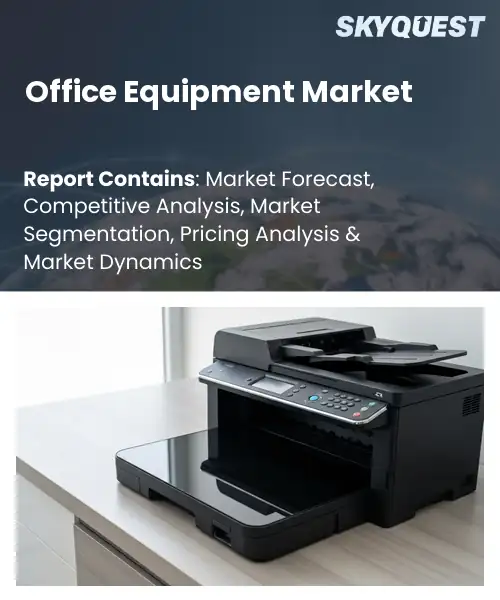
Office Equipment Market
Report ID: SQMIG20B2176
Report ID: SQMIG20B2176
[email protected]
USA +1 351-333-4748
Report ID:
SQMIG20B2176 |
Region:
Global |
Published Date: June, 2026
Pages:
157
|Tables:
139
|Figures:
78


Global Office Equipment Market size was valued at USD 34.5 Billion in 2024 and is poised to grow from USD 36.26 Billion in 2025 to USD 53.98 Billion by 2033, growing at a CAGR of 5.1% during the forecast period (2026-2033).
The primary driver shaping the office equipment market is the convergence of digital transformation with evolving workplace models, which has redefined what organizations purchase and why. The market includes hardware and supporting services such as printers, conferencing systems, ergonomic furniture and network appliances, and it matters because equipment choices influence productivity, operating costs and compliance. Historically the sector shifted from bulky analog copiers and standalone printers toward networked multifunction devices and cloud-managed peripherals, illustrated by HP and Canon adding embedded security and management software. As hybrid work patterns emerged, demand for video systems and modular desks grew, changing space strategies.One key factor driving global market expansion is the integration of smart, service-oriented solutions into traditional equipment, because vendors can now couple hardware sales with software subscriptions and analytics that reduce operational friction and total cost of ownership. For example, managed print services use cloud telemetry to cut paper and maintenance costs, which prompts firms to consolidate fleets and invest savings into video collaboration suites. Similarly, demand for energy-efficient, IoT-enabled devices creates opportunities for manufacturers to offer retrofit upgrades and leasing models, so buyers can meet sustainability targets while preserving capital, and integrators can monetize analytics and remote support services.
How is AI transforming productivity in the global office equipment market?
AI is reshaping productivity in the global office equipment market by putting intelligence directly into printers, scanners, and multifunction devices. Key aspects include smarter document capture and classification, automated routing and summarization, and predictive maintenance that reduces interruptions. Vendors now blend local device intelligence with cloud services to accelerate digitization and cut manual handoffs. Real world instances include printers that organize and summarize incoming documents and service agents that flag issues before they cause downtime. These capabilities shift routine work from people to machines so staff can focus on higher value tasks and smoother collaboration.Canon June 2026, Canon expanded its imageFORCE lineup with new models featuring AI assisted maintenance and enhanced device management which reduces service disruption and speeds document digitization. This development makes fleets easier to manage and directly supports greater operational efficiency across distributed offices.
Market snapshot - (2026-2033)
Global Market Size
USD 34.5 Billion
Largest Segment
Printers
Fastest Growth
Printers
Growth Rate
5.1% CAGR
To get more insights on this market click here to Request a Free Sample Report
Global office equipment market is segmented by office machines, office furniture, office supplies, technology products, presentation equipment and region. Based on office machines, the market is segmented into Printers and Copiers. Based on office furniture, the market is segmented into Desks and Chairs. Based on office supplies, the market is segmented into Stationery and Organizational Tools. Based on technology products, the market is segmented into Computers and Networking Devices. Based on presentation equipment, the market is segmented into Projectors and Whiteboards. Based on region, the market is segmented into North America, Europe, Asia Pacific, Latin America and Middle East & Africa.
Printers segment dominates because printers remain the primary physical interface between digital processes and tangible outputs, anchoring document-centric workflows across organizations. Their integration with scanning, cloud printing, and managed services creates a stable ecosystem that encourages vendor investment and long product lifecycles. Consistent compatibility with business applications, consumables networks, and service models drives procurement priorities and ensures printers act as focal points for operational efficiency and vendor-led innovation.
However, copiers are emerging as the most rapidly expanding area within office machines due to their evolving multifunction capabilities and higher throughput tailored to centralized print centers. Enhanced digital finishing, modular software integrations, and service-based offerings increase their appeal for organizations consolidating workload and outsourcing print management. This momentum opens avenues for advanced value-added services and platform-based revenue models, accelerating broader market opportunity creation.
Networking devices segment dominates because networking equipment forms the essential infrastructure that enables interoperability among diverse office systems, from printers to collaboration platforms. Reliable switches, routers, and wireless access points ensure consistent performance and secure data flows, which reduces downtime and supports unified communications. As office environments adopt cloud services and IoT peripherals, robust networking becomes the primary determinant of equipment performance, prompting sustained investment in resilient, manageable network architectures.
However, computers are showing the strongest growth momentum among technology offerings as endpoints evolve to support hybrid work, edge processing, and richer collaboration tools. Demand for higher-performance laptops, desktop replacements, and thin-client solutions tied to virtual desktop infrastructures drives refresh cycles and new configurations. Advances in security, form factors, and integrated software create expanding use cases, enhancing demand for complementary hardware and accelerating future market expansion.
To get detailed segments analysis, Request a Free Sample Report
Asia Pacific dominance is rooted in a combination of dense corporate ecosystems, strong manufacturing capabilities, and high adoption of technology across service and enterprise segments. Robust supply chains and proximity to component manufacturers enable rapid product development cycles and cost efficiencies. Large office space footprints in key urban centers drive steady demand for printing, document management, and collaborative hardware. Integration of advanced features through local innovation centers and partnerships with global vendors accelerates uptake. Policy support for digital transformation, growing professional services and expanding shared workspace models foster ongoing replacement and upgrade cycles. Regional expertise in electronics and precision engineering underpins product quality and supports competitive exports, reinforcing market leadership and sustained influence over global office equipment trends. Strong domestic demand combined with export orientation sustains extensive R&D investments.
Office Equipment Market in Japan benefits from high technology adoption among corporate and public sectors, rigorous quality standards, and a mature service ecosystem. Local manufacturers emphasize precision engineering and reliable aftersales support, while integrators tailor solutions for compact office environments. Demand is driven by modernization of document workflows, integration of smart office peripherals, and collaboration with global vendors. Emphasis on energy efficiency and experience shapes product portfolios and procurement decisions.
Office Equipment Market in South Korea is characterized by rapid uptake of cloud enabled solutions, strong domestic electronics capability, and a competitive supplier base focused on innovation. Office buyers prioritize connectivity, multifunctionality, and streamlined maintenance services. Collaboration between manufacturers and software providers supports integrated document management and smart office deployments. Dense urban office environments encourage frequent upgrades and tailored service offerings across corporate and public sector clients and institutional buyers.
North America expansion reflects a convergence of enterprise digitization, service oriented procurement models, and strong vendor ecosystems that emphasize managed services and lifecycle support. Large corporate headquarters and diverse small and medium enterprises push demand for integrated printing, scanning and collaboration hardware tailored to hybrid work modes. Channel partners and value added resellers play a critical role in customizing solutions and ensuring local service coverage. Investment in sustainability initiatives and preference for energy efficient, low footprint devices inform procurement choices. Software driven document workflows and cloud integration reduce barriers to adoption while financing and lease arrangements facilitate upgrades. The result is a dynamic market characterized by rapid replacement cycles, layered service offerings, and close collaboration between manufacturers, distributors and end users.
Office Equipment Market in United States is driven by diverse enterprise demand and broad adoption of managed print services. Large service providers coordinate installation, maintenance and document workflow optimization for multinational firms. Emphasis on cloud integration, security features and sustainability shapes procurement. Channel partner networks support financing and lease programs, enabling technology refreshes. Focus on hybrid workplace tools and secure document handling fuels demand across corporate, public and government segments.
Office Equipment Market in Canada reflects a balance between enterprise modernization and strong regional service networks. Buyers favor solutions that combine energy efficiency, remote management and local support. Channel partners and dealers provide tailored leasing and maintenance arrangements for corporate and public sector offices. Cross border vendor relationships with larger markets facilitate access to advanced hardware and software, while procurement priorities emphasize sustainability, cost effectiveness and seamless integration into infrastructure.
Europe is strengthening its role through emphasis on regulatory compliance, sustainability standards, and close collaboration between manufacturers and service providers. Buyers increasingly prioritize low energy consumption, recyclability and extended support lifecycles, prompting vendors to adapt product design and supply chain practices. Strong aftermarket service networks and specialized channel partners enable tailored solutions for varied office sizes and public institutions. Integration of secure cloud document services with local data governance and multilingual support enhances appeal for cross border enterprises. Strategic alliances among technology firms, software vendors and distributors accelerate innovation in document management and workflow automation, reinforcing the position of Europe as a leading market for quality, compliant and sustainable office equipment. Investment in research and development and collaborative pilot programs with institutional partners help validate new technologies and accelerate market acceptance.
Office Equipment Market in Germany emphasizes engineering quality, energy efficiency and robust aftermarket support. Industrial buyers demand durable devices that integrate with enterprise workflows and comply with environmental standards. Local manufacturing and precision engineering contribute to product reliability, while specialized resellers provide tailored maintenance and financing. Adoption is driven by procurement policies that favor lifecycle cost management, modular designs and collaboration between technology vendors and IT departments across sectors nationally.
Office Equipment Market in United Kingdom is shaped by demand for flexible, space efficient solutions and strong service ecosystems. Public procurement rules and corporate sustainability goals drive preference for energy saving models and recycling programs. Value added resellers deliver integration with cloud services and multilingual support. Demand spans legal, financial and creative sectors where document security and collaboration tools are prioritized, prompting tailored offerings and managed service agreements across markets.
Office Equipment Market in France benefits from strong demand in private and public sectors, with buyers focusing on energy efficient solutions. Manufacturers and resellers emphasize local support, multilingual interfaces and compliance with regional environmental standards. Procurement processes favor total cost of ownership and service continuity, encouraging suppliers to offer extended maintenance and leasing programs. Growth areas include integrated document workflows and secure collaboration tools tailored for administrative and professional services.
To know more about the market opportunities by region and country, click here to
Buy The Complete Report
Hybrid Workplace Demand
Cloud and Managed Print Services
High Initial Capital Requirements
Data Security Concerns
Request Free Customization of this report to help us to meet your business objectives.
Competitive dynamics in the global office equipment market are driven by consolidation, cloud migration and subscription service shifts, and rapid device innovation. Incumbents pursue acquisitions for scale such as Xerox’s Lexmark transaction, expand managed print and cloud platforms like Ricoh, and introduce subscription and smart printing ecosystems exemplified by HP’s HP plus and Instant Ink offerings. Integrations with major cloud print services further intensify competition.
Top Player’s Company Profile
Recent Developments
SkyQuest’s ABIRAW (Advanced Business Intelligence, Research & Analysis Wing) is our Business Information Services team that Collects, Collates, Correlates, and Analyses the Data collected by means of Primary Exploratory Research backed by robust Secondary Desk research. As per SkyQuest analysis, the global office equipment market is being driven by the shift to hybrid work models that demand versatile, networked devices and is further accelerated by integration of smart, service-oriented solutions such as cloud-managed print and AI-enabled device analytics. However, high upfront capital requirements remain a key restraint, slowing replacement cycles for cost-sensitive buyers. Asia Pacific emerges as the dominating region due to dense corporate ecosystems and strong manufacturing capability, while printers remain the dominating segment as the primary interface between digital workflows and tangible outputs. Vendors that bundle hardware, software and managed services are best positioned to capture growth by addressing security, sustainability and lifecycle costs.
| Report Metric | Details |
|---|---|
| Market size value in 2024 | USD 34.5 Billion |
| Market size value in 2033 | USD 53.98 Billion |
| Growth Rate | 5.1% |
| Base year | 2024 |
| Forecast period | (2026-2033) |
| Forecast Unit (Value) | USD Billion |
| Segments covered |
|
| Regions covered | North America (US, Canada), Europe (Germany, France, United Kingdom, Italy, Spain, Rest of Europe), Asia Pacific (China, India, Japan, Rest of Asia-Pacific), Latin America (Brazil, Rest of Latin America), Middle East & Africa (South Africa, GCC Countries, Rest of MEA) |
| Companies covered |
|
| Customization scope | Free report customization with purchase. Customization includes:-
|
To get a free trial access to our platform which is a one stop solution for all your data requirements for quicker decision making. This platform allows you to compare markets, competitors who are prominent in the market, and mega trends that are influencing the dynamics in the market. Also, get access to detailed SkyQuest exclusive matrix.
Table Of Content
Executive Summary
Market overview
Parent Market Analysis
Market overview
Market size
KEY MARKET INSIGHTS
COVID IMPACT
MARKET DYNAMICS & OUTLOOK
Market Size by Region
KEY COMPANY PROFILES
Methodology
For the Office Equipment Market, our research methodology involved a mixture of primary and secondary data sources. Key steps involved in the research process are listed below:
1. Information Procurement: This stage involved the procurement of Market data or related information via primary and secondary sources. The various secondary sources used included various company websites, annual reports, trade databases, and paid databases such as Hoover's, Bloomberg Business, Factiva, and Avention. Our team did 45 primary interactions Globally which included several stakeholders such as manufacturers, customers, key opinion leaders, etc. Overall, information procurement was one of the most extensive stages in our research process.
2. Information Analysis: This step involved triangulation of data through bottom-up and top-down approaches to estimate and validate the total size and future estimate of the Office Equipment Market.
3. Report Formulation: The final step entailed the placement of data points in appropriate Market spaces in an attempt to deduce viable conclusions.
4. Validation & Publishing: Validation is the most important step in the process. Validation & re-validation via an intricately designed process helped us finalize data points to be used for final calculations. The final Market estimates and forecasts were then aligned and sent to our panel of industry experts for validation of data. Once the validation was done the report was sent to our Quality Assurance team to ensure adherence to style guides, consistency & design.
Analyst Support
Customization Options
With the given market data, our dedicated team of analysts can offer you the following customization options are available for the Office Equipment Market:
Product Analysis: Product matrix, which offers a detailed comparison of the product portfolio of companies.
Regional Analysis: Further analysis of the Office Equipment Market for additional countries.
Competitive Analysis: Detailed analysis and profiling of additional Market players & comparative analysis of competitive products.
Go to Market Strategy: Find the high-growth channels to invest your marketing efforts and increase your customer base.
Innovation Mapping: Identify racial solutions and innovation, connected to deep ecosystems of innovators, start-ups, academics, and strategic partners.
Category Intelligence: Customized intelligence that is relevant to their supply Markets will enable them to make smarter sourcing decisions and improve their category management.
Public Company Transcript Analysis: To improve the investment performance by generating new alpha and making better-informed decisions.
Social Media Listening: To analyze the conversations and trends happening not just around your brand, but around your industry as a whole, and use those insights to make better Marketing decisions.
REQUEST FOR SAMPLE
 REQUEST FREE CUSTOMIZATION


Want to customize this report? This report can be personalized according to your needs. Our analysts and industry experts will work directly with you to understand your requirements and provide you with customized data in a short amount of time. We offer $1000 worth of FREE customization at the time of purchase.
Feedback From Our Clients


 USA (+1) 351-333-4748

