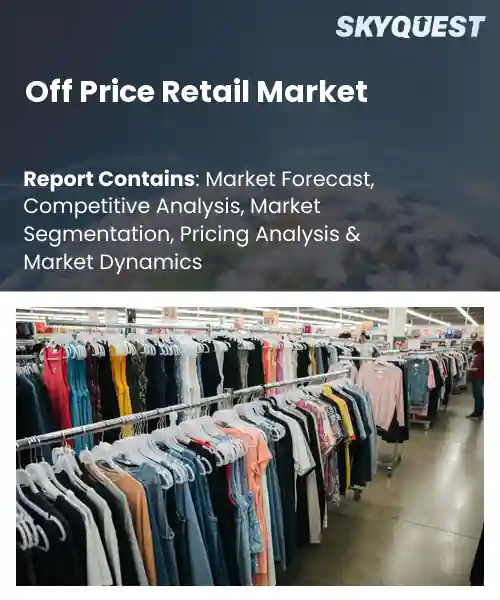
Off Price Retail Market
Report ID: SQMIG45E2752
Report ID: SQMIG45E2752
[email protected]
USA +1 351-333-4748
Report ID:
SQMIG45E2752 |
Region:
Global |
Published Date: April, 2026
Pages:
157
|Tables:
117
|Figures:
77


Global Off Price Retail Market size was valued at USD 341.63 Billion in 2024 and is poised to grow from USD 369.3 Billion in 2025 to USD 344.1 Billion by 2033, growing at a CAGR of 8.1% during the forecast period (2026-2033).
Off-price retail has been driven by persistent shifts in consumer value-seeking behavior that force retailers and brands to reconcile excess inventory with demand for discounted, branded goods. The market consists of retailers that purchase overruns, cancelled orders, and seasonal closeouts from manufacturers and department stores to sell merchandise at steep discounts; this model matters because it converts unsold stock into revenue while offering consumers access to premium labels at lower prices. Historically it evolved from factory outlet stores into sophisticated national chains such as TJX and Ross, whose scale and opportunistic buying strategies expanded during economic downturns and supply-chain disruptions.A central growth factor in the global off-price retail market is sourcing agility powered by data-driven procurement, because the ability to rapidly identify and acquire excess or short-supply inventory translates into higher margins and faster inventory turnover. When retailers deploy advanced analytics and logistics they can buy irregular consignments and optimize assortment for local demand, which causes consistent foot traffic and higher conversion rates; for example TJX’s decentralized buying and Ross’s regional purchasing have converted those sporadic closeouts into reliable product flows. This capability opens significant opportunities in e-commerce channels, cross-border expansion, and partnerships with brands seeking discreet clearance channels.
How is AI optimizing inventory management in the off-price retail market?
AI optimizes inventory management in the off price retail market by improving forecasting and making allocation more responsive to irregular supply. Key aspects include demand forecasting tuned to opportunistic receipts, assortment optimization across stores, dynamic replenishment from distribution centers, and markdown timing to preserve margin while clearing aged product. Technologies such as machine learning models, computer vision and RFID increase visibility at store level and reduce manual counting. The current market favors rapid turnover and fresh receipts so AI helps retailers match limited and variable inventory to local demand while keeping the treasure hunt shopping experience intact.Ross Stores March 2026, the company announced increased investment in AI driven supply chain and store technology which streamlines inventory flow and speeds movement of fresh receipts to stores supporting faster turnover and scalable growth.
Market snapshot - (2026-2033)
Global Market Size
USD 341.63 Billion
Largest Segment
Apparel & Footwear
Fastest Growth
Cosmetics & Personal Care
Growth Rate
8.1% CAGR
To get more insights on this market click here to Request a Free Sample Report
Global off price retail market is segmented by product category, retail format, target demographics, supply chain source and region. Based on product category, the market is segmented into Apparel & Footwear, Home Decor & Kitchenware, Cosmetics & Personal Care and Others (Toys & Small Electronics). Based on retail format, the market is segmented into Independent Off-Price Retailers (TJ Maxx, Ross), Department Store Off-Price Outlets (Nordstrom Rack) and Online Flash Sale/Discount Platforms. Based on target demographics, the market is segmented into Value-conscious Middle Income Consumers and Budget-oriented Gen Z & Millennials. Based on supply chain source, the market is segmented into Manufacturer Overstock & Closeouts and Cancelled Orders & Seasonal Liquidations. Based on region, the market is segmented into North America, Europe, Asia Pacific, Latin America and Middle East & Africa.
Apparel & Footwear segment dominates because off price channels thrive on fast-moving fashion assortments that generate abundant excess stock through seasonal shifts and returns, making apparel particularly suited to discount distribution. Strong brand recognition in clothing and footwear sustains consumer demand for perceived-value purchases, while flexible merchandising and easier size-based clearance enable retailers to rotate inventory quickly, reinforcing sourcing efficiencies and consistent replenishment cycles.
However, cosmetics & personal care is emerging as the fastest growing area as compact, high-turn items fit well with both online and in-store flash promotions. Rising consumer willingness to trial discounted beauty brands, combined with targeted digital marketing and low storage complexity, accelerates adoption and opens new margin opportunities, enabling off price retailers to diversify baskets and capture younger, trend-driven spend.
Independent Off-Price Retailers segment leads because established off-price chains combine expansive physical footprints with a treasure-hunt experience that drives repeat visits and high impulse purchase rates, giving them reliable customer acquisition advantages. Their longstanding vendor relationships and flexible buying models convert varied overstock flows into compelling in-store assortments, while consistent value perception and in-person discovery sustain foot traffic and brand loyalty across the off price ecosystem.
However, online flash sale and discount platforms are witnessing the strongest growth as curated drops and mobile discovery match evolving shopper behavior. Their data-driven personalization, low fixed costs, and speed in converting short-lived inventory attract sellers and time-sensitive buyers. This unlocks new digital channels for off price stock and accelerates customer acquisition across the broader market.
To get detailed segments analysis, Request a Free Sample Report
North America dominates the global off price retail market due to a combination of mature retail ecosystems, deep brand relationships, and consumer demand for value and discovery. Large off price chains established in the region have refined assortment strategies, inventory acquisition, and store formats that optimize turnover and margin. Robust logistics networks and flexible real estate models support rapid expansion and responsive replenishment. Brand owners in the region view off price channels as a reliable outlet for excess inventory and collaborate on product allocation and pricing discipline. Consumer familiarity with treasure-hunt shopping and strong acceptance of mixed merchandising further reinforce market depth. Operational expertise underpins continued competitive differentiation.
Off Price Retail Market in United States benefits from a dense network of established chains, sophisticated supply chain capabilities, and strong collaboration between retailers and brand partners. Retailers focus on curated assortments, rapid merchandise turnover, and omnichannel touchpoints to meet diverse consumer expectations. Mixed store footprints are complemented by data driven buying and pricing that sustain foot traffic and visitation, reinforcing its role as a benchmark for off price operations.
Off Price Retail Market in Canada is characterized by strategic adaptation of global off price concepts to local consumer preferences, supported by efficient distribution channels and collaborative vendor relationships. Retailers emphasize curated regional assortments and experiential store environments that drive loyal customer engagement. Cross border sourcing and marketplace partnerships enable varied inventory flows, while focused merchandising and community outreach help establish resilient off price formats across urban and regional markets.
Rapid expansion of the off price retail market in Europe is driven by shifting consumer preferences toward value, rising retailer sophistication, and deeper collaboration between brands and off price channels. Established retailers and nimble entrants are adapting curated assortments and store experiences to diverse national tastes, while cross border sourcing and integrated logistics improve stock variability and availability. Digital platforms and omnichannel strategies extend reach beyond physical stores, supporting discovery and conversion. Brand owners increasingly accept off price as a complementary outlet for excess inventory that preserves core price integrity through disciplined allocation. Fragmented national markets are seeing selective consolidation and localized marketing that together accelerate market penetration and elevate operational standards across the region. Cultural openness to discount shopping and the appeal of outlet experiences also stimulate footfall and broaden customer profiles.
Off Price Retail Market in Germany reflects retailer innovation and disciplined supply chain management that attract brand partners. Retailers prioritize curated assortments aligned with pragmatic consumer preferences and efficient store concepts that balance value and quality. Wholesale networks and strategic sourcing complement domestic inventory flows. Targeted merchandising and regional marketing encourage repeat visitation, while omnichannel touchpoints broaden accessibility and strengthen channel credibility with German consumers across urban and regional markets.
Off Price Retail Market in United Kingdom is characterized by a mature ecosystem of national chains and strong brand engagement that sustain consumer awareness. Retailers leverage differentiated store formats, curated product mixes, and integrated online channels to capture shopper segments. Established relationships with suppliers enable disciplined allocation and inventory pipelines. Marketing and store design emphasize discovery and value, while location choices reinforce the channel role within mainstream retailing across markets.
Off Price Retail Market in France is emerging through a blend of local entrepreneurial activity and international investment that adapts off price concepts to refined consumer tastes. Retailers focus on elevated store presentation, selective assortments, and partnerships that protect brand positioning while enabling value discovery. Outlet formats and online marketplaces expand shopper access. Focused marketing and localized sourcing nurture a steadily growing acceptance among consumers who favored traditional retail channels.
Asia Pacific is strengthening its position in the off price retail market through a combination of retail modernization, evolving consumer attitudes toward value led shopping, and enhanced international supply chain linkages. Retailers in key markets are translating global off price concepts into culturally relevant formats, blending curated in-store experiences with sophisticated online discovery tools. Improved logistics and selective partnerships with brand owners broaden access to surplus assortments and enable disciplined allocation. Urbanization and a growing interest in treasure-hunt merchandising encourage experimentation by both established retailers and new entrants. Localized marketing and experiential programming further accelerate consumer adoption in urban centers, increasing channel credibility and geographic reach across the region.
Off Price Retail Market in Japan is evolving as retailers adapt treasure-hunt merchandising to refined local tastes, combining curated assortments with careful store design. Concepts emphasize quality cues and brand protection while offering value discovery to discerning shoppers. Integration of online platforms with physical outlets supports targeted assortment exposure and inventory rotation. Partnerships with domestic and international brand owners and efficient logistics enable supply flows that underpin growing consumer interest.
Off Price Retail Market in South Korea is advancing through fast retail execution and sophisticated digital engagement that amplify discovery and conversion. Retailers curate trend assortments and deploy dynamic merchandising to appeal to style conscious shoppers. Integration between mobile platforms and physical stores facilitates inventory turnover and targeted promotions. Collaborations with global brands and agile logistics support consistent product flow and broaden consumer exposure across metropolitan and regional retail corridors.
To know more about the market opportunities by region and country, click here to
Buy The Complete Report
Value Conscious Consumer Demand
Assortment Flexibility And Sourcing
Perceived Inventory Quality Issues
Supply Chain Sourcing Risks
Request Free Customization of this report to help us to meet your business objectives.
Competition in global off-price retail is intensifying as larger consolidators use acquisitions and strategic investments to secure brand inventory and scale, for example Rue Gilt Group acquiring Shop Premium Outlets with Simon Property Group involvement. Digital challengers differentiate through partnerships and technology, using AI pricing and managed marketplace logistics to win brand consignment and returns pipelines, altering supplier relationships and speed to market.
Top Player’s Company Profile
Recent Developments
SkyQuest’s ABIRAW (Advanced Business Intelligence, Research & Analysis Wing) is our Business Information Services team that Collects, Collates, Correlates, and Analyses the Data collected by means of Primary Exploratory Research backed by robust Secondary Desk research. As per SkyQuest analysis, the global off‑price retail market is being propelled by rising value‑conscious consumer demand, with apparel and footwear remaining the dominating segment because fast‑moving fashion generates abundant excess inventory and strong brand recognition. North America is the dominating region, supported by mature retail ecosystems and large national chains. A second key driver is sourcing agility enabled by data‑driven procurement and AI that improve forecasting, assortment optimization, and inventory turnover. The main restraint is sourcing unpredictability stemming from dependence on irregular overstock and cancelled orders, which complicates assortment planning and store consistency. Overall, opportunities center on omnichannel execution and sustainable sourcing to broaden appeal.
| Report Metric | Details |
|---|---|
| Market size value in 2024 | USD 341.63 Billion |
| Market size value in 2033 | USD 344.1 Billion |
| Growth Rate | 8.1% |
| Base year | 2024 |
| Forecast period | (2026-2033) |
| Forecast Unit (Value) | USD Billion |
| Segments covered |
|
| Regions covered | North America (US, Canada), Europe (Germany, France, United Kingdom, Italy, Spain, Rest of Europe), Asia Pacific (China, India, Japan, Rest of Asia-Pacific), Latin America (Brazil, Rest of Latin America), Middle East & Africa (South Africa, GCC Countries, Rest of MEA) |
| Companies covered |
|
| Customization scope | Free report customization with purchase. Customization includes:-
|
To get a free trial access to our platform which is a one stop solution for all your data requirements for quicker decision making. This platform allows you to compare markets, competitors who are prominent in the market, and mega trends that are influencing the dynamics in the market. Also, get access to detailed SkyQuest exclusive matrix.
Table Of Content
Executive Summary
Market overview
Parent Market Analysis
Market overview
Market size
KEY MARKET INSIGHTS
COVID IMPACT
MARKET DYNAMICS & OUTLOOK
Market Size by Region
KEY COMPANY PROFILES
Methodology
For the Off Price Retail Market, our research methodology involved a mixture of primary and secondary data sources. Key steps involved in the research process are listed below:
1. Information Procurement: This stage involved the procurement of Market data or related information via primary and secondary sources. The various secondary sources used included various company websites, annual reports, trade databases, and paid databases such as Hoover's, Bloomberg Business, Factiva, and Avention. Our team did 45 primary interactions Globally which included several stakeholders such as manufacturers, customers, key opinion leaders, etc. Overall, information procurement was one of the most extensive stages in our research process.
2. Information Analysis: This step involved triangulation of data through bottom-up and top-down approaches to estimate and validate the total size and future estimate of the Off Price Retail Market.
3. Report Formulation: The final step entailed the placement of data points in appropriate Market spaces in an attempt to deduce viable conclusions.
4. Validation & Publishing: Validation is the most important step in the process. Validation & re-validation via an intricately designed process helped us finalize data points to be used for final calculations. The final Market estimates and forecasts were then aligned and sent to our panel of industry experts for validation of data. Once the validation was done the report was sent to our Quality Assurance team to ensure adherence to style guides, consistency & design.
Analyst Support
Customization Options
With the given market data, our dedicated team of analysts can offer you the following customization options are available for the Off Price Retail Market:
Product Analysis: Product matrix, which offers a detailed comparison of the product portfolio of companies.
Regional Analysis: Further analysis of the Off Price Retail Market for additional countries.
Competitive Analysis: Detailed analysis and profiling of additional Market players & comparative analysis of competitive products.
Go to Market Strategy: Find the high-growth channels to invest your marketing efforts and increase your customer base.
Innovation Mapping: Identify racial solutions and innovation, connected to deep ecosystems of innovators, start-ups, academics, and strategic partners.
Category Intelligence: Customized intelligence that is relevant to their supply Markets will enable them to make smarter sourcing decisions and improve their category management.
Public Company Transcript Analysis: To improve the investment performance by generating new alpha and making better-informed decisions.
Social Media Listening: To analyze the conversations and trends happening not just around your brand, but around your industry as a whole, and use those insights to make better Marketing decisions.
REQUEST FOR SAMPLE
 REQUEST FREE CUSTOMIZATION


Want to customize this report? This report can be personalized according to your needs. Our analysts and industry experts will work directly with you to understand your requirements and provide you with customized data in a short amount of time. We offer $1000 worth of FREE customization at the time of purchase.
Feedback From Our Clients


 USA (+1) 351-333-4748

