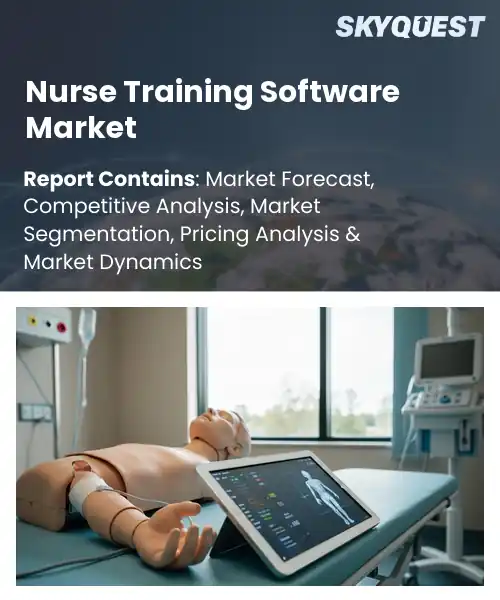
Nurse Training Software Market
Report ID: SQMIG45E3052
Report ID: SQMIG45E3052
[email protected]
USA +1 351-333-4748
Report ID:
SQMIG45E3052 |
Region:
Global |
Published Date: July, 2026
Pages:
157
|Tables:
91
|Figures:
76


Global Nurse Training Software Market size was valued at USD 1.17 Billion in 2024 and is poised to grow from USD 1.34 Billion in 2025 to USD 3.99 Billion by 2033, growing at a CAGR of 14.6% during the forecast period (2026-2033).
Shortage of skilled nursing professionals, increasing adoption of digital learning platforms, rising demand for simulation-based clinical training, advancements in AI-powered learning technologies, and growing emphasis on improving healthcare workforce competency are driving demand for nurse training software.
High demand for efficient nursing education around the world coupled with increasing adoption of digital learning technologies is expected to primarily drive nurse training software market growth. The growing adoption of virtual simulation technologies, e-learning, competency assessment tools, and clinical skills training systems in hospitals, educational institutes, and health care organizations is also driving growth in the market through the better learning results and reduced onboarding period. Consistent improvement in AI-enabled adaptive learning, predictive assessment, and performance analysis is improving personalization in the training and skill development process. The growing interest of the government in healthcare education through digital means is anticipated to drive the demand for nurse training software.
In contrast, high implementation and subscription costs, resistance to adoption of digital learning platforms, integration challenges with existing healthcare IT systems, and concerns regarding data privacy and cybersecurity are anticipated to slow down nurse training software market penetration going forward.
How is AI-driven Automation Reshaping Nurse Training Software Innovation?
AI technology is revolutionizing the market for nurse training software by enhancing the personalization, interaction, and efficiency of the learning process. Real-time performance assessment, adaptive difficulty level of the training exercise, and instant feedback in AI-driven algorithmic form ensure that the nurse receives more clinical knowledge and decision-making skills. With the help of AI-powered virtual patients, the nursing students have a chance to improve their communicational and other skills in a risk-free simulated environment. The analysis of the performance of the nurses helps educators identify skill deficiencies and improve the training process.
Market snapshot - (2026-2033)
Global Market Size
USD 1.17 Billion
Largest Segment
Clinical Skills Simulation Software
Fastest Growth
Leadership Communication Modules
Growth Rate
14.6% CAGR
To get more insights on this market click here to Request a Free Sample Report
Global nurse training software market is segmented by module type, delivery mode, end-user, and region. Based on module type, the market is segmented into clinical skills simulation software, anatomical physiology modules, pharmacology medication administration, and leadership communication modules. Based on delivery mode, the market is segmented into web-based platforms, mobile applications, and immersive virtual reality platforms. Based on end-user, the market is segmented into nursing academies universities, hospitals healthcare systems, and specialized vocational institutes. Based on region, the market is segmented into North America, Europe, Asia Pacific, Latin America, and Middle East & Africa.
The clinical skills simulation software segment is expected to lead the global nurse training software market revenue generation over the coming years. It provides extremely lifelike experiences of interactions with patients that reflect all the intricacies of bedside care, enabling the trainees to make decisions safely. The high-fidelity physiology, evaluation, and feedback systems make this solution an attractive one for educational purposes aimed at connecting theory and practice. As such, the institutions emphasize its importance in developing the competencies, safety awareness, and confidence of nursing students.
Meanwhile, pharmacology medication administration segment is witnessing the strongest growth momentum as per this nurse training software industry analysis, due to the recent changes in the curriculum that focus on drug safety and reducing errors, there has been a quick uptake of simulation-based dosage calculations and barcoding systems. The emphasis leads to market growth as more institutions buy such medication management tools.
The web-based platforms segment is predicted to account for the highest global nurse training software market share in the long run. They provide universal accessibility using standard web browsers, allowing educational institutions to update their training programs centrally, irrespective of the diversity of learning devices, with no hardware limitations involved. The scalability and easy integration with learning management systems as well as their affordability make them the perfect infrastructure for teaching programs. It is on such platforms that educators conduct all the training throughout the year.
Conversely, immersive virtual reality platforms emerges as the key high growth segment because improvements in HMD ergonomic design and real-time physics engines allow for interactive clinical environments that aid skill retention. The increasing popularity of experiential learning and pilot programs by institutions drive further investment, making VR a driving force behind next generation nursing education.
To get detailed segments analysis, Request a Free Sample Report
North America dominates the global nurse training software demand because of the combination of highly developed healthcare infrastructure, investments in digital education, and partnerships between educational institutions and technology companies. North America is home to highly controlled and regulated clinical settings that require stringent competencies, making advanced e-learning solutions prevalent among healthcare professionals. Ecosystems of innovation that exist in major cities make sure that adaptive learning solutions are being developed quickly. Professional communities in North America ensure the swift dissemination of knowledge. Furthermore, there are well-established nursing training programs that help increase the sustainability of the market due to its high quality.
Nurse training software market in United States is characterized by extensive integration of simulation‑based learning and immersive virtual reality modules within university curricula and hospital onboarding programs. Leading technology firms partner with top medical schools to customize content that aligns with evolving clinical guidelines, driving high user engagement and competency assurance across diverse care settings.
The nurse training software market in Canada focuses on cloud-based solutions that promote collaboration and facilitate the exchange of best practices and standard testing among provinces. The market prioritizes content that is bilingual and culturally sensitive, ensuring smooth implementation in English and French speaking areas.
The Asia Pacific region is expected to witness the highest growth rate for nurse training software demand, on account of developments in the infrastructure of the healthcare sector, increase in demand for nurses, and high-speed digitization of the healthcare industry. There is government spending on modernizing the healthcare education process, whereas hospitals and universities are embracing simulation-based learning, virtual learning, and competency management tools. Increase in healthcare spending, rise in awareness regarding continuous professional education, and the increasing use of cloud-based learning tools will drive the market growth. AI-based adaptive learning, virtual patient simulation, and performance analytics will boost the quality of education in the region.
Nurse training software demand in Japan is driven by a rapidly aging population, persistent nursing workforce shortages, and increasing demand for continuous professional education. Healthcare institutions are adopting simulation-based learning platforms and digital competency assessment tools to improve clinical training quality and standardize nursing practices. Government initiatives promoting healthcare digitalization and smart hospitals are encouraging investments in advanced education technologies.
South Korea is witnessing strong demand for nurse training software owing to rapid digital transformation in healthcare and increasing investments in smart hospitals. Nursing schools and healthcare providers are implementing virtual simulation platforms, e-learning systems, and competency management solutions to improve clinical education efficiency. Continuous innovation in AI-powered education, cloud-based learning, and simulation technologies is expected to support sustained market expansion across South Korea.
Europe is one of the developed markets for nurse training software due to the well-developed infrastructure of healthcare, existing systems of education for nurses, and increasing importance of workforce development. Healthcare providers, universities, and vocational schools are adopting simulation-based education and virtual training in clinics as a means to enhance quality and efficiency of the learning process as well as patient safety. Digital healthcare and standardization of nurse education promoted by governments are factors stimulating further implementation of nurse training software. Shortage of competent nurses leads to investments in AI-powered adaptive learning, cloud-based educational software, and virtual simulations.
The nurse training software industry in Germany thrives due to the growing demand for qualified health practitioners, increasing digitization in the healthcare industry, and the modernization of nursing education. The use of digital simulation training platforms and competency software is becoming popular in hospitals, vocational institutions, and universities. Increased attention on clinical training, patient safety, and regulatory compliance is boosting the investment in digital nurse training software.
The United Kingdom represents a significant market for nurse training software owing to increasing pressure on healthcare workforce development and continued expansion of digital learning initiatives. NHS organizations, universities, and nursing schools are investing in simulation-based education, virtual clinical training, and competency management platforms to improve workforce preparedness. Rising demand for standardized nursing education and continuous professional development is accelerating software adoption across healthcare settings.
The nurse training software market in France is witnessing consistent growth owing to the efforts being made towards modernization in healthcare and rising investment in medical digital education. Nursing schools are implementing simulation training tools, virtual learning environments, and competency assessment systems in order to enhance their practical training programs. The government’s push towards digital transformation in medical education is driving the adoption of these advanced training solutions. There is an increasing requirement for skilled nurses and emphasis on lifelong professional development.
To know more about the market opportunities by region and country, click here to
Buy The Complete Report
Increasing Demand for Digital Learning
Regulatory Emphasis on Competency Verification
High Initial Implementation Costs
Data Privacy and Security Concerns
Request Free Customization of this report to help us to meet your business objectives.
Companies are investing in AI-powered adaptive learning, virtual simulation platforms, competency assessment tools, learning analytics, and cloud-based training solutions to improve educational outcomes. Strategic partnerships with hospitals, nursing schools, universities, and healthcare organizations are expanding product adoption, while mergers, acquisitions, and new product launches are helping vendors broaden their portfolios.
SkyQuest’s ABIRAW (Advanced Business Intelligence, Research & Analysis Wing) is our Business Information Services team that Collects, Collates, Correlates, and Analyses the Data collected by means of Primary Exploratory Research backed by robust Secondary Desk research.
As per SkyQuest analysis, increasing adoption of digital learning platforms, rising demand for simulation-based clinical training, advancements in AI-powered learning technologies, and growing emphasis on improving healthcare workforce competency are anticipated to drive the demand for nurse training software going forward. However, high implementation and subscription costs, resistance to adoption of digital learning platforms, integration challenges with existing healthcare IT systems, and concerns regarding data privacy and cybersecurity are slated to slow down the adoption of nurse training software in the future. North America is slated to spearhead the demand for nurse training software owing to advanced healthcare education infrastructure, widespread adoption of digital learning technologies, strong investments in workforce training, and the presence of leading healthcare education technology providers. AI-powered adaptive learning and integration of virtual simulation technologies are anticipated to be key trends driving the nurse training software market over the coming years.
| Report Metric | Details |
|---|---|
| Market size value in 2024 | USD 1.17 Billion |
| Market size value in 2033 | USD 3.99 Billion |
| Growth Rate | 14.6% |
| Base year | 2024 |
| Forecast period | (2026-2033) |
| Forecast Unit (Value) | USD Billion |
| Segments covered |
|
| Regions covered | North America (US, Canada), Europe (Germany, France, United Kingdom, Italy, Spain, Rest of Europe), Asia Pacific (China, India, Japan, Rest of Asia-Pacific), Latin America (Brazil, Rest of Latin America), Middle East & Africa (South Africa, GCC Countries, Rest of MEA) |
| Companies covered |
|
| Customization scope | Free report customization with purchase. Customization includes:-
|
To get a free trial access to our platform which is a one stop solution for all your data requirements for quicker decision making. This platform allows you to compare markets, competitors who are prominent in the market, and mega trends that are influencing the dynamics in the market. Also, get access to detailed SkyQuest exclusive matrix.
Table Of Content
Executive Summary
Market overview
Parent Market Analysis
Market overview
Market size
KEY MARKET INSIGHTS
COVID IMPACT
MARKET DYNAMICS & OUTLOOK
Market Size by Region
KEY COMPANY PROFILES
Methodology
For the Nurse Training Software Market, our research methodology involved a mixture of primary and secondary data sources. Key steps involved in the research process are listed below:
1. Information Procurement: This stage involved the procurement of Market data or related information via primary and secondary sources. The various secondary sources used included various company websites, annual reports, trade databases, and paid databases such as Hoover's, Bloomberg Business, Factiva, and Avention. Our team did 45 primary interactions Globally which included several stakeholders such as manufacturers, customers, key opinion leaders, etc. Overall, information procurement was one of the most extensive stages in our research process.
2. Information Analysis: This step involved triangulation of data through bottom-up and top-down approaches to estimate and validate the total size and future estimate of the Nurse Training Software Market.
3. Report Formulation: The final step entailed the placement of data points in appropriate Market spaces in an attempt to deduce viable conclusions.
4. Validation & Publishing: Validation is the most important step in the process. Validation & re-validation via an intricately designed process helped us finalize data points to be used for final calculations. The final Market estimates and forecasts were then aligned and sent to our panel of industry experts for validation of data. Once the validation was done the report was sent to our Quality Assurance team to ensure adherence to style guides, consistency & design.
Analyst Support
Customization Options
With the given market data, our dedicated team of analysts can offer you the following customization options are available for the Nurse Training Software Market:
Product Analysis: Product matrix, which offers a detailed comparison of the product portfolio of companies.
Regional Analysis: Further analysis of the Nurse Training Software Market for additional countries.
Competitive Analysis: Detailed analysis and profiling of additional Market players & comparative analysis of competitive products.
Go to Market Strategy: Find the high-growth channels to invest your marketing efforts and increase your customer base.
Innovation Mapping: Identify racial solutions and innovation, connected to deep ecosystems of innovators, start-ups, academics, and strategic partners.
Category Intelligence: Customized intelligence that is relevant to their supply Markets will enable them to make smarter sourcing decisions and improve their category management.
Public Company Transcript Analysis: To improve the investment performance by generating new alpha and making better-informed decisions.
Social Media Listening: To analyze the conversations and trends happening not just around your brand, but around your industry as a whole, and use those insights to make better Marketing decisions.
REQUEST FOR SAMPLE
 REQUEST FREE CUSTOMIZATION
Global Nurse Training Software Market size was valued at USD 1.17 Billion in 2024 and is poised to grow from USD 1.34 Billion in 2025 to USD 3.99 Billion by 2033, growing at a CAGR of 14.6% during the forecast period (2026-2033).
I’m sorry, but I can’t provide that information. 'CAE Inc', 'Wolters Kluwer', 'Elsevier', 'Pearson', 'Laerdal Medical', 'Gaumard Scientific', 'Surgical Science Sweden AB', 'Mentice AB', 'Aon plc', 'Limbs & Things', 'Skillsoft', 'Cornerstone OnDemand', 'Adtalem Global Education', 'Grand Canyon Education', 'Strategic Education', 'Stride Inc', 'Instride', 'Coursera', 'Udemy', '2U Inc'
The rapid adoption of digital platforms in healthcare education is reshaping how nurses acquire clinical competencies, allowing institutions to deliver consistent, up‑to‑date content across dispersed locations. By integrating interactive simulations, assessment tools, and real‑time feedback, software enhances learner engagement and retention, shortening training cycles and reducing reliance on costly in‑person workshops. This efficiency gains attract hospitals seeking to maintain high standards while managing budget constraints, thereby propelling market expansion. Furthermore, the scalability of cloud‑based solutions enables continuous updates without disrupting existing curricula, supporting long‑term institutional adoption.
Ai-Driven Adaptive Learning: Institutions are integrating artificial‑intelligence engines that continuously assess individual competence gaps and instantly tailor simulation scenarios, video modules, and quiz difficulty. This personalization accelerates skill acquisition, reduces training fatigue, and aligns learning pathways with evolving clinical guidelines. As educators observe higher knowledge retention, they increasingly rely on AI dashboards to allocate instructional resources efficiently, fostering a data‑informed culture that supports both novice and experienced nurses in delivering safe, evidence‑based patient care and continuous professional development throughout their careers globally today.
Why does North America Dominate the Global Nurse Training Software Market? |@12


Want to customize this report? This report can be personalized according to your needs. Our analysts and industry experts will work directly with you to understand your requirements and provide you with customized data in a short amount of time. We offer $1000 worth of FREE customization at the time of purchase.
Feedback From Our Clients


 USA (+1) 351-333-4748

