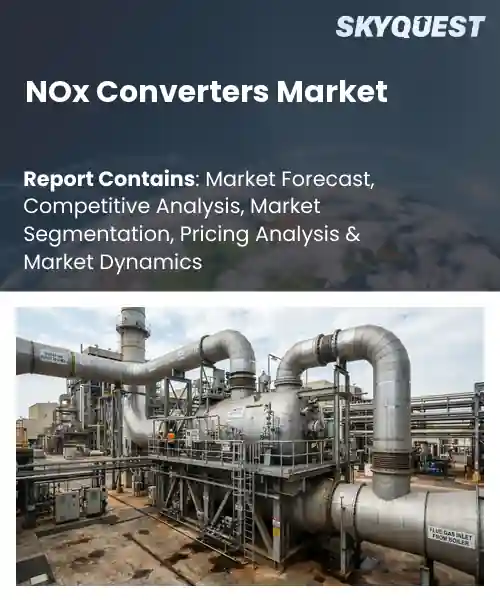
NOx Converters Market
Report ID: SQMIG15E4263
Report ID: SQMIG15E4263
[email protected]
USA +1 351-333-4748
Report ID:
SQMIG15E4263 |
Region:
Global |
Published Date: August, 2026
Pages:
157
|Tables:
174
|Figures:
79


Global Nox Converters Market size was valued at USD 4.87 Billion in 2024 and is poised to grow from USD 5.2 Billion in 2025 to USD 8.81 Billion by 2033, growing at a CAGR of 6.8% during the forecast period (2026-2033).
The NOx converters market encompasses technologies that reduce nitrogen oxides emitted from diesel engines, stationary power plants, and industrial furnaces, primarily through selective catalytic reduction (SCR) and lean NOx traps. Its importance stems from tightening emissions regulations worldwide, which compel manufacturers and operators to adopt after‑treatment solutions. Over the past decade, the market has expanded from niche applications in heavy‑duty trucks to a mainstream component of passenger‑vehicle exhaust systems, driven by the European Union’s Euro 6 standards and China’s 2025 emission targets. Early adopters such as Volvo and Caterpillar demonstrated measurable reductions of up to 90 % in NOx, cementing the technology’s credibility. The next wave of growth in the NOx converters market is propelled by electrification pressures and the need for modular retrofit solutions in legacy fleets. As governments introduce low‑carbon mandates, operators cannot replace all assets with electric alternatives, so they turn to compact SCR units that install on existing diesel trucks without extensive redesign. This creates a lucrative opportunity for suppliers to offer plug‑and‑play kits, exemplified by Bosch’s deployment of a 2‑liter SCR module on municipal buses in Brazil, cutting fuel consumption by 5 % while meeting standards. Consequently, demand for converters accelerates, spurring investment in advanced catalysts and digital monitoring.
How is AI-driven automation reshaping the Nox converters market?
AI-driven automation is streamlining the design, testing, and production of NOx converters by embedding machine‑learning models into simulation tools and manufacturing lines. These models predict catalyst performance under varying conditions, reducing trial‑and‑error cycles and accelerating product rollout. Real‑time data from engine tests feed adaptive algorithms that fine‑tune converter geometry, improving durability and emissions compliance. Plant operators benefit from predictive maintenance alerts that minimize downtime, while supply chains gain visibility through automated inventory forecasting. The overall effect is a faster response to regulatory pressure and a more cost‑effective path to market for new converter technologies.In June 2024, a leading NOx converter manufacturer announced an AI‑enhanced production platform, demonstrating how intelligent automation can boost efficiency and support market growth.
Market snapshot - (2026-2033)
Global Market Size
USD 4.87 Billion
Largest Segment
Selective Catalytic Reduction Systems
Fastest Growth
Lean NOx Traps
Growth Rate
6.8% CAGR
To get more insights on this market click here to Request a Free Sample Report
Global nox converters market is segmented by converter type, vehicle type, fuel type, sales channel, end user, substrate material and region. Based on converter type, the market is segmented into Selective Catalytic Reduction Systems, Lean NOx Traps, Three-Way Catalytic Converters and Others. Based on vehicle type, the market is segmented into Passenger Vehicles, Commercial Vehicles, Off-Highway Equipment and Others. Based on fuel type, the market is segmented into Gasoline, Diesel, Alternative Fuels and Others. Based on sales channel, the market is segmented into OEM and Aftermarket. Based on end user, the market is segmented into Automotive, Industrial Equipment, Marine and Others. Based on substrate material, the market is segmented into Ceramic, Metallic and Others. Based on region, the market is segmented into North America, Europe, Asia Pacific, Latin America and Middle East & Africa.
Selective Catalytic Reduction Systems segment dominates because it directly addresses stringent emission standards across light and heavy duty platforms, offering high NOx removal efficiency while maintaining fuel economy. Vehicle manufacturers favor SCR for its proven reliability, scalable design, and compatibility with urea based aftertreatment, which simplifies system integration. Its flexibility to match varied powertrains also shortens development timelines significantly. This technology also enables precise control of emissions through real time dosing, further strengthening its appeal to OEMs.
However, Lean NOx Traps segment is witnessing the strongest growth momentum because they offer a cost effective solution for diesel engines where urea infrastructure is limited. Their compact design and catalyst durability attract fleet operators seeking lower total ownership cost, and material innovations improve trapping efficiency, expanding market reach.
Diesel segment dominates because its high combustion energy and widespread use in commercial and off highway sectors generate substantial NOx emissions, creating persistent demand for effective aftertreatment. Engine manufacturers rely on proven technologies that can meet tight limits without compromising performance, and diesel’s established supply chain supports large scale converter production, cementing its market leadership. Additionally, frameworks prioritize diesel fleets for retrofitting, prompting OEMs to integrate converters early, reinforcing diesel’s central role in market dynamics.
Meanwhile, Alternative Fuels segment emerges as a high growth area because powertrains using bio derived, hydrogen or synthetic fuels need aftertreatment that differs from conventional diesel chemistry. Innovators are developing catalysts tolerant to variable exhaust, and the push for carbon neutral operations fuels investment, positioning this segment to accelerate market expansion and create revenue streams.
To get detailed segments analysis, Request a Free Sample Report
The region benefits from a convergence of advanced manufacturing capabilities, stringent emission regulations, and early adoption of clean‑technology policies. Leading automotive and heavy‑equipment producers have established deep supply chains that emphasize high‑performance catalyst solutions. Strong governmental support for low‑emission initiatives spurs continual investment in research and development, fostering innovative converter designs that meet demanding standards. Moreover, a culture of technical collaboration between industry and academia accelerates the diffusion of cutting‑edge technologies across the market, reinforcing the region’s leadership position.
NOx Converters Market in Japan is characterized by a long history of precision engineering and a proactive regulatory environment. Domestic manufacturers prioritize reliability and efficiency, aligning product portfolios with evolving standards. Close ties between automotive OEMs and converter suppliers strengthen innovation pipelines, while a focus on renewable energy projects expands application spheres beyond transportation.
NOx Converters Market in South Korea showcases a rapid embrace of green industrial practices and robust export capabilities. Government incentives encourage the integration of advanced emission control systems in both domestic fleets and overseas projects. Collaborative research institutions contribute to the development of next‑generation catalyst materials, supporting a competitive edge in the global supply chain.
The market experiences momentum from heightened attention to air quality improvement and a shift toward sustainable fuel alternatives. Policy frameworks promote the deployment of low‑emission technologies across transportation and power generation sectors. Industry leaders invest heavily in scalable manufacturing processes that accommodate diverse vehicle architectures. Additionally, a growing emphasis on retrofitting legacy equipment with modern converter solutions amplifies demand, while cross‑border trade relationships facilitate broader distribution networks throughout the continent.
NOx Converters Market in the United States reflects a strong emphasis on regulatory compliance and technological innovation. Major automotive manufacturers collaborate with specialist converter producers to integrate solutions that satisfy rigorous standards. A vibrant ecosystem of research universities and startup ventures fuels the development of novel catalyst formulations, while an extensive logistics infrastructure supports nationwide adoption across multiple industries.
NOx Converters Market in Canada benefits from a proactive approach to environmental stewardship and a diversified industrial base. Provincial initiatives encourage the adoption of emission control technologies in both urban transportation and remote energy projects. Partnerships between local firms and international technology providers foster knowledge transfer, enhancing the market’s capacity to deliver high‑performance solutions tailored to regional needs.
European stakeholders prioritize stringent climate objectives and collaborative standards setting, which drive continual refinement of converter performance. The region’s integrated research networks and industry clusters facilitate rapid prototyping and testing of advanced materials. Policy directives emphasize the transition to low‑emission mobility, prompting manufacturers to embed sophisticated NOx control systems across new vehicle platforms. Additionally, a focus on circular economy principles encourages the recycling and regeneration of catalyst components, reinforcing sustainability while maintaining competitive advantage.
NOx Converters Market in Germany is underpinned by a strong engineering heritage and a comprehensive regulatory framework. Leading automotive manufacturers work closely with converter suppliers to embed high‑efficiency solutions within cutting‑edge vehicle designs. German research institutes play a pivotal role in advancing catalyst science, ensuring that domestic offerings remain at the forefront of performance standards.
NOx Converters Market in the United Kingdom showcases a dynamic blend of innovation and policy alignment. Governmental commitments to reduce urban air pollutants stimulate investment in next‑generation emission control systems. Collaborative ventures between universities, tech start‑ups, and established manufacturers accelerate the commercialization of lightweight, high‑efficiency converters tailored to diverse vehicle segments.
NOx Converters Market in France reflects a concerted effort to integrate emission reduction technologies within both automotive and industrial sectors. National initiatives promote the deployment of advanced converters in public transport and heavy‑duty applications. Close cooperation between research bodies and industry leaders drives the development of environmentally resilient catalyst solutions that align with broader European objectives.
To know more about the market opportunities by region and country, click here to
Buy The Complete Report
Stringent Emission Regulations
Growing Adoption of Cleaner Fuels
High Initial Capital Expenditure
Complex Certification and Testing Processes
Request Free Customization of this report to help us to meet your business objectives.
The competitive landscape is shaped by aggressive M&A activity, strategic partnerships, and rapid technology innovation, with incumbents acquiring niche converter firms and forming alliances with equipment manufacturers to integrate low‑NOx solutions into heavy‑industry fleets, while startups accelerate deployment through pilot projects and government‑backed incentives. Recent joint ventures between major engine makers and specialist catalyst providers illustrate how collaboration is driving faster time‑to‑market for advanced NOx reduction systems.
Top Player’s Company Profile
Recent Developments
SkyQuest’s ABIRAW (Advanced Business Intelligence, Research & Analysis Wing) is our Business Information Services team that Collects, Collates, Correlates, and Analyses the Data collected by means of Primary Exploratory Research backed by robust Secondary Desk research. As per SkyQuest analysis the global NOx converters market is being propelled primarily by tightening emission regulations that force OEMs and fleet operators to adopt advanced after‑treatment solutions, while a secondary driver comes from the rise of cleaner low‑sulfur and alternative fuels which increase NOx formation and demand efficient converters. The market is led by Selective Catalytic Reduction Systems, which dominate across vehicle types because of their high removal efficiency. Asia Pacific remains the strongest region thanks to its robust manufacturing base, strict standards and early technology adoption. However, high upfront capital costs for converter packages continue to curb faster uptake, especially in price‑sensitive segments.
| Report Metric | Details |
|---|---|
| Market size value in 2024 | USD 4.87 Billion |
| Market size value in 2033 | USD 8.81 Billion |
| Growth Rate | 6.8% |
| Base year | 2024 |
| Forecast period | (2026-2033) |
| Forecast Unit (Value) | USD Billion |
| Segments covered |
|
| Regions covered | North America (US, Canada), Europe (Germany, France, United Kingdom, Italy, Spain, Rest of Europe), Asia Pacific (China, India, Japan, Rest of Asia-Pacific), Latin America (Brazil, Rest of Latin America), Middle East & Africa (South Africa, GCC Countries, Rest of MEA) |
| Companies covered |
|
| Customization scope | Free report customization with purchase. Customization includes:-
|
To get a free trial access to our platform which is a one stop solution for all your data requirements for quicker decision making. This platform allows you to compare markets, competitors who are prominent in the market, and mega trends that are influencing the dynamics in the market. Also, get access to detailed SkyQuest exclusive matrix.
Table Of Content
Executive Summary
Market overview
Parent Market Analysis
Market overview
Market size
KEY MARKET INSIGHTS
COVID IMPACT
MARKET DYNAMICS & OUTLOOK
Market Size by Region
KEY COMPANY PROFILES
Methodology
For the NOx Converters Market, our research methodology involved a mixture of primary and secondary data sources. Key steps involved in the research process are listed below:
1. Information Procurement: This stage involved the procurement of Market data or related information via primary and secondary sources. The various secondary sources used included various company websites, annual reports, trade databases, and paid databases such as Hoover's, Bloomberg Business, Factiva, and Avention. Our team did 45 primary interactions Globally which included several stakeholders such as manufacturers, customers, key opinion leaders, etc. Overall, information procurement was one of the most extensive stages in our research process.
2. Information Analysis: This step involved triangulation of data through bottom-up and top-down approaches to estimate and validate the total size and future estimate of the NOx Converters Market.
3. Report Formulation: The final step entailed the placement of data points in appropriate Market spaces in an attempt to deduce viable conclusions.
4. Validation & Publishing: Validation is the most important step in the process. Validation & re-validation via an intricately designed process helped us finalize data points to be used for final calculations. The final Market estimates and forecasts were then aligned and sent to our panel of industry experts for validation of data. Once the validation was done the report was sent to our Quality Assurance team to ensure adherence to style guides, consistency & design.
Analyst Support
Customization Options
With the given market data, our dedicated team of analysts can offer you the following customization options are available for the NOx Converters Market:
Product Analysis: Product matrix, which offers a detailed comparison of the product portfolio of companies.
Regional Analysis: Further analysis of the NOx Converters Market for additional countries.
Competitive Analysis: Detailed analysis and profiling of additional Market players & comparative analysis of competitive products.
Go to Market Strategy: Find the high-growth channels to invest your marketing efforts and increase your customer base.
Innovation Mapping: Identify racial solutions and innovation, connected to deep ecosystems of innovators, start-ups, academics, and strategic partners.
Category Intelligence: Customized intelligence that is relevant to their supply Markets will enable them to make smarter sourcing decisions and improve their category management.
Public Company Transcript Analysis: To improve the investment performance by generating new alpha and making better-informed decisions.
Social Media Listening: To analyze the conversations and trends happening not just around your brand, but around your industry as a whole, and use those insights to make better Marketing decisions.
REQUEST FOR SAMPLE
 REQUEST FREE CUSTOMIZATION


Want to customize this report? This report can be personalized according to your needs. Our analysts and industry experts will work directly with you to understand your requirements and provide you with customized data in a short amount of time. We offer $1000 worth of FREE customization at the time of purchase.
Feedback From Our Clients


 USA (+1) 351-333-4748

