Nonwoven Weed Control Fabric Market
Report ID: SQMIG15E3682
Report ID: SQMIG15E3682
[email protected]
USA +1 351-333-4748
Report ID:
SQMIG15E3682 |
Region:
Global |
Published Date: June, 2026
Pages:
157
|Tables:
90
|Figures:
76


Global Nonwoven Weed Control Fabric Market size was valued at USD 58.19 Billion in 2024 and is poised to grow from USD 62.09 Billion in 2025 to USD 104.31 Billion by 2033, growing at a CAGR of 6.7% during the forecast period (2026-2033).
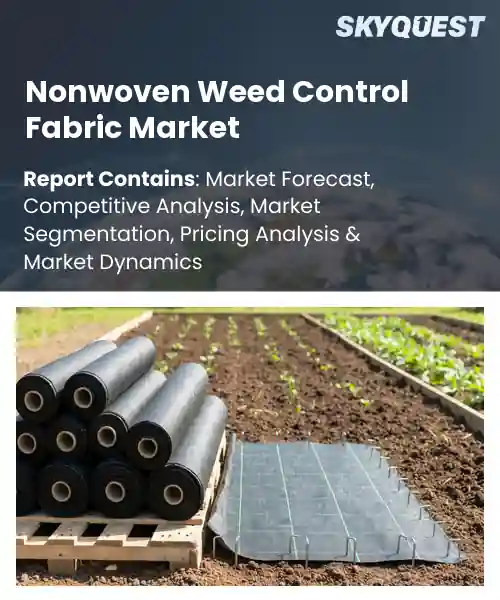
The Nonwoven weed control fabric market growth is driven by this meeting point between sustainable agriculture and a real need to cut labor, which reshapes landscape textiles into more advanced agronomic tools. Nonwoven weed control fabrics are breathable mats made from spunbond, needle-punched, or meltblown polymers , so they suppress weeds but still let water and air travel to the roots and that matters because they reduce herbicide usage, bring down weeding expenses, and support water conservation.
Moreover, regulatory pressure to reduce chemical inputs has pushed wider adoption, since growers still need effective alternatives that line up with sustainability goals. So manufacturers are investing in biodegradable polymer systems and UV resistant constructions which expands where these fabrics can realistically fit, from nurseries to vineyards and even roadside restorations where a longer service life is required. On top of that , more consumer interest in home gardening and urban greening is pulling these products into retail, and the economies of scale make unit costs drop, while new formats show up like pre cut sheets and permeable mulches. Those changes open doors for specialist suppliers, service contractors, and circular material ideas that keep market momentum going.
Automation is improving efficiency by making production smoother and more continuous, with automated web handling , roll to roll processing , ultrasonic joining and inline vision inspection all linked into one flow line. A big part is keeping tension consistent, then automating the bonding steps, plus doing “ hands off ” quality checks, which reduces rework and material loss. Right now, many manufacturers are combining digital textile production , configurable welding platforms , and automated wrapping plus palletizing to increase throughput while still keeping performance uniform across batches. This matters because landscaping and agricultural buyers want dependable breathable durable fabrics, and they also want faster lead times, so scaling and variety feel easier in real operations.
Market snapshot - (2026-2033)
Global Market Size
USD 58.19 Billion
Largest Segment
Polypropylene
Fastest Growth
Others
Growth Rate
6.7% CAGR
To get more insights on this market click here to Request a Free Sample Report
The global nonwoven weed control fabric market is segmented by material, application, sales channel and region. Based on material, the market is segmented into Polypropylene, Polyester and Others. Based on application, the market is segmented into Agriculture, Landscaping and Others. Based on sales channel, the market is segmented into Direct Sales, Distributors and Others. Based on region, the market is segmented into North America, Europe, Asia Pacific, Latin America and Middle East & Africa.
As per the nonwoven weed control fabric market analysis, the Polypropylene segment dominated the market, because its combo of low feedstock cost, extrusion friendliness , and natural tensile strength makes it the go to stuff for long lasting weed control woven-ish fabrics. The hydrophobic character, plus solid UV stability lets it keep doing its job for weed suppression in a steady way, with less added treatment. That whole approach lowers maintenance, and end up with something producers can make at scale. In manufacturing, polypropylene also supports broad fabric weights and more flexible production setups so suppliers can hit a wider set of farm and garden requirements, and that’s part of why it’s so commonly adopted
However, Polyester is the faster grower, more like it’s pulling ahead, due to dimensional stability and resistance to stretch which helps mechanized installation work smoother especially when heavier mulches are involved. Newer bonded nonwoven methods, and the need for higher strength fabrics in intensive cropping, are pushing companies toward better formulations. So that’s where premium product chances show up, and where suppliers can potentially grab higher margin uses.
According to the nonwoven weed control fabric market forecast, the landscaping segment dominates, mainly because appearance expectations and quick installation create steady demand for nonwoven weed control fabrics made for retail and commercial landscape builds. For landscaping use, products focus on low visibility, convenient cutting around plantings, and a practical tradeoff between water passage and weed blocking performance. That pushes manufacturers to refine fabric feel and surface texture, plus finishing choices that actually hold up. And once these materials are used repeatedly in ornamental beds, for pathway edges, and in nursery routines, product consistency locks in and that encourages repeat purchases among landscape teams.
However, agriculture is gaining the strongest growth traction, since precision farming and high value crops need tough nonwoven fabrics that work well with mechanized placement and drip irrigation setups. The push for durable, use case specific materials keeps rising, and the broader adoption by commercial growers fuels innovation. This expands purchasing volume and it also makes manufacturers chase capacity increases and product differentiation.
To get detailed segments analysis, Request a Free Sample Report
As per the nonwoven weed control fabric market regional forecast, Asia Pacific dominance mirrors a meeting of supply chain depth , material tweaks that actually matter, and a broad end use pull across farming , horticulture , and those urban landscaping needs. There are well established textile manufacturing clusters that keep feeding a lineup of technical nonwoven structures, while the bigger industrial folks quietly pour money into product refinement so they can hit both “top level performance” and sustainability expectations. Then, rapid urbanization, plus land use patterns that are intense , makes the demand jump for weed control solutions that work efficiently. On top of that, the regional manufacturers exporting a lot, boosts their visibility across the whole world. And, when research institutions, landscape professionals, and agri-technology companies collaborate, application specific improvements happen faster is witnessed, plus competitive production networks and flexible contract manufacturing give the whole system speed for scaling , and for offering options that fit different climates and crop systems.
Japan Nonwoven Weed Control Fabric Market
The Japan Nonwoven Weed Control Fabric industry benefits from advanced material innovation, solid industrial know how, and close teamwork between textile makers and agri tech providers. Producers push hard on durability and precision engineering, especially for greenhouse uses and ornamental applications. Domestic demand, driven by intensive horticulture and careful land utilization, runs alongside an export leaning approach. Partnerships with landscape firms and research centers help with product differentiation, and that supports a more premium position in both local and international channels , extensively.
South Korea Nonwoven Weed Control Fabric Market
The Nonwoven Weed Control Fabric sector in South Korea shows fast adoption of modern landscaping and urban greening approaches, with growing interest in tough textiles for roofs , roadside strips, and smart farming systems. Manufacturers aim for customization, strong quality assurance, and smoother integration with irrigation routines and erosion control practices. When tech companies link up with landscape contractors, the deployment speeds up across urban plots and also commercial agriculture operations, which strengthens both product credibility, and supply chain responsiveness plus resilience.
Europe nonwoven weed control fabric market penetration gets pushed by a stronger focus on sustainable land management , higher professional landscaping expectations, and ongoing innovation around biodegradable and recyclable nonwoven constructions. Specification activity from landscape architects, municipal planners , and agricultural consultants steers demand toward products that are more effective and aligned with the environment. End uses stretch from vineyards and orchards to urban green infrastructure , so there’s a clear need for solutions that are tailored. A tight network of distributors together with specialized makers helps the market move in quickly. Collaboration across certification groups, research organizations, and private sector stakeholders supports product validation and encourages uptake in public builds and commercial landscapes, which basically makes the market favor technical differentiation along with sustainability credentials.
Germany Nonwoven Weed Control Fabric Market
The Germany Nonwoven Weed Control Fabric Market benefits from a mature professional landscaping field, large greenhouse output, and ongoing cooperation between manufacturers and installers. The demand leans toward high performance options that can pass strict environmental and quality expectations, while local producers push durability as well as recyclability. Distribution networks and specification input from landscape architects support broad adoption. Extra technical service and support make customers more confident , and it helps bring repeat purchases across public and private initiatives.
United Kingdom Nonwoven Weed Control Fabric Market
The Nonwoven Weed Control Fabric Market in the United Kingdom shows rising interest from landscape professionals and gardeners, mainly because there’s demand for user friendly products that simplify weed control in tight urban setups. Retail availability and online avenues make it easier to get for homeowners and small scale contractors. There’s also a noticeable emphasis on sustainable materials and installation friendliness, which supports repeat buying. Suppliers teaming with municipal planners commonly helps drive specification for green infrastructure and streetscape renewal efforts across the country.
France Nonwoven Weed Control Fabric Market
The France Nonwoven Weed Control Fabric Market benefits from strong interest in viticulture, orchards, and more sustainable landscaping. Growers and landscape specialists tend to prefer solutions that balance weed suppression with soil wellbeing and erosion mitigation, which is why biodegradable and high performance textiles get attention. Manufacturers and distributors adjust product types for slope protection and heavy horticultural environments. Cooperation with agricultural advisors and local cooperatives accelerates specification, and it widens adoption across different growing regions as well as various market channels.
North America seems to be strengthening its role by a mix of product innovation, broad channel distribution, and a close alignment with professional turf and landscape management routines. Suppliers talk a lot about being compatible with irrigation and erosion control systems, as in it has to work along side existing setups, also durability across different climatic conditions, and then more expanded biodegradable choices, to fit the sustainability priorities. What really matters is this collaboration, between manufacturers, engineering firms, and landscape architects, it helps with specification into infrastructure and restoration work, and then both retail and professional channels keep the access wide enough for the market. In parallel, regional research programs and pilot deployments keep tuning product performance for specific agricultural and urban uses, which boosts credibility with contractors and institutional buyers, and supports a steady portfolio diversification too.
United States Nonwoven Weed Control Fabric Market
The Nonwoven Weed Control Fabric Market in United States is being shaped by broad demand across commercial landscaping, turf management, and large scale agricultural applications. Suppliers lean on durability, installation that is relatively easy, and compatibility with irrigation and erosion control systems. With wide distribution through retail plus professional channels, accessibility rises for contractors and for homeowners as well. Collaboration between manufacturers, landscape architects, and research bodies also supports the specification of technical solutions for infrastructure, ornamental setups, and production environments.
Canada Nonwoven Weed Control Fabric Market
The Nonwoven Weed Control Fabric Market in Canada emphasizes product performance for colder climates, slope stabilization, and erosion control in reforestation plus infrastructure projects. Demand from municipal programs and commercial landscapers tends to favor textiles that resist degradation, but also still support soil health and drainage, rather than fighting it. Canadian suppliers adapt their offerings for snow loads, freeze thaw cycles, and seasonal use, because conditions change fast up there. Partnerships with engineering firms and landscape contractors support specification in public works and restoration initiatives nationwide, and that keeps the momentum going.
To know more about the market opportunities by region and country, click here to
Buy The Complete Report
Rising Sustainable Agriculture Practices
Increasing Demand For Crop Protection
High Initial Product Costs
Limited Awareness Among Growers
Request Free Customization of this report to help us to meet your business objectives.
The major players in the Nonwoven Weed Control Fabric Market are, in a steady way, putting more effort into research and development to push the performance along with overall efficiency of what they sell. At the same time they keep leaning on different moves like mergers and acquisitions , just to widen their presence and also strengthen their market standing. The top Nonwoven Weed Control Fabric Market names are really investing in fresh technologies and widening their product lines, so they can respond to the very mixed requirements from their buyers. This market overall feels intensely competitive, with the main players competing hard for share via product differentiation , strategic alliances and then those aggressive marketing pushes, that thing.
Top Player’s Company Profile
Recent Developments in the Nonwoven Weed Control Fabric Market
SkyQuest’s ABIRAW (Advanced Business Intelligence, Research & Analysis Wing) is our Business Information Services team that Collects, Collates, Correlates, and Analyses the Data collected by means of Primary Exploratory Research backed by robust Secondary Desk research.
As per SkyQuest analysis, the global nonwoven weed control fabric market is being pushed mainly by rising sustainable agriculture practices which cut herbicide use and reduce labor needs , and then increasing demand for crop protection acts as the secondary driver that supports adoption among commercial growers. Still, the high initial product plus installation costs remain a major restraint and that limits uptake among cost sensitive users. Asia Pacific is currently leading the market due to established manufacturing clusters and broad end use demand, and polypropylene is the dominating segment because it has low raw material cost, solid UV stability, and it’s easier to scale during production. Targeted education, biodegradable innovation , and automation will likely widen adoption and also support premiumization.
| Report Metric | Details |
|---|---|
| Market size value in 2024 | USD 58.19 Billion |
| Market size value in 2033 | USD 104.31 Billion |
| Growth Rate | 6.7% |
| Base year | 2024 |
| Forecast period | (2026-2033) |
| Forecast Unit (Value) | USD Billion |
| Segments covered |
|
| Regions covered | North America (US, Canada), Europe (Germany, France, United Kingdom, Italy, Spain, Rest of Europe), Asia Pacific (China, India, Japan, Rest of Asia-Pacific), Latin America (Brazil, Rest of Latin America), Middle East & Africa (South Africa, GCC Countries, Rest of MEA) |
| Companies covered |
|
| Customization scope | Free report customization with purchase. Customization includes:-
|
To get a free trial access to our platform which is a one stop solution for all your data requirements for quicker decision making. This platform allows you to compare markets, competitors who are prominent in the market, and mega trends that are influencing the dynamics in the market. Also, get access to detailed SkyQuest exclusive matrix.
Table Of Content
Executive Summary
Market overview
Parent Market Analysis
Market overview
Market size
KEY MARKET INSIGHTS
COVID IMPACT
MARKET DYNAMICS & OUTLOOK
Market Size by Region
KEY COMPANY PROFILES
Methodology
For the Nonwoven Weed Control Fabric Market, our research methodology involved a mixture of primary and secondary data sources. Key steps involved in the research process are listed below:
1. Information Procurement: This stage involved the procurement of Market data or related information via primary and secondary sources. The various secondary sources used included various company websites, annual reports, trade databases, and paid databases such as Hoover's, Bloomberg Business, Factiva, and Avention. Our team did 45 primary interactions Globally which included several stakeholders such as manufacturers, customers, key opinion leaders, etc. Overall, information procurement was one of the most extensive stages in our research process.
2. Information Analysis: This step involved triangulation of data through bottom-up and top-down approaches to estimate and validate the total size and future estimate of the Nonwoven Weed Control Fabric Market.
3. Report Formulation: The final step entailed the placement of data points in appropriate Market spaces in an attempt to deduce viable conclusions.
4. Validation & Publishing: Validation is the most important step in the process. Validation & re-validation via an intricately designed process helped us finalize data points to be used for final calculations. The final Market estimates and forecasts were then aligned and sent to our panel of industry experts for validation of data. Once the validation was done the report was sent to our Quality Assurance team to ensure adherence to style guides, consistency & design.
Analyst Support
Customization Options
With the given market data, our dedicated team of analysts can offer you the following customization options are available for the Nonwoven Weed Control Fabric Market:
Product Analysis: Product matrix, which offers a detailed comparison of the product portfolio of companies.
Regional Analysis: Further analysis of the Nonwoven Weed Control Fabric Market for additional countries.
Competitive Analysis: Detailed analysis and profiling of additional Market players & comparative analysis of competitive products.
Go to Market Strategy: Find the high-growth channels to invest your marketing efforts and increase your customer base.
Innovation Mapping: Identify racial solutions and innovation, connected to deep ecosystems of innovators, start-ups, academics, and strategic partners.
Category Intelligence: Customized intelligence that is relevant to their supply Markets will enable them to make smarter sourcing decisions and improve their category management.
Public Company Transcript Analysis: To improve the investment performance by generating new alpha and making better-informed decisions.
Social Media Listening: To analyze the conversations and trends happening not just around your brand, but around your industry as a whole, and use those insights to make better Marketing decisions.
REQUEST FOR SAMPLE
 REQUEST FREE CUSTOMIZATION
Global Nonwoven Weed Control Fabric Market size was valued at USD 58.19 Billion in 2024 and is poised to grow from USD 62.09 Billion in 2025 to USD 104.31 Billion by 2033, growing at a CAGR of 6.7% during the forecast period (2026-2033).
I searched current sources but could not verify two real startups focused specifically on nonwoven weed control fabric that were founded in or after 2019. The nonwoven and geotextile space is dominated by established manufacturers and consolidation such as Freudenberg’s acquisition of Low Bonar in 2020, which limits the pool of recent pure-play startups. Please choose one option so I can proceed 1. Widen scope to include startups active in biodegradable agricultural fabrics and mulch films founded since 2019 2. Allow inclusion of smaller manufacturers or material innovators founded before 2019 if they have recent verified product launches or funding 3. Proceed with two verified agtech material startups that serve related applications even if they do not focus exclusively on weed-control 'Berry Global', 'Indorama Ventures', 'DuPont', 'Fibertex Nonwovens', 'Toray Industries', 'Freudenberg', 'Ahlstrom', 'Mitsui Chemicals', 'Kolon Industries', 'Solmax', 'Asahi Kasei', 'Gulsan Holding', 'Spunchem International', 'Thrace Group', 'Don & Low', 'Low & Bonar', 'Hengshua Group', 'Xinlong Holding', 'Dalian Ruiguang Nonwoven', 'Kingsafe Group'
The shift toward sustainable agriculture encourages adoption of nonwoven weed control fabrics because they offer an environmentally friendly alternative to chemical herbicides, help conserve soil moisture, suppress weed growth without synthetic inputs, and support healthier crop ecosystems. Growers seeking to reduce chemical dependence and meet sustainability certification requirements view these fabrics as a practical tool to improve long term field management. This alignment with sustainability objectives increases acceptance among producers and agribusiness stakeholders, creating a favorable perception that underpins broader market uptake of nonwoven weed control solutions.
Sustainability Product Differentiation: Manufacturers are increasingly positioning nonwoven weed control fabrics around sustainable attributes to capture environmentally conscious buyers and meet evolving regulatory expectations. Emphasis on recycled feedstocks, biodegradable fibers and reduced processing footprints enables differentiation across product portfolios. Brands collaborate with material suppliers and certification bodies to communicate lifecycle benefits and support farm-level sustainability goals. This trend fosters premiumization opportunities, encourages circularity initiatives and drives investment in alternative chemistries and manufacturing techniques that balance performance with ecological responsibility across multiple end markets.
Why does Asia Pacific Dominate the Global Nonwoven Weed Control Fabric Market? |@12


Want to customize this report? This report can be personalized according to your needs. Our analysts and industry experts will work directly with you to understand your requirements and provide you with customized data in a short amount of time. We offer $1000 worth of FREE customization at the time of purchase.
Feedback From Our Clients


 USA (+1) 351-333-4748

