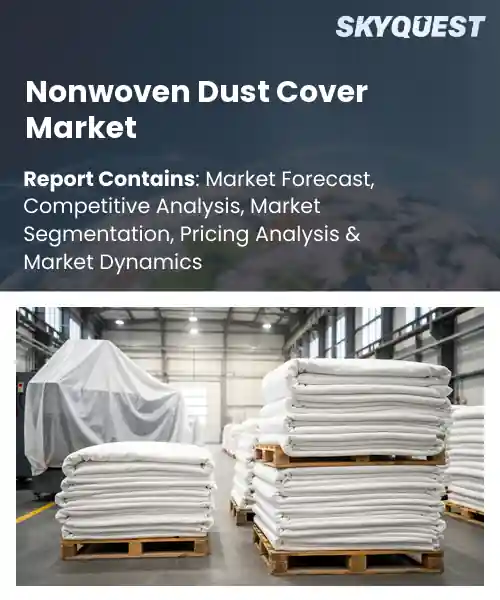
Nonwoven Dust Cover Market
Report ID: SQMIG15P2038
Report ID: SQMIG15P2038
[email protected]
USA +1 351-333-4748
Report ID:
SQMIG15P2038 |
Region:
Global |
Published Date: May, 2026
Pages:
157
|Tables:
179
|Figures:
79


Global Nonwoven Dust Cover Market size was valued at USD 2.7 Billion in 2024 and is poised to grow from USD 2.9 Billion in 2025 to USD 5.18 Billion by 2033, growing at a CAGR of 7.5% during the forecast period (2026-2033).
The nonwoven dust cover market is driven by the growing demand for contamination control in sensitive industries such as electronics manufacturing, healthcare and precision instrumentation. Engineered Fiber Protective Barriers Keep Out Particulates Protect Surfaces & Extend Equipment Life Nonwoven Dust Covers Are a Must Have for Your Facility They are important for quality assurance and for cost cutting . During the last 20 years the market has evolved from traditional cotton or woven cloth covers to technically optimized nonwovens such as spunbond, meltblown and SMS constructions that provide barrier performance and disposability. For example, semiconductor fabs employ laminar-flow covers and medical transporters employ nonwoven wraps.
Material innovation and sustainability are driving global demand for nonwoven dust covers. Manufacturers can cut the lifecycle cost of their products and meet the demands of regulators and buyers by investing in bio-based fibers, recyclable blends and better barrier treatments. Scale economies and incentives move from high-end clean rooms into the mainstream as performance goes up and the cost per unit goes down. Shipping furniture, automobile paint booths, and disposable covers for retail. This trend has created opportunities for functional coatings, antimicrobial finishes and customized grammages that address sector-specific risks and fuels geographic growth where contract manufacturing and e-commerce logistics generate demand.
How is IoT improving supply chain transparency in the nonwoven dust cover market?
The nonwoven dust cover market supply chain transparency is enhanced by the IoT through the connection of physical objects with digital records and the enablement of provenance verification, status monitoring, and traceable handoffs. Smart tags for rolls and packaged goods, environmental sensors for storage and transport and cloud platforms that aggregate data for audits are among the key focus areas. Today the use of the technology is increasing, responding to the requirements of sustainability and quality imposed by the manufacturers. In practice, brands are using RFID and Bluetooth smart labels, combined with centralized dashboards, to track batches from fiber suppliers, through converting lines to distributors, to minimize disputes and response time.
SMX April 2026 has teamed with CETI to build verifiable identities into textile and nonwoven fibers, enabling authentication of each roll and finished dust cover through IoT reads and digital records. This increases the efficiency of the market by improving provenance verification, facilitating audits and speeding up corrective action.
Market snapshot - (2026-2033)
Global Market Size
USD 2.7 Billion
Largest Segment
Polypropylene (PP)
Fastest Growth
Polyester (PET)
Growth Rate
7.5% CAGR
To get more insights on this market click here to Request a Free Sample Report
Global nonwoven dust cover market is segmented by material type, product type, application, function, end user, distribution channel and region. Based on material type, the market is segmented into Polypropylene (PP), Polyester (PET), Polyethylene (PE) and Others. Based on product type, the market is segmented into Needle-Punched Nonwoven Dust Covers, Spunbond Nonwoven Dust Covers, Laminated Nonwoven Dust Covers and Others. Based on application, the market is segmented into Mattresses, Furniture, Automotive Interiors, Bedding Products and Others. Based on function, the market is segmented into Dust Protection, Moisture Resistance, Breathability, Insulation and Others. Based on end user, the market is segmented into Furniture Manufacturers, Mattress Manufacturers, Automotive Manufacturers, Home Furnishing Companies and Others. Based on distribution channel, the market is segmented into Direct Sales, Distributors & Wholesalers and Online Sales. Based on region, the market is segmented into North America, Europe, Asia Pacific, Latin America and Middle East & Africa.
Polypropylene (PP) is the largest segment owing to the affordability of raw materials, high processing flexibility, and the capacity of manufacturers to produce durable, lightweight dust covers in large quantities. It can be processed in conventional nonwoven processes yielding uniform fabric strength and hydrophobic behavior for easy dust shedding and handling. Such efficiencies in production lower unit costs, encouraging wide adoption in applications where the cost-performance ratio is the key determinant in purchasing decisions, improving its position in the market.
However, the polyester (PET) segment is gaining momentum as the fastest growing segment due to the demand for recycled content and superior durability of premium dust covers. Trained on data up to October 2023.
The Spunbond nonwoven dust covers segment leads Continuous filament formation produces uniform fabrics with high strength that balance breathability and lightweight protection of furniture and bedding. High production efficiency combined with compatibility with lamination enables cost effective composite constructions that offer moisture barriers and tear resistance without sacrificing handling. These performance attributes meet manufacturer requirements for scalable, consistent protective covers, leading to widespread specification by OEMs seeking reliable, easily processed materials.
The Needle-Punched Nonwoven Dust Covers segment is, meanwhile, registering the most robust growth momentum as demand for heavier, more durable protective layers increases in automotive interiors and industrial applications. Mechanical entanglement provides improved abrasion resistance and sound insulation, opening up new applications where heavier duty protection is critical. Continued process improvements and use in higher performance end uses are accelerating market opportunities for robust needle-punched products.
To get detailed segments analysis, Request a Free Sample Report
The strength of Asia Pacific lies in its large manufacturing ecosystems, specialized supply chains in electronics and automotive, and a mature nonwoven materials industry based on innovation and scale. Regional manufacturers are positioned near major end use sectors that require protective dust covers such as semiconductor fabrication, consumer electronics assembly and heavy industrial production. Built-in supplier networks, established contract manufacturing and prioritized investments in material science & production efficiency allow for rapid product development & customized solutions. Product quality and contamination control are on the radar of regulators in key markets, which drives the need for advanced nonwoven dust covers. Intra regional and export channels through trade facilitation and collaborative industry clusters also add to cost competitiveness and market access. And the increasing focus on sustainability and lifecycle has increased demand for solutions that are reusable and recyclable. Close cooperation between raw material suppliers and converters allows for continuous performance and cost improvements.
The drivers of Nonwoven Dust Cover Market in Japan are the electronics and automotive industries that need precision manufacturing and strict contamination control requirements. Fiber technology manufacturers work with OEMs to provide custom dust protection with a focus on quality and innovation. Demand from cleanroom environments and specialty industrial applications is supporting the development of nonwoven solutions. Material scientists and converters are working together with rapid prototyping and widespread adoption of sophisticated, durable dust cover designs.
South Korea Nonwoven Dust Cover Market is driven by electronics and semiconductor manufacturing, advanced textile capabilities. Local firms are developing high barrier, lightweight materials and precision fabrication to provide contamination control solutions for clean manufacturing environments. Converters and OEMs working together deliver customized solutions and scale up. The adoption of specialized nonwoven dust cover products in industrial applications is underpinned by the focus on material performance, process reliability and export oriented supply chains.
The rapid growth in Europe is due to high product quality standards, a broad spectrum of end-use demand and a strong push for sustainable materials and circular solutions. The region has strong textile and technical fiber clusters that allow for high quality production and rapid customization to meet specific contamination control needs in the healthcare, automotive, aerospace and industrial segments. The public and private procurement preferences are changing to favour certified low environmental impact solutions and that means suppliers need to innovate around recyclability, reuse and lifecycle performance. Strong distribution channels and close engagement between converters, brand owners and technical specifiers are driving the uptake of specialized nonwoven dust covers. Cross-border trade cooperation and collaborative innovation platforms further promote knowledge transfer and scalability of novel materials and manufacturing practices across the region. Rigorous qualification and market readiness are supported by regional research institutions and testing facilities.
The German nonwoven dust cover market is driven by the automotive, machinery and precision manufacturing sectors which require effective contamination control and strong protection solutions. Manufacturers focus on engineering grade nonwovens, process reliability and OEM supply chain integration. The strong standards compliance and technical specifications culture encourages adoption of certified products. Together – converters, testing bodies and end users – it is possible to improve the performance of products and adapt solutions to industrial applications.
The Nonwoven Dust Cover Market in United Kingdom is characterized by dynamic growth, driven by healthcare, laboratory and high precision manufacturing segments, and increasing commercial applications. Suppliers leverage flexible manufacturing models and material innovation to produce lightweight, recyclable and application specific products. Sustainability and procurement policies also push the adoption of certified nonwoven solutions. Close cooperation between research institutions and converters speeds up the validation and market introduction of products.
Artisanal textile expertise and technical fiber innovation for sustainable solutions are the basis of the development of the nonwoven dust cover market in France. To suit procurement preferences in medical, automotive and specialized industrial applications, manufacturers are developing recyclable and bio based nonwovens. The difference comes from the focus on design, customization and regulatory compliance. Convergence of converters, research centers and end users facilitates pilot programs to validate new materials and production processes, to enable wider market adoption.
North America is expanding its footprint with targeted initiatives that improve supply chain resilience, drive material innovation and ensure product portfolios are up to the industry’s toughest demands. Sectors such as healthcare, aerospace, electronics and logistics are driving demand and prompting manufacturers and converters to invest in advanced production technologies and formulations with a focus on contamination control, durability and environmental performance. The qualification cycles are shortened and the use of tailor-made solutions is promoted by strategic partnerships between producers, research institutions and large end users. Through our flexible contracts and nearshore manufacturing, we can respond to changes in the market. The region has strong distribution network and service oriented value propositions such as technical support and customization to capture complex high value nonwoven dust cover applications through domestic and export channels. Compliance with Regulatory Requirements Adoption of sustainable material substitutes accelerated Skilled manufacturing workforce development It builds market credibility and competitive advantage in the long run.
The demand for nonwoven dust covers in the US is primarily driven by the end-use industries such as healthcare, aerospace, electronics, and industrial industries. More focus on improving supply chain resilience and product qualification. Domestic producers are turning to automation, advanced fiber technologies and customization to meet the stringent contamination control requirements. Collaboration with research institutes and OEMs speeds up the innovation and validation. Broad distribution and service network for the realization of certified dust cover solutions in the work environment.
The Canadian nonwoven dust cover market is driven by healthcare, manufacturing and resource sectors which are in need of contamination control and durable protection. Converters and specialty textile companies are exploring sustainable material alternatives and application-specific designs that are suitable to field conditions. Cooperation with research institutes and procurement confirms the products. Due to close proximity to export markets, and focus on supply chain transparency, the domestic supply chains are adopting certified nonwoven dust cover solutions.
To know more about the market opportunities by region and country, click here to
Buy The Complete Report
Rising Demand From Healthcare
Growth In Protective Applications
Stringent Environmental Regulations
Dependence On Specific Raw Materials
Request Free Customization of this report to help us to meet your business objectives.
The competitive landscape is driven by consolidation, partnerships and capacity investments in targeted segments as suppliers hunt OEM and retail business. Recent examples include major industry acquisitions, material partnerships to provide sustainable nonwovens, and regional capacity expansions due to demand for differentiated protective covers. M&A provides companies with a way to access new geographies, collaborate on sustainable fibres and invest in production technology to win specification-led contracts.
SkyQuest’s ABIRAW (Advanced Business Intelligence, Research & Analysis Wing) is our Business Information Services team that Collects, Collates, Correlates, and Analyses the Data collected by means of Primary Exploratory Research backed by robust Secondary Desk research.
As per SkyQuest analysis, the global nonwoven dust cover market is poised for steady expansion driven primarily by rising contamination control needs in electronics, healthcare and precision manufacturing, and further supported by growing demand for protective applications across furniture, automotive and logistics. Polypropylene remains the dominating segment due to its cost and process advantages, while Asia Pacific leads regionally because of integrated manufacturing ecosystems and proximity to key end users. Regulatory headwinds related to single use plastics and end of life disposal present a key restraint that pressures material choices and innovation timelines. Opportunity exists for sustainable material advances and digital traceability to unlock new value across supply chains.
| Report Metric | Details |
|---|---|
| Market size value in 2024 | USD 2.7 Billion |
| Market size value in 2033 | USD 5.18 Billion |
| Growth Rate | 7.5% |
| Base year | 2024 |
| Forecast period | (2026-2033) |
| Forecast Unit (Value) | USD Billion |
| Segments covered |
|
| Regions covered | North America (US, Canada), Europe (Germany, France, United Kingdom, Italy, Spain, Rest of Europe), Asia Pacific (China, India, Japan, Rest of Asia-Pacific), Latin America (Brazil, Rest of Latin America), Middle East & Africa (South Africa, GCC Countries, Rest of MEA) |
| Companies covered |
|
| Customization scope | Free report customization with purchase. Customization includes:-
|
To get a free trial access to our platform which is a one stop solution for all your data requirements for quicker decision making. This platform allows you to compare markets, competitors who are prominent in the market, and mega trends that are influencing the dynamics in the market. Also, get access to detailed SkyQuest exclusive matrix.
Table Of Content
Executive Summary
Market overview
Parent Market Analysis
Market overview
Market size
KEY MARKET INSIGHTS
COVID IMPACT
MARKET DYNAMICS & OUTLOOK
Market Size by Region
KEY COMPANY PROFILES
Methodology
For the Nonwoven Dust Cover Market, our research methodology involved a mixture of primary and secondary data sources. Key steps involved in the research process are listed below:
1. Information Procurement: This stage involved the procurement of Market data or related information via primary and secondary sources. The various secondary sources used included various company websites, annual reports, trade databases, and paid databases such as Hoover's, Bloomberg Business, Factiva, and Avention. Our team did 45 primary interactions Globally which included several stakeholders such as manufacturers, customers, key opinion leaders, etc. Overall, information procurement was one of the most extensive stages in our research process.
2. Information Analysis: This step involved triangulation of data through bottom-up and top-down approaches to estimate and validate the total size and future estimate of the Nonwoven Dust Cover Market.
3. Report Formulation: The final step entailed the placement of data points in appropriate Market spaces in an attempt to deduce viable conclusions.
4. Validation & Publishing: Validation is the most important step in the process. Validation & re-validation via an intricately designed process helped us finalize data points to be used for final calculations. The final Market estimates and forecasts were then aligned and sent to our panel of industry experts for validation of data. Once the validation was done the report was sent to our Quality Assurance team to ensure adherence to style guides, consistency & design.
Analyst Support
Customization Options
With the given market data, our dedicated team of analysts can offer you the following customization options are available for the Nonwoven Dust Cover Market:
Product Analysis: Product matrix, which offers a detailed comparison of the product portfolio of companies.
Regional Analysis: Further analysis of the Nonwoven Dust Cover Market for additional countries.
Competitive Analysis: Detailed analysis and profiling of additional Market players & comparative analysis of competitive products.
Go to Market Strategy: Find the high-growth channels to invest your marketing efforts and increase your customer base.
Innovation Mapping: Identify racial solutions and innovation, connected to deep ecosystems of innovators, start-ups, academics, and strategic partners.
Category Intelligence: Customized intelligence that is relevant to their supply Markets will enable them to make smarter sourcing decisions and improve their category management.
Public Company Transcript Analysis: To improve the investment performance by generating new alpha and making better-informed decisions.
Social Media Listening: To analyze the conversations and trends happening not just around your brand, but around your industry as a whole, and use those insights to make better Marketing decisions.
REQUEST FOR SAMPLE
 REQUEST FREE CUSTOMIZATION
Global Nonwoven Dust Cover Market size was valued at USD 2.7 Billion in 2024 and is poised to grow from USD 2.9 Billion in 2025 to USD 5.18 Billion by 2033, growing at a CAGR of 7.5% during the forecast period (2026-2033).
The competitive landscape is shaped by consolidation, strategic partnerships, and targeted capacity investments as suppliers secure OEM and retail contracts; recent examples include major industry acquisitions, material partnerships to supply sustainable nonwovens, and regional capacity expansions driven by demand for differentiated protective covers. Companies pursue M&A to access new geographies, partner on sustainable fibers, and invest in production technology to win specification-led contracts. 'Freudenberg Performance Materials', 'Berry Global Inc.', 'Ahlstrom Corporation', 'Fitesa S.A.', 'PFNonwovens Group', 'Mogul Nonwovens', 'Fibertex Nonwovens A/S', 'Suominen Corporation', 'Avgol Industries 1953 Ltd.', 'Toray Industries, Inc.', 'Asahi Kasei Corporation', 'Kimberly-Clark Corporation', 'Johns Manville Corporation', 'TWE Group GmbH', 'Don & Low Ltd.', 'Hollingsworth & Vose Company', 'Glatfelter Corporation', 'Autoneum Holding AG', 'DuPont de Nemours, Inc.', 'Lydall, Inc.'
The increasing emphasis on infection control and sterile environments in medical facilities has expanded the role of nonwoven dust covers as an effective protective accessory. Healthcare providers prioritize materials that reduce particulate transfer and maintain cleanliness during storage and transport of instruments and equipment. This preference encourages manufacturers to prioritize nonwoven solutions that are lightweight, disposable, and compatible with sterilization workflows, thereby supporting product development, portfolio expansion, and procurement commitments that collectively reinforce market growth across institutional and clinical segments.
Sustainable Material Innovation: Demand for eco-conscious end products is driving manufacturers to explore bio-based fibers, closed-loop recycling processes, and additives that enhance biodegradability while preserving performance. This shift encourages partnerships between material suppliers and nonwoven producers to co-develop low-impact formulations and scalable processing methods. Adoption of novel feedstocks and surface treatments is opening new product differentiation opportunities, reducing lifecycle footprints and meeting buyer expectations for corporate sustainability commitments without compromising protective functionality or aesthetics across diverse end-use segments globally.
Why does Asia Pacific Dominate the Global Nonwoven Dust Cover Market? |@12


Want to customize this report? This report can be personalized according to your needs. Our analysts and industry experts will work directly with you to understand your requirements and provide you with customized data in a short amount of time. We offer $1000 worth of FREE customization at the time of purchase.
Feedback From Our Clients


 USA (+1) 351-333-4748

