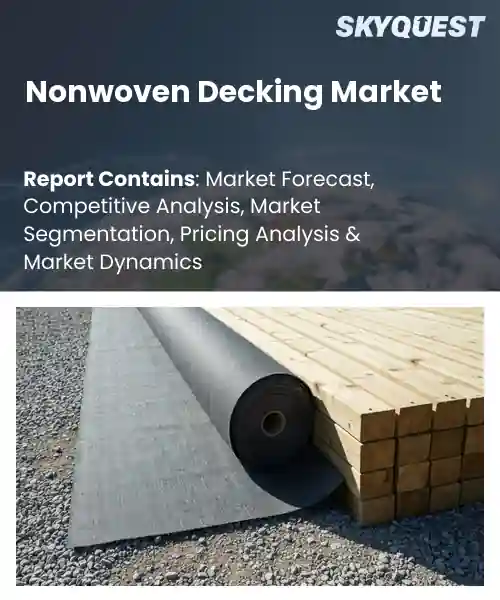
Nonwoven Decking Market
Report ID: SQMIG15F2373
Report ID: SQMIG15F2373
[email protected]
USA +1 351-333-4748
Report ID:
SQMIG15F2373 |
Region:
Global |
Published Date: June, 2026
Pages:
157
|Tables:
177
|Figures:
79


Global Nonwoven Decking Market size was valued at USD 482.3 Million in 2024 and is poised to grow from USD 510.27 Million in 2025 to USD 801.1 Million by 2033, growing at a CAGR of 5.8% during the forecast period (2026-2033).
The major factor contributing to the growth of nonwoven decking market is increasing demand for durable and low maintenance outdoor surfaces which are resistant to moisture, UV exposure and biological degradation. Nonwoven decking is the engineered fabric elements used as underlayment, drainage mat, protective layer and reinforcement in decking systems, and matters because it extends service life and reduces lifecycle costs for residential, commercial and marine structures. In the last two decades, manufacturers have moved from simple needle-punched felts to polymer-engineered spunbond and composite nonwovens. Applications such as rooftop terraces, pool surrounds, and boardwalks have suffered from rot and warping of traditional wood, and costs have risen as well.
The key growth factor for the global nonwoven decking market is regulatory pressure and sustainability targets as increasing lifecycle costs and resilience concerns push owners to opt for engineered solutions. Stricter building codes calling for moisture control and stormwater management have compelled architects and contractors to specify nonwoven underlayments and drainage mats, leading to steady volume growth and economies of scale. As makers build spunbond lines for recycled polymers, unit costs drop and new products for rooftop gardens, marina walkways and transit platforms are born. This cycle provides opportunities in retrofit markets and in developing regions where infrastructure upgrades favor low-maintenance, long-lived decking systems.
How is AI enhancing quality control in the nonwoven decking market?
Machine vision, pattern recognition and predictive analytics are revolutionizing the quality control in nonwoven decking market by identifying defects during the manufacturing. Sensor fusion and inline cameras link physical test data to process controls and map fiber irregularities and surface flaws. Automation of sorting and feedback loops reduces re-work and improves consistency for outdoor and marine applications. Integration with quality management systems and factory digital twins means traceable inspection records and faster root cause analysis to help suppliers meet durability and sustainability expectations and accelerate product release.
At Techtextil April 2026 R.O.A.M Systems presented a new nonwoven production method and AI supported inspection showing tighter defect detection and faster quality release helping nonwoven decking manufacturers to scale up and improve supply chain efficiency. Less garbage.
Market snapshot - (2026-2033)
Global Market Size
USD 482.3 Million
Largest Segment
Polypropylene (PP)
Fastest Growth
Polyester (PET)
Growth Rate
5.8% CAGR
To get more insights on this market click here to Request a Free Sample Report
Global nonwoven decking market is segmented by material type, product type, application, vehicle type, sales channel, end user and region. Based on material type, the market is segmented into Polypropylene (PP), Polyester (PET), Polyethylene (PE) and Others. Based on product type, the market is segmented into Needle-Punched Nonwoven Decking, Thermally Bonded Nonwoven Decking, Chemically Bonded Nonwoven Decking and Others. Based on application, the market is segmented into Automotive Interiors, Trunk & Cargo Areas, Parcel Shelves, Door Panels, Headliners and Others. Based on vehicle type, the market is segmented into Passenger Cars, Light Commercial Vehicles, Heavy Commercial Vehicles and Electric Vehicles. Based on sales channel, the market is segmented into OEM and Aftermarket. Based on end user, the market is segmented into Automotive Manufacturers, Automotive Component Suppliers, Aftermarket Suppliers and Others. Based on region, the market is segmented into North America, Europe, Asia Pacific, Latin America and Middle East & Africa.
The polypropylene (PP) segment leads as its inherent light weight and structural stiffness allow the creation of decking solutions that are both strong and light, a combination attractive to vehicle designers. Its resistance to moisture and chemical exposure reduces long term degradation and its compatibility with established meltblown and spunbond manufacturing allows for scalable low cost production. These material properties facilitate integration with trim and molding processes, meet aggressive automotive durability and cost targets, and push broad adoption across OEMs and component suppliers.
However, the Polyester (PET) is growing as the fastest material on the market due to better thermal stability and tensile strength of the material which enables reliable performance under the higher service conditions and advanced interior finishes. Increasing use of recycled PET feedstock and advances in bonding and finishing processes that enable new applications and commercial opportunities for nonwoven decking are driving the innovation.
The Needle-Punched Nonwoven Decking segment accounts for the largest share due to their mechanically entangled fiber structure providing high bulk and controlled porosity ideal for noise absorption and cushioning in vehicle interiors. The process produces durable, formable mats that are trim and attachment resistant, yet resilient and dimensionally stable enough to provide consistent NVH performance across a variety of applications. For many OEM interior specifications it is a popular choice due to existing production methods and broad supplier expertise which reduces integration risk.
The Thermally Bonded Nonwoven Decking is meanwhile showing the strongest growth momentum, and the heat fusion process allows for cleaner production, sharper surface appearance and predictable mechanical properties that attract premium interior designs. Suppliers and OEMs are embracing these materials to enable differentiated acoustics and lightweighting opportunities in emerging vehicle architectures, driven by improved process efficiencies and recyclability from fiber blends and thermal bonding equipment improvements.
To get detailed segments analysis, Request a Free Sample Report
The largest nonwoven decking market globally, North America has mature infrastructure, advanced manufacturing capabilities and strong demand for durable, low maintenance exterior materials. Integrated supply chains and the proximity to big raw material producers facilitates efficient production and consistent quality. Engineered nonwoven decking solutions are gaining traction in residential and commercial segments due to stringent building performance standards and sustainable materials. Fast market introduction and customization is possible due to strong distribution channels and mature fabricators. Material scientists, product developers and construction companies are collaborating to keep innovating surface texture, weather resistance and recyclability. Strong testing and certification regimes benefit market participants by increasing customer confidence and enabling differentiated product offerings to command a premium position. Regional leadership continues to be cemented through strategic investments in process efficiency and product diversification.
United States Nonwoven Decking Market is characterized by high-tech fabrication networks, emphasis on code compliance, and a strong demand from renovation and new build sectors. Manufacturers focus on material performance, long term durability and environmental credentials to allow the product to be marketed as a premium product. Specification into a variety of project types is supported by close partnerships between suppliers, architects and installers. The continued emphasis on design flexibility and lifecycle benefits continues to drive commercial acceptance and consumer confidence in regional markets throughout the country.
interest in durable low maintenance exterior solutions suited to varied climates and architectural styles Canadian Nonwoven Decking Market Local manufacturers collaborate with overseas vendors to design products that resist heat and dampness. Sustainable sourcing and recyclability are a focus for builder and homeowner decisions. Regional distributors and fabricators offer installation and technical support, increasing confidence in the market and driving specification on residential and commercial projects, across provinces in markets.
Europe is witnessing a rapid growth of nonwoven decking driven by a strong focus on sustainability, strict building codes and a mature design culture that emphasizes on long term performance and aesthetic integration. Active material innovation with renewable feedstocks, recycled content and lifecycle recyclability aligned with regional environmental policy objectives is driving market growth. Architects and specifiers are increasingly turning to engineered nonwovens for the balance of texture, durability and ease of installation. well established distribution networks and cross border collaboration among manufacturers accelerates technology transfer and scale up production. Further stimulating adoption and market depth across Western European economies is the consumer preference for low maintenance and high quality exterior finishes in urban regeneration and residential refurbishment projects. Investment in testing standards and performance certification in national markets builds trust and encourages procurement by institutional clients and high end residential developers.
Germany Nonwoven Decking Market is driven by stringent engineering standards and focus on sustainability and durability. Producers also cite high quality manufacture, performance testing and recyclability credentials that meet stringent specifications. Material and texture are the product of collaborative research. Reliable application and aftercare through established distribution channels and certified installers. This technical rigor and regulatory alignment makes Germany a benchmark market in European regional leadership for advanced nonwoven decking solutions.
The UK nonwoven decking market is seeing a boom in adoption, driven by renovation activity, urban densification and demand for design oriented exterior solutions. Manufacturers and distributors are looking to differentiate their products by textures, color palettes and sustainable compositions that will appeal to architects and consumers. Rapid specification supported by agile supply chains and trade promotion. Installer expertise and an increasing awareness of the benefits of low maintenance are driving wider acceptance in both private and public sector projects across the country.
France Nonwoven Decking Market is gaining traction as architects and homeowners are increasingly interested in sustainable and refined exterior materials for modern and traditional settings. The manufacturers and designers adapt the textures and finishes to the French taste, while integrating environmental criteria. More visibility through increasing installer capability and targeted pilot projects in the urban and leisure segments. Procurement is performance based on lifecycle and recyclability and envisages expansion into metropolitan and resort areas.
Asia Pacific is solidifying its position in the nonwoven decking market via strategic investments in manufacturing scale, materials research and downstream fabrication capabilities. Local manufacturers are fine tuning their processes to ensure consistent quality and to create custom products that withstand regional climate and UV performance. We partner with global technology providers and local companies to help us adopt best practices and accelerate product development. A growing trade in engineered building products, a growing consumer awareness of low maintenance exteriors and growing construction activity provide an enabling environment. Training of professional installers and the local distribution network improves the quality of installation and after-sales service and adds to the credibility of the product. All these factors are assisting in moving the region from a cost driven supplier base to a provider of competitive high performance nonwoven decking solutions.
Japan Nonwoven Decking Market has precision manufacturing, rigid quality control and materials designed for different climatic conditions. Producers combine polymer science and surface engineering to provide durable, low maintenance deck finishes. Close working with architects and builders ensures compatibility with traditional and modern building types. Focus on performance testing and validation helps to gain acceptance in both residential and commercial segments. Distribution and certified installer networks increase specification and on site reliability.
South Korea Nonwoven Decking Market Drivers The South Korea nonwoven decking market is driven by the adoption of modern exterior materials, strong manufacturing capacities and focus on weather resistant formulations. Local firms are exploring product customisation, new surface textures and integration with modular construction techniques. Suppliers, contractors and designers work together to make specification easier for urban and leisure projects. Training installation personnel and extension of distribution networks to improve application and maintenance quality. These developments, in turn, improve market sophistication and regional competitiveness.
To know more about the market opportunities by region and country, click here to
Buy The Complete Report
Rising Demand For Sustainable Materials
Advancements In Manufacturing Technologies
Limited Raw Material Availability
Perception And Acceptance Challenges
Request Free Customization of this report to help us to meet your business objectives.
Global nonwoven decking market’s competitive landscape is shaped by consolidation, vertical integration and material innovation as manufacturers seek to lock in recycled feedstock and sustainability credentials. Firms engage in targeted M&A and capacity builds to control inputs and margins, e.g. AZEK’s purchase of Return Polymers, and Trex’s multi site capacity ramp, while technology buyers support material innovation such as Desktop Metal’s Forust.
SkyQuest’s ABIRAW (Advanced Business Intelligence, Research & Analysis Wing) is our Business Information Services team that Collects, Collates, Correlates, and Analyses the Data collected by means of Primary Exploratory Research backed by robust Secondary Desk research.
As per SkyQuest analysis, a key driver is growing demand for durable, low‑maintenance outdoor surfaces that resist moisture and UV, and a second driver is advancements in manufacturing technologies that improve uniformity and scale. A major restraint remains limited raw material availability, which can disrupt supply and slow capacity expansion. North America continues to dominate the market due to mature infrastructure, strong standards and integrated supply chains, while the polypropylene material segment leads overall because of its light weight, moisture resistance and cost efficiency, and growing retrofit and marine application opportunities expand addressable demand supporting longer term growth through specification and sustainability-driven procurement.
| Report Metric | Details |
|---|---|
| Market size value in 2024 | USD 482.3 Million |
| Market size value in 2033 | USD 801.1 Million |
| Growth Rate | 5.8% |
| Base year | 2024 |
| Forecast period | (2026-2033) |
| Forecast Unit (Value) | USD Million |
| Segments covered |
|
| Regions covered | North America (US, Canada), Europe (Germany, France, United Kingdom, Italy, Spain, Rest of Europe), Asia Pacific (China, India, Japan, Rest of Asia-Pacific), Latin America (Brazil, Rest of Latin America), Middle East & Africa (South Africa, GCC Countries, Rest of MEA) |
| Companies covered |
|
| Customization scope | Free report customization with purchase. Customization includes:-
|
To get a free trial access to our platform which is a one stop solution for all your data requirements for quicker decision making. This platform allows you to compare markets, competitors who are prominent in the market, and mega trends that are influencing the dynamics in the market. Also, get access to detailed SkyQuest exclusive matrix.
Table Of Content
Executive Summary
Market overview
Parent Market Analysis
Market overview
Market size
KEY MARKET INSIGHTS
COVID IMPACT
MARKET DYNAMICS & OUTLOOK
Market Size by Region
KEY COMPANY PROFILES
Methodology
For the Nonwoven Decking Market, our research methodology involved a mixture of primary and secondary data sources. Key steps involved in the research process are listed below:
1. Information Procurement: This stage involved the procurement of Market data or related information via primary and secondary sources. The various secondary sources used included various company websites, annual reports, trade databases, and paid databases such as Hoover's, Bloomberg Business, Factiva, and Avention. Our team did 45 primary interactions Globally which included several stakeholders such as manufacturers, customers, key opinion leaders, etc. Overall, information procurement was one of the most extensive stages in our research process.
2. Information Analysis: This step involved triangulation of data through bottom-up and top-down approaches to estimate and validate the total size and future estimate of the Nonwoven Decking Market.
3. Report Formulation: The final step entailed the placement of data points in appropriate Market spaces in an attempt to deduce viable conclusions.
4. Validation & Publishing: Validation is the most important step in the process. Validation & re-validation via an intricately designed process helped us finalize data points to be used for final calculations. The final Market estimates and forecasts were then aligned and sent to our panel of industry experts for validation of data. Once the validation was done the report was sent to our Quality Assurance team to ensure adherence to style guides, consistency & design.
Analyst Support
Customization Options
With the given market data, our dedicated team of analysts can offer you the following customization options are available for the Nonwoven Decking Market:
Product Analysis: Product matrix, which offers a detailed comparison of the product portfolio of companies.
Regional Analysis: Further analysis of the Nonwoven Decking Market for additional countries.
Competitive Analysis: Detailed analysis and profiling of additional Market players & comparative analysis of competitive products.
Go to Market Strategy: Find the high-growth channels to invest your marketing efforts and increase your customer base.
Innovation Mapping: Identify racial solutions and innovation, connected to deep ecosystems of innovators, start-ups, academics, and strategic partners.
Category Intelligence: Customized intelligence that is relevant to their supply Markets will enable them to make smarter sourcing decisions and improve their category management.
Public Company Transcript Analysis: To improve the investment performance by generating new alpha and making better-informed decisions.
Social Media Listening: To analyze the conversations and trends happening not just around your brand, but around your industry as a whole, and use those insights to make better Marketing decisions.
REQUEST FOR SAMPLE
 REQUEST FREE CUSTOMIZATION
Global Nonwoven Decking Market size was valued at USD 482.3 Million in 2024 and is poised to grow from USD 510.27 Million in 2025 to USD 801.1 Million by 2033, growing at a CAGR of 5.8% during the forecast period (2026-2033).
The competitive landscape in the global nonwoven decking market is driven by consolidation, vertical integration and material innovation as manufacturers secure recycled feedstock and sustainability credentials. Firms pursue targeted M&A and capacity builds to control inputs and margins, for example AZEK’s purchase of Return Polymers, and Trex’s multi site capacity ramp, while technology buyers back material innovation such as Desktop Metal’s Forust. 'Freudenberg Performance Materials', 'Ahlstrom Corporation', 'Berry Global Inc.', 'DuPont de Nemours, Inc.', 'Fitesa S.A.', 'Johns Manville Corporation', 'Kimberly-Clark Corporation', 'Toray Industries, Inc.', 'Mogul Nonwovens', 'TWE Group GmbH', 'Avgol Industries 1953 Ltd.', 'PFNonwovens Group', 'Autoneum Holding AG', 'Hollingsworth & Vose Company', 'Lydall, Inc.', 'Fibertex Nonwovens A/S', 'Don & Low Ltd.', 'Asahi Kasei Corporation', 'Suominen Corporation', 'Glatfelter Corporation'
Sustainable Material Adoption: Market demand is shifting toward nonwoven decking that emphasizes sustainable inputs and end of life strategies, prompting manufacturers to prioritize recycled fibers, bio based polymers and product reuse. Buyers and specifiers increasingly favor products aligned with green building priorities and circularity goals, driving collaborations with recyclers and suppliers of certified feedstocks. This focus enhances brand differentiation, supports procurement criteria and accelerates adoption in projects seeking lower environmental impact, while encouraging investment in traceability, third party certifications and lifecycle communication standards.
Why does North America Dominate the Global Nonwoven Decking Market? |@12


Want to customize this report? This report can be personalized according to your needs. Our analysts and industry experts will work directly with you to understand your requirements and provide you with customized data in a short amount of time. We offer $1000 worth of FREE customization at the time of purchase.
Feedback From Our Clients


 USA (+1) 351-333-4748

