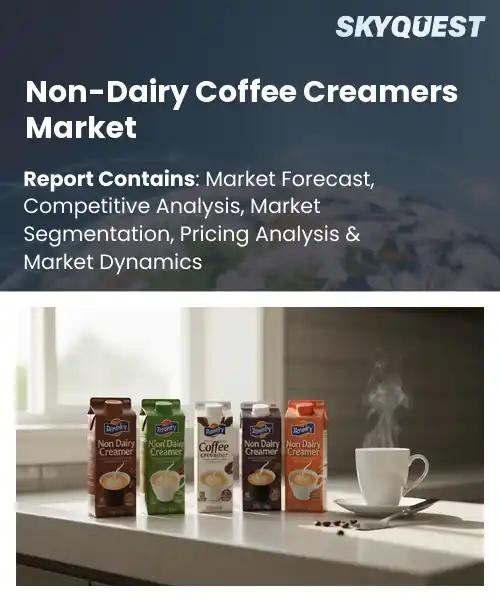
Non-Dairy Coffee Creamers Market
Report ID: SQMIG30I2996
Report ID: SQMIG30I2996
[email protected]
USA +1 351-333-4748
Report ID:
SQMIG30I2996 |
Region:
Global |
Published Date: July, 2026
Pages:
157
|Tables:
122
|Figures:
75


Global Non-Dairy Coffee Creamers Market size was valued at USD 4.38 Billion in 2024 and is poised to grow from USD 4.57 Billion in 2025 to USD 6.44 Billion by 2033, growing at a CAGR of 4.38% during the forecast period (2026-2033).
Building on that consumer shift, supply‑chain resilience has emerged as a second key factor driving market growth. As dairy sourcing faces volatility from climate‑related feed shortages, coffee brands increasingly source plant proteins that offer yields and lower pricing, reducing risk. Companies such as Starbucks and Nestlé have launched oat‑based creamer lines, citing lower price elasticity and longer shelf life as benefits of the plant base. This stability invites investment in processing infrastructure, exemplified by the surge in oat‑milk plants in the United States and Europe. Consequently, retailers gain products while manufacturers access export markets, creating a loop that expands distribution and accelerates adoption
How is AI-driven personalization influencing growth in the non-dairy coffee creamers market?
AI‑driven personalization is reshaping the non‑dairy coffee creamer market by matching consumers with flavors, textures and nutritional profiles that fit their individual tastes and dietary needs. Brands collect data from online orders, loyalty apps and smart kitchen devices, then use machine‑learning models to predict which creamer variants will resonate with each shopper. This creates a more engaging buying experience, reduces trial‑and‑error purchases and shortens the path from discovery to repeat purchase. Retailers benefit from higher conversion rates as curated product suggestions increase basket size, while manufacturers gain insight into emerging flavor trends and can fine‑tune formulations quickly. The result is a virtuous cycle where data‑rich personalization fuels both consumer satisfaction and faster product innovation, accelerating overall market growth.Oatly announced in March 2024, an AI‑powered taste‑profiling feature that suggests the optimal oat‑based creamer for each user, helping the brand expand its reach and streamline formulation cycles. This development showcases how AI personalization directly drives market expansion and operational efficiency.
Market snapshot - (2026-2033)
Global Market Size
USD 4.38 Billion
Largest Segment
Oat-Based Creamers
Fastest Growth
Coconut-Based Creamers
Growth Rate
4.38% CAGR
To get more insights on this market click here to Request a Free Sample Report
Global non-dairy coffee creamers market is segmented by source base, form, flavor profile, distribution channel and region. Based on source base, the market is segmented into Soy-Based Creamers, Almond-Based Creamers, Oat-Based Creamers, Coconut-Based Creamers, Palm Oil-Based Creamers and Others. Based on form, the market is segmented into Liquid Creamers and Powdered Creamers. Based on flavor profile, the market is segmented into Original and Unflavored, Vanilla Flavored, Caramel Flavored, Hazelnut Flavored, Chocolate Flavored and Others. Based on distribution channel, the market is segmented into Offline Retail, Online Retail and Foodservice and Cafes. Based on region, the market is segmented into North America, Europe, Asia Pacific, Latin America and Middle East & Africa.
Oat‑based creamers segment dominates because its creamy mouthfeel closely mimics dairy, satisfying taste expectations while delivering clean‑label appeal. Consumers associate oats with sustainability, and the natural sweetness reduces the need for added sugars, reinforcing brand loyalty. Manufacturers benefit from abundant oat supplies and straightforward processing, enabling cost‑effective scaling. Together these sensory, environmental, and operational advantages solidify oat‑based offerings as the preferred choice within the non‑dairy coffee creamers market.
Meanwhile, almond‑based creamers are witnessing the strongest growth momentum as plant‑protein innovation expands flavor versatility. Emerging cold brew trends and premium café applications favor almond’s nutty profile, prompting brands to launch fortified variants. This rising consumer curiosity accelerates product pipeline development, positioning almond options as a pivotal driver of future market expansion.
Liquid creamers segment leads because its ready to pour convenience aligns with fast‑paced morning routines, eliminating preparation steps. The smooth texture integrates seamlessly with hot and iced beverages, preserving aroma and enhancing body without separating. Producers can incorporate natural stabilizers, delivering consistent performance across diverse coffee styles. This ease of use, combined with sensory satisfaction, drives household preference and entrenches liquid offerings as the core product format in the market.
However, powdered creamers are emerging as the key high‑growth area as shelf‑stable convenience gains traction among on the go consumers. Advances in micro encapsulation improve solubility and flavor release, while promotions highlight portability and reduced waste. This innovation fuels adoption in travel and office settings, catalyzing new distribution opportunities and expanding the market footprint.
To get detailed segments analysis, Request a Free Sample Report
North America maintains a dominant position through a combination of strong consumer preference for plant‑based alternatives, extensive retail infrastructure, and intense product innovation. Health‑conscious buyers in the United States and Canada gravitate toward dairy‑free creamers that deliver flavor variety and clean‑label attributes, prompting manufacturers to invest heavily in research and brand differentiation. Sophisticated supply chains ensure rapid distribution across supermarkets, specialty stores, and e‑commerce platforms, while robust marketing spends reinforce perception of sustainability and dietary inclusivity. Additionally, early adoption of regulatory frameworks that favor transparent labeling has built consumer trust, allowing the region to set global standards and attract multinational producers seeking a reliable launchpad for new formulations. These interconnected factors reinforce North America’s leadership and create a self‑sustaining cycle of demand and supply.
Non-Dairy Coffee Creamers Market in the United States thrives on a culture that values convenience and culinary experimentation, encouraging a broad spectrum of flavors from oat to almond. Retail giants and boutique chains alike prioritize shelf space for plant‑based options, while consumer advocacy groups champion clean‑label claims that reinforce trust. Collaborative efforts between ingredient suppliers and brand owners accelerate formulation breakthroughs, ensuring product cycles that align with evolving taste expectations.
Non-Dairy Coffee Creamers Market in Canada benefits from a strong emphasis on sustainability and a diverse multicultural palate that welcomes innovative dairy‑free formulations. Provincial grocery chains allocate placement to oat and coconut based options, while coffeehouse chains integrate these products into specialty beverages that attract aware patrons. Partnerships with local agriculture strengthen supply transparency, and consumer education campaigns highlight nutritional advantages, fostering loyalty and encouraging repeat trials across the nation.
The European market expands swiftly due to heightened consumer awareness of health and environmental impact, coupled with a regulatory environment that rewards transparent labeling and sustainable sourcing. Shoppers across Germany, the United Kingdom and France increasingly seek dairy‑free options that deliver premium taste without compromising ethical values, prompting manufacturers to diversify portfolios with oat, soy and emerging nut bases. Collaborative innovation hubs in key cities accelerate formulation testing while retail chains integrate these products into both traditional grocery aisles and specialty coffee counters. Moreover, cultural shifts toward plant‑centric diets reinforce demand, and cross‑border trade within the bloc facilitates rapid diffusion of successful brands, establishing Europe as a catalyst for broader global adoption of non‑dairy coffee creamer solutions. This momentum also encourages investment in sustainable packaging and locally sourced ingredients, further enhancing market resilience.
Non-Dairy Coffee Creamers Market in Germany reflects a consumer base that prioritizes functional nutrition and eco‑friendly production, driving manufacturers to emphasize low‑sugar oat blends and responsibly sourced almond alternatives. Large supermarket chains allocate dedicated shelf space, while specialty coffee outlets experiment with barista‑approved formulations. Collaborative research between dairy‑free ingredient providers and local universities fuels continuous improvement, and rigorous certification schemes reassure shoppers of traceability, fostering brand loyalty across the nation.
Non-Dairy Coffee Creamers Market in the United Kingdom accelerates through a vibrant café culture that embraces experimental flavors and ethical sourcing, prompting brands to launch oat and pea‑protein blends. Marketing campaigns align with sustainability narratives, while digital grocery platforms increase accessibility for younger consumers. Partnerships with local roasters enable branding opportunities, and regulatory encouragement of plant‑based labeling builds consumer confidence, resulting in repeat purchases and expanding market penetration across regions.
Non-Dairy Coffee Creamers Market in France is emerging as consumers seek lighter textures and plant‑derived nutrition within coffee rituals. Boutique retailers introduce almond and hazelnut creamers, while mainstream supermarkets begin to allocate shelf space for oat‑based options that emphasize natural ingredients. Influencer collaborations highlight benefits, and French culinary schools experiment with dairy‑free foams, creating buzz that attracts adopters. Regulatory support for clean‑label claims further encourages brand experimentation and consumer trial.
Asia Pacific advances its market position by leveraging rising urbanization, a growing affinity for specialty coffee, and a cultural openness to plant‑based nutrition. Consumers in Japan and South Korea increasingly incorporate dairy‑free creamers into daily coffee rituals, driven by health considerations and a desire for innovative textures. Local manufacturers harness advanced food‑technology expertise to develop low‑fat, high‑solubility formulations that meet exacting taste standards, while e‑commerce channels expand distribution reach. Strategic collaborations with coffee chains accelerate product visibility, and regional trade agreements facilitate cross‑border ingredient sourcing, reinforcing a resilient supply network that supports continued expansion across the Pacific basin. Additionally, growing consumer education on environmental impact drives preference for sourced ingredients, prompting brands to adopt eco‑friendly packaging and transparent sourcing narratives. These combined forces nurture a vibrant ecosystem where innovation, distribution efficiency, and sustainability converge to elevate Asia Pacific as a pivotal growth engine for non‑dairy coffee creamer adoption worldwide.
Non-Dairy Coffee Creamers Market in Japan reflects a consumer palate that values subtle sweetness and silky texture, prompting producers to fine‑tune oat and soy blends for optimal mouthfeel. Premium retail chains allocate shelf space for artisanal variants, while convenience stores introduce single‑serve packets for consumption. Collaborative research with local universities drives ingredient optimization, and cultural emphasis on seasonal flavors sparks limited‑edition releases that capture consumer enthusiasm and reinforce brand loyalty.
Non-Dairy Coffee Creamers Market in South Korea benefits from a consumer base that embraces novelty and convenience, encouraging brands to launch almond and coconut blends with health benefits. Major coffee chains integrate these creamers into drinks, while marketplaces promote trial kits that appeal to younger demographics. Incentives for plant‑based food development support ingredient research, and influencer‑driven campaigns highlight advantages, accelerating acceptance and fostering a growing community of dairy‑free coffee enthusiasts.
To know more about the market opportunities by region and country, click here to
Buy The Complete Report
Rising Health Conscious Consumer Preference
Expansion Of Plant‑Based Ingredient Innovations
High Cost Of Specialized Ingredients
Regulatory Scrutiny Over Novel Additives
Request Free Customization of this report to help us to meet your business objectives.
The non‑dairy coffee creamer market is intensifying as incumbents pursue M&A and startups leverage biotech. Nutpods’ recent acquisition by MPearlRock signals consolidation, while Cultivated Biosciences’ $5 million seed round fuels its yeast‑fermentation platform aimed at coffee‑creamer applications. These moves heighten competition around product differentiation, supply‑chain control and rapid innovation and brand positioning.
Top Player’s Company Profile
Recent Developments
SkyQuest’s ABIRAW (Advanced Business Intelligence, Research & Analysis Wing) is our Business Information Services team that Collects, Collates, Correlates, and Analyses the Data collected by means of Primary Exploratory Research backed by robust Secondary Desk research. As per SkyQuest analysis, the global non‑dairy coffee creamer market is propelled primarily by rising health‑conscious consumer preference, which pushes retailers to expand plant‑based shelves and fuels brand loyalty. A second driver is the rapid expansion of innovative plant‑based ingredients such as oat, almond and coconut, enabling diverse flavors and textures that attract both wellness and gourmet coffee drinkers. The market’s growth is tempered by the high cost of specialized ingredients, which raises retail prices and can deter price‑sensitive shoppers. North America remains the dominant region, supported by strong demand, advanced supply chains and continuous product innovation. Within the category, oat‑based creamers hold the largest share, thanks to their creamy mouthfeel, sustainability appeal and scalable production.
| Report Metric | Details |
|---|---|
| Market size value in 2024 | USD 4.38 Billion |
| Market size value in 2033 | USD 6.44 Billion |
| Growth Rate | 4.38% |
| Base year | 2024 |
| Forecast period | (2026-2033) |
| Forecast Unit (Value) | USD Billion |
| Segments covered |
|
| Regions covered | North America (US, Canada), Europe (Germany, France, United Kingdom, Italy, Spain, Rest of Europe), Asia Pacific (China, India, Japan, Rest of Asia-Pacific), Latin America (Brazil, Rest of Latin America), Middle East & Africa (South Africa, GCC Countries, Rest of MEA) |
| Companies covered |
|
| Customization scope | Free report customization with purchase. Customization includes:-
|
To get a free trial access to our platform which is a one stop solution for all your data requirements for quicker decision making. This platform allows you to compare markets, competitors who are prominent in the market, and mega trends that are influencing the dynamics in the market. Also, get access to detailed SkyQuest exclusive matrix.
Table Of Content
Executive Summary
Market overview
Parent Market Analysis
Market overview
Market size
KEY MARKET INSIGHTS
COVID IMPACT
MARKET DYNAMICS & OUTLOOK
Market Size by Region
KEY COMPANY PROFILES
Methodology
For the Non-Dairy Coffee Creamers Market, our research methodology involved a mixture of primary and secondary data sources. Key steps involved in the research process are listed below:
1. Information Procurement: This stage involved the procurement of Market data or related information via primary and secondary sources. The various secondary sources used included various company websites, annual reports, trade databases, and paid databases such as Hoover's, Bloomberg Business, Factiva, and Avention. Our team did 45 primary interactions Globally which included several stakeholders such as manufacturers, customers, key opinion leaders, etc. Overall, information procurement was one of the most extensive stages in our research process.
2. Information Analysis: This step involved triangulation of data through bottom-up and top-down approaches to estimate and validate the total size and future estimate of the Non-Dairy Coffee Creamers Market.
3. Report Formulation: The final step entailed the placement of data points in appropriate Market spaces in an attempt to deduce viable conclusions.
4. Validation & Publishing: Validation is the most important step in the process. Validation & re-validation via an intricately designed process helped us finalize data points to be used for final calculations. The final Market estimates and forecasts were then aligned and sent to our panel of industry experts for validation of data. Once the validation was done the report was sent to our Quality Assurance team to ensure adherence to style guides, consistency & design.
Analyst Support
Customization Options
With the given market data, our dedicated team of analysts can offer you the following customization options are available for the Non-Dairy Coffee Creamers Market:
Product Analysis: Product matrix, which offers a detailed comparison of the product portfolio of companies.
Regional Analysis: Further analysis of the Non-Dairy Coffee Creamers Market for additional countries.
Competitive Analysis: Detailed analysis and profiling of additional Market players & comparative analysis of competitive products.
Go to Market Strategy: Find the high-growth channels to invest your marketing efforts and increase your customer base.
Innovation Mapping: Identify racial solutions and innovation, connected to deep ecosystems of innovators, start-ups, academics, and strategic partners.
Category Intelligence: Customized intelligence that is relevant to their supply Markets will enable them to make smarter sourcing decisions and improve their category management.
Public Company Transcript Analysis: To improve the investment performance by generating new alpha and making better-informed decisions.
Social Media Listening: To analyze the conversations and trends happening not just around your brand, but around your industry as a whole, and use those insights to make better Marketing decisions.
REQUEST FOR SAMPLE
 REQUEST FREE CUSTOMIZATION


Want to customize this report? This report can be personalized according to your needs. Our analysts and industry experts will work directly with you to understand your requirements and provide you with customized data in a short amount of time. We offer $1000 worth of FREE customization at the time of purchase.
Feedback From Our Clients


 USA (+1) 351-333-4748

