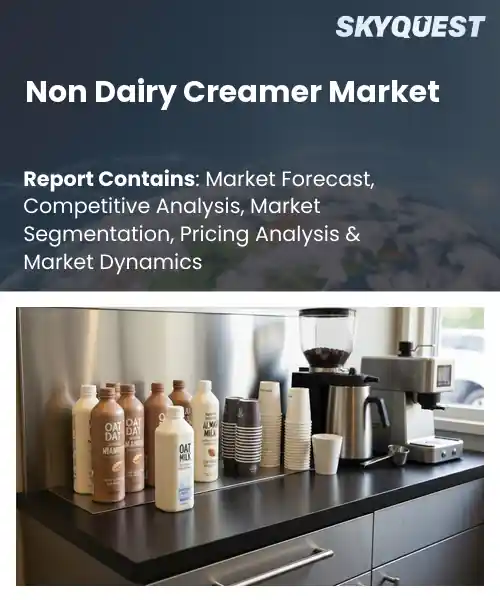
Non Dairy Creamer Market
Report ID: SQMIG30I2953
Report ID: SQMIG30I2953
[email protected]
USA +1 351-333-4748
Report ID:
SQMIG30I2953 |
Region:
Global |
Published Date: June, 2026
Pages:
157
|Tables:
145
|Figures:
78


Global Non Dairy Creamer Market size was valued at USD 3.00 Billion in 2024 and is poised to grow from USD 3.18 Billion in 2025 to USD 5.07 Billion by 2033, growing at a CAGR of 6.0% during the forecast period (2026-2033).
The major force behind the expansion of the non dairy creamer market growth is the changing eating habits of consumers towards plant-based diets combined with the rapid growth of the specialty coffee movement. This has driven a need for dairy alternative creamers, which can be either liquid or powdered and designed to simulate the mouthfeel of traditional dairy creamers, while also allowing for extended shelf life and providing a point of differentiation to retailers and food-service operators. For the last several decades, the creamers market has evolved from primarily soy-based powder creamers in the early days to today's oat, almond and coconut-based creamers made using emulsifiers. Major companies like Coffee-Mate have adapted to this trend while new plant-based start-up companies came to market with barista formulations, which have fundamentally changed the way suppliers and new entrants view their supply chains and how innovation will occur.
As example of product innovation is barista formulation, which allows cafes to create the same texture as a traditional latte, thereby helping specialty coffee consumer segment restaurants and foodservice establishments to offer more plant-based coffee options, increasing total volume/foodservice sales. In addition, e-commerce and single serve format products allow premium/National brands, as well as private label products, to offer convenience to busy consumers by extending product distribution and creating more margin opportunities. There will be future demand for innovative products that will also attract the attention of retailers. Manufacturer-driven shifts in sourcing strategies (that take into account supply chain constraints on key agricultural crops and have sustainable sourcing credentials) will impact investment priorities and create a competitive advantage amongst suppliers.
How is AI Optimizing Product Development in the Non-Dairy Creamer Market?
The use of AI has been key to streamlining the formulation of non dairy creamer market trends as companies are able to predict the sensory characteristics of products as they develop, create texture simulations, and identify ingredient combinations that will work together to form the intended flavour. Predictive flavour modelling, in particular, allows companies to match the sensory characteristics from consumer insights with lab data so they can produce products that eat/experience clean labels and provide a barista style mouthfeel to their customers. Streamlining the formulation process has reduced the number of physical trials, waste, and allows teams to make iterative improvements more quickly to both flavour and stability. A couple of examples of this include companies that supply emulsifiers using machine learning to predict how emulsifiers will react to various temperatures and customer insights being used to guide the creation of limited editions on a seasonal basis by applying social listening.
The Kerry Group, on January 2022, released its 2022 Taste Charts and reaffirmed AI-assisted flavour curation will help accelerate the development of plant-based creamers. AI technology will assist companies in their R&D departments in determining how flavours should be blended, the types of ingredients that they should use, and how the companies can reach finished, consumer acceptable products more quickly and with fewer physical trials, which supports operational efficiency and growth.
Market snapshot - (2026-2033)
Global Market Size
USD 3.0 Billion
Largest Segment
Powder
Fastest Growth
Liquid
Growth Rate
6.0% CAGR
To get more insights on this market click here to Request a Free Sample Report
Global non dairy creamer market is segmented by form, source, application, distribution channel, end-use and region. Based on form, the market is segmented into powder and liquid. Based on source, the market is segmented into coconut, soy, almond, oat and rice. Based on application, the market is segmented into coffee, tea and food & beverages. Based on distribution channel, the market is segmented into supermarkets & hypermarkets, convenience stores, online retail and foodservice. Based on end-use, the market is segmented into household and commercial. Based on region, the market is segmented into North America, Europe, Asia Pacific, Latin America and Middle East & Africa.
The powder segment is the leader because it offers greater stability for storage, provides better transport efficiency, and allows for a wide range of formulation options for manufacturers and retailers. Dry powder products can be stored for long periods of time, taken out easily, and dosed consistently, allowing for less waste and greater room for flavors and functional ingredients. This reduces the complexity of producing and distributing creamers, making powders the go-to choice for most mainstream non dairy creamer market share.
Liquid in non dairy creamers market forecast are the fastest growing segment. They offer convenience and can be served single serve or ready to use at coffee shops and restaurants catering to on-the-go consumption and foodservice applications. The clean label and ready-to-use aspects of liquids are contributing to retailers and operators using more liquid form products, which has resulted in a wave of packaging and formulation innovations to provide new usage occasions and higher margins for retailers through increasing channels.
The oat segment's dominance is due to its naturally creamy mouthfeel and neutral flavor profile, which aligns closely with consumers’ expectations for coffee and specialty drinks, thus aiding in the easy formulation of these products while minimizing off-flavors. Retail and foodservice are furthering this trend by marketing Oat purchases toward eco-conscious and health-conscious customers through perceived environmental sustainability and clean-label credentials while driving manufacturer focus on oat-based products. Many of these characteristics positively support adoption of oat products throughout the retail and foodservice sectors, and further continue to drive the entire transition of producers’ portfolios to oat-based products, creating a very strong leadership position for oat-based non-dairy creamers.
Coconut is the fastest-growing product area in that coconut’s all-natural oils and creamy mouthfeel create dairy-style textures that appeal to high-end and bold flavors. Emulsification and flavor creation developers are beginning to produce stable emulsions (and flavored) Coconut to enable producers to expand beyond coconut beverages into culinary and new market opportunities, thereby creating new sources of distribution, value added product offerings and greater market share.
To get detailed segments analysis, Request a Free Sample Report
Asia Pacific is the centre of the world's economy because of current global consumer trends, widespread available distribution and logistics from supply chains, and innovative thinking about the products consumers want to buy. The rapid acceptance of plant-based diets emphasises the upsurge in the interest of functional beverages; therefore, it is critical for manufacturers to create products that match the local taste profiles. With the large-scale retail distribution channels and diversified foodservice distribution, product distribution is further enhanced through the established ingredient sourcing networks and concentration of manufacturers. Furthermore, there is substantial experience in formulating and innovating flavour products in the region, which is helped by well-developed cold-chain distribution channels and high urban population densities. Ingredient manufacturers, brands, and retailers work collaboratively to develop new products through trial and adoption, enabling a cycle of innovation, availability, and customer preference that helps maintain regional market leadership. The continued use of e-commerce marketplaces and the premiumisation of clean-label and functional consumer products will increase brand investment in the region and further support consumer demand.
Non dairy creamer market forecast in Japan combines refined consumer taste and high expectations for quality with strong specialty coffee culture and a preference for premium, clean label formulations. Manufacturers emphasize texture, flavor layering, and novel ingredients tailored to local palates, while tight retail and convenience store channels support rapid product rotation. Collaboration with food service partners and a focus on premiumization and ingredient provenance drive continued product differentiation and market sophistication.
Non dairy creamer market outlook in South Korea is shaped by dynamic cafe culture, rapid flavor trends, and consumer openness to novel formats and functional variants. Brands prioritize bold flavor profiles, convenience formats, and collaborations with lifestyle retailers to capture daily beverage occasions. Strong urban retail density and active social media influence accelerate trend diffusion, encouraging agile product development and localized flavor innovation that aligns with health awareness and premium positioning strategies.
In North America, the desire for healthy products, ease of use, and enjoyment (in addition to having many pathways to launch new products) are key driving forces behind the speedy growth of this sector. In North America, an increase in demand for plant-based products, the need for clean label, allergen friendly products and increased manufacturer interest in expanding their portfolio means that manufacturers are also putting a greater focus on being transparent about where they source their products. The growth of coffee culture because of the increased number of food service operations provides multiple occasions to consume creamer in a higher frequency and therefore supports innovation in texture/format of creamer products. The close collaborations between ingredient suppliers/marketers, as well as the implementation of omnichannel retail strategies, have enabled manufacturers and marketers to bring new textural/flavor innovations to market at an accelerated rate, are making it possible to have a greater number of options available to consumers through private label initiatives. Focus on premiumization, functionalization and culinary versatility continues to strengthen the positioning of this region as one of the leading areas for experimentation and extension into new product categories. As more companies include e-commerce channels in their business strategies and develop agile production cycles that enable them to get rapid consumer feedback and make product changes quicker, these companies will be able to introduce more targeted product innovations to respond to evolving tastes and health trends.
Non dairy creamer market regional outlook in United States is characterized by broad consumer segmentation, active private label involvement, and a robust food service landscape that sustains daily consumption occasions. Brands focus on clean label messaging, plant based ingredients, and functional enhancements to capture diverse lifestyle needs. Extensive retail shelf space and a strong specialty coffee scene support frequent product introductions and experimentation, encouraging continual refinement of flavor and texture across channels nationwide.
Non dairy creamer market regional forecast in Canada reflects a health oriented consumer base and strong multicultural culinary influences that shape flavor development and ingredient choices. Retailers and specialty grocers offer a diversified aisle that supports niche and mainstream brands, while food service partnerships help broaden daily usage. Manufacturers emphasize clean labels, organic and allergen friendly options, and flexible formats that suit home and on the go consumption, encouraging product refinement and variety.
Combining sustainability priorities, regulatory alignment, and culinary innovation that reflects the tastes of today’s sophisticated consumers, Europe is continuing to establish itself as a leader in food and beverage development. The increasing demand for clean label, organic, and local ingredients has driven producers to rework their formulas and make claims regarding ingredient provenance. Premium positioned and distinctive flavor experiences have become critical to food retailers and foodservice providers as they compete for consumer attention; at the same time, increased investments in formulation science and plant-based technology have brought texture and sensory attributes of traditional creamers closer together. Collaborative efforts between ingredients manufacturers and retailers/brands/sustainability certifiers all support improved responsible sourcing practices; improved packaging; improved supply chain efficiencies; increased consumer awareness of the benefits of sourcing local ingredient(s). Well established cross-border distribution systems and sophisticated retail environments will enable the rapid introduction of unique SKUs that satisfy regional consumer tastes while reinforcing Europe as a global hub of quality products and continued innovation through sustainability. Emerging collaborations among start-up companies, academic institutions, and research organizations will further accelerate the adoption of alternative proteins and texture modification systems suited for European recipes/cuisines.
Non dairy creamer market anlysis in Germany emphasizes sustainability credentials, ingredient traceability, and rigorous manufacturing standards that appeal to both value and premium consumers. Retailers offer mainstream and organic specialty ranges, allowing mainstream and artisanal brands to coexist. Manufacturers focus on supply chain resilience and clear labeling to meet regulatory and consumer expectations. Flavor approaches often blend classic coffee pairings with plant based textures suited for home and food service use settings.
Non dairy creamer industry in United Kingdom reflects strong tea and coffee traditions alongside a dynamic specialty coffee and convenience sector that shapes consumption. Retailers and on trade operators balance premium and value offerings, supporting diverse formulation strategies. Brands emphasize clean label credentials, sustainability claims, and flavours adapted to local palates. Partnerships with coffee chains and quick service operators speed trials and help embed novel formats and functional variants in routines.
Non dairy creamer industry trends in France is shaped by strong culinary traditions with preference for indulgent textures that influence formulation and flavor focus. Retailers and specialty grocers present curated selections supporting artisanal and premium brands, while cafes and patisseries serve as testing grounds for novel offerings. Producers concentrate on ingredient provenance, clean label claims, and sensory quality to meet discerning consumer expectations across home and food service use and market differentiation.
To know more about the market opportunities by region and country, click here to
Buy The Complete Report
Rising Consumer Health Awareness
Innovation In Ingredient Formulation
Price Volatility Of Raw Materials
Regulatory and Labelling Challenges
Request Free Customization of this report to help us to meet your business objectives.
Competitive landscape in the global nondairy creamer market is shaped by consolidation, ingredient technology and retail partnerships that directly influence shelf placement and formulation. Leading firms pursue acquisitions such as MPearlRock’s purchase of nutpods, while multinationals apply AI driven formulation platforms and enzymatic oat protein extraction to improve mouthfeel and stability; challengers respond with direct to consumer functional launches and celebrity backed funding.
Top Player’s Company Profile
Recent Developments in the Non Dairy Creamer Market
SkyQuest’s ABIRAW (Advanced Business Intelligence, Research & Analysis Wing) is our Business Information Services team that Collects, Collates, Correlates, and Analyses the Data collected by means of Primary Exploratory Research backed by robust Secondary Desk research. As per SkyQuest analysis, the global non dairy creamer market is driven primarily by rising consumer health awareness and shifting preferences toward plant based diets that favor lactose free and vegan alternatives, while product innovation driven by ingredient science and retail channel shifts such as barista formulations and e commerce expansion provides a second strong growth driver. Price volatility of key plant based raw materials poses a significant restraint by squeezing margins and complicating launch plans. Asia Pacific dominates the market due to manufacturing scale, supply chain capabilities and rapid consumer adoption, and the powder segment remains the market leader because of its superior shelf stability, logistics efficiency and formulation flexibility.
| Report Metric | Details |
|---|---|
| Market size value in 2024 | USD 3.0 Billion |
| Market size value in 2033 | USD 5.07 Billion |
| Growth Rate | 6.0% |
| Base year | 2024 |
| Forecast period | (2026-2033) |
| Forecast Unit (Value) | USD Billion |
| Segments covered |
|
| Regions covered | North America (US, Canada), Europe (Germany, France, United Kingdom, Italy, Spain, Rest of Europe), Asia Pacific (China, India, Japan, Rest of Asia-Pacific), Latin America (Brazil, Rest of Latin America), Middle East & Africa (South Africa, GCC Countries, Rest of MEA) |
| Companies covered |
|
| Customization scope | Free report customization with purchase. Customization includes:-
|
To get a free trial access to our platform which is a one stop solution for all your data requirements for quicker decision making. This platform allows you to compare markets, competitors who are prominent in the market, and mega trends that are influencing the dynamics in the market. Also, get access to detailed SkyQuest exclusive matrix.
Table Of Content
Executive Summary
Market overview
Parent Market Analysis
Market overview
Market size
KEY MARKET INSIGHTS
COVID IMPACT
MARKET DYNAMICS & OUTLOOK
Market Size by Region
KEY COMPANY PROFILES
Methodology
For the Non Dairy Creamer Market, our research methodology involved a mixture of primary and secondary data sources. Key steps involved in the research process are listed below:
1. Information Procurement: This stage involved the procurement of Market data or related information via primary and secondary sources. The various secondary sources used included various company websites, annual reports, trade databases, and paid databases such as Hoover's, Bloomberg Business, Factiva, and Avention. Our team did 45 primary interactions Globally which included several stakeholders such as manufacturers, customers, key opinion leaders, etc. Overall, information procurement was one of the most extensive stages in our research process.
2. Information Analysis: This step involved triangulation of data through bottom-up and top-down approaches to estimate and validate the total size and future estimate of the Non Dairy Creamer Market.
3. Report Formulation: The final step entailed the placement of data points in appropriate Market spaces in an attempt to deduce viable conclusions.
4. Validation & Publishing: Validation is the most important step in the process. Validation & re-validation via an intricately designed process helped us finalize data points to be used for final calculations. The final Market estimates and forecasts were then aligned and sent to our panel of industry experts for validation of data. Once the validation was done the report was sent to our Quality Assurance team to ensure adherence to style guides, consistency & design.
Analyst Support
Customization Options
With the given market data, our dedicated team of analysts can offer you the following customization options are available for the Non Dairy Creamer Market:
Product Analysis: Product matrix, which offers a detailed comparison of the product portfolio of companies.
Regional Analysis: Further analysis of the Non Dairy Creamer Market for additional countries.
Competitive Analysis: Detailed analysis and profiling of additional Market players & comparative analysis of competitive products.
Go to Market Strategy: Find the high-growth channels to invest your marketing efforts and increase your customer base.
Innovation Mapping: Identify racial solutions and innovation, connected to deep ecosystems of innovators, start-ups, academics, and strategic partners.
Category Intelligence: Customized intelligence that is relevant to their supply Markets will enable them to make smarter sourcing decisions and improve their category management.
Public Company Transcript Analysis: To improve the investment performance by generating new alpha and making better-informed decisions.
Social Media Listening: To analyze the conversations and trends happening not just around your brand, but around your industry as a whole, and use those insights to make better Marketing decisions.
REQUEST FOR SAMPLE
 REQUEST FREE CUSTOMIZATION
Global Non Dairy Creamer Market size was valued at USD 3.0 Billion in 2024 and is poised to grow from USD 3.18 Billion in 2025 to USD 5.07 Billion by 2033, growing at a CAGR of 6.0% during the forecast period (2026-2033).
Competitive landscape in the global nondairy creamer market is shaped by consolidation, ingredient technology and retail partnerships that directly influence shelf placement and formulation. Leading firms pursue acquisitions such as MPearlRock’s purchase of nutpods, while multinationals apply AI driven formulation platforms and enzymatic oat protein extraction to improve mouthfeel and stability; challengers respond with direct to consumer functional launches and celebrity backed funding. 'Nestlé S.A.', 'Danone S.A.', 'Kerry Group plc', 'Rich Products Corporation', 'TreeHouse Foods Inc.', 'FrieslandCampina Kievit', 'Califia Farms', 'Nutpods Inc.', 'Oatly Group AB', 'Chobani LLC', 'Ripple Foods', 'Elmhurst Milked Inc.', 'Laird Superfood', 'Super Group Ltd.', 'Dairy Farmers of America', 'Suntory Holdings', 'WhiteWave Foods', 'Coconut Secret', 'Cremica Group', 'Mokate Group'
Growing consumer emphasis on healthier diets and increased interest in plant based choices supports demand for non dairy creamers. As shoppers seek products perceived as cleaner and aligned with dietary preferences, manufacturers respond with formulations that highlight natural ingredients and functional benefits, encouraging trial and repeat purchases. This shift in consumer priorities reshapes product development and retail placement strategies, prompting wider availability and targeted marketing that amplifies visibility and acceptance, thereby creating sustained market momentum grounded in evolving health and lifestyle considerations.
Clean Label Demand: Consumers increasingly seek simple, recognizable ingredient lists and transparent sourcing, prompting manufacturers to reformulate non-dairy creamers with fewer synthetic additives and clearer origin claims. Brands emphasize natural emulsifiers, minimal processing, and farm-to-shelf narratives to build trust and justify premium positioning. Retailers favor products that communicate clean label benefits through straightforward packaging language and ingredient storytelling. This shift influences innovation pipelines, supplier relationships, and marketing strategies across the category as companies align product profiles with evolving expectations for purity and provenance.
Why does Asia Pacific Dominate the Global Non Dairy Creamer Market? |@12


Want to customize this report? This report can be personalized according to your needs. Our analysts and industry experts will work directly with you to understand your requirements and provide you with customized data in a short amount of time. We offer $1000 worth of FREE customization at the time of purchase.
Feedback From Our Clients


 USA (+1) 351-333-4748

