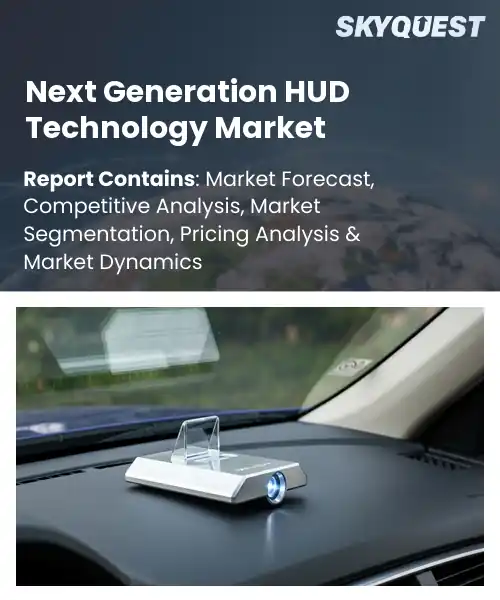
Next Generation HUD Technology Market
Report ID: SQMIG25A2947
Report ID: SQMIG25A2947
[email protected]
USA +1 351-333-4748
Report ID:
SQMIG25A2947 |
Region:
Global |
Published Date: August, 2026
Pages:
157
|Tables:
117
|Figures:
77


Global Next Generation Hud Technology Market size was valued at USD 3.76 Billion in 2024 and is poised to grow from USD 4.41 Billion in 2025 to USD 15.69 Billion by 2033, growing at a CAGR of 17.2% during the forecast period (2026-2033).
The global next‑generation heads‑up display (HUD) market encompasses projection systems that overlay critical information onto a driver’s line of sight, ranging from automotive windshields to aviation cockpits and augmented‑reality helmets. Its significance lies in improving situational awareness while reducing visual distraction, a necessity as vehicles become more autonomous and sensor‑laden. The primary driver is the relentless push for safety and efficiency in transportation, a trend that began with military jet HUDs in the 1970s and migrated to luxury cars in the early 2000s. Recent advancements in OLED micro‑displays and waveguide optics have lowered costs, enabling adoption and expanding the ecosystem.
The second decisive factor shaping the global next‑generation HUD market is the integration of driver‑assistance systems (ADAS) with data pipelines, which fuels richer visualizations and interactive alerts. Regulatory pressure on safety standards pushes manufacturers to embed lidar, radar and V2X communication, producing data streams that must be displayed instantly to prevent driver overload. This creates demand for HUDs with eye‑tracking and AI‑driven context awareness, showing only relevant cues within the field of view. Deployments such as Mercedes’ MBUX Hyperscreen and Boeing’s upgraded cockpit displays demonstrate how this synergy expands opportunities for HUD platforms, waveguide licensing and aftermarket retrofits across fleets.
How are AI and IoT Accelerating Next-generation HUD Technology Adoption In Automotive Displays?
AI and IoT are jointly pushing next-generation HUD technology from basic projected readouts toward intelligent, context-aware windshield systems. AI enables real-time contextual alerts, predictive ADAS overlays, eye-tracking-based personalization, and dynamic content that adapts to driving conditions, while IoT and connected vehicle infrastructure supply the live data streams, cloud connectivity, and V2X inputs needed for accurate lane guidance, hazard warnings, and traffic updates. Together they are shifting HUDs from standalone hardware into software-driven, OTA-updatable components of the broader digital cockpit, incorporating waveguide and micro-LED optics for sharper AR overlays. This convergence, paired with declining component costs and tightening safety regulations, is accelerating adoption beyond luxury EVs into mid-segment vehicles, positioning AI-IoT-enabled AR-HUDs as a near-standard safety and infotainment feature.
Market snapshot - (2026-2033)
Global Market Size
USD 3.76 Billion
Largest Segment
Windshield HUD
Fastest Growth
Augmented Reality HUD
Growth Rate
17.2% CAGR
To get more insights on this market click here to Request a Free Sample Report
Global next generation hud technology market is segmented by product type, component, vehicle type, propulsion and region. Based on product type, the market is segmented into Windshield HUD, Combiner HUD and Augmented Reality HUD. Based on component, the market is segmented into Display Unit, Projection Unit, Software and Sensors & Electronics. Based on vehicle type, the market is segmented into Passenger Vehicles and Commercial Vehicles. Based on propulsion, the market is segmented into Internal Combustion Engine Vehicles, Electric Vehicles and Hybrid Vehicles. Based on region, the market is segmented into North America, Europe, Asia Pacific, Latin America and Middle East & Africa.
Windshield HUD segment dominates because it integrates directly into the driver’s line of sight, delivering critical information without requiring eye movement. Its seamless integration builds trust, enhances safety, and aligns with OEM design priorities, making it the preferred choice for new vehicle platforms. The inherent simplicity of retrofitting existing glass and the clear visual advantage drive its leadership. Additionally, the scalability of existing production lines allows manufacturers to meet growing demand without extensive retooling, further cementing its dominance in the market.
However, augmented reality HUD emerges as the key high growth area in the next generation hud technology market. Its ability to overlay contextual data onto real world scenes creates immersive driver experiences, attracting premium vehicle programs and technology focused consumers. Advances in sensor fusion and graphics processing accelerate adoption, opening new revenue streams and expanding market scope.
Display Unit segment dominates because it provides the visual core that translates digital information into driver readable imagery. Its high brightness, contrast, and reliability meet safety standards, making it indispensable for OEMs seeking to integrate HUDs across vehicle lines. The maturity of micro display manufacturing and proven performance reinforce its central market role. Additionally, the scalability of existing production lines allows manufacturers to meet growing demand without extensive retooling, further cementing its dominance in the market.
Meanwhile, Software emerges as the most rapidly expanding area in the next generation HUD market. Its capacity to deliver customizable interfaces, over the air updates, and advanced driver assistance integration fuels demand from automakers aiming for differentiated user experiences. Continuous innovation in AI driven content and cloud connectivity accelerates adoption, creating new business models and broadening the market’s growth horizon.
To get detailed segments analysis, Request a Free Sample Report
North America dominates due to a mature automotive ecosystem, strong OEM collaborations, and aggressive investment in advanced driver assistance systems. The United States benefits from a deep pool of technology talent and leading research institutions that accelerate HUD integration with next‑generation vehicle platforms. Canada contributes a robust supply chain in sensors and optical components, supported by favorable government incentives for innovation. Together, the region enjoys a regulatory environment that encourages rapid testing and deployment, providing a competitive edge that attracts global partners seeking to leverage cutting‑edge display solutions. The convergence of high‑bandwidth communication standards and a strong emphasis on driver safety creates fertile ground for HUD developers to experiment with augmented reality overlays and personalized information streams. Moreover, the presence of major automotive manufacturers alongside agile start‑ups fosters an ecosystem where innovation cycles are shortened and market acceptance is accelerated.
Next Generation HUD Technology Market in the United States benefits from a dense network of automotive OEMs and tech giants that prioritize immersive driver interfaces. Research collaborations between universities and industry leaders accelerate the development of high‑resolution projection systems, while venture capital activity fuels start‑up innovation in sensor fusion and eye‑tracking. Regulatory frameworks encourage early field trials, allowing manufacturers to refine user experience and safety standards ahead of broader market rollout.
Next Generation HUD Technology Market in Canada leverages a strong base of optical component manufacturers and a collaborative ecosystem linking research institutes with automotive suppliers. Government programs that support clean‑technology innovation provide funding pathways for prototype development and cross‑border testing with neighboring markets. The emphasis on safety standards and driver assistance integration positions Canada as an attractive hub for firms seeking to validate HUD solutions under real‑world driving conditions.
Asia Pacific experiences rapid expansion due to strong consumer demand for advanced infotainment, supportive government policies, and a vibrant electronics manufacturing base. Japan’s deep heritage in precision optics and its focus on vehicle safety drives integration of immersive HUD experiences, while South Korea’s leadership in semiconductors and display technologies accelerates the rollout of high‑definition, low‑latency projections. The region benefits from extensive automotive supply chains that enable swift scaling, and collaborative research initiatives that blend automotive engineering with cutting‑edge visual computing. Additionally, a cultural emphasis on technology adoption among drivers nurtures market readiness for sophisticated head‑up displays that combine navigation, driver monitoring, and augmented reality content. Automakers in the region are also investing in platform‑agnostic HUD architectures that can be customized across multiple vehicle models, fostering economies of scale and encouraging cross‑brand collaboration.
Next Generation HUD Technology Market in Japan builds on a legacy of precision engineering and a rigorous safety culture that values driver awareness. Leading sensor manufacturers collaborate with automotive giants to create transparent displays that integrate seamlessly with head‑up navigation and night‑vision functions. Research consortia supported by governmental innovation funds focus on augmented reality overlays, enabling real‑time hazard detection. This ecosystem nurtures both established suppliers and agile start‑ups, ensuring continuous technological advancement.
Next Generation HUD Technology Market in South Korea leverages world‑class semiconductor fabrication and sophisticated display panel expertise to deliver ultra‑bright, low‑power head‑up solutions. Major automotive OEMs partner with local component suppliers to embed HUD systems that combine navigation, driver assistance alerts, and infotainment on a single transparent surface. Government technology initiatives promote the convergence of 5G connectivity with HUD platforms, enabling real‑time data streaming for augmented reality navigation. The collaborative environment accelerates product rollout and enhances competitive positioning globally.
Europe strengthens its position through coordinated standards harmonization, strong emphasis on sustainability, and deep automotive heritage across key markets. Germany’s engineering excellence and its focus on high‑performance vehicle systems drive the development of HUDs that meet rigorous functional safety requirements. The United Kingdom’s vibrant digital innovation ecosystem encourages integration of artificial intelligence and cloud services with head‑up displays, while France combines luxury design aesthetics with advanced optical technologies to create premium HUD experiences. Collaborative research programs funded by the European Union foster cross‑border knowledge sharing, enabling rapid prototyping and validation of augmented reality features. Additionally, regulatory frameworks that prioritize driver assistance systems create a supportive environment for manufacturers to introduce next‑generation HUDs that enhance safety, convenience, and user engagement across the continent.
Next Generation HUD Technology Market in Germany benefits from a strong tradition of automotive engineering and a robust supply chain for precision optics. Leading vehicle manufacturers collaborate closely with technology firms to integrate high‑resolution holographic displays that align with the country’s focus on safety and performance. Research institutes receive substantial support for developing eye‑tracking and gesture‑based controls, ensuring that HUD solutions remain at the forefront of driver interaction. This synergy between OEMs, suppliers, and academia sustains continuous innovation and reinforces Germany’s reputation as a leader in automotive display technology.
Next Generation HUD Technology Market in the United Kingdom draws on a dynamic software development sector and a growing number of autonomous vehicle testbeds. Partnerships between automotive manufacturers and AI start‑ups enable HUD platforms that deliver predictive navigation cues and real‑time traffic analytics. Government incentives for advanced driver assistance technologies encourage rapid prototyping and field trials on public roads. The blend of creative design expertise and engineering rigor creates head‑up systems that emphasize intuitive user interfaces and seamless connectivity with mobile ecosystems.
Next Generation HUD Technology Market in France merges luxury automotive branding with cutting‑edge optical engineering to produce elegant, high‑definition head‑up displays. Collaboration between premium car makers and specialized optics firms results in HUD solutions that prioritize aesthetic integration and crystal‑clear visuals. National research programs focus on augmented reality content that enhances driver perception without distraction. Supportive regulatory policies and a strong emphasis on automotive design excellence ensure that French HUD offerings remain synonymous with sophistication and technological advancement.
To know more about the market opportunities by region and country, click here to
Buy The Complete Report
Increasing Vehicle Connectivity
Regulatory Support for Advanced Displays
High Development Cost
Stringent Safety Certification
Request Free Customization of this report to help us to meet your business objectives.
Competition in the global next‑generation HUD market is intensifying as automotive OEMs and Tier‑1 suppliers race to embed immersive, holographic displays in vehicles. Key drivers include the demand for safer, glance‑free information and the shift toward software‑defined cockpit experiences. Companies are pursuing M&A to acquire waveguide patents, forming OEM‑supplier alliances, and accelerating tech innovation through joint development of holographic engine platforms.
SkyQuest’s ABIRAW (Advanced Business Intelligence, Research & Analysis Wing) is our Business Information Services team that Collects, Collates, Correlates, and Analyses the Data collected by means of Primary Exploratory Research backed by robust Secondary Desk research.
As per SkyQuest analysis, the global next‑generation HUD market is expanding rapidly, driven primarily by increasing vehicle connectivity that merges navigation, infotainment and driver‑assist data into a single glance‑free display, while regulatory support for advanced displays further accelerates adoption by providing clear compliance pathways and incentives. The dominant region is North America, where mature OEM ecosystems and strong tech talent foster swift integration, and the leading segment is the windshield HUD, which offers seamless line‑of‑sight information without eye movement. However, high development costs for sophisticated optics and software remain a restraint, limiting entry for smaller players and tempering the pace of market penetration.
| Report Metric | Details |
|---|---|
| Market size value in 2024 | USD 3.76 Billion |
| Market size value in 2033 | USD 15.69 Billion |
| Growth Rate | 17.2% |
| Base year | 2024 |
| Forecast period | (2026-2033) |
| Forecast Unit (Value) | USD Billion |
| Segments covered |
|
| Regions covered | North America (US, Canada), Europe (Germany, France, United Kingdom, Italy, Spain, Rest of Europe), Asia Pacific (China, India, Japan, Rest of Asia-Pacific), Latin America (Brazil, Rest of Latin America), Middle East & Africa (South Africa, GCC Countries, Rest of MEA) |
| Companies covered |
|
| Customization scope | Free report customization with purchase. Customization includes:-
|
To get a free trial access to our platform which is a one stop solution for all your data requirements for quicker decision making. This platform allows you to compare markets, competitors who are prominent in the market, and mega trends that are influencing the dynamics in the market. Also, get access to detailed SkyQuest exclusive matrix.
Table Of Content
Executive Summary
Market overview
Parent Market Analysis
Market overview
Market size
KEY MARKET INSIGHTS
COVID IMPACT
MARKET DYNAMICS & OUTLOOK
Market Size by Region
KEY COMPANY PROFILES
Methodology
For the Next Generation HUD Technology Market, our research methodology involved a mixture of primary and secondary data sources. Key steps involved in the research process are listed below:
1. Information Procurement: This stage involved the procurement of Market data or related information via primary and secondary sources. The various secondary sources used included various company websites, annual reports, trade databases, and paid databases such as Hoover's, Bloomberg Business, Factiva, and Avention. Our team did 45 primary interactions Globally which included several stakeholders such as manufacturers, customers, key opinion leaders, etc. Overall, information procurement was one of the most extensive stages in our research process.
2. Information Analysis: This step involved triangulation of data through bottom-up and top-down approaches to estimate and validate the total size and future estimate of the Next Generation HUD Technology Market.
3. Report Formulation: The final step entailed the placement of data points in appropriate Market spaces in an attempt to deduce viable conclusions.
4. Validation & Publishing: Validation is the most important step in the process. Validation & re-validation via an intricately designed process helped us finalize data points to be used for final calculations. The final Market estimates and forecasts were then aligned and sent to our panel of industry experts for validation of data. Once the validation was done the report was sent to our Quality Assurance team to ensure adherence to style guides, consistency & design.
Analyst Support
Customization Options
With the given market data, our dedicated team of analysts can offer you the following customization options are available for the Next Generation HUD Technology Market:
Product Analysis: Product matrix, which offers a detailed comparison of the product portfolio of companies.
Regional Analysis: Further analysis of the Next Generation HUD Technology Market for additional countries.
Competitive Analysis: Detailed analysis and profiling of additional Market players & comparative analysis of competitive products.
Go to Market Strategy: Find the high-growth channels to invest your marketing efforts and increase your customer base.
Innovation Mapping: Identify racial solutions and innovation, connected to deep ecosystems of innovators, start-ups, academics, and strategic partners.
Category Intelligence: Customized intelligence that is relevant to their supply Markets will enable them to make smarter sourcing decisions and improve their category management.
Public Company Transcript Analysis: To improve the investment performance by generating new alpha and making better-informed decisions.
Social Media Listening: To analyze the conversations and trends happening not just around your brand, but around your industry as a whole, and use those insights to make better Marketing decisions.
REQUEST FOR SAMPLE
 REQUEST FREE CUSTOMIZATION
Global Next Generation Hud Technology Market size was valued at USD 3.76 Billion in 2024 and is poised to grow from USD 4.41 Billion in 2025 to USD 15.69 Billion by 2033, growing at a CAGR of 17.2% during the forecast period (2026-2033).
Competition in the global next‑generation HUD market is intensifying as automotive OEMs and Tier‑1 suppliers race to embed immersive, holographic displays in vehicles. Key drivers include the demand for safer, glance‑free information and the shift toward software‑defined cockpit experiences. Companies are pursuing M&A to acquire waveguide patents, forming OEM‑supplier alliances, and accelerating tech innovation through joint development of holographic engine platforms. 'Continental AG', 'Panasonic Holdings Corporation', 'DENSO Corporation', 'Robert Bosch GmbH', 'Nippon Seiki Co., Ltd.', 'Visteon Corporation', 'Yazaki Corporation', 'LG Electronics Inc.', 'Garmin Ltd.', 'Sony Group Corporation', 'Texas Instruments Incorporated', 'MicroVision, Inc.', 'WayRay AG', 'Huawei Technologies Co., Ltd.', 'AUO Corporation', 'Japan Display Inc.', 'XREAL Technology Co., Ltd.', 'Cinemo GmbH', 'Hyundai Mobis Co., Ltd.', 'Valeo SE'
The rise of connected vehicle ecosystems enables seamless integration of next generation heads‑up displays with navigation, infotainment, and driver assistance functions, creating richer user experiences. Manufacturers leverage this connectivity to deliver real‑time traffic updates, predictive maintenance alerts, and augmented reality overlays directly within the driver’s line of sight. This capability not only differentiates premium vehicle offerings but also accelerates consumer acceptance, driving demand for sophisticated HUD solutions across multiple vehicle segments. As automakers prioritize digital cockpits, they increasingly collaborate with HUD suppliers to embed advanced visualization, further expanding market opportunities.
Augmented Reality Integration: Automotive manufacturers are increasingly embedding augmented reality overlays into head‑up displays to enhance driver perception and situational awareness. By projecting navigation cues, hazard warnings, and contextual information directly onto the windshield, AR‑driven HUDs create an immersive cockpit experience that reduces eye‑movement distraction. This evolution is driven by consumer demand for intuitive interfaces, advances in projection optics, and the convergence of vehicle infotainment ecosystems, positioning AR‑enhanced HUDs as a differentiator for premium and mainstream vehicle segments alike.
Why does North America Dominate the Global Next Generation HUD Technology Market? |@12


Want to customize this report? This report can be personalized according to your needs. Our analysts and industry experts will work directly with you to understand your requirements and provide you with customized data in a short amount of time. We offer $1000 worth of FREE customization at the time of purchase.
Feedback From Our Clients


 USA (+1) 351-333-4748

