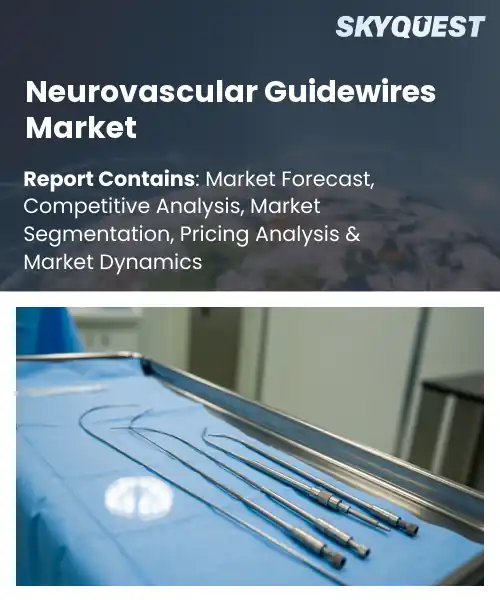
Neurovascular Guidewires Market
Report ID: SQMIG35A4052
Report ID: SQMIG35A4052
[email protected]
USA +1 351-333-4748
Report ID:
SQMIG35A4052 |
Region:
Global |
Published Date: July, 2026
Pages:
157
|Tables:
175
|Figures:
79


Global Neurovascular Guidewires Market size was valued at USD 4.2 Billion in 2024 and is poised to grow from USD 4.5 Billion in 2025 to USD 7.85 Billion by 2033, growing at a CAGR of 7.2% during the forecast period (2026-2033).
The primary driver of the neurovascular guidewires market is the rapid expansion of endovascular treatment for cerebrovascular disease, propelled by stronger clinical evidence and a rising incidence of ischemic stroke in aging populations. Neurovascular guidewires are specialized, flexible wires used to navigate cerebral vasculature during interventions such as thrombectomy, aneurysm coiling, and stent placement, and their role has become central as minimally invasive techniques replace open surgery. Over the last two decades the sector has evolved from simple stainless steel wires to sophisticated nitinol cores, hydrophilic coatings, and variable tip designs, which together have enabled improved success rates and adoption.
Building on that clinical momentum, a key trend driving the global neurovascular guidewiressector growth is continuous technological innovation in guidewire materials and design which improves navigability and reduces procedural complications, thereby expanding indications and clinician confidence. For example, hydrophilic coatings and tapered nitinol cores lower friction and improve torque transmission so operators can access distal occlusions more quickly during mechanical thrombectomy, which shortens door-to-recanalization times and improves functional outcomes. As outcomes improve hospitals invest more in neurointerventional suites and training, creating demand in developed markets and attracting manufacturers to emerging markets where unmet stroke care needs and improving reimbursement create commercial opportunities.
How is AI Improving Procedural Outcomes in the Neurovascular Guidewires Market?
AI is improving procedural outcomes in the neurovascular guidewires market by combining advanced imaging analysis with real time navigation. Key aspects include automated vessel segmentation, smart roadmapping, sensor fusion and clinician decision support that reduce uncertainty during complex intracranial navigation. The current state shows early clinical adoption where AI assists imaging workflows and guides device selection and trajectory planning. In a market challenged by tortuous anatomy and sensitivity to small errors, these capabilities lower complication risk and make training more efficient. Examples include AI imaging partnerships and emerging robotic navigation systems that integrate guidance data for smoother guidewire control.
In January 2026, Boston Scientific, the acquisition of Penumbra accelerated access to thrombectomy platforms and prompted faster integration of AI enabled imaging and navigation tools that help clinicians choose and steer guidewires with greater confidence, reducing device exchanges and supporting faster clinical decision making across teams.
Market snapshot - (2026-2033)
Global Market Size
USD 4.2 Billion
Largest Segment
Micro Guidewires
Fastest Growth
Specialty Guidewires (Shaped/Steerable/Chronic Occlusion)
Growth Rate
7.2% CAGR
To get more insights on this market click here to Request a Free Sample Report
Global neurovascular guidewires market is segmented by product type, tip configuration, coating type, material, application, end user and region. Based on product type, the market is segmented into standard guidewires, micro guidewires and specialty guidewires (shaped/steerable/chronic occlusion). Based on tip configuration, the market is segmented into straight tip, angled tip, J-shaped / curved tip, shapeable tip and others. Based on coating type, the market is segmented into hydrophilic coated, hydrophobic / PTFE coated and uncoated. Based on material, the market is segmented into nitinol, stainless steel and hybrid / composite materials. Based on application, the market is segmented into ischemic stroke, cerebral aneurysm, arteriovenous malformation (AVM), intracranial stenosis and other neurovascular interventions. Based on end user, the market is segmented into hospitals, ambulatory surgical centers (ASCs) and specialty neuroscience & neurovascular centers. Based on region, the market is segmented into North America, Europe, Asia Pacific, Latin America and Middle East & Africa.
Based on the global neurovascular guidewires market growth, micro guidewires segment dominates because micro guidewires enable reliable distal vessel access and delicate navigation through tortuous cerebral anatomy, directly improving procedural precision and safety. Their fine profiles and enhanced flexibility reduce vessel trauma and facilitate delivery of devices such as coils and stents, prompting clinician preference and procedural standardization. This performance reliability drives innovation and procurement focus, reinforcing their central role in treatment pathways and training programs.
However, specialty guidewires (shaped/steerable/chronic occlusion) are emerging as the most rapidly expanding area due to increasing demand for tailored tip shapes and steerable control in complex lesion management. Advances in steerable designs and chronic occlusion tooling open new therapeutic options for difficult anatomies, encouraging adoption among interventionists and stimulating product development that creates new procedural opportunities.
Nitinol segment dominates because nitinol's superelasticity and shape memory provide exceptional flexibility and resilience when navigating fragile intracranial vessels, reducing buckling and tip prolapse during complex maneuvers. Its fatigue resistance and conformability lower the risk of vessel injury and device failure, which enhances operator confidence and broadens clinical indications. These material advantages have guided manufacturers to prioritize nitinol in design, influencing procurement and clinical practice patterns.
On the other hand, hybrid / composite materials are witnessing the strongest growth momentum as they combine tailored stiffness and enhanced tactile feedback to address gaps left by single material designs. Innovations in composite layering and material bonding improve torque transmission and support, enabling more precise control in challenging interventions and driving adoption where nuanced mechanical performance creates procedural advantages.
To get detailed segments analysis, Request a Free Sample Report
As per the global neurovascular guidewires market share, North America dominance is rooted in a confluence of advanced clinical infrastructure, concentrated industry leadership, and a favorable innovation ecosystem. The region benefits from a dense network of specialized neurointerventional centers and highly trained clinicians who drive adoption of novel guidewire technologies. A supportive regulatory environment and structured reimbursement pathways encourage commercialization and iterative device refinement. Strong collaboration between device manufacturers, academic research centers, and imaging technology providers accelerates development of integrated solutions. Robust capital availability and an established supply chain facilitate rapid scale up and distribution. Altogether, these strengths create a market environment where clinical demand, technological innovation, and commercial capability reinforce one another to sustain leadership in neurovascular guidewire development and adoption.
Neurovascular guidewires market in the United States is characterized by leadership in device innovation and early clinical adoption. A concentrated base of manufacturers, close ties to academic research hospitals, and extensive clinical expertise support rapid evaluation and refinement of guidewire designs. Large medical centers and specialized stroke networks drive procedural demand while private and public funding channels enable translational research. The ecosystem promotes collaboration across imaging, catheter technologies, and device makers, fostering a pipeline of advanced, high-performance guidewire solutions tailored to complex neurovascular anatomies.
Neurovascular guidewires market in Canada reflects a more centralized but progressive healthcare environment with strong emphasis on quality and cost effectiveness. Major tertiary centers and provincial stroke networks lead clinical adoption and training, creating concentrated pockets of expertise. Procurement practices and collaborative evaluation processes encourage adoption of proven technologies while fostering partnerships with international manufacturers. Focus on equitable access and outcomes measurement drives attention to devices that balance clinical efficacy with system value, supporting steady integration of refined guidewire technologies into neurointerventional practice.
Based on global neurovascular guidewires regional forecast, Europe exhibits rapid industry expansion driven by converging clinical priorities, industrial capability, and regulatory alignment. Investment in stroke care pathways and regional center development has heightened demand for advanced neurovascular tools. A mature medtech manufacturing base, particularly in certain countries, supports localized production and customization of guidewire designs. Regulatory harmonization across national markets facilitates cross-border product availability while evidence generation through clinical collaborations bolsters clinician confidence. Enhanced training programs and multidisciplinary stroke networks accelerate device uptake. Additionally, strategic partnerships between local manufacturers and global firms enable technology transfer and scale, positioning Europe as a dynamic, innovation-minded region for neurovascular guidewire development and deployment.
Neurovascular guidewires market in Germany is shaped by a strong industrial foundation in medical technology and an extensive network of specialty hospitals. German engineering emphasis supports high quality manufacturing and iterative product refinement. Clinical centers with concentrated expertise in neurointervention drive demand for precision devices and foster rigorous clinical evaluation. Close collaboration between industry, research institutions, and hospital networks enables rapid prototyping and adoption of advanced guidewire solutions tailored to complex procedural needs and regulatory expectations within the region.
Neurovascular guidewires market in the United Kingdom is influenced by an active innovation landscape and responsive clinical networks that support rapid adoption. Strong academic-clinical partnerships and a focus on translational research enable early evaluation of novel guidewire concepts. Health system initiatives that prioritize stroke outcomes and streamlined pathways for device assessment encourage uptake of effective technologies. Engagement between start ups, established medtech firms, and clinical leaders fuels development of specialized guidewire designs and training programs that support expanding procedural volumes across the country.
Neurovascular guidewires market in France is emerging through coordinated healthcare modernization and investments in specialized neurovascular services. National procurement structures and regional centers of excellence guide technology adoption with an emphasis on clinical value and safety. Collaborative research between hospitals and industry supports evidence generation and localized device adaptation. The environment encourages manufacturers to align product development with clinical workflow requirements, promoting steady integration of refined guidewire solutions into neurointerventional practice.
As per global neurovascular guidewires regional outlook, Asia Pacific is strengthening its role through a combination of healthcare modernization, targeted industry investment, and strategic international collaboration. Rising capability in hospital infrastructure and specialist training increases procedural capacity and clinical demand for neurovascular devices. Local manufacturers are investing in design and materials expertise, often collaborating with global firms to accelerate technology transfer and meet regional anatomical and cost considerations. Regulatory pathways are progressively aligning with international standards, enabling faster market entry for innovative devices. Focus on scalable manufacturing, export orientation, and clinical research partnerships is creating a more competitive and innovation-driven regional market for neurovascular guidewires.
Neurovascular guidewires market in Japan benefits from a strong culture of precision engineering and a vibrant medtech sector that emphasizes high quality and performance. Clinical centers with deep expertise in neurointervention enable rigorous device testing and refinement. Domestic manufacturers collaborate closely with academic institutions to drive incremental innovation in materials and design. Regulatory mechanisms and clinical networks support methodical evaluation, allowing advanced guidewire technologies to be adopted with an emphasis on safety, efficacy, and procedural compatibility.
Neurovascular guidewires market in South Korea is characterized by a dynamic device development ecosystem and growing manufacturing sophistication. Companies focus on innovation in materials and device architecture while engaging with clinical centers to validate designs in real world settings. Governmental and industry support for medtech fosters rapid iteration and export capability. Clinician training initiatives and partnerships with international firms enhance adoption of novel guidewire solutions that address both local clinical needs and broader market opportunities.
To know more about the market opportunities by region and country, click here to
Buy The Complete Report
Rising Incidence Of Neurovascular Diseases
Technological Advancements In Guidewires
Regulatory Approval Complexity
High Procedural and Training Requirements
Request Free Customization of this report to help us to meet your business objectives.
The global neurovascular guidewires market outlook is highly competitive, led by Stryker Corporation, Medtronic plc, Terumo Corporation, Penumbra, Inc., and MicroVention (Terumo). Companies compete through advanced guidewire technologies, physician training, and strategic acquisitions. Stryker focuses on expanding its neurovascular portfolio through innovation and product integration, while Medtronic invests in R&D for minimally invasive stroke interventions. Terumo emphasizes global distribution expansion and continuous development of precision neurovascular devices.
Top Player’s Company Profile
Recent Developments
SkyQuest’s ABIRAW (Advanced Business Intelligence, Research & Analysis Wing) is our Business Information Services team that Collects, Collates, Correlates, and Analyses the Data collected by means of Primary Exploratory Research backed by robust Secondary Desk research.
As per SkyQuest analysis, the global neurovascular guidewires industry is being propelled primarily by rapid expansion of endovascular treatments driven by a rising incidence of ischemic stroke and growing clinician preference for minimally invasive therapies. Growth is further supported by continuous technological innovation in materials, coatings and tip designs that improve navigability and reduce complications. However, progress is tempered by complex and variable regulatory approval pathways that slow new product introductions. North America remains the dominant region due to advanced clinical infrastructure and strong industry collaboration, while the micro guidewires segment leads market share because of its superior distal access and procedural precision.
| Report Metric | Details |
|---|---|
| Market size value in 2024 | USD 4.2 Billion |
| Market size value in 2033 | USD 7.85 Billion |
| Growth Rate | 7.2% |
| Base year | 2024 |
| Forecast period | (2026-2033) |
| Forecast Unit (Value) | USD Billion |
| Segments covered |
|
| Regions covered | North America (US, Canada), Europe (Germany, France, United Kingdom, Italy, Spain, Rest of Europe), Asia Pacific (China, India, Japan, Rest of Asia-Pacific), Latin America (Brazil, Rest of Latin America), Middle East & Africa (South Africa, GCC Countries, Rest of MEA) |
| Companies covered |
|
| Customization scope | Free report customization with purchase. Customization includes:-
|
To get a free trial access to our platform which is a one stop solution for all your data requirements for quicker decision making. This platform allows you to compare markets, competitors who are prominent in the market, and mega trends that are influencing the dynamics in the market. Also, get access to detailed SkyQuest exclusive matrix.
Table Of Content
Executive Summary
Market overview
Parent Market Analysis
Market overview
Market size
KEY MARKET INSIGHTS
COVID IMPACT
MARKET DYNAMICS & OUTLOOK
Market Size by Region
KEY COMPANY PROFILES
Methodology
For the Neurovascular Guidewires Market, our research methodology involved a mixture of primary and secondary data sources. Key steps involved in the research process are listed below:
1. Information Procurement: This stage involved the procurement of Market data or related information via primary and secondary sources. The various secondary sources used included various company websites, annual reports, trade databases, and paid databases such as Hoover's, Bloomberg Business, Factiva, and Avention. Our team did 45 primary interactions Globally which included several stakeholders such as manufacturers, customers, key opinion leaders, etc. Overall, information procurement was one of the most extensive stages in our research process.
2. Information Analysis: This step involved triangulation of data through bottom-up and top-down approaches to estimate and validate the total size and future estimate of the Neurovascular Guidewires Market.
3. Report Formulation: The final step entailed the placement of data points in appropriate Market spaces in an attempt to deduce viable conclusions.
4. Validation & Publishing: Validation is the most important step in the process. Validation & re-validation via an intricately designed process helped us finalize data points to be used for final calculations. The final Market estimates and forecasts were then aligned and sent to our panel of industry experts for validation of data. Once the validation was done the report was sent to our Quality Assurance team to ensure adherence to style guides, consistency & design.
Analyst Support
Customization Options
With the given market data, our dedicated team of analysts can offer you the following customization options are available for the Neurovascular Guidewires Market:
Product Analysis: Product matrix, which offers a detailed comparison of the product portfolio of companies.
Regional Analysis: Further analysis of the Neurovascular Guidewires Market for additional countries.
Competitive Analysis: Detailed analysis and profiling of additional Market players & comparative analysis of competitive products.
Go to Market Strategy: Find the high-growth channels to invest your marketing efforts and increase your customer base.
Innovation Mapping: Identify racial solutions and innovation, connected to deep ecosystems of innovators, start-ups, academics, and strategic partners.
Category Intelligence: Customized intelligence that is relevant to their supply Markets will enable them to make smarter sourcing decisions and improve their category management.
Public Company Transcript Analysis: To improve the investment performance by generating new alpha and making better-informed decisions.
Social Media Listening: To analyze the conversations and trends happening not just around your brand, but around your industry as a whole, and use those insights to make better Marketing decisions.
REQUEST FOR SAMPLE
 REQUEST FREE CUSTOMIZATION
Global Neurovascular Guidewires Market size was valued at USD 4.2 Billion in 2024 and is poised to grow from USD 4.5 Billion in 2025 to USD 7.85 Billion by 2033, growing at a CAGR of 7.2% during the forecast period (2026-2033).
I can do this, but I cannot confidently verify two real, publicly documented startups that both (a) specifically operate in the neurovascular guidewire space and (b) were established in 2019 or later using the latest sources I can access. Do you want me to (A) proceed using two verified emerging companies active in neurovascular access or steerable-neuro devices regardless of exact founding year, or (B) proceed with two verified companies founded 2019 or later that work in adjacent neurovascular access technologies (steerable microcatheters, robotic access systems) rather than pure guidewires? Please pick A or B. 'Abbott Laboratories', 'Asahi Intecc Co., Ltd.', 'Balt Group', 'Boston Scientific Corporation', 'Cook Medical LLC', 'Integer Holdings Corporation', 'Johnson & Johnson MedTech', 'Medtronic plc', 'Merit Medical Systems, Inc.', 'MicroPort Scientific Corporation', 'MicroVention, Inc.', 'Penumbra, Inc.', 'Phenox GmbH', 'Scientia Vascular, Inc.', 'Shenzhen MicroApproach Medical Technology Co., Ltd.', 'Stryker Corporation', 'Teleflex Incorporated', 'Terumo Corporation', 'Wallaby Medical Holding, Inc.', 'W. L. Gore & Associates, Inc.'
The growing prevalence of cerebrovascular disorders and related conditions increases clinical demand for effective neurovascular interventions, prompting healthcare providers to adopt specialized guidewires more frequently. As patient volumes and clinical awareness rise, clinicians seek devices that improve access, maneuverability, and procedural success, encouraging procurement and investment by hospitals and interventional centers. Manufacturers respond with focused product portfolios and training support, which further reinforces market expansion by aligning device development with evolving clinical needs and procedural complexity. This creates sustained demand for specialized guidewire solutions across care settings.
Shift To Minimally Invasive Procedures: Growing clinician preference for less invasive neurovascular interventions is reshaping market demand for guidewires designed for atraumatic navigation and reduced procedure times. Hospitals and specialist centers prioritize devices that support quicker patient recovery, shorter stays, and lower complication risk. This trend encourages manufacturers to optimize flexibility, tip stability, and compatibility with microcatheters, and fosters collaboration with clinicians to refine procedural workflows. Market focus shifts toward solutions that balance performance with safety, enabling broader adoption of neurointerventional techniques across clinical settings.
Why does North America Dominate the Global Neurovascular Guidewires Market? |@12


Want to customize this report? This report can be personalized according to your needs. Our analysts and industry experts will work directly with you to understand your requirements and provide you with customized data in a short amount of time. We offer $1000 worth of FREE customization at the time of purchase.
Feedback From Our Clients


 USA (+1) 351-333-4748

