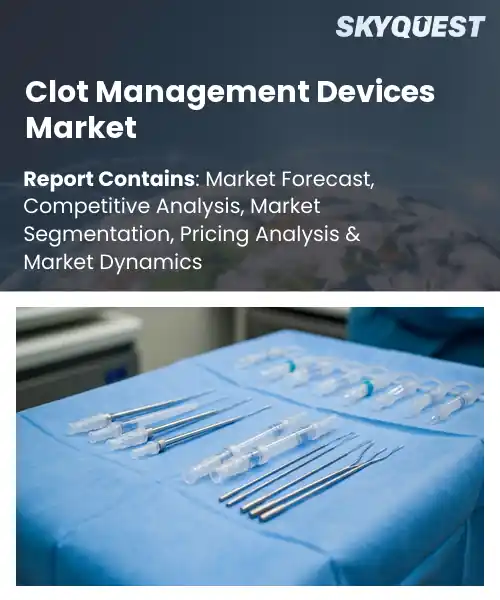
Clot Management Devices Market
Report ID: SQMIG35A3503
Report ID: SQMIG35A3503
[email protected]
USA +1 351-333-4748
Report ID:
SQMIG35A3503 |
Region:
Global |
Published Date: May, 2026
Pages:
157
|Tables:
96
|Figures:
76


Global Clot Management Devices Market size was valued at USD 1.9 Billion in 2024 and is poised to grow from USD 2.02 Billion in 2025 to USD 3.26 Billion by 2033, growing at a CAGR of 6.2% during the forecast period (2026-2033).
The market for clot management devices is driven mainly by the increasing clinical need for rapid diagnosis and removal or dissolution of thrombi, driven by aging populations and increasing rates of cardiovascular and cerebrovascular disease. The market comprises devices for prevention, detection and intervention including point-of-care coagulation monitors, catheter-directed thrombolysis systems, stent retrievers and aspiration thrombectomy tools, and imaging-enabled delivery platforms. It is important because it can reduce morbidity, long-term disability and healthcare costs and has moved from systemic pharmacological treatments to image-guided, minimally invasive mechanical solutions, as shown by the wide use of mechanical thrombectomy for acute ischemic stroke.
The convergence of clinical evidence, reimbursement reforms and technological integration is a key driver of global market growth as it creates measurable incentives for hospitals and physicians to adopt advanced clot management tools. Once randomized trials show improved functional outcomes with mechanical thrombectomy and catheter-based therapies, payers change coverage policies and hospitals invest in infrastructure, increasing device procurement and training programs. This has resulted in faster door-to-reperfusion workflows for stroke centers, reduced lengths of stay for deep vein thrombosis interventions, and opportunities in emerging markets where portable coagulation monitoring and telemedicine-supported decision pathways dramatically reduce barriers to care.
How is AI improving thrombus detection in clot management devices?
AI is improving thrombus detection in clot management devices through automated image analysis, occlusion segmentation and quantification of clot composition to support device selection and procedural strategy. The current AI-assisted tools combine CT and fluoroscopic data to identify occlusion of large vessels and to depict thrombus deformation during retrieval. The defining characteristic of the current state is increasing clinical validation and closer integration between imaging software and interventional hardware, making workflows faster and more predictable. The market is looking for solutions that will reduce device iterations and cut down time to treatment.” Examples include advanced coronary and neuroimaging platforms and academic work that links AI quantification to procedural decision-making.
In May 2026, Viz.ai announced early results in reducing time to treatment and improving outcomes, showing how AI detection speeds thrombus identification, enabling clinicians to deploy clot retrieval devices earlier and with more confidence. It enables market adoption and operational efficiency.
Market snapshot - (2026-2033)
Global Market Size
USD 1.9 Billion
Largest Segment
Mechanical Thrombectomy Devices
Fastest Growth
Mechanical Thrombectomy Devices
Growth Rate
6.2% CAGR
To get more insights on this market click here to Request a Free Sample Report
Global clot management devices market is segmented by product type, application, end user and region. Based on product type, the market is segmented into Mechanical Thrombectomy Devices, Neurovascular Clot Retrieval Devices, Inferior Vena Cava (IVC) Filters and Chronic Total Occlusion (CTO) Devices. Based on application, the market is segmented into Ischemic Stroke, Deep Vein Thrombosis (DVT), Pulmonary Embolism (PE), Peripheral Arterial Disease (PAD), Coronary Artery Disease and Others. Based on end user, the market is segmented into Hospitals, Ambulatory Surgical Centers (ASCs), Specialty Clinics, Cardiac Catheterization Laboratories and Neurovascular Centers. Based on region, the market is segmented into North America, Europe, Asia Pacific, Latin America and Middle East & Africa.
Mechanical Thrombectomy Devices segment continues to lead as ongoing improvements in retrieval mechanics and catheter systems have made these tools the treatment of choice for large vessel occlusions, propelling their use throughout the spectrum of acute neurology and interventional teams. Improved device performance and ease of use lead to shorter procedures and fewer complications, motivating hospitals to invest in training, infrastructure and protocols that reinforce clinical confidence and purchasing decisions.
However, Inferior Vena Cava (IVC) Filters are the fastest growing field with design features that are evolving to make placement and retrieval easier, there is an increased clinical focus on venous thromboembolism prophylaxis and expanded indications for a few high-risk patients. These advances are driving growth in procedures performed and creating opportunities to differentiate products and grow service lines.
The Neurovascular Clot Retrieval Devices segment features specialized stent retrievers and aspiration technologies designed for the intricate cerebral vasculature, enhancing navigability and clot engagement, and minimizing endothelial trauma. Strong clinical performance and device refinements for tortuous anatomy are driving adoption by neurointerventionalists, which in turn standardizes care pathways, reduces peri-procedural adverse events and solidifies this category’s leadership in acute stroke management.
The most significant growth momentum is seen in the Chronic Total Occlusion (CTO) Devices, however, as innovations in crossing, re-entry and support technologies broaden the range of feasible interventions for complex coronary and peripheral occlusions. Operator expertise, procedural success rates, and growing indications are driving the demand, creating opportunities for specialized tooling, adjunctive therapies, and integrated treatment approaches that extend market potential.
To get detailed segments analysis, Request a Free Sample Report
The largest regional market for clot management devices is North America. North America also has developed clinical infrastructure, targeted investment for medical innovation, and developed reimbursement mechanisms driving device adoption. Validation and refinement of new thrombectomy and thrombolysis technology is driven by a network of specialized stroke and cardiovascular centers, active clinical research, and early adoption by opinion leaders. Existing relationships between the device manufacturers and the purchasing channels of hospitals facilitate and speed up commercialization. Good rules and strong intellectual property protection help keep investment and partnerships. Training program service ecosystems, postmarket surveillance and vigilant distribution networks ensure device performance, clinician confidence and continuity of care across the range of care settings and further consolidate market leadership . Collaboration of industry, academia and clinical societies is the key to effective development of guidelines and dissemination of best practice.
The US Clot Management Devices Market benefits from concentrated centres of excellence, large clinical research networks and clinician familiarity with advanced thrombectomy platforms. Reimbursement schemes, hospital procurement drive adoption of innovative devices Device manufacturers are robust Trials are collaborative, improving technology Training programs and specialty societies ensure clinicians are competent, and robust distribution and post market support ensure devices are available and care is continuous across hospitals;
Integrated health systems, provincial procurement strategies, and growing expertise in endovascular therapies are driving the market for clot management devices in Canada. Evaluations and training are done in collaboration with academic hospitals and manufacturers. Centralized buying and an emphasis on equal access influence adoption trends and the types of devices selected. Regulatory engagement and creation of real-world evidence are critical to ensure product offerings are aligned with system priorities and distribution networks and service agreements support implementation across hospitals.
The European market for clot management devices is growing fast, driven by the structure of integrated health systems, strong development of clinical guidelines and collaborative procurement processes for device assessment and implementation. Thrombectomy and thrombolysis solutions can be rapidly implemented in clinical practice through pathways such as national and regional stroke networks and specialized centers. Regulatory harmonization and targeted innovation ecosystems are forcing local and international manufacturers to adapt their products to regional needs. Health technology assessment processes and payer engagement guide value propositions and adoption when clinical benefit is seen . Training initiatives and telemedicine integration improve access to advanced clot management across heterogeneous care settings while multicenter registries and cross border research collaborations generate real world evidence to inform practice. Strong partnerships between hospitals and industry further facilitate product refinement and diffusion .
Germany’s Clot Management Devices market is supported by a well-developed medical technology manufacturing industry, a dense network of specialized stroke centers and systematic hospital purchasing. Academic hospitals with strong clinical research partnerships with industry help with device validation and iterative design. Clinician adoption through reimbursement mechanisms and targeted training The established distribution channel makes the product available in the marketplace at all times and it will be supported in other care settings in the post-market environment. Interaction with regulators and payers helps to align product positioning.
United Kingdom Clot Management Devices Market The United Kingdom Clot Management Devices Market is dynamic with organized stroke services, coordinated referral pathways and clinical trials fostering early adoption of thrombectomy platforms. Purchasing is carried out through centralised commissioning and procurement arrangements. Industry and hospital collaborations allow iterative product assessment. Invest in your team and training - build expertise. Integration with digital stroke pathways and registries offers opportunities for quality improvement and wider sharing across networks.
The French market for clot management devices is progressing, driven by investment in stroke units, uptake from hospitals and joint pilots between clinicians and manufacturers. National and regional hospital networks are evaluating device performance via registries and payer engagement is starting to impact value criteria. Clinician training and multi-disciplinary pathways of care are emphasised to support procedural uptake. Local manufacturing partnerships and regulatory engagement are critical to adapt products that can effectively address the priorities and needs of the national system.
Asia Pacific is playing a greater role in the clot management devices market as clinical capacity rises, investments in hospital infrastructure are focused and regional manufacturers are collaborating more with global medtech companies. The large centers are able to apply advanced thrombectomy and thrombolysis solutions with increasing clinical expertise and specialized stroke programs.< Regulatory frameworks and reimbursement pathways are improving to better support device innovation by governments and health systems. Innovation on a budget Local production gives access to the market through a mosaic of payers and care settings. Cross border partnerships, clinician training initiatives and regional registries help generate evidence; whilst digital health integration and telemedicine extend access to specialist care beyond metropolitan centres; Mature markets such as Japan and South Korea are technology centers that experiment with new ideas and set regional best practices.
Japan’s hospital infrastructure is sophisticated, and the country has well-established medical device industry and strong clinical research programs, all of which support the country’s clot management devices market. The use of thrombectomy devices is associated with a high level of procedural expertise in specialized centers. Coordinated clinician training, registry based evidence generation and regulatory engagement can enable careful integration of new devices. All this is further facilitated by partnerships between local companies and global manufacturers to further develop products iteratively to meet clinical practice needs and operational support .
The South Korea Clot Management Devices Market is driven by an advanced healthcare ecosystem, hospital adoption, and a strong domestic medtech sector that adapts thrombectomy solutions to local needs. Academic centers provide clinical evaluation and training programs for clinicians. We work with manufacturers and providers to design and manufacture products. This is a discussion on reimbursement and on modernizing regulations to ensure that innovations are aligned with the priorities of care. Digital health initiatives allow access to specialized services to be scaled across regions.
To know more about the market opportunities by region and country, click here to
Buy The Complete Report
Increasing Prevalence Of Cardiovascular Diseases
Advances In Thrombectomy And Catheter Technologies
High Device And Procedure Costs
Regulatory Approval Complexity
Request Free Customization of this report to help us to meet your business objectives.
The global market for clot management devices is witnessing a flurry of strategic M&A activity, focused partnerships and rapid product innovation and competition is heating up. Acquirers got big with Stryker’s acquisition of Inari Medical and Boston Scientific’s deal to acquire Penumbra. Commercial-stage startups are seeking regulatory approvals and funding for clinical adoption, forcing incumbents to accelerate launches of their pipelines and tie-ups on distribution.
SkyQuest’s ABIRAW (Advanced Business Intelligence, Research & Analysis Wing) is our Business Information Services team that Collects, Collates, Correlates, and Analyses the Data collected by means of Primary Exploratory Research backed by robust Secondary Desk research.
As per SkyQuest analysis, a key driver is the rising clinical need to rapidly diagnose and remove thrombi amid aging populations and increasing cardiovascular disease burdens. A second driver is ongoing advances in thrombectomy and catheter technologies that improve procedural efficiency and outcomes. A key restraint is high device and procedure costs, which limit access in resource constrained settings. North America dominates the market thanks to advanced clinical infrastructure, strong reimbursement frameworks and concentrated centers of excellence, while mechanical thrombectomy devices represent the leading segment due to demonstrated clinical benefit in large vessel occlusion and widespread adoption across stroke and interventional teams.
| Report Metric | Details |
|---|---|
| Market size value in 2024 | USD 1.9 Billion |
| Market size value in 2033 | USD 3.26 Billion |
| Growth Rate | 6.2% |
| Base year | 2024 |
| Forecast period | (2026-2033) |
| Forecast Unit (Value) | USD Billion |
| Segments covered |
|
| Regions covered | North America (US, Canada), Europe (Germany, France, United Kingdom, Italy, Spain, Rest of Europe), Asia Pacific (China, India, Japan, Rest of Asia-Pacific), Latin America (Brazil, Rest of Latin America), Middle East & Africa (South Africa, GCC Countries, Rest of MEA) |
| Companies covered |
|
| Customization scope | Free report customization with purchase. Customization includes:-
|
To get a free trial access to our platform which is a one stop solution for all your data requirements for quicker decision making. This platform allows you to compare markets, competitors who are prominent in the market, and mega trends that are influencing the dynamics in the market. Also, get access to detailed SkyQuest exclusive matrix.
Table Of Content
Executive Summary
Market overview
Parent Market Analysis
Market overview
Market size
KEY MARKET INSIGHTS
COVID IMPACT
MARKET DYNAMICS & OUTLOOK
Market Size by Region
KEY COMPANY PROFILES
Methodology
For the Clot Management Devices Market, our research methodology involved a mixture of primary and secondary data sources. Key steps involved in the research process are listed below:
1. Information Procurement: This stage involved the procurement of Market data or related information via primary and secondary sources. The various secondary sources used included various company websites, annual reports, trade databases, and paid databases such as Hoover's, Bloomberg Business, Factiva, and Avention. Our team did 45 primary interactions Globally which included several stakeholders such as manufacturers, customers, key opinion leaders, etc. Overall, information procurement was one of the most extensive stages in our research process.
2. Information Analysis: This step involved triangulation of data through bottom-up and top-down approaches to estimate and validate the total size and future estimate of the Clot Management Devices Market.
3. Report Formulation: The final step entailed the placement of data points in appropriate Market spaces in an attempt to deduce viable conclusions.
4. Validation & Publishing: Validation is the most important step in the process. Validation & re-validation via an intricately designed process helped us finalize data points to be used for final calculations. The final Market estimates and forecasts were then aligned and sent to our panel of industry experts for validation of data. Once the validation was done the report was sent to our Quality Assurance team to ensure adherence to style guides, consistency & design.
Analyst Support
Customization Options
With the given market data, our dedicated team of analysts can offer you the following customization options are available for the Clot Management Devices Market:
Product Analysis: Product matrix, which offers a detailed comparison of the product portfolio of companies.
Regional Analysis: Further analysis of the Clot Management Devices Market for additional countries.
Competitive Analysis: Detailed analysis and profiling of additional Market players & comparative analysis of competitive products.
Go to Market Strategy: Find the high-growth channels to invest your marketing efforts and increase your customer base.
Innovation Mapping: Identify racial solutions and innovation, connected to deep ecosystems of innovators, start-ups, academics, and strategic partners.
Category Intelligence: Customized intelligence that is relevant to their supply Markets will enable them to make smarter sourcing decisions and improve their category management.
Public Company Transcript Analysis: To improve the investment performance by generating new alpha and making better-informed decisions.
Social Media Listening: To analyze the conversations and trends happening not just around your brand, but around your industry as a whole, and use those insights to make better Marketing decisions.
REQUEST FOR SAMPLE
 REQUEST FREE CUSTOMIZATION
Global Clot Management Devices Market size was valued at USD 1.9 Billion in 2024 and is poised to grow from USD 2.02 Billion in 2025 to USD 3.26 Billion by 2033, growing at a CAGR of 6.2% during the forecast period (2026-2033).
Competition in the global clot management devices market is intensifying as strategic M&A, targeted partnerships and rapid product innovation reshape share dynamics. Large acquirers have consolidated capability through the Stryker acquisition of Inari Medical and Boston Scientific's agreement to buy Penumbra, while commercial stage startups pursue regulatory clearances and financing to scale clinical adoption, forcing incumbents to accelerate pipeline launches and distribution tie ups. 'Boston Scientific Corporation', 'Medtronic plc', 'Penumbra, Inc.', 'Stryker Corporation', 'Terumo Corporation', 'Johnson & Johnson MedTech', 'Teleflex Incorporated', 'Becton, Dickinson and Company', 'Abbott Laboratories', 'Koninklijke Philips N.V.', 'Merit Medical Systems, Inc.', 'Argon Medical Devices, Inc.', 'AngioDynamics, Inc.', 'Inari Medical, Inc.', 'Acandis GmbH', 'MicroVention, Inc.', 'Asahi Intecc Co., Ltd.', 'Cook Medical', 'Imperative Care, Inc.', 'Surmodics, Inc.'
The rising prevalence of cardiovascular diseases elevates demand for clot management devices by expanding patient pools requiring diagnosis and intervention. As more patients present with thrombotic conditions, clinicians increasingly rely on both acute and preventive tools to manage clot formation and resolution, which encourages procurement and development of diverse device portfolios. This sustained clinical need incentivizes manufacturers to invest in improved designs, training, and distribution, thereby reinforcing adoption across hospital settings and supporting overall market expansion through broader clinical utilization.
Minimally Invasive Interventions: Clinicians and device developers are prioritizing minimally invasive techniques that reduce recovery time and procedural risk while expanding treatment access across care settings. Innovations in device design, smaller profiles, and novel delivery mechanisms enable broader adoption by interventional teams and ambulatory centers. Payers and providers increasingly value therapies that improve patient experience and streamline care pathways, driving investment in devices that enable outpatient management and collaborative workflows between specialties, fostering new service models and competitive differentiation across the market landscape.
Why does North America Dominate the Global Clot Management Devices Market? |@12


Want to customize this report? This report can be personalized according to your needs. Our analysts and industry experts will work directly with you to understand your requirements and provide you with customized data in a short amount of time. We offer $1000 worth of FREE customization at the time of purchase.
Feedback From Our Clients


 USA (+1) 351-333-4748

