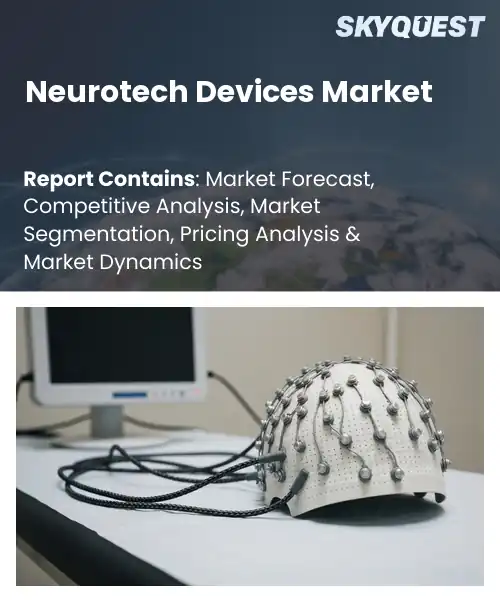
Neurotech Devices Market
Report ID: SQMIG35A3482
Report ID: SQMIG35A3482
[email protected]
USA +1 351-333-4748
Report ID:
SQMIG35A3482 |
Region:
Global |
Published Date: May, 2026
Pages:
157
|Tables:
178
|Figures:
79


Global Neurotech Devices Market size was valued at USD 15.1 Billion in 2024 and is poised to grow from USD 17.08 Billion in 2025 to USD 45.72 Billion by 2033, growing at a CAGR of 13.1% during the forecast period (2026-2033).
The neurotechnology devices market as a convergence of diagnostic sensors, neuromodulation systems and brain computer interfaces designed to measure, interpret and modulate nervous system activity. This market matters because neurological and psychiatric disorders impose rising clinical and economic burdens globally, prompting demand for more precise and personalized interventions. Historically the field progressed from early electroencephalography and lesioning toward implantable stimulators and closed loop systems, exemplified by Medtronic’s deep brain stimulation platforms and NeuroPace’s responsive neurostimulation. Technological miniaturization, advances in signal processing and clinical validation have been the primary driver accelerating commercial adoption and investment.
The growth lever is algorithmic intelligence that converts complex neural signals into actionable therapies, creating a cascade of market effects. When machine learning improves decoding accuracy, devices can operate in adaptive closed loop modes that reduce side effects and extend battery life, which in turn convinces clinicians to adopt systems such as responsive stimulation for epilepsy and adaptive deep brain stimulation for Parkinson’s disease. Better clinical outcomes strengthen reimbursement cases and attract venture and strategic capital, enabling scale up into rehabilitation robotics, brain computer interfaces for communication in paralysis, and remote monitoring services that open commercial and public health opportunities.
How Is AI Enhancing Diagnostic Accuracy in the Neurotech Devices Market?
The use of artificial intelligence (AI) in the neurological technology industry will improve the ability to diagnose conditions by using advanced signal processing, pattern recognition, and predictive analytics, which allows for cleaner neural signals to be more useful to the clinician. Key components of AI include automatic artifact rejection, having strong methods of extracting features, and using a model to interpret data that reveals clinically relevant patterns at the bedside. The current use of AI has been embedded throughout the EEG systems at the point of care, the use of a headband worn on the patient’s head, as well as in cloud computing analytics to improve how quickly clinical decisions are made and reduce the number of reviews each clinician must have done on the data prior to making any decision. Market context favors vendors that deliver regulatory cleared tools for seizure detection, sleep assessment, and delirium monitoring. Examples include expert level automated EEG interpretation and real time on device inference.
In May 2026, Ceribell reported first quarter results that emphasized its AI powered point of care EEG system and algorithms for rapid seizure and delirium detection, a development that shortens time to bedside diagnosis and expands monitoring beyond specialty units, thereby improving clinical workflow efficiency and supporting broader market uptake.
Market snapshot - (2026-2033)
Global Market Size
USD 15.1 Billion
Largest Segment
Blood Components
Fastest Growth
Blood Collection Consumables
Growth Rate
13.1% CAGR
To get more insights on this market click here to Request a Free Sample Report
Global neurotech devices market is segmented by by product type, by collection type, by application, by end user, by storage type, by distribution channel and region. Based on by product type, the market is segmented into Whole Blood, Blood Components, Blood Collection Consumables and Blood Bank Equipment. Based on by collection type, the market is segmented into Voluntary Blood Donation, Replacement Blood Donation, Autologous Blood Donation and Apheresis Donation. Based on by application, the market is segmented into Trauma & Emergency Care, Surgeries, Cancer Treatment, Hematological Disorders, Organ Transplantation and Others. Based on by end user, the market is segmented into Hospitals, Independent Blood Banks, Diagnostic Laboratories, Research Institutes and Others. Based on by storage type, the market is segmented into Refrigerated Storage, Frozen Storage and Room Temperature Storage. Based on by distribution channel, the market is segmented into Hospital-based Distribution, Regional Blood Centers and National Blood Services. Based on region, the market is segmented into North America, Europe, Asia Pacific, Latin America and Middle East & Africa.
Based on the global neurotech devices market growth, blood bank equipment segment dominates because it underpins clinical readiness for neurotech interventions by ensuring reliable blood management and infrastructure alignment with device deployment. Hospitals and surgical centers rely on specialized storage, crossmatch, and transfusion support systems to enable complex neurosurgical procedures and neuro implantations, creating procurement priorities and standardization requirements that favor vendors offering integrated equipment, compliance expertise, and interoperability with neurocritical workflows, driving market preference and operational resilience.
However, blood collection consumables is the most rapidly expanding area due to rising demand for sterile single use kits for neurointerventional procedures and point of care biomarker sampling. With advancements in micro sampling, government emphasis on preventing infections during health care, and simplified supply lines from manufacturers to end-users, new markets will quickly evolve for both manufacturers of devices and suppliers of consumables.
Surgeries segment dominates because operative settings create the primary demand pipeline for advanced neurotech devices, driving procurement, clinical validation, and sustained use. During surgery, surgeons and their teams require intraoperative monitoring systems, navigation systems, and neuromodulation systems that can be integrated into their workflows and are compliant with rigorous safety requirements. Additionally, this creates a high emphasis on durable, validated systems from leasing or sales vendors that generate long-term outcome data to become the established standard within a medical institution and drive market demand.
Meanwhile, trauma & emergency care is witnessing the strongest growth momentum as demand rises for portable neuro monitoring, rapid diagnostics, and tele neurology for acute brain injury. Miniaturization, clearer regulatory paths for emergency tools, and clinician preference for point of care solutions accelerate adoption, broadening use cases and enabling scalable device distribution and service models.
To get detailed segments analysis, Request a Free Sample Report
Based on the global neurotech devices market share, North America dominates the industry due to a combination of concentrated clinical expertise, deep private and public research ecosystems, and well established pathways for regulatory approval and reimbursement. Due to a well established network of regional hospitals, academic research centres and specialist research centres, clinical verification and implementation will occur much more rapidly than many current clinical trials. The combination of this and venture capital funding and corporate sponsorships are important drivers of new product development. The partnerships between technology companies, healthcare delivery systems and digital health infrastructure have significantly accelerated the commercialisation of medical technologies through the best of both worlds. Partnerships with these organisations as well as clinician led support groups and patient advocacy groups have provided significant support in recruiting trial subjects for clinical trials and providing real world evidence.
Neurotech devices market in United States is anchored by a sophisticated clinical research environment, concentrated centers of neurological excellence, and extensive private investment supporting early stage innovation. Established reimbursement pathways and proactive engagement between industry and regulatory stakeholders enable accelerated development and adoption. Strong collaboration among technology firms, academic institutions, and specialized manufacturers supports translation from laboratory to clinical use. This environment supports pilot programs and integration into healthcare networks.
Neurotech devices market in Canada benefits from strong public healthcare institutions and collaborative research networks that link academic centers and community hospitals. A supportive regulatory environment and strategic funding initiatives encourage clinical studies and technology transfer. Partnerships established between borders and trialing devices on a multinational basis extend access to the most advanced devices as well as specialist capabilities. Local manufacturers and service providers work to adapt new technologies used within hospitals to the varying operate and delivery methods between urban and regional communities.
Due to global neurotech devices regional forecast, Europe rapid expansion in indsutry is driven by harmonized regulatory frameworks, dense clinical trial networks, and entrenched medical technology manufacturing capability across multiple markets. By working collaboratively with academia, hospitals, and industry; pan-regional development of multicenter validation outcomes can be achieved, along with support for translational research through focused investment initiatives. Stronger alignment on reimbursement criteria and clinical practice guidelines creates an environment for adoption by health systems as well as allowing digital health platforms to be integrated into the clinical workflow, thereby enabling the use of data-driven methods for optimizing devices. Strong manufacturing clusters create supply chain resiliency while supporting larger populations of specialized providers and patient-advocate organizations to enhance the awareness and clinical adoption of devices.
Neurotech devices market in Germany is characterized by deep industrial expertise, established medical device manufacturers, and integrated hospital networks that facilitate clinical validation. A strong culture of engineering and precision manufacturing supports high quality device production and iterative design. Collaborative ecosystems link research institutions, specialty clinics, and small and large enterprises, enabling efficient product development and scale up. National procurement practices and clinician engagement support adoption across specialist centers nationally.
Neurotech devices market in United Kingdom is propelled by a vibrant innovation ecosystem combining academic excellence, dynamic startups, and active clinical adoption pathways. Collaborative pilot programs between health services, research hospitals, and industry create rapid validation opportunities. Policy initiatives and targeted funding channels encourage commercialization and attract international partnerships. Growing specialization in neurotechnology, supportive reimbursement pilots, and strong clinician networks drive early market entry and scaling across diverse care settings.
Neurotech devices market in France is emerging through concentrated research centers, growing medtech clusters, and targeted national initiatives that support translational science. Clinical infrastructure investments and increased collaboration between universities and industry lead to improved prototype testing and regulatory compliance. Regional innovation centers incubate startups and improve supply chain abilities. Clinician involvement and patient advocacy will also raise awareness of gradual adoption within specialty hospitals and care teams.
As per global neurotech devices regional outlook, Asia Pacific is strengthening its role in neurotech through coordinated investments in research, expanding local manufacturing capacity, and active engagement with global technology partners. Core competencies in government and industry are being developed across a spectrum of infrastructure enhancements and streamlined regulatory avenues that facilitate clinical investigation and the entrance of medical devices to market. Through increased urgency of adopting digital health platforms and a plethora of clinical expertise, there is an ever-growing ability to refine products through data-driven processes and to develop scalable implementations of products throughout complicated care networks. Furthermore, international collaborations, focused incubation programs, and skill development initiatives help to build a more developed ecosystem capable of turning innovations into commercially viable products at both regional and international levels.
Neurotech devices market in Japan benefits from advanced precision engineering, strong robotics expertise, and collaboration between universities, research hospitals, and industry. Established manufacturing excellence supports high quality device development. Evaluating the devices and training the clinicians requires assistance from government initiatives as well as clinics. Solutions tailored to fit the requirements of complex care process are also created as a result of partnership with international technology companies, the use of user-centered design principles, and the implementation of solutions into clinical acceptance, healthcare infrastructure integration, and use in practice.
Neurotech devices market in South Korea leverages advanced electronics and semiconductor capabilities, driving miniaturization and performance sensing technologies. Strong public private collaboration and focused industrial policy foster rapid prototyping and scale. Clinical validation and continual enhancement are supported by how well digital health platforms integrate with hospitals and how well they collaborate. Additionally, clinical skill and readiness for the adoption of the new technology are developed through training programs and specialty centers.
To know more about the market opportunities by region and country, click here to
Buy The Complete Report
Increasing Demand For Noninvasive Therapies
Advances In Neural Interface Technology
High Regulatory Approval Complexity
Limited Reimbursement and Clinical Adoption
Request Free Customization of this report to help us to meet your business objectives.
Competition in the global neurotech devices market outlook is intensifying as incumbent medtech and newcomers pursue M&A, strategic OEM partnerships, and platform integration to capture clinical and consumer use cases. Examples include Medtronic’s partnership with Precision Neuroscience to integrate BCI with surgical navigation, CorTec’s manufacturing tie up with Heraeus Medevio, and Neuroelectrics’ alliance with Neuronostics to bundle EEG hardware and analytics. Regulatory progress and demand for minimally invasive wearable BCIs drive consolidation.
Top Player’s Company Profile
Recent Developments
SkyQuest’s ABIRAW (Advanced Business Intelligence, Research & Analysis Wing) is our Business Information Services team that Collects, Collates, Correlates, and Analyses the Data collected by means of Primary Exploratory Research backed by robust Secondary Desk research.
As per SkyQuest analysis, the global neurotech devices industry is being propelled by increasing demand for noninvasive therapies while advances in neural interface technology further accelerate product performance and adoption. Growth is concentrated in North America where clinical expertise, funding and regulatory pathways favor rapid commercialization, and the surgeries segment remains the dominant application area due to operating room demand for monitoring and neuromodulation systems. A key restraint is the high regulatory approval complexity that lengthens development cycles and raises costs.
| Report Metric | Details |
|---|---|
| Market size value in 2024 | USD 15.1 Billion |
| Market size value in 2033 | USD 45.72 Billion |
| Growth Rate | 13.1% |
| Base year | 2024 |
| Forecast period | (2026-2033) |
| Forecast Unit (Value) | USD Billion |
| Segments covered |
|
| Regions covered | North America (US, Canada), Europe (Germany, France, United Kingdom, Italy, Spain, Rest of Europe), Asia Pacific (China, India, Japan, Rest of Asia-Pacific), Latin America (Brazil, Rest of Latin America), Middle East & Africa (South Africa, GCC Countries, Rest of MEA) |
| Companies covered |
|
| Customization scope | Free report customization with purchase. Customization includes:-
|
To get a free trial access to our platform which is a one stop solution for all your data requirements for quicker decision making. This platform allows you to compare markets, competitors who are prominent in the market, and mega trends that are influencing the dynamics in the market. Also, get access to detailed SkyQuest exclusive matrix.
Table Of Content
Executive Summary
Market overview
Parent Market Analysis
Market overview
Market size
KEY MARKET INSIGHTS
COVID IMPACT
MARKET DYNAMICS & OUTLOOK
Market Size by Region
KEY COMPANY PROFILES
Methodology
For the Neurotech Devices Market, our research methodology involved a mixture of primary and secondary data sources. Key steps involved in the research process are listed below:
1. Information Procurement: This stage involved the procurement of Market data or related information via primary and secondary sources. The various secondary sources used included various company websites, annual reports, trade databases, and paid databases such as Hoover's, Bloomberg Business, Factiva, and Avention. Our team did 45 primary interactions Globally which included several stakeholders such as manufacturers, customers, key opinion leaders, etc. Overall, information procurement was one of the most extensive stages in our research process.
2. Information Analysis: This step involved triangulation of data through bottom-up and top-down approaches to estimate and validate the total size and future estimate of the Neurotech Devices Market.
3. Report Formulation: The final step entailed the placement of data points in appropriate Market spaces in an attempt to deduce viable conclusions.
4. Validation & Publishing: Validation is the most important step in the process. Validation & re-validation via an intricately designed process helped us finalize data points to be used for final calculations. The final Market estimates and forecasts were then aligned and sent to our panel of industry experts for validation of data. Once the validation was done the report was sent to our Quality Assurance team to ensure adherence to style guides, consistency & design.
Analyst Support
Customization Options
With the given market data, our dedicated team of analysts can offer you the following customization options are available for the Neurotech Devices Market:
Product Analysis: Product matrix, which offers a detailed comparison of the product portfolio of companies.
Regional Analysis: Further analysis of the Neurotech Devices Market for additional countries.
Competitive Analysis: Detailed analysis and profiling of additional Market players & comparative analysis of competitive products.
Go to Market Strategy: Find the high-growth channels to invest your marketing efforts and increase your customer base.
Innovation Mapping: Identify racial solutions and innovation, connected to deep ecosystems of innovators, start-ups, academics, and strategic partners.
Category Intelligence: Customized intelligence that is relevant to their supply Markets will enable them to make smarter sourcing decisions and improve their category management.
Public Company Transcript Analysis: To improve the investment performance by generating new alpha and making better-informed decisions.
Social Media Listening: To analyze the conversations and trends happening not just around your brand, but around your industry as a whole, and use those insights to make better Marketing decisions.
REQUEST FOR SAMPLE
 REQUEST FREE CUSTOMIZATION
Global Neurotech Devices Market size was valued at USD 15.1 Billion in 2024 and is poised to grow from USD 17.08 Billion in 2025 to USD 45.72 Billion by 2033, growing at a CAGR of 13.1% during the forecast period (2026-2033).
Competition in the global neurotech devices market is intensifying as incumbent medtech and newcomers pursue M&A, strategic OEM partnerships, and platform integration to capture clinical and consumer use cases. Examples include Medtronic’s partnership with Precision Neuroscience to integrate BCI with surgical navigation, CorTec’s manufacturing tie up with Heraeus Medevio, and Neuroelectrics’ alliance with Neuronostics to bundle EEG hardware and analytics. Regulatory progress and demand for minimally invasive wearable BCIs drive consolidation. 'Grifols', 'CSL Behring', 'Terumo Corporation', 'Haemonetics Corporation', 'Fresenius Kabi', 'Macopharma', 'Immucor', 'Ortho Clinical Diagnostics', 'Cerus Corporation', 'Abbott Laboratories', 'Becton Dickinson', 'Bio-Rad Laboratories', 'Kawasumi Laboratories', 'SARSTEDT', 'Nipro Corporation', 'QIAGEN', 'Roche Diagnostics', 'Sysmex Corporation', 'Thermo Fisher Scientific', 'Danaher Corporation'
The growing preference among patients and clinicians for noninvasive neurotechnology that reduces procedural risk and recovery time has expanded adoption across care settings, encouraging manufacturers to prioritize development and refinement of devices that meet those needs. This shift supports broader clinical acceptance, facilitates integration into standard care pathways, and stimulates investment in user-friendly platforms and remote monitoring capabilities. As a result, a larger range of treatment options becomes available, enabling scaled deployment and increased demand for devices that align with patient safety and convenience priorities.
Home Based Neurotherapeutics Expansion: Patient demand for noninvasive, portable neurotechnology is driving companies to develop at-home therapeutic devices and digital care pathways. Manufacturers and care providers are focusing on usability, remote monitoring, and integration with telehealth to support chronic neurological conditions and recovery programs outside traditional clinical settings. This shift encourages iterative product design, new service models, and partnerships between technology firms and healthcare organizations to enhance patient adherence, continuity of care, and long term outcome tracking while lowering access barriers.
Why does North America Dominate the Global Neurotech Devices Market? |@12


Want to customize this report? This report can be personalized according to your needs. Our analysts and industry experts will work directly with you to understand your requirements and provide you with customized data in a short amount of time. We offer $1000 worth of FREE customization at the time of purchase.
Feedback From Our Clients


 USA (+1) 351-333-4748

