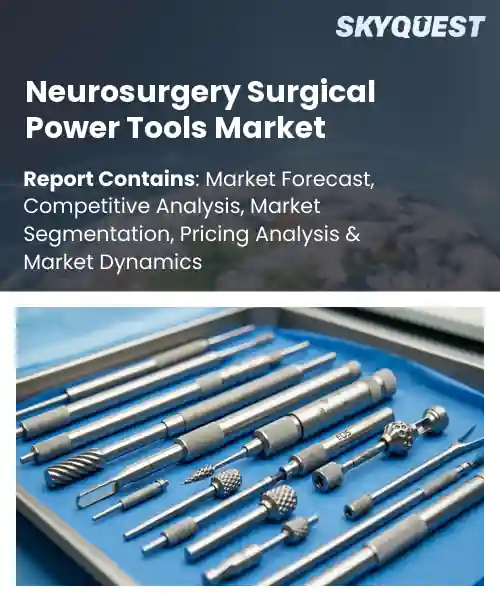
Neurosurgery Surgical Power Tools Market
Report ID: SQMIG35A3526
Report ID: SQMIG35A3526
[email protected]
USA +1 351-333-4748
Report ID:
SQMIG35A3526 |
Region:
Global |
Published Date: May, 2026
Pages:
157
|Tables:
127
|Figures:
77


Global Neurosurgery Surgical Power Tools Market size was valued at USD 1.6 Billion in 2024 and is poised to grow from USD 1.67 Billion in 2025 to USD 2.32 Billion by 2033, growing at a CAGR of 4.2% during the forecast period (2026-2033).
The neurosurgery surgical power tools market growth is driven by specialized products that supply electric and pneumatic instruments, helping surgeons work with precision, speed, and safety during intracranial and spinal procedures. It matters because outcomes and patient recovery are more and more tied to how accurate the devices are, and how ergonomic they feel during use, so hospitals and surgeon networks keep putting money into advanced burrs drills, and ultrasonic aspirators.
Moreover, one key factor driving the neurosurgery surgical power tools market penetration is how digital navigation and robotics are getting integrated into power tool platforms, because when pair real-time imaging with the instrument, accuracy tends to improve and complication rates go down. That’s why neurosurgical centers tend to prioritize these types of purchases. Then, as a consequence, manufacturers are investing in modular devices that can be software-upgraded, and they aim for intraoperative MRI compatibility and even data analytics. With that setup, remote diagnostics, predictive maintenance, and value-based contracting become more realistic. In practice, hospitals doing tricky tumor resections and spinal deformity corrections often report shorter operative times and fewer readmissions, which also opens commercial doors for subscription service models, training partnerships, and deeper entry into emerging markets where surgical capacity is still growing.
AI is enhancing precision by mixing improved imaging interpretation with real-time control and decision support. It helps the system “understand” what it sees while also managing how the tool behaves. Key things include AI-driven image segmentation, which sorts out the targets and the sensitive structures more clearly and easily, and predictive models that suggest optimal pathways. In addition, onboard control algorithms moderate tool speed and force, so the device can act more consistently, rather than wobbling around. Right now, a lot of major vendors, as well as startups, are rolling in navigation and robotic guidance and intelligent safety extras into drills and burrs, all with the idea of cutting variability and raising confidence during those complex steps. These improvements track the push for less invasive approaches and safer bedside interventions, while also trying to make workflow integration easier for the surgical team.
Market snapshot - (2026-2033)
Global Market Size
USD 1.6 Billion
Largest Segment
Accessories & Consumables
Fastest Growth
Battery-Powered Surgical Power Tools
Growth Rate
4.2% CAGR
To get more insights on this market click here to Request a Free Sample Report
The global neurosurgery surgical power tools market is segmented by component, product type, application, end user, and region. Based on component, the market is segmented into Electric Surgical Power Tools, Pneumatic Surgical Power Tools, Battery-Powered Surgical Power Tools, and Accessories & Consumables. Based on product type, the market is segmented into Neurosurgical Drills, Cranial Perforators, Saws, Reamers, Ultrasonic Bone Cutters, High-Speed Surgical Systems and Others. Based on application, the market is segmented into Craniotomy Procedures, Spine Surgery, Deep Brain Stimulation Procedures, Skull Base Surgery, Neuroendoscopy Procedures, Trauma & Emergency Neurosurgery, and Others. Based on end user, the market is segmented into Hospitals, Ambulatory Surgical Centers (ASCs), Specialty Neurosurgical Clinics and Academic & Research Institutes. By region, the market is segmented into North America, Europe, Asia Pacific, Latin America, and the Middle East & Africa.
As per the neurosurgery surgical power tools market analysis, the Electric Surgical Power Tools segment dominates since these setups give consistent torque, more refined speed handling, and broad compatibility with neurosurgical attachments, so surgeons can do precise bone removal and manage delicate tissues, especially in those complicated cranial and spinal cases. Their dependability, and the way they plug into surgical navigation, and ergonomic designs that help reduce surgeon fatigue, along with the already established hospital procurement and service channels, make institutions lean toward them. That’s why they end up being central in high-volume neurosurgical suites.
At the same time, Battery-Powered Surgical Power Tools are showing up as the fastest expanding bit of the market, because cordless mobility really backs ambulatory workflows and minimally invasive settings. It cuts the dependence on fixed infrastructure, and it also helps speed workflow turnover. Battery performance keeps improving along with compact motor architecture, which increases runtime and cutting effectiveness. Also, the idea of better infection control and everyday convenience makes surgeons more willing to adopt them, so you see fresh opportunities, especially in outpatient units and specialty clinic environments.
According to the neurosurgery surgical power tools market forecast, the Ultrasonic Bone Cutters segment leads for a reason; they do selective bone cutting while keeping neighboring neural structures and soft tissues safer. This approach usually brings down thermal injury, and it helps reduce intraoperative bleeding, which is a big deal in those delicate skull base and cranial procedures. Because the system is precise, it makes visualization easier, and it lowers procedural risk overall. Ongoing device tuning, like altering the tip geometry and tightening irrigation control, keeps improving efficiency along with safety. All of this, together, is why more centers choose them when they want outcome optimization and handle complex neurosurgical interventions.
Meanwhile, the High-Speed Surgical Systems category is predicted to have the largest neurosurgery surgical power tools market share, mainly because vendors are folding in advanced cooling, vibration reduction, and digital speed regulation into consolidated platforms meant for a range of neurosurgical applications. Their modular approach improves ergonomics and strengthens compatibility with imaging and navigation. As a result, surgical units justify capital spending more readily, and procedural usage keeps widening, which then boosts market uptake and also increases demand for accessories and service support.
To get detailed segments analysis, Request a Free Sample Report
As per the neurosurgery surgical power tools market regional forecast, North America stays in the leading position because of a messy mix of structural advantages in healthcare delivery, innovation, and market behavior. Solidly built hospital systems and specialized neurosurgical centers end up pulling in concentrated demand for advanced surgical power tools. There is this tight ecosystem of manufacturers, suppliers and service providers, which helps new devices show up faster and also keeps the aftermarket support from lagging. Also clinical research worlds, especially academic medical centers, make early uptake easier through trials, and clinician cooperation that sounds simple but actually matters a lot. On top of that, reimbursement structures and purchasing power at big institutions let providers invest in premium tech without stalling.
United States Neurosurgery Surgical Power Tools Market
The Neurosurgery Surgical Power Tools sector in the United States is basically deeply integrated, where academic research meets industry innovation, and where high procedure volumes at tertiary centers do the heavy lifting. Hospitals and specialty clinics commonly prioritize state-of-the-art instrumentation, expecting more than just hardware, like end-to-end service, training, and proof through evidence generation. Clinician opinion leaders and professional societies weigh in on procurement decisions and on how techniques spread. At the same time, big health systems shape purchasing frameworks, which can make adoption feel both structured and fast. So, the market is friendly for newcomers, as long as they can show clinical benefits and improvements in total cost of ownership, not just “new and shiny” claims.
Canada Neurosurgery Surgical Power Tools Market
The Neurosurgery Surgical Power Tools market in Canada leans toward centralized purchasing habits and an emphasis on equitable access across regional health authorities. Centers of excellence, along with provincial hospitals, drive demand for dependable instruments that are well supported. There is also a noticeable preference for long-term service relationships and clinician education. Procurement collaboration and technology assessment processes tend to favor solutions that connect clinical benefit with budgetary stewardship. In practice, partnerships between hospitals and vendors support adoption and enable local clinical validation without too much delay.
What is Driving the Rapid Expansion of Neurosurgery Surgical Power Tools Market in Europe?
Europe is seeing rapid expansion because several threads are pulling together at once: modernization in healthcare, stronger clinical networks, and real industry investment. National health systems, and private hospitals too, are upgrading surgical capacity for advanced neurosurgical procedures, so precision power tools become more important, almost non-negotiable. Regulatory harmonization, along with well-known entry pathways, helps cross-border distribution and lets companies scale more easily. In addition, a solid manufacturing base in key countries supports product availability and localized support. Clinical training programs and centers of excellence help spread techniques and also build clinician confidence. Collaboration between device makers and healthcare providers on cost effectiveness and procedure optimization pushes procurement further, since both sides can connect the dots. In some places, payer structures are fragmented, which can trigger competitive pricing and bundled service offers, encouraging adoption across different care environments, even when budgets vary.
Germany Neurosurgery Surgical Power Tools Market
In Germany, the Neurosurgery Surgical Power Tools market is supported by a strong medical technology manufacturing culture and a mature hospital infrastructure. Major clinics and research institutions create demand for well-engineered instruments. Local production abilities also help with timely support and even customization when needed. Procurement tends to emphasize quality, clinical evidence, and lifecycle service. Due to that, the market often stays open to new offerings that pair robustness with clinical efficacy. Supplier partnerships with academic centers can speed up clinical validation and also improve clinician training, which helps reduce uncertainty during early rollouts.
United Kingdom Neurosurgery Surgical Power Tools Market
The United Kingdom Neurosurgery Surgical Power Tools market shows a fairly lively uptake. Hospital modernization initiatives play a role, but so does active engagement between industry and clinical networks. Both the public and private sectors look for technologies that improve procedural outcomes and support operational efficiency. There is an emphasis on streamlined evaluation steps and on pilot implementations, which can speed up the point at which clinicians actually get exposure. Supplier models that include training, outcome measurement, and service support are usually more attractive, since many hospitals want to fit new tools into existing surgical pathways without disrupting everything.
France Neurosurgery Surgical Power Tools Market
The French Neurosurgery Surgical Power Tools market is developing through targeted investments in regional neurosurgical centers and through collaborative procurement practices. Health authorities and hospital groups are placing priority on upgrades that support minimally invasive and precision-oriented neurosurgery. That creates opportunities for vendors who bring strong clinical backing, and training. The market also values devices that match national clinical guidelines and can show clear advantages in patient pathways and resource utilization.
Asia Pacific is getting a stronger footing through a mix of healthcare capacity building, regulatory modernization, and local industry development. Investment pushing hospital infrastructure forward, and expanded specialized surgical centers, and that really boosts the clinical need for more sophisticated power tools. At the same time, regulators are reworking the approval pathways for medical devices, and local manufacturing is ramping up via partnerships as well as technology transfer. Skilled clinicians who trained in global centers are coming back, with a clear preference for advanced instrumentation, and that helps adoption move faster. Also, competitive manufacturing ecosystems keep things cost-effective, and they open up export opportunities too. In the background, collaborative programs between suppliers and hospitals, training efforts, service models, and clinical evaluation are helping the market grow in a steady way and even deepen regional integration.
Japan Neurosurgery Surgical Power Tools Market
The Neurosurgery Surgical Power Tools Market in Japan looks established, with a mature healthcare setup and strong in-country manufacturing know-how. Hospitals and research organizations tend to choose high-precision instruments, and they often look for suppliers that can show reliability, and advanced engineering details. Adoption in clinics is supported by careful evaluation and ongoing interaction between manufacturers and neurosurgery teams. The overall direction leans toward incremental innovation because it improves surgical command and, importantly, patient safety.
South Korea Neurosurgery Surgical Power Tools Market
The neurosurgery Surgical Power Tools market in South Korea is moving fast, driven by a tech-leaning healthcare system and this active medical device sector. Hospitals are actively in search of fresh solutions that can sit inside digital platforms, and they also want them to work smoothly with surgical navigation, while local suppliers try to boost product sophistication via careful partnerships. At the same time, clinical training programs and government-backed initiatives focused on medical technology exports provide extra momentum. Taken as a whole, these moves support better uptake capacity and help overall global competitiveness in a quieter but steady way.
To know more about the market opportunities by region and country, click here to
Buy The Complete Report
Advancements In Surgical Navigation
Rising Demand For Specialized Devices
High Acquisition and Maintenance Costs
Regulatory Complexity and Reimbursement Challenges
Request Free Customization of this report to help us to meet your business objectives.
The competitive landscape gets shaped by incumbents and more agile startups, and the whole thing seems driven by acquisitions, strategic partnerships, and device innovation, to snag neurosurgical access share. This can be witnessed in the big M&A waves, like Johnson and Johnson buying Auris Health, then navigation alliances such as ClearPoint with adeor, and product innovation that pops up with Hubly Surgical’s auto stop cranial drill, all of this revealing a competition that’s really anchored in safety automation, bedside single-use devices, and commercialization that’s deliberately targeted.
Top Player’s Company Profile
Recent Developments in the Neurosurgery Surgical Power Tools Market
SkyQuest’s ABIRAW (Advanced Business Intelligence, Research & Analysis Wing) is our Business Information Services team that Collects, Collates, Correlates, and Analyses the Data collected by means of Primary Exploratory Research backed by robust Secondary Desk research.
As per SkyQuest analysis, the global neurosurgery surgical power tools market is being driven by the integration of digital navigation and robotics as a key catalyst, while a major restraint is the high acquisition and maintenance costs. Those costs can limit adoption in smaller centers. The dominating region is North America, largely because of strong clinical ecosystems, active research networks, and solid procurement capacity. The biggest segment is electric surgical power tools. It seems to win out mostly because they provide steady torque, good compatibility, and some serious institutional backing, you know, the usual story. Another factor is the upsurge in demand for specialized devices that can, in practice, boost procedural outcomes and day-to-day ergonomics. This pushes the market toward modular, software-upgradeable platforms and service models, which then open up more room across hospitals, ASCs, and specialty clinics.
| Report Metric | Details |
|---|---|
| Market size value in 2024 | USD 1.6 Billion |
| Market size value in 2033 | USD 2.32 Billion |
| Growth Rate | 4.2% |
| Base year | 2024 |
| Forecast period | (2026-2033) |
| Forecast Unit (Value) | USD Billion |
| Segments covered |
|
| Regions covered | North America (US, Canada), Europe (Germany, France, United Kingdom, Italy, Spain, Rest of Europe), Asia Pacific (China, India, Japan, Rest of Asia-Pacific), Latin America (Brazil, Rest of Latin America), Middle East & Africa (South Africa, GCC Countries, Rest of MEA) |
| Companies covered |
|
| Customization scope | Free report customization with purchase. Customization includes:-
|
To get a free trial access to our platform which is a one stop solution for all your data requirements for quicker decision making. This platform allows you to compare markets, competitors who are prominent in the market, and mega trends that are influencing the dynamics in the market. Also, get access to detailed SkyQuest exclusive matrix.
Table Of Content
Executive Summary
Market overview
Parent Market Analysis
Market overview
Market size
KEY MARKET INSIGHTS
COVID IMPACT
MARKET DYNAMICS & OUTLOOK
Market Size by Region
KEY COMPANY PROFILES
Methodology
For the Neurosurgery Surgical Power Tools Market, our research methodology involved a mixture of primary and secondary data sources. Key steps involved in the research process are listed below:
1. Information Procurement: This stage involved the procurement of Market data or related information via primary and secondary sources. The various secondary sources used included various company websites, annual reports, trade databases, and paid databases such as Hoover's, Bloomberg Business, Factiva, and Avention. Our team did 45 primary interactions Globally which included several stakeholders such as manufacturers, customers, key opinion leaders, etc. Overall, information procurement was one of the most extensive stages in our research process.
2. Information Analysis: This step involved triangulation of data through bottom-up and top-down approaches to estimate and validate the total size and future estimate of the Neurosurgery Surgical Power Tools Market.
3. Report Formulation: The final step entailed the placement of data points in appropriate Market spaces in an attempt to deduce viable conclusions.
4. Validation & Publishing: Validation is the most important step in the process. Validation & re-validation via an intricately designed process helped us finalize data points to be used for final calculations. The final Market estimates and forecasts were then aligned and sent to our panel of industry experts for validation of data. Once the validation was done the report was sent to our Quality Assurance team to ensure adherence to style guides, consistency & design.
Analyst Support
Customization Options
With the given market data, our dedicated team of analysts can offer you the following customization options are available for the Neurosurgery Surgical Power Tools Market:
Product Analysis: Product matrix, which offers a detailed comparison of the product portfolio of companies.
Regional Analysis: Further analysis of the Neurosurgery Surgical Power Tools Market for additional countries.
Competitive Analysis: Detailed analysis and profiling of additional Market players & comparative analysis of competitive products.
Go to Market Strategy: Find the high-growth channels to invest your marketing efforts and increase your customer base.
Innovation Mapping: Identify racial solutions and innovation, connected to deep ecosystems of innovators, start-ups, academics, and strategic partners.
Category Intelligence: Customized intelligence that is relevant to their supply Markets will enable them to make smarter sourcing decisions and improve their category management.
Public Company Transcript Analysis: To improve the investment performance by generating new alpha and making better-informed decisions.
Social Media Listening: To analyze the conversations and trends happening not just around your brand, but around your industry as a whole, and use those insights to make better Marketing decisions.
REQUEST FOR SAMPLE
 REQUEST FREE CUSTOMIZATION
Global Neurosurgery Surgical Power Tools Market size was valued at USD 1.6 Billion in 2024 and is poised to grow from USD 1.67 Billion in 2025 to USD 2.32 Billion by 2033, growing at a CAGR of 4.2% during the forecast period (2026-2033).
Competitive landscape is shaped by incumbents and agile startups using acquisitions, strategic partnerships, and device innovation to capture neurosurgical access share. Large M&A deals such as Johnson and Johnson's acquisition of Auris Health, navigation partnerships like ClearPoint with adeor, and product innovation exemplified by Hubly Surgical's auto stop cranial drill reveal competition driven by safety automation, bedside single use devices, and targeted commercialization. 'Stryker Corporation', 'Medtronic plc', 'DePuy Synthes', 'Zimmer Biomet Holdings, Inc.', 'Aesculap, Inc.', 'NOUVAG AG', 'Bien-Air Surgery SA', 'NSK Ltd.', 'CONMED Corporation', 'Brasseler USA', 'KLS Martin Group', 'De Soutter Medical', 'Micromar Indústria e Comércio Ltda.', 'Xishan Medical', 'Shanghai Bojin Medical Instrument Co., Ltd.', 'Ningbo Techart Medical Equipment Co., Ltd.', 'Aygun Surgical Instruments Co., Inc.', 'Rimec Srl', 'MicroAire Surgical Instruments, LLC', 'MatOrtho Limited'
Advancements in surgical navigation and imaging technologies have improved procedural precision and confidence during complex neurosurgical interventions, increasing clinical reliance on compatible power tools. Enhanced visualization allows surgeons to execute delicate dissections and trajectories with reduced risk, prompting preference for instruments that integrate with navigation systems. This close alignment between navigation improvements and tool functionality supports adoption by demonstrating clinical value, streamlining workflows, and reducing operative uncertainty, thereby encouraging healthcare providers to invest in specialized surgical power tools that facilitate safer, more efficient neurosurgical procedures.
Minimally Invasive Adoption: Demand for minimally invasive approaches is driving preference for compact, ergonomic neurosurgical tools toward connected systems that enable precision in constrained corridors. Manufacturers focus on modular designs, enhanced tactile feedback and intuitive operation to align with evolving surgical workflows. Hospitals prioritize instruments that support faster recovery and reduced tissue disruption, prompting suppliers to collaborate on training and integration with instrument trays. This trend expands opportunities for service contracts, procedure accessories and partnerships between makers and surgical teams to optimize outcomes and adoption.
Why does North America Dominate the Global Neurosurgery Surgical Power Tools Market? |@12


Want to customize this report? This report can be personalized according to your needs. Our analysts and industry experts will work directly with you to understand your requirements and provide you with customized data in a short amount of time. We offer $1000 worth of FREE customization at the time of purchase.
Feedback From Our Clients


 USA (+1) 351-333-4748

