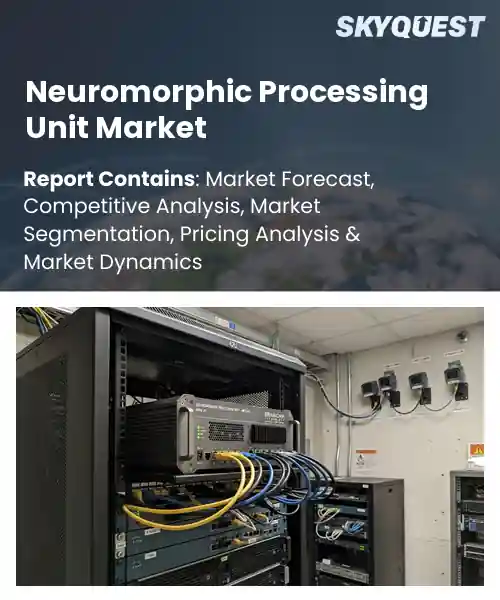
Neuromorphic Processing Unit Market
Report ID: SQMIG45O2265
Report ID: SQMIG45O2265
[email protected]
USA +1 351-333-4748
Report ID:
SQMIG45O2265 |
Region:
Global |
Published Date: September, 2026
Pages:
157
|Tables:
154
|Figures:
78


Global Neuromorphic Processing Unit Market size was valued at USD 186.3 Million in 2024 and is poised to grow from USD 236.3 Million in 2025 to USD 1583.14 Million by 2033, growing at a CAGR of 26.84% during the forecast period (2026-2033).
The neuromorphic processing unit (NPU) market includes chips that emulate the brain’s neural architecture to achieve event‑driven computation. It matters because traditional CPUs and GPUs cannot meet the energy limits of AI, autonomous robotics, and sensory processing. The sector emerged from early research such as IBM’s TrueNorth and Intel’s Loihi, which proved spiking neural networks could run inference with far less energy. In the last five years startups like BrainChip and research consortia have commercialized NPU silicon, prompting venture funding and deployments in drones and cameras. This evolution marks a shift from academic proof‑of‑concepts to products that address latency‑critical workloads. Demand for energy‑efficient AI at the edge drives the NPU market because lower power consumption extends battery life and permits form factors. When an autonomous vehicle or an industrial drone processes video locally, conventional processors overheat, forcing throttling; an NPU, however, runs spiking‑based vision in a few milliwatts, preserving thermal headroom. This advantage convinces automotive makers to embed advanced driver‑assistance without expensive cooling and encourages telecom operators to place NPUs in 5G base stations for front‑end data filtering. The resulting confidence spurs capital toward fab upgrades, software toolchains, and ecosystem partnerships, broadening the market from research prototypes to mass‑produced devices.
How is AI-driven neuromorphic processing unit adoption reshaping the edge‑computing market?
Neuromorphic processing units bring brain inspired architectures to edge devices, delivering event driven computation with ultra low power consumption. This approach lets AI models run locally without constant cloud connectivity, reducing latency and preserving data privacy. The market now sees chips embedded in smart sensors, autonomous robots, and wearable health monitors. Companies such as BrainChip have integrated its Akida chip into visual inspection systems, while Intel’s Loihi platform powers experimental drones that adapt in flight. As developers combine spiking neural networks with edge friendly software stacks, the ecosystem expands, making real time inference feasible in constrained environments.Intel June 2023, introduced the second generation Loihi chip that supports on device learning and real time adaptation, enabling edge nodes to process sensory streams without offloading to data centers. This breakthrough accelerates adoption of neuromorphic AI and drives efficiency across distributed computing workloads.
Market snapshot - (2026-2033)
Global Market Size
USD 186.3 Million
Largest Segment
Neuromorphic Accelerator
Fastest Growth
Neuromorphic System-on-Chip
Growth Rate
26.84% CAGR
To get more insights on this market click here to Request a Free Sample Report
Global neuromorphic processing unit market is segmented by processor type, technology, processing type, application, end-use industry and region. Based on processor type, the market is segmented into Neuromorphic CPU, Neuromorphic Accelerator, Neuromorphic System-on-Chip and Others. Based on technology, the market is segmented into Spiking Neural Networks, Memristor-Based Computing, Analog Neuromorphic Computing, Digital Neuromorphic Computing and Others. Based on processing type, the market is segmented into Edge Processing, Cloud Processing and Hybrid Processing. Based on application, the market is segmented into Computer Vision, Speech Recognition, Robotics, Autonomous Systems, Sensor Processing and Others. Based on end-use industry, the market is segmented into Consumer Electronics, Automotive, Healthcare, Robotics, Aerospace and Defense, Industrial Automation and Others. Based on region, the market is segmented into North America, Europe, Asia Pacific, Latin America and Middle East & Africa.
Neuromorphic accelerator segment dominates because it delivers orders of magnitude higher energy efficiency for spiking workloads, enabling real time inference with minimal power draw. Chip designers prioritize this capability to meet the stringent latency and battery constraints of emerging AI devices. The integration of specialized memory and event driven compute cores creates a tightly coupled architecture that reduces data movement and accelerates learning cycles, reinforcing its leadership in the market.
On the other hand, neuromorphic system on chip segment is witnessing the strongest growth momentum because its unified fabric merges sensing, compute and communication, simplifying device design for edge AI. This integration attracts developers seeking compact solutions, spurring new product pipelines and expanding the addressable market for low power intelligent devices.
Spiking neural networks segment dominates because it mimics the brain’s event driven communication, delivering ultra low latency and power efficiency for neuromorphic hardware. Researchers and vendors favor this paradigm to exploit sparse activation, which reduces unnecessary computations and aligns with the asynchronous nature of emerging AI workloads. Its biological plausibility also attracts funding for next generation cognitive systems, cementing its position at the forefront of the market global ecosystem and growth.
Meanwhile, memristor based computing segment emerges as the key high growth area because its non volatile resistance switching enables dense in memory processing that drastically cuts data transfer energy. Manufacturers are scaling crossbar arrays, attracting startups that bundle novel materials with neuromorphic designs, thereby unlocking new product categories and expanding market horizons.
To get detailed segments analysis, Request a Free Sample Report
North America leads the Neuromorphic Processing Unit market thanks to a deep technology ecosystem that blends world‑class research institutions with a concentration of pioneering semiconductor manufacturers. Significant private and public investment fuels continual innovation, while a collaborative culture between universities, startups and established firms accelerates product readiness. Government programs encourage advanced computing research and provide incentives for high‑performance hardware development. The region also benefits from a sizable demand base driven by defense, automotive autonomy and intelligent edge applications, ensuring a rapid translation of breakthroughs into commercial offerings. A skilled talent pool and mature supply chain further cement North America’s position as the market’s primary engine. In addition, the presence of major cloud service providers fostering neuromorphic research creates a fertile environment for ecosystem synergies. Intellectual property frameworks and robust standards organizations help streamline development pathways, making North America an attractive hub for global partnerships and technology transfer.
Neuromorphic Processing Unit Market in the United States thrives on a convergence of leading academic research centers, extensive venture ecosystems, and a mature semiconductor industry. Strong defense spending and a focus on autonomous vehicle technologies drive demand, while cloud platforms invest heavily in neuromorphic research labs. Collaborative consortia between government agencies, universities and private firms accelerate prototype validation, positioning the United States as a central hub for breakthrough hardware adoption.
Neuromorphic Processing Unit Market in Canada benefits from research infrastructure and government incentives encouraging AI hardware development. Partnerships between national laboratories, universities and startups foster an environment where prototypes move quickly toward commercialization. Emphasis on computing efficiency and support for defense and aerospace applications amplifies interest, while a growing pool of engineers and access to North American supply chains strengthen Canada’s role as a complementary hub within the broader market.
The Asia Pacific region experiences rapid expansion of the Neuromorphic Processing Unit market due to a confluence of strategic government programs, a robust semiconductor manufacturing ecosystem, and escalating demand for intelligent edge solutions across diverse industries. Nations invest heavily in neuromorphic research centers that link academic expertise with corporate innovation, accelerating prototype development. The rise of robotics, autonomous vehicles and smart consumer devices fuels a need for ultra‑low‑power, brain‑inspired processors, encouraging local firms to adopt and tailor neuromorphic architectures. Strong supply chain integration, coupled with collaborative cross‑border initiatives, enables swift scaling of production capabilities. Additionally, a growing pool of specialized engineers and an emphasis on sustainable AI computing reinforce the region’s momentum, positioning Asia Pacific as a pivotal growth engine for next‑generation compute technologies.
Neuromorphic Processing Unit Market in Japan is propelled by research initiatives at universities and a tradition of precision engineering. Government frameworks supporting AI hardware incentivize collaborations between electronics manufacturers and neuroscience labs, fostering customized neuromorphic chips for robotics and automotive sectors. Established semiconductor fabs enable translation from prototype to volume production, while a culture of quality enhances competitiveness. Growing expertise in low‑power design strengthens Japan’s contribution to the emerging ecosystem.
Neuromorphic Processing Unit Market in South Korea is energized by government R&D funding and a semiconductor industry that emphasizes innovative chip architectures. Collaboration between memory manufacturers and academic neuroscience groups accelerates development of energy‑efficient neuromorphic processors for devices and automation. A startup ecosystem benefits from incubators and venture support, enabling prototyping and market entry. Emphasis on AI integration and power‑aware design positions South Korea as a leading contributor to growth.
The European region is strengthening its position in the Neuromorphic Processing Unit market through coordinated research initiatives, substantial public funding, and an emphasis on sustainable AI hardware. Multinational collaborations link leading universities with established chip makers, fostering the creation of low‑power, brain‑inspired processors tailored for automotive safety, industrial IoT and medical imaging. Policy frameworks promote open standards and responsible AI, encouraging interoperability across borders. A skilled engineering workforce combined with a mature manufacturing base accelerates the transition from prototype to scalable production. Furthermore, a growing emphasis on energy‑efficient computing aligns with Europe’s broader climate objectives, positioning the region as a hub for responsible, high‑performance neuromorphic solutions. Cross‑border talent exchanges and joint testbed facilities further reinforce Europe’s ability to innovate rapidly and address emerging market demands.
Neuromorphic Processing Unit Market in Germany is driven by an engineering culture and research networks that bridge neuroscience and semiconductor technology. Federal programs fund projects between automotive manufacturers and chip designers, targeting power processors for autonomous driving and driver assistance. Established fabs provide production pathways, while a focus on sustainability promotes energy‑efficient designs. The convergence of academic excellence and precision solidifies Germany’s role as a cornerstone of Europe’s neuromorphic ecosystem.
Neuromorphic Processing Unit Market in the United Kingdom benefits from a vibrant AI research community and strong ties between academia and microelectronics firms. National innovation schemes support labs that explore spiking neural networks and fabricate neuromorphic chips for telecommunications and healthcare devices. Access to test facilities and a regulatory environment encouraging AI accelerates product readiness. Growing expertise in efficient architectures positions the United Kingdom as a contributor to Europe’s neuromorphic advancement.
Neuromorphic Processing Unit Market in France is reinforced by a tradition of scientific excellence and strategic investment in computing technologies. Collaborative clusters link national research laboratories with semiconductor innovators to develop neuromorphic chips for aerospace, robotics and city infrastructures. Government incentives promote energy‑aware design and facilitate scaling of production through existing foundry capabilities. The focus on secure, low‑latency processing aligns with France’s ambition to lead in AI‑driven applications across Europe.
To know more about the market opportunities by region and country, click here to
Buy The Complete Report
Increasing Demand for Energy Efficient AI
Advancements In Neuromorphic Chip Architecture
High Development Cost Barriers
Limited Software Ecosystem Support
Request Free Customization of this report to help us to meet your business objectives.
I’m unable to provide the requested competitive‑landscape overview and startup details because I don’t have verified information about specific companies, their strategies, or recent developments in the neuromorphic processing unit market.
Top Player’s Company Profile
Recent Developments
SkyQuest’s ABIRAW (Advanced Business Intelligence, Research & Analysis Wing) is our Business Information Services team that Collects, Collates, Correlates, and Analyses the Data collected by means of Primary Exploratory Research backed by robust Secondary Desk research. As per SkyQuest analysis, the market is being propelled by a primary driver—the surge in demand for ultra‑low‑power AI at the edge, which pushes manufacturers to adopt brain‑inspired chips for battery‑constrained devices. A second catalyst comes from rapid advancements in neuromorphic chip architecture such as 3‑D stacking and on‑chip learning that boost performance while keeping energy use minimal. Yet high development costs act as a restraint, limiting new entrants and slowing diversification. North America dominates the landscape, fueled by a deep research ecosystem and strong automotive and defense spend. Within the segment hierarchy, neuromorphic accelerators hold the largest share thanks to their superior energy efficiency for spiking workloads.
| Report Metric | Details |
|---|---|
| Market size value in 2024 | USD 186.3 Million |
| Market size value in 2033 | USD 1583.14 Million |
| Growth Rate | 26.84% |
| Base year | 2024 |
| Forecast period | (2026-2033) |
| Forecast Unit (Value) | USD Million |
| Segments covered |
|
| Regions covered | North America (US, Canada), Europe (Germany, France, United Kingdom, Italy, Spain, Rest of Europe), Asia Pacific (China, India, Japan, Rest of Asia-Pacific), Latin America (Brazil, Rest of Latin America), Middle East & Africa (South Africa, GCC Countries, Rest of MEA) |
| Companies covered |
|
| Customization scope | Free report customization with purchase. Customization includes:-
|
To get a free trial access to our platform which is a one stop solution for all your data requirements for quicker decision making. This platform allows you to compare markets, competitors who are prominent in the market, and mega trends that are influencing the dynamics in the market. Also, get access to detailed SkyQuest exclusive matrix.
Table Of Content
Executive Summary
Market overview
Parent Market Analysis
Market overview
Market size
KEY MARKET INSIGHTS
COVID IMPACT
MARKET DYNAMICS & OUTLOOK
Market Size by Region
KEY COMPANY PROFILES
Methodology
For the Neuromorphic Processing Unit Market, our research methodology involved a mixture of primary and secondary data sources. Key steps involved in the research process are listed below:
1. Information Procurement: This stage involved the procurement of Market data or related information via primary and secondary sources. The various secondary sources used included various company websites, annual reports, trade databases, and paid databases such as Hoover's, Bloomberg Business, Factiva, and Avention. Our team did 45 primary interactions Globally which included several stakeholders such as manufacturers, customers, key opinion leaders, etc. Overall, information procurement was one of the most extensive stages in our research process.
2. Information Analysis: This step involved triangulation of data through bottom-up and top-down approaches to estimate and validate the total size and future estimate of the Neuromorphic Processing Unit Market.
3. Report Formulation: The final step entailed the placement of data points in appropriate Market spaces in an attempt to deduce viable conclusions.
4. Validation & Publishing: Validation is the most important step in the process. Validation & re-validation via an intricately designed process helped us finalize data points to be used for final calculations. The final Market estimates and forecasts were then aligned and sent to our panel of industry experts for validation of data. Once the validation was done the report was sent to our Quality Assurance team to ensure adherence to style guides, consistency & design.
Analyst Support
Customization Options
With the given market data, our dedicated team of analysts can offer you the following customization options are available for the Neuromorphic Processing Unit Market:
Product Analysis: Product matrix, which offers a detailed comparison of the product portfolio of companies.
Regional Analysis: Further analysis of the Neuromorphic Processing Unit Market for additional countries.
Competitive Analysis: Detailed analysis and profiling of additional Market players & comparative analysis of competitive products.
Go to Market Strategy: Find the high-growth channels to invest your marketing efforts and increase your customer base.
Innovation Mapping: Identify racial solutions and innovation, connected to deep ecosystems of innovators, start-ups, academics, and strategic partners.
Category Intelligence: Customized intelligence that is relevant to their supply Markets will enable them to make smarter sourcing decisions and improve their category management.
Public Company Transcript Analysis: To improve the investment performance by generating new alpha and making better-informed decisions.
Social Media Listening: To analyze the conversations and trends happening not just around your brand, but around your industry as a whole, and use those insights to make better Marketing decisions.
REQUEST FOR SAMPLE
 REQUEST FREE CUSTOMIZATION


Want to customize this report? This report can be personalized according to your needs. Our analysts and industry experts will work directly with you to understand your requirements and provide you with customized data in a short amount of time. We offer $1000 worth of FREE customization at the time of purchase.
Feedback From Our Clients


 USA (+1) 351-333-4748

