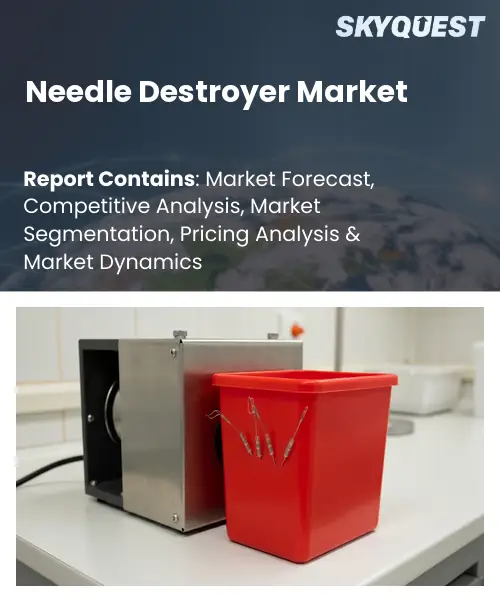
Needle Destroyer Market
Report ID: SQMIG35A3561
Report ID: SQMIG35A3561
[email protected]
USA +1 351-333-4748
Report ID:
SQMIG35A3561 |
Region:
Global |
Published Date: May, 2026
Pages:
157
|Tables:
92
|Figures:
76


Global Needle Destroyer Market size was valued at USD 6.15 Billion in 2024 and is poised to grow from USD 6.48 Billion in 2025 to USD 9.79 Billion by 2033, growing at a CAGR of 5.3% during the forecast period (2026-2033).
Primary driver of the needle destroyer market growth is the imperative to prevent needlestick injuries and control bloodborne pathogen transmission, which has intensified as injectable treatments and immunization campaigns expanded. The market comprises point‑of‑use devices that render hypodermic needles inoperable through thermal, mechanical or chemical methods, replacing bulky sharps bins and incineration. This market is significant because frontline healthcare workers, home caregivers and waste handlers face measurable infection risk that translates into human and economic costs. Over past two decades uptake moved from hospital rooms to ambulatory clinics, dialysis centers and home care as regulators tightened disposal rules and chronic disease prevalence rose.
A central growth factor shaping the global needle destroyer market is rapid technological innovation that reduces size, cost and complexity, accelerating adoption across clinical settings. When manufacturers introduce compact, powered destroyers suitable for home insulin users and mobile vaccination teams, buyers see lower handling risk and operators experience fewer needlestick incidents, yielding measurable savings in treatment and litigation. This cascading effect creates opportunities for hospitals, harm reduction programs and rural clinics to invest in point‑of‑use solutions, driving scale manufacturing, fostering integration with waste tracking software and opening markets in emerging economies seeking safer, cost effective disposal and reducing long-term costs.
How is automation improving safety and efficiency in the needle destroyer market?
Automation is increasing the safety and efficiency of the needle destroyer market by automating the manual handling procedures of the past. Important elements are secure needle neutralization, constant containment and little operator contact. Many hospitals today use automated units because they standardize disposal, facilitate training staff and integrate with current waste procedures. According to market data, regulators and procurement teams choose technologies that decrease exposure risk and simplify backroom activities. Practical examples include machines that use controlled heat or mechanical destruction coupled with automatic locking and connectivity to maintenance warnings for reliable and easy-to-use gadgets.
The BD Eclipse Sharps Container with SmartClip, released by Becton Dickinson in December 2025, is a real-world example of how automated secure locking and streamlined disposal processes can improve staff safety and operational efficiency and encourage wider use of automated sharps destruction.
Automation is increasing the safety and efficiency of the needle destroyer market by automating the manual handling procedures of the past. Important elements are secure needle neutralization, constant containment and little operator contact. Many hospitals today use automated units because they standardize disposal, facilitate training staff and integrate with current waste procedures. According to market data, regulators and procurement teams choose technologies that decrease exposure risk and simplify backroom activities.
BD Eclipse Sharps Container with SmartClip, released by Becton Dickinson in December 2025, is a real-world example of how automated secure locking and streamlined disposal processes can improve staff safety and operational efficiency and encourage wider use of automated sharps destruction.
Market snapshot - (2026-2033)
Global Market Size
USD 6.15 Billion
Largest Segment
Electrical/Thermal Destroyers
Fastest Growth
Portable and Battery-Operated Devices
Growth Rate
5.3% CAGR
To get more insights on this market click here to Request a Free Sample Report
Global needle destroyer market is segmented by product design, application capacity, end-user and region. Based on product design, the market is segmented into Electrical/Thermal Destroyers, Mechanical/Manual Cutters, Portable and Battery-Operated Devices and Others. Based on application capacity, the market is segmented into Heavy-Duty/High-Capacity Systems and Standard/Low-Capacity Systems. Based on end-user, the market is segmented into Hospitals and Centralized Diagnostic Laboratories, General Medical Clinics and Nursing Homes, Blood Banks, Home Care and Self-Injection Settings and Others. Based on region, the market is segmented into North America, Europe, Asia Pacific, Latin America and Middle East & Africa.
The portable and battery operated devices segment is dominates with needle destroyer market share owing to its mobility and ease of deployment, addressing point of care safety and convenience needs. These devices allow on-the-spot neutralization of needles without fixed infrastructure, reducing handling risks and fitting workflows across outpatient, mobile and residential environments. Manufacturers concentrate R&D efforts on small thermal and electromechanical technologies, while procurement prioritizes devices that minimize staff exposure and simplify waste chains, promoting widespread adoption.
As per needle destroyer market outlook, the electrical and thermal destroyers segment is showing the highest growth momentum as institutions focus on closed system automated neutralization for pathogen inactivation and compliance. Supplier service models and validation services are pushing procurement for improved systems, supported by energy efficiency advances and seamless integration into clinical waste procedures, creating options for recurring revenue streams.
As per needle destroyer market forecast, home care and self injection settings segment dominates because the growing preference for self administration of chronic therapies shifts safety responsibility outside clinical walls. Needle destroyers designed for home use reduce accidental sharps injuries and simplify disposal for patients and caregivers, prompting manufacturers to develop compact, user friendly models with clear instructions and tamper resistance. Payers and care providers increasingly endorse these devices to improve compliance and lower downstream clinical risk, reinforcing market uptake.
As per needle destroyer market outlook, hospitals and centralized diagnostic laboratories are emerging as the key high-growth area as regulatory focus drives centralized sharps management. Need for heavy duty automated destroyers that integrate with hospital waste streams and provide validation data is prompting capital investment and vendor partnerships, enabling sales of specialized equipment, service contracts, and long term maintenance models.
To get detailed segments analysis, Request a Free Sample Report
North America is in the forefront with a mix of robust healthcare infrastructure, strict regulatory demands, and well established procurement processes with a focus on occupational and patient safety. High awareness among healthcare stakeholders and severe directives from professional bodies are driving consistent demand for safety designed sharps management. All care settings benefit from the timely product availability and service support of experienced manufacturers and dedicated distribution networks. Corporate hygiene initiatives and hospital safety committees favor improved needle elimination systems. Partnerships between providers, device developers and waste management companies are actively pushing innovation for clinical workflows, growing market depth and the continued demand for reliable, compliance solutions in hospitals, clinics and comm
As per needle destroyer market regional outlook, United States market is characterized by a mature healthcare delivery system with wide procurement channels and high attention on workplace safety. Hospitals and ambulatory centers want integrated sharps systems that comply with regulatory guidance and institutional safety standards. Clinical teams work together with local manufacturers and service providers to optimize device ergonomics and disposal operations. Institutional purchase decisions are based on reliability, service support and compliance with existing waste management processes, supporting consistent growth of needle destruction technology across varied care settings.
As per needle destroyer market regional forecast, Canada market indicates a public focused healthcare approach with provincial procurement regimes that focus on worker protection and standardized safety equipment. Health agencies and hospital systems are assessing the usability of equipment in both urban and remote clinical settings, searching for solutions that offer a balance between clinical safety and operational pragmatism. Suppliers are working with regional health agencies to help pilots and larger rollouts. The pattern of adoption is considered and safety focused with an emphasis on occupational health, regulatory conformance with international norms and consideration to community clinic needs throughout health care facilities.
European expansion is driven by coordinated safety priorities, innovative legislative frameworks and centralized procurement systems that reward proven advances in sharps management. Hospitals and primary care networks are focusing more and more on devices that lower the risk of needlestick injuries and make waste streams easier to manage, while public health campaigns are raising awareness among doctors and patients. Regional manufacturing clusters and specialist vendors offer a range of equipment solutions for hospital, outpatient, and home care settings. Cross-border collaboration and tenders mean wider dissemination and uptake. Sustainability concerns and tighter waste management regulations will further drive the adoption of compact, effective needle destruction solutions that fit into existing sterilization and disposal procedures, increasing market momentum and triggering local innovation.
As per needle destroyer industry analysis, Germany market is characterized by a strong industrial basis and interaction with hospital procurement processes. German healthcare facilities usually favor proven, trustworthy technology because of the technical rigor and strict quality and safety requirements. Local manufacturers enable modification for clinical workflows and engineering and distribution networks ensure availability for major hospital systems and specialty clinics. In care settings, lasting, serviceable needle destruction methods are preferred, driven by institutional concerns for worker safety and compliance.
United Kingdom market is witnessing rapid acceptance because to the presence of active innovation hubs and collaborative collaborations between healthcare providers and technology innovators. Novel approaches to sharps management are piloted in health care organizations, public and private, and successful applications are swiftly scaled up to community and hospital care. Uptake is driven by procurement strategies focusing on clinical outcomes and cost effective safety solutions. Involvement of professional societies and regional health authorities also supports uptake of small, user friendly needle destruction devices particularly for outpatient and home care settings where ease of use is critical.
France is emerging through targeted safety campaigns and evolving procurement practices that encourage trials of advanced sharps management technologies. Urban hospital centers and specialized clinics are primary adopters, with growing interest in solutions that align with sustainability and waste reduction goals. Collaboration between suppliers and regional health agencies supports demonstration projects that assess device adaptation to local clinical routines. As awareness increases among healthcare professionals, demand for reliable, environmentally considerate needle destruction options is gathering momentum across the care continuum.
Asia Pacific is preparing itself with a mix of increasing healthcare capacity, legislative updates, and boosting local manufacturing capabilities that focus on gadget safety and usability. Regional markets benefit from global manufacturers and domestic companies who adjust designs to local clinical norms and procurement systems, and work together. The focus on workplace safety and infection control in hospitals and community care is driving increasing interest in needle destruction devices. Product development investment and speedier routes to clinical review drive innovation, while integrated supply chains and logistics advancements boost distribution across continents. Cost effective, compact solutions targeting both tertiary institutions and primary care clinics fosters wider adoption, and enhances regional competitiveness.
Japan is driven by advanced manufacturing strengths and a cultural emphasis on meticulous clinical safety. Hospitals and clinics prioritize devices that offer precision, reliability, and seamless integration with existing sterilization and waste handling systems. Collaboration between device makers and clinical end users refines ergonomics for routine use in high volume settings. Regulatory thoroughness and attention to quality standards support market acceptance and foster developments that can be adapted for export to neighboring markets.
A vibrant medical device industry and a robust innovation ecosystem that speeds up product enhancement and local acceptance help the South Korea market. Healthcare providers are actively exploring new ways to handle sharps and close relationships between manufacturers, hospitals and purchasing authorities help get effective devices into use quickly. Emphasis on design innovation, usability in hospital and outpatient settings and integration with waste management services is leading to increasing acceptability and setting up the market for further progress in the region.
To know more about the market opportunities by region and country, click here to
Buy The Complete Report
Increasing Regulatory Emphasis Globally
Advancements In Device Design
High Upfront Acquisition Costs
Limited Awareness In Emerging Regions
Request Free Customization of this report to help us to meet your business objectives.
The competitive landscape is split between large medical device OEMs, regional low-cost equipment manufacturers, and consolidated medical-waste operators, with competition driven by procurement focus on point-of-care safety and total disposal cost. Active strategies include M&A consolidation in waste services exemplified by Waste Management’s acquisition of Stericycle, public private partnerships expanding syringe capacity as BD did with HHS BARDA, and product innovation from Asian OEMs launching compact electric needle destroyers.
SkyQuest’s ABIRAW (Advanced Business Intelligence, Research & Analysis Wing) is our Business Information Services team that Collects, Collates, Correlates, and Analyses the Data collected by means of Primary Exploratory Research backed by robust Secondary Desk research.
As per SkyQuest analysis, the global needle destroyer market trend is being propelled by a key driver, the imperative to prevent needlestick injuries and curb bloodborne pathogen transmission, while a second driver is rapid technological innovation that lowers size, cost and complexity, enabling point-of-care adoption. A restraint is high upfront acquisition costs that slow procurement in resource-constrained facilities. North America remains the dominating region due to stringent regulations and established procurement networks, and portable and battery-operated devices are the dominating segment given their mobility and suitability for home and mobile care. Overall, adoption is advancing as manufacturers focus on compact, automated solutions that fit clinical workflows.
| Report Metric | Details |
|---|---|
| Market size value in 2024 | USD 6.15 Billion |
| Market size value in 2033 | USD 9.79 Billion |
| Growth Rate | 5.3% |
| Base year | 2024 |
| Forecast period | (2026-2033) |
| Forecast Unit (Value) | USD Billion |
| Segments covered |
|
| Regions covered | North America (US, Canada), Europe (Germany, France, United Kingdom, Italy, Spain, Rest of Europe), Asia Pacific (China, India, Japan, Rest of Asia-Pacific), Latin America (Brazil, Rest of Latin America), Middle East & Africa (South Africa, GCC Countries, Rest of MEA) |
| Companies covered |
|
| Customization scope | Free report customization with purchase. Customization includes:-
|
To get a free trial access to our platform which is a one stop solution for all your data requirements for quicker decision making. This platform allows you to compare markets, competitors who are prominent in the market, and mega trends that are influencing the dynamics in the market. Also, get access to detailed SkyQuest exclusive matrix.
Table Of Content
Executive Summary
Market overview
Parent Market Analysis
Market overview
Market size
KEY MARKET INSIGHTS
COVID IMPACT
MARKET DYNAMICS & OUTLOOK
Market Size by Region
KEY COMPANY PROFILES
Methodology
For the Needle Destroyer Market, our research methodology involved a mixture of primary and secondary data sources. Key steps involved in the research process are listed below:
1. Information Procurement: This stage involved the procurement of Market data or related information via primary and secondary sources. The various secondary sources used included various company websites, annual reports, trade databases, and paid databases such as Hoover's, Bloomberg Business, Factiva, and Avention. Our team did 45 primary interactions Globally which included several stakeholders such as manufacturers, customers, key opinion leaders, etc. Overall, information procurement was one of the most extensive stages in our research process.
2. Information Analysis: This step involved triangulation of data through bottom-up and top-down approaches to estimate and validate the total size and future estimate of the Needle Destroyer Market.
3. Report Formulation: The final step entailed the placement of data points in appropriate Market spaces in an attempt to deduce viable conclusions.
4. Validation & Publishing: Validation is the most important step in the process. Validation & re-validation via an intricately designed process helped us finalize data points to be used for final calculations. The final Market estimates and forecasts were then aligned and sent to our panel of industry experts for validation of data. Once the validation was done the report was sent to our Quality Assurance team to ensure adherence to style guides, consistency & design.
Analyst Support
Customization Options
With the given market data, our dedicated team of analysts can offer you the following customization options are available for the Needle Destroyer Market:
Product Analysis: Product matrix, which offers a detailed comparison of the product portfolio of companies.
Regional Analysis: Further analysis of the Needle Destroyer Market for additional countries.
Competitive Analysis: Detailed analysis and profiling of additional Market players & comparative analysis of competitive products.
Go to Market Strategy: Find the high-growth channels to invest your marketing efforts and increase your customer base.
Innovation Mapping: Identify racial solutions and innovation, connected to deep ecosystems of innovators, start-ups, academics, and strategic partners.
Category Intelligence: Customized intelligence that is relevant to their supply Markets will enable them to make smarter sourcing decisions and improve their category management.
Public Company Transcript Analysis: To improve the investment performance by generating new alpha and making better-informed decisions.
Social Media Listening: To analyze the conversations and trends happening not just around your brand, but around your industry as a whole, and use those insights to make better Marketing decisions.
REQUEST FOR SAMPLE
 REQUEST FREE CUSTOMIZATION
Global Needle Destroyer Market size was valued at USD 6.15 Billion in 2024 and is poised to grow from USD 6.48 Billion in 2025 to USD 9.79 Billion by 2033, growing at a CAGR of 5.3% during the forecast period (2026-2033).
The competitive landscape is split between large medical device OEMs, regional low-cost equipment manufacturers, and consolidated medical-waste operators, with competition driven by procurement focus on point-of-care safety and total disposal cost. Active strategies include M&A consolidation in waste services exemplified by Waste Management’s acquisition of Stericycle, public private partnerships expanding syringe capacity as BD did with HHS BARDA, and product innovation from Asian OEMs launching compact electric needle destroyers. 'Becton Dickinson', 'Nipro Corporation', 'Terumo Corporation', 'B. Braun Melsungen', 'Smiths Group', 'Cardinals Health', 'Medline Industries', 'Amec Technology', 'Biocon', 'Meco Instruments', 'Bondcare', 'Yuyue Medical', 'DeRoyal Industries', 'Hi-Tech Medical', 'Humard Automation', 'GPC Medical', 'Inline Systems', 'Micsafe Medical Group', 'Romsons Group', 'Dynamic Techno Medicals'
Increasing regulatory emphasis globally has prompted healthcare institutions to upgrade sharps management practices and adopt devices that permanently render needles unusable. Mandatory guidelines and accreditation standards require secure disposal solutions, creating procurement incentives for needle destroyers that align with compliance goals. This regulatory pressure encourages health systems and clinics to replace unsafe practices with engineered products, reduces institutional liability concerns, and supports budgets allocated specifically for safety equipment. As a result, manufacturers see clearer demand signals, procurement cycles shorten, and adoption becomes a routine component of clinical safety programs.
Integration Into Healthcare Workflows: Needle destroyer devices are increasingly incorporated into broader clinical waste management processes, enabling seamless on site sharps neutralization alongside existing disposal practices. This trend is driven by demand for closed loop solutions that reduce handling steps, minimize cross contamination risk, and fit within routine nursing and phlebotomy workflows. Manufacturers form partnerships with hospitals and waste providers to provide training, maintenance, and collection schemes that ease procurement and encourage sustained adoption across acute and outpatient care settings.
Why does North America Dominate the Global Needle Destroyer Market? |@12


Want to customize this report? This report can be personalized according to your needs. Our analysts and industry experts will work directly with you to understand your requirements and provide you with customized data in a short amount of time. We offer $1000 worth of FREE customization at the time of purchase.
Feedback From Our Clients


 USA (+1) 351-333-4748

