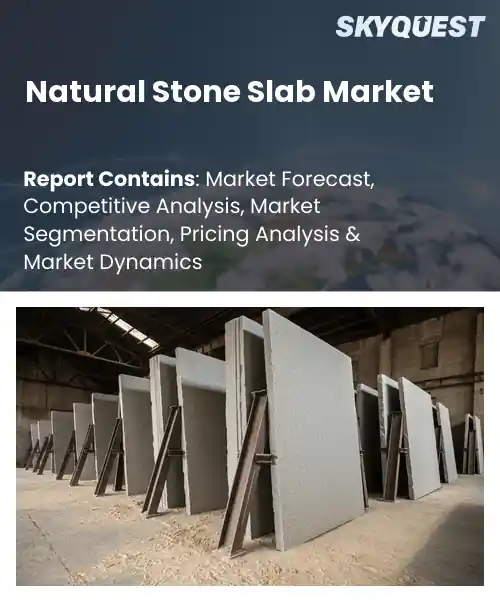
Natural Stone Slab Market
Report ID: SQMIG15F2397
Report ID: SQMIG15F2397
[email protected]
USA +1 351-333-4748
Report ID:
SQMIG15F2397 |
Region:
Global |
Published Date: July, 2026
Pages:
157
|Tables:
189
|Figures:
79


Global Natural Stone Slab Market size was valued at USD 51.2 Billion in 2024 and is poised to grow from USD 53.66 Billion in 2025 to USD 78.08 Billion by 2033, growing at a CAGR of 4.8% during the forecast period (2026-2033).
The global natural stone slab industry comprises quarried stone panels processed into thin, uniform sheets for use in flooring, countertops, and exterior cladding. Its significance drives from the material’s durability, aesthetic appeal, and low environmental impact compared with synthetic alternatives.
The primary driver today is urbanization, which fuels demand for residential and commercial projects seeking premium finishes. The second pivotal factor shaping the natural stone slab market is the rising consumer preference for sustainable interiors, which expands demand for building materials. Green‑building certifications now require recyclable or locally sourced inputs, prompting architects and developers to choose stone slabs with a smaller carbon footprint than synthetic alternatives. This trend compels manufacturers to adopt polishing methods and to obtain sourcing certifications, opening export opportunities in Europe and North America. For example, a hotel chain selected limestone from a quarry, cutting embodied energy by 30 % and promoting the project as a sustainability showcase, thereby turning environmental concerns into market growth.
How is AI-driven automation reshaping the natural stone slab market?
AI-driven automation is streamlining every stage of the natural stone slab value chain. Intelligent scanning systems now map raw blocks with pinpoint accuracy, allowing software to generate optimal cutting patterns that reduce waste and speed up production. Robotic arms equipped with machine‑learning algorithms handle lifting, sawing and polishing, delivering consistent surface quality while freeing skilled workers from repetitive tasks. Real‑time data feeds from sensors enable predictive maintenance, so equipment downtime drops and overall plant efficiency climbs. These technologies are reshaping supplier relationships as manufacturers can promise faster lead times and more reliable inventory, making the market more responsive to design trends and construction schedules.
Recent development from a major stone producer in April 2024 illustrates this shift, as the company deployed an AI‑powered cutting platform that cut processing time dramatically and boosted throughput, underscoring how automation fuels growth and operational excellence in the sector.
Market snapshot - (2026-2033)
Global Market Size
USD 51.2 Billion
Largest Segment
Granite Slabs
Fastest Growth
Onyx Slabs
Growth Rate
4.8% CAGR
To get more insights on this market click here to Request a Free Sample Report
Global natural stone slab market is segmented by by stone type, by finish type, by thickness, by application, by end-use industry, by distribution channel and region. Based on by stone type, the market is segmented into Granite Slabs, Marble Slabs, Limestone Slabs, Travertine Slabs, Slate Slabs, Quartzite Slabs, Sandstone Slabs, Onyx Slabs and Others. Based on by finish type, the market is segmented into Polished, Honed, Flamed, Brushed, Leathered, Sandblasted and Others. Based on by thickness, the market is segmented into Below 10 mm, 10 mm to 20 mm and Above 20 mm. Based on by application, the market is segmented into Flooring, Wall Cladding, Countertops, Staircases, Facades, Monuments & Decorative Applications and Others. Based on by end-use industry, the market is segmented into Residential Construction, Commercial Construction, Institutional Construction, Infrastructure Projects, Hospitality Sector and Others. Based on by distribution channel, the market is segmented into Direct Sales, Distributors & Wholesalers, Specialty Stone Retailers and Online Sales. Based on region, the market is segmented into North America, Europe, Asia Pacific, Latin America and Middle East & Africa.
Polished finish segment dominates with large natural stone slab market share because it offers a high‑gloss aesthetic that aligns with contemporary design trends, delivering visual appeal and perceived luxury in residential and commercial interiors. This appeal drives architects and specifiers to prioritize polished slabs, while manufacturers benefit from established processing techniques that ensure consistency and durability, reinforcing its market leadership.
As per natural stone slab market outlook, honed finish segment emerges as the fastest‑growing area as designers seek softer visual textures and slip‑resistant surfaces for high‑traffic applications. The tactile comfort and low‑maintenance characteristics of honed slabs attract projects focused on sustainability and safety, propelling rapid adoption and expanding market opportunities.
As per natural stone slab market forecast, granite slabs segment leads because its exceptional durability and resistance to staining make it a preferred choice for long‑lasting residential surfaces. Its natural variation and ability to accommodate diverse design palettes satisfy homeowner preferences, while its proven performance reduces lifecycle costs, cementing its position as the core material in residential builds.
Meanwhile, quartzite slabs segment is witnessing the strongest growth momentum as emerging consumer awareness of its unique translucence and higher hardness compared with traditional marble fuels demand for premium countertops. This growing fascination with distinctive aesthetics and superior wear resistance accelerates adoption, opening new design possibilities and expanding the market’s premium segment.
To get detailed segments analysis, Request a Free Sample Report
The dominance of Asia Pacific drives from deep‑rooted heritage in stone craftsmanship combined with extensive natural marble and granite reserves that support a robust supply chain. Advanced manufacturing capabilities and economies of scale enable producers to meet a wide range of design specifications while maintaining high quality standards. Strategic positioning of major ports facilitates efficient export logistics, allowing regional firms to serve both domestic construction booms and international demand. In addition, strong governmental support for infrastructure development and urbanization fuels continuous consumption of natural stone for residential, commercial, and public projects, reinforcing the region’s leading market position.
As per natural stone slab market regional outlook, Japan reflects a long tradition of architectural elegance and meticulous material selection. Premium quality expectations drive local manufacturers to focus on refined finishes and innovative applications. Close collaboration between designers and suppliers ensures that stone solutions align with contemporary aesthetic trends, while the nation’s emphasis on sustainability promotes the use of responsibly sourced stone in both new constructions and heritage renovations.
As per natural stone slab market regional forecast, South Korea are shaped by rapid urban development and a growing preference for high‑end interior finishes. The country’s strategic investments in quarry development and processing technology have enhanced its capacity to produce sophisticated stone products. Design‑centric culture encourages the integration of natural stone in upscale residential and commercial spaces, and a focus on export diversification expands South Korean presence in global supply networks.
Europe’s rapid expansion is propelled by a convergence of design sophistication, environmental awareness, and strong regulatory frameworks that favor natural materials. Architectural trends across the continent emphasize timeless aesthetics and durability, positioning natural stone as a preferred choice for premium projects. Stringent sustainability standards encourage the adoption of durable, low‑maintenance stone solutions, while a well‑established distribution network ensures timely delivery to diverse markets. Collaborative innovation between designers, architects, and stone processors drives the development of new finishes and applications, reinforcing Europe’s reputation as a hub for high‑value natural stone consumption.
Germany benefits from a legacy of precision engineering and rigorous quality control. Producers emphasize technical excellence and consistent product performance, catering to demanding construction and renovation sectors. Close cooperation with architects and interior designers fosters the creation of bespoke stone solutions that align with Germany’s reputation for functional design. Emphasis on sustainability and circular economy principles further enhances the appeal of natural stone in both new builds and retrofitting projects.
United Kingdom experiences accelerated growth driven by a surge in high‑end residential and commercial developments. Designers seek natural stone for its timeless elegance and versatility, leading to increased demand for diverse color palettes and finishes. Strong heritage conservation practices also stimulate the use of stone in restoration works. Market participants focus on innovative sourcing and processing techniques that align with the UK’s sustainability commitments, reinforcing rapid expansion.
France is emerging as a vibrant segment, supported by a cultural appreciation for artisanal craftsmanship and luxury interiors. French architects and designers prioritize natural stone for its aesthetic richness and tactile quality, especially in upscale hospitality and residential projects. Emerging quarry developments and investment in modern processing facilities are expanding the domestic supply base. This nurturing environment encourages the adoption of natural stone as a hallmark of refined French design.
North America reinforces its position through a combination of innovative design trends, expanding construction activities, and a focus on sustainable sourcing. The region’s architectural landscape increasingly embraces natural stone for its durability and distinctive visual appeal, especially in premium residential and commercial spaces. Collaborative efforts between suppliers and designers facilitate the introduction of new textures and edge profiles that cater to evolving consumer preferences. Strong logistics infrastructure and proximity to major quarries enable efficient distribution, while heightened environmental consciousness drives the selection of long‑lasting stone solutions, solidifying North America’s advancing role.
United States is characterized by a diverse demand spectrum ranging from large‑scale infrastructure projects to boutique interior design. The market benefits from extensive domestic quarry resources and sophisticated processing capabilities that deliver a wide array of stone types. Architects value natural stone for its ability to convey strength and elegance, prompting its integration into contemporary façades and interior finishes. Emphasis on green building certifications further fuels adoption of natural stone as a resilient, low‑maintenance material.
Canada reflects a growing inclination toward natural aesthetics and durability in both urban and remote construction. Domestic quarries provide high‑quality granite and marble, supporting local manufacturers who emphasize sustainable extraction practices. The Canadian market values the thermal performance and longevity of stone, making it a preferred choice for energy‑efficient building envelopes. Collaborative design initiatives and a focus on responsibly sourced materials enhance the sector’s reputation and expand its contribution to the national construction landscape.
To know more about the market opportunities by region and country, click here to
Buy The Complete Report
Urbanization and Infrastructure Growth
Sustainable Design Preferences Emerging
High Extraction and Processing Costs
Regulatory and Environmental Compliance Challenges
Request Free Customization of this report to help us to meet your business objectives.
The natural stone slab industry is intensely competitive, with leading manufacturers leveraging strategic acquisitions, joint ventures, and advanced processing technologies to secure premium quarry assets and expand distribution networks. Recent partnerships between quarry owners and construction firms aim to streamline supply chains, while investments in CNC cutting and digital design tools enable faster project turnaround and higher customization, intensifying rivalry among global players.
SkyQuest’s ABIRAW (Advanced Business Intelligence, Research & Analysis Wing) is our Business Information Services team that Collects, Collates, Correlates, and Analyses the Data collected by means of Primary Exploratory Research backed by robust Secondary Desk research.
As per SkyQuest analysis, the natural stone slab market growth is being propelled primarily by rapid urbanization and infrastructure growth, which fuels strong demand for durable, high‑visibility surfaces, while a rising preference for sustainable design serves as a second driver as architects seek low‑embodied‑energy, recyclable materials. The market’s restraint lies in high extraction and processing costs that pressure pricing against alternative panels. Asia Pacific dominates the landscape due to abundant reserves, advanced manufacturing and robust export logistics, and within the segment hierarchy, polished finish slabs hold the largest share, supported by contemporary design trends and well‑established processing lines. The global natural stone slab market trend driven by increasing demand for premium construction materials in residential, commercial, and hospitality projects.
| Report Metric | Details |
|---|---|
| Market size value in 2024 | USD 51.2 Billion |
| Market size value in 2033 | USD 78.08 Billion |
| Growth Rate | 4.8% |
| Base year | 2024 |
| Forecast period | (2026-2033) |
| Forecast Unit (Value) | USD Billion |
| Segments covered |
|
| Regions covered | North America (US, Canada), Europe (Germany, France, United Kingdom, Italy, Spain, Rest of Europe), Asia Pacific (China, India, Japan, Rest of Asia-Pacific), Latin America (Brazil, Rest of Latin America), Middle East & Africa (South Africa, GCC Countries, Rest of MEA) |
| Companies covered |
|
| Customization scope | Free report customization with purchase. Customization includes:-
|
To get a free trial access to our platform which is a one stop solution for all your data requirements for quicker decision making. This platform allows you to compare markets, competitors who are prominent in the market, and mega trends that are influencing the dynamics in the market. Also, get access to detailed SkyQuest exclusive matrix.
Table Of Content
Executive Summary
Market overview
Parent Market Analysis
Market overview
Market size
KEY MARKET INSIGHTS
COVID IMPACT
MARKET DYNAMICS & OUTLOOK
Market Size by Region
KEY COMPANY PROFILES
Methodology
For the Natural Stone Slab Market, our research methodology involved a mixture of primary and secondary data sources. Key steps involved in the research process are listed below:
1. Information Procurement: This stage involved the procurement of Market data or related information via primary and secondary sources. The various secondary sources used included various company websites, annual reports, trade databases, and paid databases such as Hoover's, Bloomberg Business, Factiva, and Avention. Our team did 45 primary interactions Globally which included several stakeholders such as manufacturers, customers, key opinion leaders, etc. Overall, information procurement was one of the most extensive stages in our research process.
2. Information Analysis: This step involved triangulation of data through bottom-up and top-down approaches to estimate and validate the total size and future estimate of the Natural Stone Slab Market.
3. Report Formulation: The final step entailed the placement of data points in appropriate Market spaces in an attempt to deduce viable conclusions.
4. Validation & Publishing: Validation is the most important step in the process. Validation & re-validation via an intricately designed process helped us finalize data points to be used for final calculations. The final Market estimates and forecasts were then aligned and sent to our panel of industry experts for validation of data. Once the validation was done the report was sent to our Quality Assurance team to ensure adherence to style guides, consistency & design.
Analyst Support
Customization Options
With the given market data, our dedicated team of analysts can offer you the following customization options are available for the Natural Stone Slab Market:
Product Analysis: Product matrix, which offers a detailed comparison of the product portfolio of companies.
Regional Analysis: Further analysis of the Natural Stone Slab Market for additional countries.
Competitive Analysis: Detailed analysis and profiling of additional Market players & comparative analysis of competitive products.
Go to Market Strategy: Find the high-growth channels to invest your marketing efforts and increase your customer base.
Innovation Mapping: Identify racial solutions and innovation, connected to deep ecosystems of innovators, start-ups, academics, and strategic partners.
Category Intelligence: Customized intelligence that is relevant to their supply Markets will enable them to make smarter sourcing decisions and improve their category management.
Public Company Transcript Analysis: To improve the investment performance by generating new alpha and making better-informed decisions.
Social Media Listening: To analyze the conversations and trends happening not just around your brand, but around your industry as a whole, and use those insights to make better Marketing decisions.
REQUEST FOR SAMPLE
 REQUEST FREE CUSTOMIZATION
Global Natural Stone Slab Market size was valued at USD 51.2 Billion in 2024 and is poised to grow from USD 53.66 Billion in 2025 to USD 78.08 Billion by 2033, growing at a CAGR of 4.8% during the forecast period (2026-2033).
The natural stone slab market is intensely competitive, with leading manufacturers leveraging strategic acquisitions, joint ventures, and advanced processing technologies to secure premium quarry assets and expand distribution networks. Recent partnerships between quarry owners and construction firms aim to streamline supply chains, while investments in CNC cutting and digital design tools enable faster project turnaround and higher customization, intensifying rivalry among global players. 'Levantina y Asociados de Minerales S.A.', 'Polycor Inc.', 'Cosentino S.A.', 'Antolini Luigi & C. S.p.A.', 'Temmer Marble', 'Mumal Marbles Pvt. Ltd.', 'Aro Granite Industries Ltd.', 'Dimpomar Rochas Portuguesas S.A.', 'Vetter Stone Company', 'Dermitzakis Bros S.A.', 'Xishi Group Co. Ltd.', 'Fox Marble Holdings plc', 'Pokarna Limited', 'Topalidis S.A.', 'MGT Stone Co.', 'R.E.D. Graniti S.p.A.', 'Dal-Tile Corporation', 'Tab India Granites Pvt. Ltd.', 'Stone World Canada Inc.', 'Arizona Tile LLC'
Rapid expansion of cities and infrastructure projects creates a steady need for durable, aesthetically pleasing surfaces, positioning natural stone slabs as a preferred material for façades, flooring, and cladding. Architects and developers appreciate the material’s resilience and timeless appeal, which align with long‑term construction goals. Consequently, the growing urban footprint directly fuels demand, encouraging manufacturers to expand capacity and innovate product offerings, thereby reinforcing market momentum and supporting overall growth. This trend also stimulates investment in logistics networks, ensuring timely delivery across expanding metropolitan regions.
Sustainable Design Preference: Architects and designers increasingly prioritize natural stone slabs that convey timeless elegance while supporting sustainability goals. Customers appreciate low‑maintenance surfaces that reduce chemical cleaning, and builders value the material’s durability that extends building lifecycles. This shift encourages suppliers to source responsibly managed quarries, adopt waste‑reduction technologies, and highlight provenance in marketing narratives. As green building certifications gain traction, demand for eco‑friendly stone solutions accelerates, positioning sustainable design preference as a decisive growth driver for the market in global market growth.
Why does Asia Pacific Dominate the Global Natural Stone Slab Market? |@12


Want to customize this report? This report can be personalized according to your needs. Our analysts and industry experts will work directly with you to understand your requirements and provide you with customized data in a short amount of time. We offer $1000 worth of FREE customization at the time of purchase.
Feedback From Our Clients


 USA (+1) 351-333-4748

