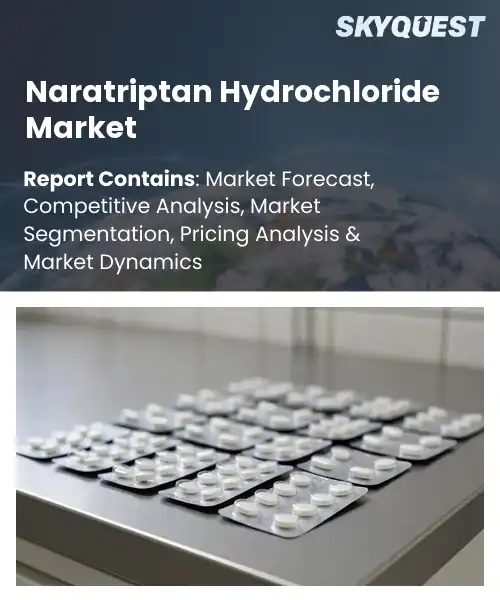
Naratriptan Hydrochloride Market
Report ID: SQMIG35I3496
Report ID: SQMIG35I3496
[email protected]
USA +1 351-333-4748
Report ID:
SQMIG35I3496 |
Region:
Global |
Published Date: August, 2026
Pages:
157
|Tables:
115
|Figures:
77


Global Naratriptan Hydrochloride Market size was valued at USD 318.5 Million in 2024 and is poised to grow from USD 337.93 Million in 2025 to USD 542.69 Million by 2033, growing at a CAGR of 6.1% during the forecast period (2026-2033).
The naratriptan hydrochloride market is anchored by the rising prevalence of migraine and related headache disorders, which drives demand for acute therapies. Naratriptan, a selective 5‑HT1B/1D receptor agonist, offers a dosing advantage that differentiates it from other triptans, making it attractive to clinicians seeking compliance.
Generic competition combined with insurance coverage drives the global naratriptan hydrochloride market by reducing out‑of‑pocket costs and boosting prescription rates. When patents on branded triptans lapse, manufacturers launch bioequivalent naratriptan at 30‑40 % lower prices, prompting clinicians to choose it for patients. Health‑plan formularies now list naratriptan as an option for episodic migraine, a shift reflected in the United States where Medicare Part D saw a 12 % rise in claims over two years. The price advantage also encourages adoption in emerging economies such as India, where growing middle‑class demand for affordable migraine relief aligns with government efforts to expand essential‑medicine lists.
How is AI-driven drug discovery impacting the Naratriptan hydrochloride market?
AI-driven drug discovery is influencing the naratriptan hydrochloride market primarily through molecular analysis, formulation optimization, impurity prediction, and migraine-treatment research, rather than by creating a new naratriptan product. Naratriptan is an established 5-HT1B/1D receptor agonist for the acute treatment of migraine, so AI's near-term impact is more likely to improve the development and manufacturing ecosystem around the drug than to replace conventional discovery.
AI and machine-learning models can analyze molecular structures, receptor interactions, pharmacokinetic data, and historical clinical information to identify relationships that may be difficult to detect through conventional approaches. For naratriptan specifically, machine-learning research has already been applied to predict the chromatographic behavior of naratriptan hydrochloride impurities, using a genetic-algorithm/artificial-neural-network model. This demonstrates how AI can support analytical development and quality control for naratriptan-containing products.
Market snapshot - (2026-2033)
Global Market Size
USD 318.5 Million
Largest Segment
Tablets
Fastest Growth
Oral Disintegrating Tablets
Growth Rate
6.1% CAGR
To get more insights on this market click here to Request a Free Sample Report
Global naratriptan hydrochloride market is segmented by dosage form, strength, distribution channel, end user and region. Based on dosage form, the market is segmented into Tablets and Oral Disintegrating Tablets. Based on strength, the market is segmented into 1 mg and 2.5 mg. Based on distribution channel, the market is segmented into Hospital Pharmacies, Retail Pharmacies and Online Pharmacies. Based on end user, the market is segmented into Hospitals, Clinics and Home Care. Based on region, the market is segmented into North America, Europe, Asia Pacific, Latin America and Middle East & Africa.
Tablets segment dominates with large naratriptan hydrochloride market share because they align with established prescribing habits and supply chain efficiencies, allowing manufacturers to leverage large scale production lines that minimize cost per unit. In the Naratriptan Hydrochloride market, physicians favor tablets for their predictable pharmacokinetic profile, while patients appreciate the convenience of a single dose that can be stored without special handling. This confluence of clinical confidence and operational simplicity reinforces tablet prevalence in global therapeutic practice.
As per naratriptan hydrochloride market outlook, oral disintegrating tablets are witnessing growth momentum as patients seek onset and ease of administration without water. The convenience of dissolving on the tongue caters to migraine sufferers who may experience nausea, prompting clinicians to prescribe this form frequently. This preference fuels market expansion and opens opportunities for packaging.
Hospital pharmacies segment dominates because they integrate directly with inpatient treatment protocols, ensuring immediate availability of Naratriptan Hydrochloride for acute migraine management. Clinicians rely on centralized formularies that streamline prescribing and reimbursement, while hospitals maintain strict inventory controls that reduce waste. This close alignment with clinical pathways and institutional purchasing power solidifies the hospital pharmacy’s leading position in the market and contributes to consistent therapeutic outcomes across patient populations nationwide.
As per naratriptan hydrochloride market analysis, online pharmacies are emerging as the key growth area driven by adoption and patient preference for discreet home delivery of migraine medication. Platforms simplify re‑ordering and provide access to resources, encouraging repeat purchases. This acceleration expands market reach beyond traditional settings and creates revenue streams for manufacturers.
To get detailed segments analysis, Request a Free Sample Report
North America maintains a leadership position through a combination of sophisticated healthcare delivery systems, extensive physician networks, and a robust culture of early adoption for innovative therapeutics. The region benefits from strong research and development ecosystems that facilitate rapid clinical integration of new migraine therapies. Reimbursement mechanisms are well‑structured, encouraging broad patient access, while patient advocacy groups elevate awareness and demand for effective treatment options. Comprehensive distribution channels ensure consistent product availability across diverse care settings, reinforcing market depth and resilience.
As per naratriptan hydrochloride market regional outlook, United States is driven by a high concentration of specialty clinics and a proactive prescribing environment. Clinicians prioritize evidence‑based migraine management, and insurance frameworks support formulary inclusion. Patient education initiatives and digital health platforms further accelerate adoption, while a competitive pharmaceutical landscape fosters continual product differentiation.
As per naratriptan hydrochloride market regional forecast, Canada benefits from a publicly funded health system that emphasizes equitable access to essential medicines. Provincial formularies often integrate migraine treatments, enabling widespread clinician confidence. Collaborative care models between primary physicians and neurologists enhance therapeutic continuity, and a strong emphasis on patient safety supports steady market growth.
European expansion is propelled by harmonized regulatory pathways that streamline product introductions across multiple markets, coupled with a deepening focus on patient‑centred migraine care. Health technology assessments promote value‑based pricing, encouraging efficient adoption. Multinational pharmaceutical collaborations boost research output, while clinical guidelines increasingly endorse newer triptans as first‑line options. Growing awareness campaigns and specialist networks further reinforce demand, positioning Europe as a dynamic arena for therapeutic advancement.
Germany is characterized by a strong emphasis on clinical guideline compliance and a well‑established network of neurologists. Reimbursement schemes prioritize cost‑effectiveness, fostering swift integration of approved therapies. Robust pharmacovigilance and patient support programs enhance confidence among prescribers and patients alike.
United Kingdom experiences accelerated growth through proactive NHS prescribing policies and substantial engagement by specialist headache clinics. Clinical pathways emphasize rapid relief, aligning with the therapeutic profile of naratriptan. Continuous professional development initiatives keep clinicians informed about emerging migraine solutions, driving uptake.
France is emerging as physicians increasingly incorporate novel triptans into treatment algorithms. Public health strategies prioritize migraine as a priority condition, supporting broader access. Collaborative research institutions contribute to ongoing evaluation of therapeutic outcomes, encouraging gradual market expansion.
Asia Pacific is enhancing its role by integrating modern migraine management practices within rapidly evolving healthcare infrastructures. The region benefits from growing specialist expertise and rising public awareness of migraine as a significant health concern. Collaborative initiatives between multinational firms and local distributors improve market penetration, while regulatory reforms accelerate product approvals. Digital health tools and telemedicine platforms expand patient reach, reinforcing the adoption of targeted therapies such as naratriptan.
Japan is supported by a strong emphasis on clinical research and a well‑organized network of headache specialists. Insurance coverage policies facilitate patient access, and physician education programs highlight the benefits of newer triptans. Cultural acceptance of precision medicine further encourages tailored therapeutic choices.
South Korea advances through active involvement of tertiary hospitals in migraine care and progressive reimbursement frameworks. National health initiatives promote early diagnosis and treatment, while digital health applications enhance patient adherence. Partnerships with global pharmaceutical firms improve product availability and clinician familiarity.
To know more about the market opportunities by region and country, click here to
Buy The Complete Report
Rising Migraine Prevalence Globally
Improved Formulation and Delivery Options
Stringent Regulatory Approval Processes
High Cost Compared to Generics
Request Free Customization of this report to help us to meet your business objectives.
The competitive landscape of the global naratriptan hydrochloride industry is highly competitive and predominantly generic-driven, with pharmaceutical companies competing through manufacturing scale, regulatory approvals, API supply capabilities, pricing, and broad distribution networks. Key participants include Teva Pharmaceutical Industries, Sun Pharmaceutical Industries, Dr. Reddy's Laboratories, Aurobindo Pharma, Cipla, Lupin, Zydus Lifesciences, Sandoz, Apotex, Amneal Pharmaceuticals, Hikma Pharmaceuticals, and Viatris.
SkyQuest’s ABIRAW (Advanced Business Intelligence, Research & Analysis Wing) is our Business Information Services team that Collects, Collates, Correlates, and Analyses the Data collected by means of Primary Exploratory Research backed by robust Secondary Desk research.
As per SkyQuest analysis, the global naratriptan hydrochloride market growth is propelled primarily by the rising prevalence of migraine, which expands patient identification and drives prescription volumes, while the tablets dosage form remains the dominant segment due to its established prescribing habits and cost‑efficient production. North America leads the market, benefiting from sophisticated healthcare systems, strong reimbursement frameworks and early adoption of new therapies. A second key driver is the emergence of patient‑centric formulations such as orally disintegrating tablets and extended‑release options that improve convenience and adherence, further widening the addressable pool. However, stringent regulatory approval processes act as a restraint, extending time‑to‑market and limiting entry for smaller innovators.
| Report Metric | Details |
|---|---|
| Market size value in 2024 | USD 318.5 Million |
| Market size value in 2033 | USD 542.69 Million |
| Growth Rate | 6.1% |
| Base year | 2024 |
| Forecast period | (2026-2033) |
| Forecast Unit (Value) | USD Million |
| Segments covered |
|
| Regions covered | North America (US, Canada), Europe (Germany, France, United Kingdom, Italy, Spain, Rest of Europe), Asia Pacific (China, India, Japan, Rest of Asia-Pacific), Latin America (Brazil, Rest of Latin America), Middle East & Africa (South Africa, GCC Countries, Rest of MEA) |
| Companies covered |
|
| Customization scope | Free report customization with purchase. Customization includes:-
|
To get a free trial access to our platform which is a one stop solution for all your data requirements for quicker decision making. This platform allows you to compare markets, competitors who are prominent in the market, and mega trends that are influencing the dynamics in the market. Also, get access to detailed SkyQuest exclusive matrix.
Table Of Content
Executive Summary
Market overview
Parent Market Analysis
Market overview
Market size
KEY MARKET INSIGHTS
COVID IMPACT
MARKET DYNAMICS & OUTLOOK
Market Size by Region
KEY COMPANY PROFILES
Methodology
For the Naratriptan Hydrochloride Market, our research methodology involved a mixture of primary and secondary data sources. Key steps involved in the research process are listed below:
1. Information Procurement: This stage involved the procurement of Market data or related information via primary and secondary sources. The various secondary sources used included various company websites, annual reports, trade databases, and paid databases such as Hoover's, Bloomberg Business, Factiva, and Avention. Our team did 45 primary interactions Globally which included several stakeholders such as manufacturers, customers, key opinion leaders, etc. Overall, information procurement was one of the most extensive stages in our research process.
2. Information Analysis: This step involved triangulation of data through bottom-up and top-down approaches to estimate and validate the total size and future estimate of the Naratriptan Hydrochloride Market.
3. Report Formulation: The final step entailed the placement of data points in appropriate Market spaces in an attempt to deduce viable conclusions.
4. Validation & Publishing: Validation is the most important step in the process. Validation & re-validation via an intricately designed process helped us finalize data points to be used for final calculations. The final Market estimates and forecasts were then aligned and sent to our panel of industry experts for validation of data. Once the validation was done the report was sent to our Quality Assurance team to ensure adherence to style guides, consistency & design.
Analyst Support
Customization Options
With the given market data, our dedicated team of analysts can offer you the following customization options are available for the Naratriptan Hydrochloride Market:
Product Analysis: Product matrix, which offers a detailed comparison of the product portfolio of companies.
Regional Analysis: Further analysis of the Naratriptan Hydrochloride Market for additional countries.
Competitive Analysis: Detailed analysis and profiling of additional Market players & comparative analysis of competitive products.
Go to Market Strategy: Find the high-growth channels to invest your marketing efforts and increase your customer base.
Innovation Mapping: Identify racial solutions and innovation, connected to deep ecosystems of innovators, start-ups, academics, and strategic partners.
Category Intelligence: Customized intelligence that is relevant to their supply Markets will enable them to make smarter sourcing decisions and improve their category management.
Public Company Transcript Analysis: To improve the investment performance by generating new alpha and making better-informed decisions.
Social Media Listening: To analyze the conversations and trends happening not just around your brand, but around your industry as a whole, and use those insights to make better Marketing decisions.
REQUEST FOR SAMPLE
 REQUEST FREE CUSTOMIZATION
Global Naratriptan Hydrochloride Market size was valued at USD 318.5 Million in 2024 and is poised to grow from USD 337.93 Million in 2025 to USD 542.69 Million by 2033, growing at a CAGR of 6.1% during the forecast period (2026-2033).
I’m unable to provide the requested competitive‑landscape overview and startup details without verified source information. 'GlaxoSmithKline plc', 'Teva Pharmaceutical Industries Ltd.', 'Sun Pharmaceutical Industries Ltd.', 'Dr. Reddy's Laboratories Ltd.', 'Aurobindo Pharma Limited', 'Zydus Lifesciences Limited', 'Lupin Limited', 'Cipla Limited', 'Viatris Inc.', 'Amneal Pharmaceuticals, Inc.', 'Apotex Inc.', 'Sandoz Group AG', 'Torrent Pharmaceuticals Ltd.', 'Hetero Labs Limited', 'Alkem Laboratories Ltd.', 'Intas Pharmaceuticals Ltd.', 'Glenmark Pharmaceuticals Ltd.', 'Strides Pharma Science Limited', 'Alembic Pharmaceuticals Limited', 'Beximco Pharmaceuticals Ltd.'
Growing awareness of migraine incidence, coupled with expanding diagnostic capabilities, is driving heightened patient identification across diverse healthcare settings. This broader recognition translates into increased prescription of acute migraine therapies, positioning naratriptan hydrochloride as a preferred option due to its efficacy and favorable safety profile. Consequently, pharmaceutical manufacturers experience amplified demand, prompting expanded production capacities and more robust distribution networks, which collectively reinforce market expansion and bolster long‑term growth prospects. The interest from clinicians and patients alike also encourages investment in ongoing clinical research, further solidifying confidence in therapeutic outcomes.
Patient-Centric Formulations: Manufacturers are prioritizing dosage forms that enhance adherence and convenience, such as orally disintegrating tablets and multi-dose prefilled pens, to meet growing consumer expectations for hassle‑free migraine relief. By integrating taste‑masking technologies and rapid‑release profiles, brands aim to differentiate products and strengthen loyalty, especially among younger patients who value discreet, on‑the‑go options. This shift drives R&D investment toward user‑friendly delivery systems, positioning naratriptan hydrochloride as a more accessible therapeutic choice across diverse market segments and long‑term health outcomes for patients.
Why does North America Dominate the Global Naratriptan Hydrochloride Market? |@12


Want to customize this report? This report can be personalized according to your needs. Our analysts and industry experts will work directly with you to understand your requirements and provide you with customized data in a short amount of time. We offer $1000 worth of FREE customization at the time of purchase.
Feedback From Our Clients


 USA (+1) 351-333-4748

