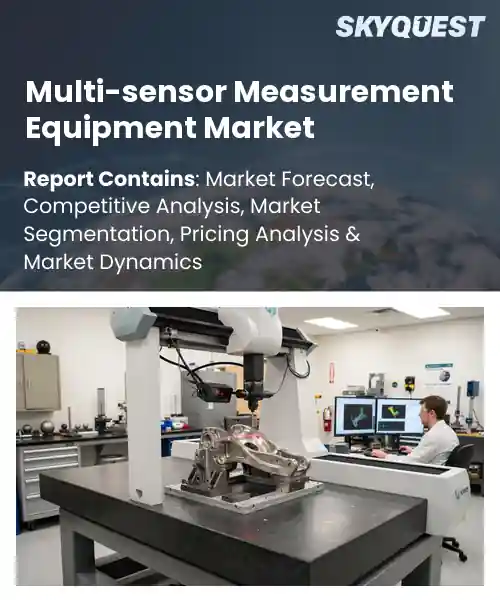
Multi-sensor Measurement Equipment Market
Report ID: SQMIG45J2916
Report ID: SQMIG45J2916
[email protected]
USA +1 351-333-4748
Report ID:
SQMIG45J2916 |
Region:
Global |
Published Date: September, 2026
Pages:
157
|Tables:
126
|Figures:
77


Global Multi-Sensor Measurement Equipment Market size was valued at USD 1.28 Billion in 2024 and is poised to grow from USD 1.38 Billion in 2025 to USD 2.48 Billion by 2033, growing at a CAGR of 7.6% during the forecast period (2026-2033).
One of the growth driver for the multi‑sensor measurement equipment market is the expansion of Industry 4.0 initiatives, which demand data fusion across production lines. As factories adopt digital twins, the need for synchronized sensor inputs to model equipment behavior in time becomes critical; without such integration, predictive algorithms lose fidelity, leading to unplanned downtime. Companies like Siemens and Bosch are deploying modular sensor arrays that combine ultrasonic, infrared, and strain‑gauge elements to monitor robotic welders, enabling adjustment of force parameters. This capability not only improves product quality but also opens revenue streams for service‑based maintenance contracts, encouraging further investment in AI‑compatible sensor platforms. The global multi‑sensor measurement equipment market comprises devices that integrate two or more sensing modalities such as temperature, pressure, vibration, and humidity into a single platform for data acquisition. Its importance stems from the need for accurate monitoring in industries ranging from aerospace to manufacturing, where separate sensors often generate datasets. Historically, the market emerged in the early 2000s as manufacturers sought to reduce wiring complexity and improve speed; for example, automotive OEMs adopted combined accelerometer‑gyroscope units to enhance vehicle stability control. Over the past decade, advances in MEMS technology and IoT connectivity have accelerated adoption, turning multi‑sensor rigs into indispensable tools for maintenance and assurance.
How is AI-driven automation reshaping the multi-sensor measurement equipment market?
AI-driven automation is weaving intelligence into every stage of multi‑sensor measurement, from data capture to real‑time analysis. Smart algorithms now calibrate sensors on the fly, reducing manual setup and boosting repeatability. Integrated platforms fuse temperature, pressure, vibration and optical inputs, delivering a unified view that accelerates troubleshooting and product development. Edge computing pushes processing closer to the device, cutting latency and enabling predictive maintenance without relying on distant servers. Vendors are packaging these capabilities into modular kits, allowing users to scale solutions as needs evolve, which makes adoption more flexible across industries ranging from automotive testing to aerospace manufacturing. The shift toward self‑optimizing systems is also lowering total cost of ownership by trimming labor and downtime.Recent AI‑enhanced sensor suites released in June 2024 illustrate how automation shortens testing cycles and improves data fidelity, reinforcing market momentum and operational efficiency.
Market snapshot - (2026-2033)
Global Market Size
USD 1.28 Billion
Largest Segment
Temperature Sensors
Fastest Growth
Humidity Sensors
Growth Rate
7.6% CAGR
To get more insights on this market click here to Request a Free Sample Report
Global multi-sensor measurement equipment market is segmented by sensor type, measurement parameter, application, end user and region. Based on sensor type, the market is segmented into Temperature Sensors, Pressure Sensors, Humidity Sensors, Position Sensors, Force & Load Sensors and Others. Based on measurement parameter, the market is segmented into Physical Parameters, Chemical Parameters, Environmental Parameters and Others. Based on application, the market is segmented into Industrial Manufacturing, Automotive, Aerospace & Defense, Healthcare, Environmental Monitoring and Others. Based on end user, the market is segmented into Manufacturing, Automotive, Aerospace & Defense, Healthcare and Others. Based on region, the market is segmented into North America, Europe, Asia Pacific, Latin America and Middle East & Africa.
Temperature Sensors segment leads because its fundamental role in capturing precise thermal data underpins virtually every multi‑sensor deployment. Continuous improvements in accuracy, miniaturization, and ruggedization enable seamless integration across industrial, automotive, and aerospace systems. These attributes satisfy stringent performance requirements, stimulate OEM adoption, and foster ecosystem confidence, making temperature sensing the backbone of the market’s value proposition and driving long‑term reliability incentives for end users through enhanced predictive maintenance capabilities.
However, Pressure Sensors segment is witnessing the strongest growth momentum because emerging high‑pressure processes in additive manufacturing and renewable energy systems demand advanced pressure monitoring. Innovations in MEMS design and wireless connectivity accelerate adoption, unlocking new system architectures and expanding the overall market opportunity for both OEMs and end‑users alike.
Environmental Monitoring application stands out because stringent regulatory requirements for air and water quality compel continuous, high‑resolution sensing. Integrated multi‑sensor platforms deliver real‑time data analytics, enabling stakeholders to meet compliance and drive sustainability initiatives. This regulatory pressure combined with rising public awareness fuels robust demand, positioning environmental monitoring as a cornerstone of market expansion. The need for interoperable modules also spurs investments in modular designs, further cementing its role in driving system integration across diverse sectors.
Meanwhile, Healthcare application emerges as the key high‑growth area because wearable diagnostics and remote patient monitoring demand compact, multi‑parameter sensors. Advances in biocompatible materials and AI‑driven analytics enable precise physiological tracking, prompting hospitals and telehealth providers to adopt integrated measurement solutions. This surge expands market horizons and creates new revenue streams for equipment manufacturers.
To get detailed segments analysis, Request a Free Sample Report
North America leads through a convergence of advanced research ecosystems, robust industrial automation adoption, and deep integration of sensor technologies within high‑tech manufacturing corridors. A strong emphasis on precision engineering drives continuous refinement of multi‑sensor platforms, while extensive collaboration between academic institutions and equipment manufacturers accelerates innovation cycles. The regulatory environment encourages quality standards that reinforce market confidence, and extensive supply chain networks ensure rapid deployment of emerging solutions. Customer demand for integrated monitoring across aerospace, automotive, and energy sectors reinforces the region’s position as a benchmark for performance and reliability, attracting global partners seeking collaborative development and technology transfer opportunities.
Multi-sensor Measurement Equipment Market in the United States benefits from a dense network of research universities and a vibrant venture capital community that fuels start‑up activity. Industry clusters in the Midwest and West Coast prioritize customizable sensor fusion solutions for aerospace, defense, and advanced manufacturing, fostering strong demand for high‑resolution, real‑time data acquisition systems. Close collaboration between OEMs and technology providers accelerates the rollout of next‑generation platforms that address complex process control challenges across a broad spectrum of applications.
Multi-sensor Measurement Equipment Market in Canada is shaped by a strategic focus on sustainable industrial practices and a growing emphasis on digital twins within the resource extraction sector. Collaborative initiatives between government research agencies and private firms promote the development of rugged, low‑power sensor arrays optimized for harsh environments. The national emphasis on standards alignment and certification supports confidence in system interoperability, encouraging adoption across aerospace, automotive, and precision agriculture domains.
Europe’s expansion is propelled by a strong commitment to Industry 4.0 principles, extensive cross‑border research collaborations, and a policy landscape that rewards eco‑efficient production. Deep expertise in precision engineering, particularly in automotive and aerospace hubs, fuels demand for integrated sensor suites that enable predictive maintenance and real‑time quality monitoring. The region’s emphasis on modular design and open standards promotes interoperability, enhancing the appeal of multi‑sensor solutions across diverse manufacturing environments. Investment in digital infrastructure and a culture of standards‑driven innovation further amplify market momentum, positioning Europe as a leading incubator for cutting‑edge sensor technologies.
Multi-sensor Measurement Equipment Market in Germany is anchored by a legacy of high‑precision engineering and a dense concentration of automotive and machinery manufacturers. Collaborative research institutes work closely with equipment suppliers to develop sensor arrays that deliver ultra‑high accuracy for process optimization. Emphasis on modular architecture and seamless integration with existing control systems supports widespread adoption across industrial sectors, reinforcing Germany’s reputation as a leader in sensor‑driven automation.
Multi-sensor Measurement Equipment Market in the United Kingdom gains momentum from a thriving fintech and aerospace ecosystem that prioritizes data‑centric decision making. Innovation hubs and accelerators nurture start‑ups focused on AI‑enhanced sensor analytics, driving rapid deployment of intelligent monitoring solutions. Strong ties between academic research centers and industry accelerate the translation of cutting‑edge sensor technologies into practical applications for manufacturing, energy, and defense sectors.
Multi-sensor Measurement Equipment Market in France benefits from a strategic emphasis on sustainable manufacturing and a strong aerospace heritage. Government‑supported research clusters encourage the development of compact, energy‑efficient sensor platforms that align with circular economy goals. Collaborative projects between national laboratories and industrial partners facilitate the integration of multi‑sensor solutions into automotive and pharmaceutical production lines, expanding the market footprint across high‑value sectors.
Asia Pacific advances its role through a combination of rapid industrial modernization, sizable investments in smart factory initiatives, and a growing culture of technology transfer between multinational corporations and local innovators. Nations in the region emphasize the scalability of multi‑sensor solutions to accommodate diverse manufacturing scales, from large‑volume electronics assembly to niche precision engineering. Government programs that promote digital transformation and standards harmonization enable smoother adoption across supply chains. Increased focus on resilience, quality control, and predictive analytics drives manufacturers to embed sensor networks deeply within production processes, solidifying the region’s reputation as an emerging hub for advanced measurement technologies.
Multi-sensor Measurement Equipment Market in Japan is shaped by a tradition of meticulous quality control and a forward‑looking approach to robotics and automation. Collaborative ventures between electronics manufacturers and sensor specialists yield highly integrated platforms that support real‑time monitoring in semiconductor and automotive production. A strong emphasis on reliability and miniaturization drives the development of compact, high‑precision sensor arrays that meet the exacting standards of Japanese manufacturing environments.
Multi-sensor Measurement Equipment Market in South Korea is propelled by a dynamic semiconductor and display manufacturing sector that demands sophisticated process monitoring. Close cooperation between leading conglomerates and research institutes accelerates the creation of high‑speed, high‑resolution sensor solutions tailored for ultra‑clean production lines. The national focus on digital innovation and smart factory adoption fuels rapid integration of multi‑sensor systems across diverse industrial applications.
To know more about the market opportunities by region and country, click here to
Buy The Complete Report
Increasing Adoption of IoT Sensors
Regulatory Push for Precision Monitoring
High Initial Capital Expenditure
Complex Integration and Calibration
Request Free Customization of this report to help us to meet your business objectives.
Top Player’s Company Profile
Recent Developments
SkyQuest’s ABIRAW (Advanced Business Intelligence, Research & Analysis Wing) is our Business Information Services team that Collects, Collates, Correlates, and Analyses the Data collected by means of Primary Exploratory Research backed by robust Secondary Desk research. As per SkyQuest analysis, the market is propelled primarily by the surge in IoT sensor adoption, which fuels demand for integrated multi‑sensor platforms that enable real‑time monitoring and predictive maintenance. A second catalyst is AI‑driven automation that embeds intelligent calibration and edge analytics, shortening testing cycles and lowering total cost of ownership. The biggest hurdle remains the high upfront capital outlay, which deters many SMEs from upgrading legacy systems. North America dominates the market thanks to its strong research ecosystem and advanced manufacturing base, while temperature sensors remain the leading segment due to their essential role across virtually all applications.
| Report Metric | Details |
|---|---|
| Market size value in 2024 | USD 1.28 Billion |
| Market size value in 2033 | USD 2.48 Billion |
| Growth Rate | 7.6% |
| Base year | 2024 |
| Forecast period | (2026-2033) |
| Forecast Unit (Value) | USD Billion |
| Segments covered |
|
| Regions covered | North America (US, Canada), Europe (Germany, France, United Kingdom, Italy, Spain, Rest of Europe), Asia Pacific (China, India, Japan, Rest of Asia-Pacific), Latin America (Brazil, Rest of Latin America), Middle East & Africa (South Africa, GCC Countries, Rest of MEA) |
| Companies covered |
|
| Customization scope | Free report customization with purchase. Customization includes:-
|
To get a free trial access to our platform which is a one stop solution for all your data requirements for quicker decision making. This platform allows you to compare markets, competitors who are prominent in the market, and mega trends that are influencing the dynamics in the market. Also, get access to detailed SkyQuest exclusive matrix.
Table Of Content
Executive Summary
Market overview
Parent Market Analysis
Market overview
Market size
KEY MARKET INSIGHTS
COVID IMPACT
MARKET DYNAMICS & OUTLOOK
Market Size by Region
KEY COMPANY PROFILES
Methodology
For the Multi-sensor Measurement Equipment Market, our research methodology involved a mixture of primary and secondary data sources. Key steps involved in the research process are listed below:
1. Information Procurement: This stage involved the procurement of Market data or related information via primary and secondary sources. The various secondary sources used included various company websites, annual reports, trade databases, and paid databases such as Hoover's, Bloomberg Business, Factiva, and Avention. Our team did 45 primary interactions Globally which included several stakeholders such as manufacturers, customers, key opinion leaders, etc. Overall, information procurement was one of the most extensive stages in our research process.
2. Information Analysis: This step involved triangulation of data through bottom-up and top-down approaches to estimate and validate the total size and future estimate of the Multi-sensor Measurement Equipment Market.
3. Report Formulation: The final step entailed the placement of data points in appropriate Market spaces in an attempt to deduce viable conclusions.
4. Validation & Publishing: Validation is the most important step in the process. Validation & re-validation via an intricately designed process helped us finalize data points to be used for final calculations. The final Market estimates and forecasts were then aligned and sent to our panel of industry experts for validation of data. Once the validation was done the report was sent to our Quality Assurance team to ensure adherence to style guides, consistency & design.
Analyst Support
Customization Options
With the given market data, our dedicated team of analysts can offer you the following customization options are available for the Multi-sensor Measurement Equipment Market:
Product Analysis: Product matrix, which offers a detailed comparison of the product portfolio of companies.
Regional Analysis: Further analysis of the Multi-sensor Measurement Equipment Market for additional countries.
Competitive Analysis: Detailed analysis and profiling of additional Market players & comparative analysis of competitive products.
Go to Market Strategy: Find the high-growth channels to invest your marketing efforts and increase your customer base.
Innovation Mapping: Identify racial solutions and innovation, connected to deep ecosystems of innovators, start-ups, academics, and strategic partners.
Category Intelligence: Customized intelligence that is relevant to their supply Markets will enable them to make smarter sourcing decisions and improve their category management.
Public Company Transcript Analysis: To improve the investment performance by generating new alpha and making better-informed decisions.
Social Media Listening: To analyze the conversations and trends happening not just around your brand, but around your industry as a whole, and use those insights to make better Marketing decisions.
REQUEST FOR SAMPLE
 REQUEST FREE CUSTOMIZATION


Want to customize this report? This report can be personalized according to your needs. Our analysts and industry experts will work directly with you to understand your requirements and provide you with customized data in a short amount of time. We offer $1000 worth of FREE customization at the time of purchase.
Feedback From Our Clients


 USA (+1) 351-333-4748

