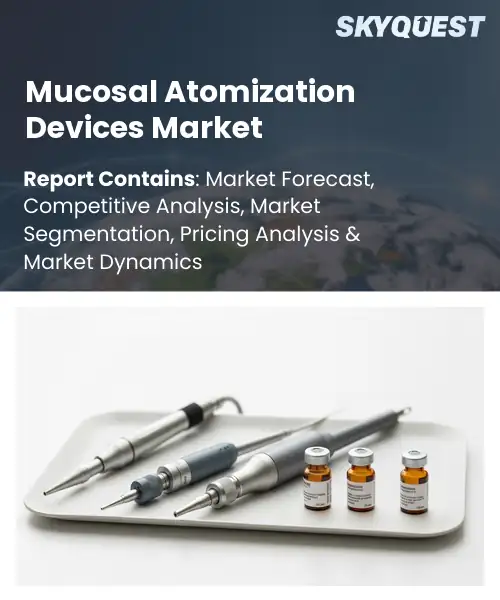
Mucosal Atomization Devices Market
Report ID: SQMIG35A4053
Report ID: SQMIG35A4053
[email protected]
USA +1 351-333-4748
Report ID:
SQMIG35A4053 |
Region:
Global |
Published Date: July, 2026
Pages:
157
|Tables:
177
|Figures:
79


Global Mucosal Atomization Devices Market size was valued at USD 730 million in 2024 and is poised to grow from USD 780 million in 2025 to USD 1330 Million by 2033, growing at a CAGR of 6.9% during the forecast period (2026-2033).
The global mucosal atomization devices (MAD) market is about handheld-ish spray systems that deliver exact drug doses onto nasal, oral, or respiratory mucosa, so absorption can happen fast, without the invasive stuff. Its “weight” is coming from the steady rise of patient-friendly routes, especially in emergency care, chronic respiratory therapy, and vaccine delivery. The non-invasive delivery demand went up fast, and regulators were like ok then, let’s push approvals for MADs used for intranasal antivirals plus monoclonal antibodies quickly. Hospitals also started using them as a way to reduce aerosol spread, and manufacturers ramped up sterile single-use production. Even insurers got in on it, covering these devices as a cheaper injection substitute, so the ripple effect went through the whole supply chain. Some recognizable examples are Japan’s home-based influenza prophylaxis initiative that uses atomizers, and in the U.S. emergency services that deploy spray-based epinephrine kits. That momentum pulls investors toward smart connected MADs with dosage monitoring, so telehealth collaborations become easier and the market’s reachable patient group expands across both city and rural care settings, globally today.
AI improves dosing precision for mucosal atomization devices by tucking machine learning models into the workflow, and these models look at patient-specific variables, like airway resistance, drug viscosity, and inhalation flow. In real time, sensors collect what’s happening during administration, then the device can adjust spray pressure and also droplet size while it’s operating. That closed-loop control helps lower the risk of under-dosing or over-dosing, which then supports better therapeutic results and can shorten treatment cycles. Manufacturers are also mixing AI platforms with existing handheld atomizers to make smarter kits that basically guide clinicians through the “right” settings, while recording use patterns for ongoing refinement. On top of that, the approach can help meet regulatory needs because it generates documented dosing logs, and that is getting more important as the market grows, and competition keeps tightening.
Market snapshot - (2026-2033)
Global Market Size
USD 0.73 Billion
Largest Segment
Intranasal Atomization Devices
Fastest Growth
Intranasal Atomization Devices
Growth Rate
6.9% CAGR
To get more insights on this market click here to Request a Free Sample Report
The global mucosal atomization devices market is segmented by product type, application, end user, patient type, usage type, drug type and region. Based on product type, the market is segmented into Intranasal Atomization Devices, Oral Atomization Devices, Laryngo-Tracheal Atomization Devices and Others. Based on application, the market is segmented into Pain Management, Emergency Medicine, Sedation & Anesthesia, Vaccination, Drug Delivery and Others. Based on end user, the market is segmented into Hospitals, Emergency Medical Services (EMS), Ambulatory Surgical Centers, Clinics and Military & Defense Healthcare. Based on patient type, the market is segmented into Adult and Pediatric. Based on usage type, the market is segmented into Disposable Devices and Reusable Devices. Based on drug type, the market is segmented into Analgesics, Sedatives, Vaccines, Antidotes and Others. Based on region, the market is segmented into North America, Europe, Asia Pacific, Latin America and Middle East & Africa.
As per the mucosal atomization devices market analysis, the Oral Atomization Devices segment dominates here, mostly because clinicians like delivering very precise drug volumes straight onto the oral mucosa, it just feels easier for patients and also seems to speed up the therapeutic onset. The design is simple too, so training time stays low and infection risk gets pushed down a little, leading to broad use across hospitals and also in ambulatory clinics. Plus it works with a wide range of formulations, and the efficacy has been demonstrated, so it keeps showing up as the leading choice in both acute and outpatient setups.
At the same time, the Intranasal Atomization Devices segment is the one with the key high-growth momentum, because newer spray technologies help with fast absorption of vaccines and biologics. That draws pharmaceutical investment consistently. On top of that, regulators are encouraging needle-free delivery, and the result is a quick uptake. As home use also keeps expanding, the market grows more quickly, which basically creates fresh revenue paths for manufacturers.
According to the mucosal atomization devices market forecast, the Sedation & Anesthesia segment leads because clinicians want anesthetic agents to reach mucosal surfaces quickly, so onset can be faster and systemic side effects can be reduced. This method also helps simplify procedural steps in operating rooms and emergency contexts. So adoption tends to follow, especially in hospitals and surgical centers. The fact that it fits with many anesthetic formulations makes it more durable in different care environments, and it also supports easier integration with existing monitoring equipment, which strengthens safety protocols.
On the other hand, the vaccination segment looks like the most rapidly expanding area, since public health initiatives keep emphasizing needle-free immunization. Developers respond by producing mucosal spray vaccines. Administration feels simpler for patients, so compliance tends to improve, and the regulatory route for new vaccine delivery gets cleaner too, which helps market entry happen sooner. This momentum builds broader adoption across clinics, and that unlocks serious growth potential.
To get detailed segments analysis, Request a Free Sample Report
As per the mucosal atomization devices market regional forecast, the dominance of North America comes from a mature healthcare ecosystem that embraces advanced drug delivery technologies. There are strong linkages between device manufacturers, clinical research organizations, and big hospitals, which helps mucosal atomization solutions get into routine practice faster. Also, the regulatory setup tends to be supportive; it encourages new ideas while keeping product safety in check, and then the reimbursement routes, they reduce the adoption friction. Clinician awareness is high about the therapeutic wins, and patients often can actually access specialized care, so demand stays consistent. Plus, steady investment in research and development keeps tweaking the products, so the market stays near the front of technological progress
United States Mucosal Atomization Devices Market
The Mucosal Atomization Devices Market growth in the United States is supported by a large web of academic medical centers that push clinical trials and they do early adoption of novel delivery approaches. With leading manufacturers around, product availability speeds up, and payer structures frequently include coverage for advanced therapies, which helps patients actually move forward. A culture built around evidence based practice means clinicians stay updated on efficacy, and safety too, which in turn reinforces market momentum
Canada Mucosal Atomization Devices Market
The Mucosal Atomization Devices industry in Canada benefits from a publicly funded health system that leans toward cost effective innovations. Provincial health authorities work closely with manufacturers to check clinical value, and that supports fast inclusion in formularies. There is also a big focus on patient centered care, plus multidisciplinary coordination across physicians, which boosts awareness and use of mucosal atomization technologies throughout the country
The European mucosal atomization devices market penetration is driven by a shared intent on patient comfort, plus precision dosing across its connected health systems. Collaborative research efforts involving top universities and industry teams produce solid clinical proof, which strengthens trust that mucosal atomization is a preferred delivery route. Regulatory guidance that is more harmonized across member states simplifies approvals, while value based reimbursement models make adoption more attractive. On top of that, healthcare professionals are increasingly aware of the advantages for respiratory and upper airway conditions, and that pushes demand even further. The region also keeps talking about sustainability, so devices that cut waste and improve therapeutic efficiency get more attention, placing Europe as a lively growth center
Germany Mucosal Atomization Devices Market
The Mucosal Atomization Devices industry in Germany is supported by its engineering legacy and close ties between medical device firms and research hospitals. The healthcare system tends to emphasize clinical outcomes, which leads to a careful assessment of new technologies, and that often results in early adoption in specialized clinics. Reimbursement policies that reward innovative, patient friendly solutions help penetration, while ongoing professional education keeps clinician familiarity from slipping
United Kingdom Mucosal Atomization Devices Market
The Mucosal Atomization Devices sector in the United Kingdom is boosted by proactive health technology assessments that aim for quick entry of evidence based innovations. The National health services encourages pilot programs in leading hospitals, so there are clearer paths for wider rollout. Patient advocacy for less invasive treatments keeps rising, and specialist societies form a strong network that raises awareness, helping market expansion move quickly
France Mucosal Atomization Devices Market
The Mucosal Atomization Devices Market in France is taking shape through collaborations between academic groups and biotech firms that focus on respiratory care. Public health programs that underline the importance of targeted drug delivery raise clinician curiosity. Reimbursement frameworks that back novel therapies, plus growing patient interest in comfortable administration options, contribute to steady market growth
Asia Pacific is pushing forward through rapid healthcare modernization and it’s also expanding access to specialized treatments, not just in theory. Governments across the region are putting money into infrastructure upgrades that can hold up to cutting‑edge delivery devices, while regulatory agencies are leaning into streamlined pathways for new products. At the same time, the rising prevalence of chronic respiratory conditions keeps the clinical spotlight on administration methods that actually work, so clinicians start looking into mucosal atomization more often. There are also collaborative efforts between multinational manufacturers and local partners, which help with technology transfer and then adapting it to what fits regional practice patterns. Plus, educational outreach programs are empowering healthcare providers with up to date knowledge, this adds confidence in these devices, and it quietly helps lock in the regions emerging market stature.
Japan Mucosal Atomization Devices Market
The Mucosal Atomization Devices Market in Japan tends to benefit from a medical environment that feels very sophisticated, where precision medicine is treated like a big deal. Close connections between device developers and university hospitals encourage careful clinical validation, so adoption in pulmonary and otolaryngology specialties remains trusted. National health insurance schemes that acknowledge therapeutic benefits also support patient access, and ongoing professional development keeps clinicians current with new delivery options.
South Korea Mucosal Atomization Devices Market
In South Korea, the Mucosal Atomization Devices Market is being helped by a regulatory environment that feels agile enough to get innovative medical technologies into the market faster. Hospital networks that are active in early‑stage clinical research create a launchpad for generating real-world evidence. There’s also rising consumer awareness of minimally invasive therapies, which helps patients accept these options, and government incentives aimed at domestic manufacturing strengthen supply chain resilience.
To know more about the market opportunities by region and country, click here to
Buy The Complete Report
Increasing Adoption of Non-Invasive Therapies
Advancements in Device Miniaturization
High Cost of Advanced Devices
Regulatory Hurdles Across Regions
Request Free Customization of this report to help us to meet your business objectives.
Teleflex , DeVilbiss Healthcare, BD, Kurve Therapeutics and Cook dominate the global mucosal atomization devices market, and in doing so they ramp up competition through steady product innovation,plus some targeted collaborations with healthcare providers. At the same time, they lean on strategic alliances to widen distribution, and help technology adoption move faster. Given how quickly the market is growing, companies feel pushed to stand out, using more sophisticated spray mechanisms, adding integrated digital monitoring, and also expanding clinical indications a bit broader than before.
Top Player’s Company Profile
Recent Developments
SkyQuest’s ABIRAW (Advanced Business Intelligence, Research & Analysis Wing) is our Business Information Services team that Collects, Collates, Correlates, and Analyses the Data collected by means of Primary Exploratory Research backed by robust Secondary Desk research.
As per SkyQuest analysis, the global mucosal atomization devices market is being pushed along by the rising adoption of non invasive therapies, that improve patient comfort and also streamline clinical workflows, while device miniaturization keeps improving and adds portability, plus enables smarter features. Still, the high cost of advanced devices can restrain budget constrained buyers, which can slow adoption in places where cost sensitivity is high. North America stays the leading region because of mature healthcare infrastructure, supportive reimbursement, and a strong R&D ecosystem. For product types, oral atomization devices take the lead, mostly because they’re easier to use, they work with a wide formulation range, and they can produce a rapid onset, which underpins ongoing growth.
| Report Metric | Details |
|---|---|
| Market size value in 2024 | USD 0.73 Billion |
| Market size value in 2033 | USD 1.33 Billion |
| Growth Rate | 6.9% |
| Base year | 2024 |
| Forecast period | (2026-2033) |
| Forecast Unit (Value) | USD Billion |
| Segments covered |
|
| Regions covered | North America (US, Canada), Europe (Germany, France, United Kingdom, Italy, Spain, Rest of Europe), Asia Pacific (China, India, Japan, Rest of Asia-Pacific), Latin America (Brazil, Rest of Latin America), Middle East & Africa (South Africa, GCC Countries, Rest of MEA) |
| Companies covered |
|
| Customization scope | Free report customization with purchase. Customization includes:-
|
To get a free trial access to our platform which is a one stop solution for all your data requirements for quicker decision making. This platform allows you to compare markets, competitors who are prominent in the market, and mega trends that are influencing the dynamics in the market. Also, get access to detailed SkyQuest exclusive matrix.
Table Of Content
Executive Summary
Market overview
Parent Market Analysis
Market overview
Market size
KEY MARKET INSIGHTS
COVID IMPACT
MARKET DYNAMICS & OUTLOOK
Market Size by Region
KEY COMPANY PROFILES
Methodology
For the Mucosal Atomization Devices Market, our research methodology involved a mixture of primary and secondary data sources. Key steps involved in the research process are listed below:
1. Information Procurement: This stage involved the procurement of Market data or related information via primary and secondary sources. The various secondary sources used included various company websites, annual reports, trade databases, and paid databases such as Hoover's, Bloomberg Business, Factiva, and Avention. Our team did 45 primary interactions Globally which included several stakeholders such as manufacturers, customers, key opinion leaders, etc. Overall, information procurement was one of the most extensive stages in our research process.
2. Information Analysis: This step involved triangulation of data through bottom-up and top-down approaches to estimate and validate the total size and future estimate of the Mucosal Atomization Devices Market.
3. Report Formulation: The final step entailed the placement of data points in appropriate Market spaces in an attempt to deduce viable conclusions.
4. Validation & Publishing: Validation is the most important step in the process. Validation & re-validation via an intricately designed process helped us finalize data points to be used for final calculations. The final Market estimates and forecasts were then aligned and sent to our panel of industry experts for validation of data. Once the validation was done the report was sent to our Quality Assurance team to ensure adherence to style guides, consistency & design.
Analyst Support
Customization Options
With the given market data, our dedicated team of analysts can offer you the following customization options are available for the Mucosal Atomization Devices Market:
Product Analysis: Product matrix, which offers a detailed comparison of the product portfolio of companies.
Regional Analysis: Further analysis of the Mucosal Atomization Devices Market for additional countries.
Competitive Analysis: Detailed analysis and profiling of additional Market players & comparative analysis of competitive products.
Go to Market Strategy: Find the high-growth channels to invest your marketing efforts and increase your customer base.
Innovation Mapping: Identify racial solutions and innovation, connected to deep ecosystems of innovators, start-ups, academics, and strategic partners.
Category Intelligence: Customized intelligence that is relevant to their supply Markets will enable them to make smarter sourcing decisions and improve their category management.
Public Company Transcript Analysis: To improve the investment performance by generating new alpha and making better-informed decisions.
Social Media Listening: To analyze the conversations and trends happening not just around your brand, but around your industry as a whole, and use those insights to make better Marketing decisions.
REQUEST FOR SAMPLE
 REQUEST FREE CUSTOMIZATION
Global Mucosal Atomization Devices Market size was valued at USD 0.73 Billion in 2024 and is poised to grow from USD 0.78 Billion in 2025 to USD 1.33 Billion by 2033, growing at a CAGR of 6.9% during the forecast period (2026-2033).
Teleflex, DeVilbiss Healthcare, BD, Kurve Therapeutics and Cook dominate the global mucosal atomization devices market, intensifying competition through continuous product innovation and targeted collaborations with healthcare providers, while leveraging strategic partnerships to broaden distribution and accelerate technology adoption. These actions, combined with the market’s rapid growth, drive firms to differentiate via advanced spray mechanisms, integrated digital monitoring and expanded clinical indications. 'Teleflex Incorporated', 'Medline Industries, LP', 'Wolfe Tory Medical, Inc.', 'DeVilbiss Healthcare LLC', 'Becton, Dickinson and Company', 'Cook Medical LLC', 'Vyaire Medical, Inc.', 'Mercury Medical LLC', 'ICU Medical, Inc.', 'Intersurgical Ltd.', 'Flexicare Medical Limited', 'Besmed Health Business Corp.', 'Phoenix Medical Systems Pvt. Ltd.', 'Neotech Products LLC', 'AptarGroup, Inc.', 'Nemera Development S.A.', 'Unit Dose Solutions Inc.', 'Kurve Technology, Inc.', 'Nasal Medical Ltd.', 'Koken Co., Ltd.'
Healthcare providers increasingly prefer non‑invasive mucosal atomization devices because they reduce discomfort, lower the risk of infection, and simplify administration procedures, which collectively enhance patient adherence to treatment regimens. This preference encourages manufacturers to expand product portfolios, invest in targeted marketing, and collaborate with clinical stakeholders, thereby broadening market reach. As patients experience improved therapeutic outcomes and clinicians observe streamlined workflow, demand for such devices intensifies across diverse care settings, reinforcing sustained market expansion. The ease of use with portable designs supports home‑based therapy, driving adoption among chronic disease populations.
Innovative Drug Formulations: The market is being reshaped by a surge in novel drug formulations designed specifically for mucosal delivery, such as biologics and peptide therapies. Manufacturers are integrating advanced atomization technologies to ensure precise dosing and enhanced mucosal absorption, meeting clinician demand for higher therapeutic efficacy. This shift encourages partnerships between device makers and pharmaceutical innovators, accelerating product pipelines and expanding clinical indications beyond traditional respiratory applications, thereby broadening the addressable patient base and reinforcing growth prospects for global stakeholder confidence today.
Why does North America Dominate the Global Mucosal Atomization Devices Market? |@12


Want to customize this report? This report can be personalized according to your needs. Our analysts and industry experts will work directly with you to understand your requirements and provide you with customized data in a short amount of time. We offer $1000 worth of FREE customization at the time of purchase.
Feedback From Our Clients


 USA (+1) 351-333-4748

