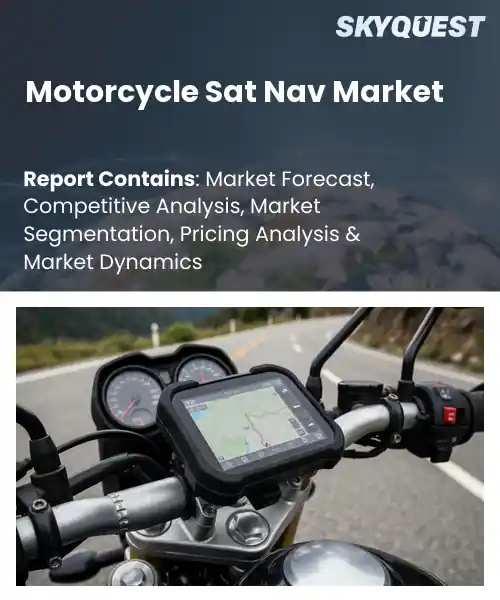
Motorcycle Sat Nav Market
Report ID: SQMIG25A2655
Report ID: SQMIG25A2655
[email protected]
USA +1 351-333-4748
Report ID:
SQMIG25A2655 |
Region:
Global |
Published Date: March, 2026
Pages:
157
|Tables:
117
|Figures:
77


Global Motorcycle Sat Nav Market size was valued at USD 260.30 Million in 2024 and is poised to grow from USD 274.62 Million in 2025 to USD 421.45 Million by 2033, growing at a CAGR of 5.5% during the forecast period (2026-2033).
The motorcycle sat nav market is driven primarily by riders’ need for route certainty and safety, a demand that has transformed navigation into specialized devices today. Starting out as the refreshing redesign of an automobile GPS, rugged, glove-friendly bike GPS units (such as the Garmin Zumo and TomTom Rider) advanced technology by adding features required for two-wheel dynamics to support functions like lane assistance and weather resistance capabilities. This evolution matters because it reduces rider distraction and improves trip planning, aiding touring enthusiasts, couriers and adventure riders who traverse areas. Over time connectivity features like Bluetooth, smartphone routing, and live traffic data have further differentiated offerings.
Building on rider demand for reliability, the key trend driving the global motorcycle Sat Nav sector is expanding use cases that convert need into sales and services. Rapid urbanization and the rise of app-based delivery in India, Southeast Asia and Latin America cause fleets to prefer purpose-built sat navs that tolerate vibration and provide offline maps, which in turn drives manufacturers to supply rugged hardware and fleet management features. Simultaneously growth in adventure tourism and OEM integration, exemplified by BMW’s navigation and Garmin’s adventure-focused Zumo line, produces opportunities for connectivity services, helmet HUD pairing and subscription maps, creating recurring revenue streams and incentivizing further innovation.
How is AI Enhancing User Safety and Navigation in the Motorcycle Sat Nav Market?
AI is enhancing user safety and navigation within the motorcycle sat nav industry by using different types of sensor inputs (road signals, road signs, etc.); route/roadmap data; and context-based rider information to help reduce rider distraction and support riders in making better navigational decisions. Key components of this integration include: AI-driven methods of noise/sound suppression for clear voice navigation prompts; natural language voice-controlled navigation (keeping the rider's hands free); advanced route prediction that provides the rider with information on potential hazards ahead; and adaptive maps that learn about the rider's preferences over time.
In January 2025, Sena released firmware updates that enabled advanced mesh compatibility and AI noise reduction across its intercom and smart helmet range, improving voice clarity and hands-free navigation and helping the market grow by making connected navigation more usable and trusted by riders.
Market snapshot - (2026-2033)
Global Market Size
USD 260.3 Million
Largest Segment
Smartphone Integration Mounts/Dongles
Fastest Growth
Bluetooth-enabled Smart HUDs
Growth Rate
5.5% CAGR
To get more insights on this market click here to Request a Free Sample Report
Global motorcycle sat nav market is segmented by device configuration, feature set, screen size, connectivity and region. Based on device configuration, the market is segmented into dedicated GPS units, bluetooth-enabled smart HUDs and smartphone integration mounts/dongles. Based on feature set, the market is segmented into rugged/weatherproof (IP67/68), glove-friendly touchscreens, specialized route tracking and rider safety alerts. Based on screen size, the market is segmented into under 4.5 inches, 4.5 to 5.5 Inches and above 5.5 Inches. Based on connectivity, the market is segmented into standalone offline mapping and connected/cloud-based. Based on region, the market is segmented into North America, Europe, Asia Pacific, Latin America and Middle East & Africa.
Based on global motorcycle Sat Nav market growth, dedicated GPS units segment dominates because purpose built devices deliver consistent route accuracy and reliability under motorcycle operating conditions, with hardware and software tuned to motorbike ergonomics. Mounting, routing algorithm, offline map support, and vehicle power integration make these units a favorite among those who rely on hands free operation and long lasting performance. The manufacturers optimised their interfaces so that they work well when using gloves, and also can withstand vibration damage, thereby establishing themselves as the leader in optimising their interfaces for proven reliability.
However, bluetooth-enabled smart HUDs are the fastest growing area because their heads up guidance reduces distraction and supports voice control. The growing interest in integrating helmet displays with real-time connectivity is attracting more safety-focused riders. The continued advancement of compact projection capability and low power design is opening up new market opportunities for products and services that are driving the market's growth.
Glove-friendly touchscreens segment leads because tactile and responsive interfaces enable safe, accurate input while wearing protective gear, directly addressing a core rider usability pain point. In designing touch surfaces with greater sensitivity, having larger on-screen targets, and supporting alternative gestures, manufacturers are enabling riders to operate their navigation systems while wearing gloves. This focus on minimizing distraction should lead to greater acceptance of integrated navigation systems, causing manufacturers of both hardware and software to optimize displays and controls for motorcycles.
Meanwhile, rider safety alerts are the most rapidly expanding feature, propelled by rising demand for proactive hazard warnings and integration with sensors and crowd sourced data. By having improved alert functionality, emergency contacts, and possible incentives from insurers for both riders and fleet operators, there is an appealing proposition for these user groups which provides new avenues for monetizing through subscription-based services or partnerships that provide new revenue streams.
To get detailed segments analysis, Request a Free Sample Report
As per the global motorcycle Sat Nav market share, Europe commands the industry through a combination of mature transport infrastructure, high rider affinity for technology, and strong presence of established navigation suppliers. Road Safety laws will promote tourism, increasing the need for dedicated motorcycle navigation devices. Off-road options and secondary markets support the variety of products available. Cooperative automotive and electronic industry research encourages new product creation on a local level, while the high-end markets in feature-rich vehicles designed for motorcycle applications. Leading-edge map integration combined with an increased focus on connected service provides the end user with a better experience. Extensive aftermarket motorcycle modifications and accessories allow product differentiation; and the breadth of professional distributors and specialized dealers provide optimal long-term distribution channels.
Motorcycle Sat Nav market in Germany benefits from advanced rider culture and extensive touring routes that favor dedicated navigation equipment. Ruggedized devices with high precision mapping and durability have grown rapidly in popularity because of the increasing demand for these features in consumer products. Motorcycle dealerships and consumer electronics stores provide dealerships with the ability to easily access ruggedized devices, which increases their demand. Strong partnerships between suppliers and technical organizations are creating innovations and new forms of use in this market, consistently position Germany as a leader in the premium product market.
Motorcycle Sat Nav market in United Kingdom reflects diverse rider segments ranging from commuters to touring enthusiasts, which sustains demand for versatile navigation solutions. The focus of this initiative will be on developing a highly connected and user-friendly interface that can work with both smartphones and integrated headsets (e.g. HELMET, etc.). Developing retail outlets, as well as a network of motorcycle clubs and associations from which to raise awareness about these new products, will also be an important aspect of this initiative.
Motorcycle Sat Nav market in France is shaped by strong touring culture and varied roadscapes that create demand for adaptable and intuitive navigation devices. The Manufacturer's desire to provide complete mapping functionality, coupled with a demand for scenic travel choices by route planners, has given rise to integrated route planning. The partnership between distributors and motorcycle tourism, travel agencies and motorcycle manufacturers is helping to increase visibility of these products to touring motorcyclists. An emphasis on ergonomic design and multi-language user interfaces are also addressing the need for different kinds of end users within both metropolitan and regional riding environments.
Based on global motorcycle Sat Nav regional forecast, North America is experiencing rapid expansion of the industry driven by rising rider interest in technology enhanced safety and route personalization, alongside growing aftermarket ecosystems and specialty retail channels. The increase in popularity of helmet communication devices and smartphones has created an increase in consumer demand for helmet-based communication systems that provide seamless communications. This has led to suppliers developing helmet-based communication systems that support modular, compatible navigation solutions. The increasing prevalence of active touring culture and the number of organized rides has also created a greater need for reliable routing and real-time information services to support off-road riding. Due to a combination of strong dealer networks and a large number of online specialty retailers, dealers and online retailers are able to effectively connect with consumers.
Motorcycle Sat Nav market in United States is characterized by strong demand for versatile navigation that supports long distance touring and urban commuting. Devices that provide a reliable connection, can connect to a smartphone, or work in conjunction with helmet communication systems are popular among customers. Many navigation devices partner with mapping service providers to increase route accuracy and simplify finding location-based points-of-interest; as such, these partnerships will help make each of the devices more relevant to that specific riding style and environmental condition.
Motorcycle Sat Nav market in Canada reflects strong interest in navigation tailored to long distance touring and remote routes, requiring reliable mapping capabilities. Motorcycle riders tend to value durable products, specifically those that have good construction quality and can be used in conjunction with their communication equipment. These motorcycle parts can be purchased through an established dealership network and or a variety of retailers as an accessory to motorbike sales. Partnerships between motorcycle companies and local tourism agencies have developed tour routes and points of interest to enhance the desirability of the product to touring and adventure motorcycle riders alike.
As per global motorcycle Sat Nav regional outlook, Asia Pacific is strengthening its position in the industry through targeted investments in technological capabilities, urban mobility solutions, and partnerships that enhance localized content. The electronic proficiency of strong manufacturing facilities enables the development of quickly developed connected navigation devices optimized for smaller sizes with improved connectivity. Integrating other regional map providers and developing interfaces for specific languages will help to appeal to local riders. The growing number of people who use their motorcycles for commuting and leisure riding also helps to expand the target market. Strategic partnerships between original equipment manufacturers (OEM), navigation vendors, and telematics companies allow for the integration of features such as traffic and infrastructure alerts, helping differentiate products. Expanding the number and presence of aftermarket sales channels and e-commerce sites will provide increased opportunities for consumers to access products and make informed purchasing decisions throughout urban and suburban regions.
Motorcycle Sat Nav market in Japan benefits from advanced electronics manufacturing and emphasis on compact high performance navigation solutions. Riders want to be able to easily connect helmet communication systems with services to get transport information. Suppliers need to build connectivity and easy-to-use interfaces for both urban and rural areas. Dealers and service centers provide a full range of support after the purchase of helmets. Navigation development companies and mapping providers work together to ensure accurate local routing as well as Japanese riders can use Japanese language content.
Motorcycle Sat Nav market trends in South Korea is driven by widespread smartphone use and advanced telecom infrastructure that enable connected navigation experiences. Riders favor compact designs with reliable connectivity to helmet audio, mobile apps. Local navigation companies focus on providing accurate urban route and public information system integration. Ecommerce sites and retailers have a wide variety of product offerings, whereas partnering with motorcycle clubs and touring companies creates personalized route information and rider services.
To know more about the market opportunities by region and country, click here to
Buy The Complete Report
Rising Demand For Connected Navigation
Advancements In Sensor Integration
High Product Costs And Price Sensitivity
Fragmented Aftermarket And Standards
Request Free Customization of this report to help us to meet your business objectives.
Competitive dynamics in the global motorcycle Sat Nav market outlook are shaped by incumbents using targeted M&A and platform partnerships while startups push rider-focused safety and connectivity innovations. Examples include Comoto’s 2020 acquisition of REVER and Ride Vision’s technical partnerships with Continental, and newer entrants pursuing OEM pilots, C-V2X trials and lidar and video AI integration to differentiate on rider-specific ADAS and HUD capabilities.
SkyQuest’s ABIRAW (Advanced Business Intelligence, Research & Analysis Wing) is our Business Information Services team that Collects, Collates, Correlates, and Analyses the Data collected by means of Primary Exploratory Research backed by robust Secondary Desk research.
As per SkyQuest analysis, the global motorcycle Sat Nav industry is propelled by a key driver, riders’ demand for route certainty and safety, and a second driver is advancements in sensor integration that improve positioning and reliability. A notable restraint is high product costs and price sensitivity which limit adoption among cost conscious riders. Europe is the dominating region due to strong touring culture, mature infrastructure and established suppliers, while Dedicated GPS Units are the dominating segment thanks to purpose built durability, offline mapping and motorcycle tuned interfaces. These dynamics favor continued innovation in connected ecosystems and personalized routing while challenging manufacturers to balance features and price.
| Report Metric | Details |
|---|---|
| Market size value in 2024 | USD 260.3 Million |
| Market size value in 2033 | USD 421.45 Million |
| Growth Rate | 5.5% |
| Base year | 2024 |
| Forecast period | (2026-2033) |
| Forecast Unit (Value) | USD Million |
| Segments covered |
|
| Regions covered | North America (US, Canada), Europe (Germany, France, United Kingdom, Italy, Spain, Rest of Europe), Asia Pacific (China, India, Japan, Rest of Asia-Pacific), Latin America (Brazil, Rest of Latin America), Middle East & Africa (South Africa, GCC Countries, Rest of MEA) |
| Companies covered |
|
| Customization scope | Free report customization with purchase. Customization includes:-
|
To get a free trial access to our platform which is a one stop solution for all your data requirements for quicker decision making. This platform allows you to compare markets, competitors who are prominent in the market, and mega trends that are influencing the dynamics in the market. Also, get access to detailed SkyQuest exclusive matrix.
Table Of Content
Executive Summary
Market overview
Parent Market Analysis
Market overview
Market size
KEY MARKET INSIGHTS
COVID IMPACT
MARKET DYNAMICS & OUTLOOK
Market Size by Region
KEY COMPANY PROFILES
Methodology
For the Motorcycle Sat Nav Market, our research methodology involved a mixture of primary and secondary data sources. Key steps involved in the research process are listed below:
1. Information Procurement: This stage involved the procurement of Market data or related information via primary and secondary sources. The various secondary sources used included various company websites, annual reports, trade databases, and paid databases such as Hoover's, Bloomberg Business, Factiva, and Avention. Our team did 45 primary interactions Globally which included several stakeholders such as manufacturers, customers, key opinion leaders, etc. Overall, information procurement was one of the most extensive stages in our research process.
2. Information Analysis: This step involved triangulation of data through bottom-up and top-down approaches to estimate and validate the total size and future estimate of the Motorcycle Sat Nav Market.
3. Report Formulation: The final step entailed the placement of data points in appropriate Market spaces in an attempt to deduce viable conclusions.
4. Validation & Publishing: Validation is the most important step in the process. Validation & re-validation via an intricately designed process helped us finalize data points to be used for final calculations. The final Market estimates and forecasts were then aligned and sent to our panel of industry experts for validation of data. Once the validation was done the report was sent to our Quality Assurance team to ensure adherence to style guides, consistency & design.
Analyst Support
Customization Options
With the given market data, our dedicated team of analysts can offer you the following customization options are available for the Motorcycle Sat Nav Market:
Product Analysis: Product matrix, which offers a detailed comparison of the product portfolio of companies.
Regional Analysis: Further analysis of the Motorcycle Sat Nav Market for additional countries.
Competitive Analysis: Detailed analysis and profiling of additional Market players & comparative analysis of competitive products.
Go to Market Strategy: Find the high-growth channels to invest your marketing efforts and increase your customer base.
Innovation Mapping: Identify racial solutions and innovation, connected to deep ecosystems of innovators, start-ups, academics, and strategic partners.
Category Intelligence: Customized intelligence that is relevant to their supply Markets will enable them to make smarter sourcing decisions and improve their category management.
Public Company Transcript Analysis: To improve the investment performance by generating new alpha and making better-informed decisions.
Social Media Listening: To analyze the conversations and trends happening not just around your brand, but around your industry as a whole, and use those insights to make better Marketing decisions.
REQUEST FOR SAMPLE
 REQUEST FREE CUSTOMIZATION
Global Motorcycle Sat Nav Market size was valued at USD 260.3 Million in 2024 and is poised to grow from USD 274.62 Million in 2025 to USD 421.45 Million by 2033, growing at a CAGR of 5.5% during the forecast period (2026-2033).
Competitive dynamics in the global motorcycle sat nav market are shaped by incumbents using targeted M&A and platform partnerships while startups push rider-focused safety and connectivity innovations. Examples include Comoto’s 2020 acquisition of REVER and Ride Vision’s technical partnerships with Continental, and newer entrants pursuing OEM pilots, C-V2X trials and lidar and video AI integration to differentiate on rider-specific ADAS and HUD capabilities. 'Garmin', 'TomTom', 'Magellan', 'BMW Motorrad', 'Honda', 'Navman', 'TomTom Rider', 'Sena Technologies', 'SP Connect', 'Tread and Trail', 'Mio', 'Beeline', 'MotoGadget', 'V-Box', 'Coyote Systems', 'NavAtlas', 'Trail Tech', 'iGO Navigation', 'Symtec', 'Biketrac'
The increasing preference among motorcyclists for connected route optimized navigation enhances adoption by improving trip confidence, safety, and convenience. Purpose built sat navs for motorcycles integrate weather aware routing, live traffic context, and smartphone connectivity, which align with riders' needs for reliable guidance on varied road types. OEM and aftermarket offerings that deliver intuitive interfaces and robust mounting options reduce perceived barriers to use, making navigation units a more appealing accessory and thereby encouraging manufacturers and retailers to expand product availability and supportive ecosystems.
Connected Rider Ecosystems: Adoption of integrated communication platforms is reshaping expectations for motorcycle navigation, with systems linking sat nav, helmet displays, ride communities and telematics. Vendors are prioritizing seamless smartphone pairing, voice control and over-the-air content updates to deliver contextual route suggestions, hazard alerts and group coordination. This shift emphasizes user experience, ecosystem partnerships and hardware design, encouraging aftermarket and OEM collaboration. As rider demand focuses on connectivity and convenience, sat nav providers adapt interfaces and services to support continuous engagement on rides.
Why does Europe Dominate the Global Motorcycle Sat Nav Market? |@12


Want to customize this report? This report can be personalized according to your needs. Our analysts and industry experts will work directly with you to understand your requirements and provide you with customized data in a short amount of time. We offer $1000 worth of FREE customization at the time of purchase.
Feedback From Our Clients


 USA (+1) 351-333-4748

