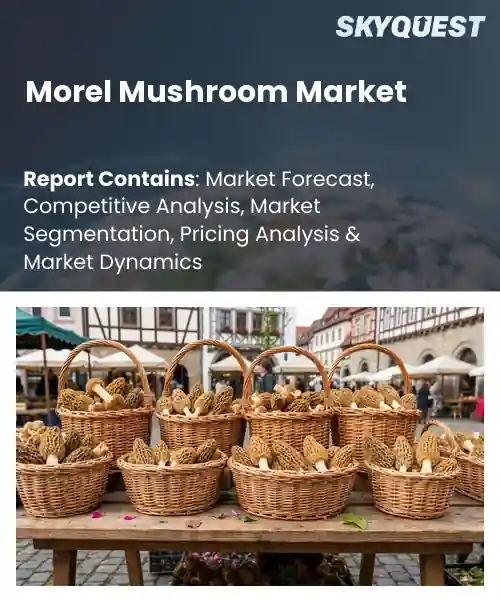
Morel Mushroom Market
Report ID: SQMIG30I2865
Report ID: SQMIG30I2865
[email protected]
USA +1 351-333-4748
Report ID:
SQMIG30I2865 |
Region:
Global |
Published Date: March, 2026
Pages:
157
|Tables:
171
|Figures:
79


Global Morel Mushroom Market size was valued at USD 2.6 Billion in 2024 and is poised to grow from USD 2.72 Billion in 2025 to USD 3.96 Billion by 2033, growing at a CAGR of 4.8% during the forecast period (2026-2033).
The primary driver of the morel mushroom market is premium culinary demand linked to scarcity and seasonality, which elevates prices and incentivizes supply innovations. This market encompasses wild-harvested and increasingly cultivated morels sold fresh, dried, or as ingredients to restaurants, specialty grocers, and food processors, and it matters because high margins support rural livelihoods and export earnings. Historically morels were gathered by foragers and traded locally, but globalization and gourmet trends expanded international demand; for example, North American and Turkish harvests now feed European and Asian fine-dining circuits while Chinese commercial cultivation experiments have begun to modify supply dynamics gradually.A pivotal growth factor is scalable cultivation and improved supply chain infrastructure, because predictable yields reduce price volatility and enable downstream investment in processing and retail channels. When growers adopt substrate optimization and controlled-environment techniques, successful harvests lower sourcing risk for chefs and manufacturers, leading to expanded menu offerings and shelf-stable products such as dried morel slices and powdered concentrates for soup bases. In practice this has allowed artisan food brands to introduce morel-infused sauces and snack lines, while exporters use refrigerated logistics and ecommerce platforms to reach distant specialty markets, thereby turning seasonal rarity into more consistent commercial opportunity.
How is AI improving yield prediction in the Morel mushroom market?
AI improves yield prediction in the Morel mushroom market by combining ecological signals with machine learning to model fruiting behavior. Key aspects include integrating weather patterns with soil and tree species data and using remote sensing and image based detection to confirm field presence. The current state blends academic research and community sighting maps with emerging commercial tools so growers and buyers can better anticipate short seasons and supply gaps. Instances include crowd sourced forecasting maps and AI trained vision models that refine species detection and timing which makes harvest planning and premium sales more reliable and less guess driven.Mushrooms Inc March 2026, completed beta testing of its MycoLab.ai research platform and announced expansion of AI driven mycology datasets. That development enables linking species specific research with habitat and weather inputs to improve Morel fruiting forecasts and to support more efficient harvest scheduling and market planning.
Market snapshot - (2026-2033)
Global Market Size
USD 2.6 Billion
Largest Segment
Dried Morels
Fastest Growth
Dried Morels
Growth Rate
4.8% CAGR
To get more insights on this market click here to Request a Free Sample Report
Global morel mushroom market is segmented by product type, nature, by form, application, distribution channel, end user and region. Based on product type, the market is segmented into Fresh Morels, Dried Morels, Canned Morels and Others. Based on nature, the market is segmented into Organic and Conventional. Based on by form, the market is segmented into Whole, Powder and Others. Based on application, the market is segmented into Food & Culinary (Gourmet Dishes), Nutraceuticals / Dietary Supplements, Pharmaceuticals and Cosmetics & Personal Care. Based on distribution channel, the market is segmented into Online and Offline. Based on end user, the market is segmented into Food Service, Household Consumers and Food Processing Companies. Based on region, the market is segmented into North America, Europe, Asia Pacific, Latin America and Middle East & Africa.
Fresh Morels segment dominates because culinary demand and premium positioning drive consistent retail and foodservice preference. Chefs and high end consumers favor fresh specimens for texture and flavor, creating sustained demand that incentivizes growers and distributors to prioritize harvesting and rapid cold chain logistics. The perishable nature compels investments in specialized handling and direct sourcing relationships, which in turn reinforce quality perceptions and allow suppliers to command higher margins, consolidating market leadership.
However, Dried Morels are emerging as the fastest growing product type due to broader shelf stability and year round availability that expand retail distribution. Growing interest from home cooks and food processors, combined with innovation in rehydration and packaging formats, is enabling market reach expansion and creating new channels for manufacturers to scale production and broaden application use.
Whole segment dominates because intact morels preserve distinctive texture and visual appeal that chefs and discerning consumers prioritize for premium culinary applications. Retaining the mushroom structure reduces the need for transformative processing, enabling product developers to market authenticity and clean label credentials. This preference drives suppliers to focus on gentle handling and selective harvesting, which reinforces quality differentiation, sustains higher price points, and shapes portfolio strategies toward whole format offerings across retail and foodservice channels.
Meanwhile, Powder is emerging as the most rapidly expanding form because its convenience, extended shelf life, and easy incorporation into blends appeal to food processors and supplement makers. Advances in micronization and encapsulation widen application in nutraceuticals and functional foods, enabling formulation innovation, reducing logistics costs, and unlocking scale opportunities that accelerate product diversification and market entry for manufacturers.
To get detailed segments analysis, Request a Free Sample Report
Asia Pacific dominates the global Morel Mushroom market due to a combination of strong culinary traditions, favorable ecological conditions, and concentrated demand for premium ingredients. Countries such as Japan and South Korea exhibit deep cultural appreciation for wild fungi, which supports both foraging and cultivated supply channels. Advanced cultivation techniques, increasing investment in controlled production, and well developed processing and cold chain infrastructure reinforce consistent quality and year round availability for domestic and export markets. Collaborative links among research institutions, private growers and culinary sectors drive innovation in cultivation and value added product development. Widespread consumer preference for foraged flavor profiles, premium foodservice demand and supportive policy and trade frameworks further strengthen the ability of the region to shape global supply dynamics.
Morel Mushroom Market in Japan benefits from deep culinary appreciation for wild fungi, a strong tradition of seasonal foraging and high end dining that values premium ingredients. Domestic growers combine artisanal techniques with emerging controlled cultivation methods to supply restaurants and specialty retailers. Collaboration between chefs, research institutions and private producers enhances product quality and market visibility, while supply chain capabilities support distribution across urban culinary centers and international foodservice networks.
Morel Mushroom Market in South Korea reflects a convergence of traditional foraging culture and culinary innovation, with strong interest from premium restaurants and gourmet retailers. Local growers focus on quality oriented cultivation practices and cooperatives that facilitate knowledge sharing. Strategic partnerships between culinary institutions and producers drive product differentiation, while improving cold chain and distribution networks enhance access to urban markets and specialty exporters seeking high quality, distinctive mushroom varieties.
Rapid expansion in North America is driven by growing culinary interest in foraged and specialty mushrooms, parallel growth in premium foodservice and retail channels, and increased capacity in commercial cultivation. Producers are adopting scalable techniques and forming collaborative supply networks that prioritize quality, traceability and year round availability. Investment in processing, cold chain logistics and product innovation supports wider distribution into urban markets and specialty retailers. Consumer willingness to pay for unique flavor profiles, along with strong interest from chefs and culinary media, elevates demand. Expansion of direct to consumer channels, collaborations with research programs and increased institutional procurement for specialty restaurants and culinary programs contribute to broader market penetration and product diversification.
Morel Mushroom Market in United States benefits from strong culinary demand, expanding specialty retail and proactive commercial cultivation that focus on quality and consistency. Producers invest in controlled cultivation and enhanced cold chain logistics to reach urban markets and foodservice. Collaboration with chefs and culinary institutions fuels product innovation and consumer recognition, while value added processing and targeted distribution networks underpin broader availability across premium retail and dining channels nationwide.
Morel Mushroom Market in Canada reflects increasing consumer interest in specialty and foraged ingredients, supported by regional producers and cooperative networks. Growers emphasize traceability, sustainable cultivation and partnerships with artisanal processors to create value added products for specialty retailers and premium restaurants. Investment in distribution infrastructure and collaborative marketing initiatives raises awareness among chefs and discerning consumers, while cross border trade relationships and culinary tourism deepen exposure and maturation nationwide.
Europe is strengthening its position through a mix of culinary heritage, investment in cultivation research and a growing emphasis on quality, traceability and sustainability. Producers across Germany, United Kingdom and France are integrating advanced cultivation techniques with traditional foraging knowledge to produce consistent, high quality supply for premium foodservice and specialty retail. Improvements in processing, certification and cold chain logistics enable better access to regional and export markets. Collaborative networks among growers, academic institutions and culinary professionals foster product innovation and diversified offerings, while marketing efforts and food culture appreciation increase consumer recognition and willingness to seek out distinctive mushroom varieties within gourmet and retail segments. Regulatory harmonization and certification schemes facilitate trade and consumer confidence, while culinary festivals and specialty retail channels showcase products and promote sustainable sourcing and short supply chains that appeal to discerning buyers.
Morel Mushroom Market in Germany reflects strong focus on quality, traceability and sustainability, with producers adopting advanced cultivation and certification to satisfy discerning consumers. Collaboration among research institutions and growers fosters innovation and operational efficiency. Specialty retailers and high end restaurants sustain demand for premium mushrooms, while regional branding and short supply chains emphasize responsible sourcing and reinforce consumer trust in differentiated morel offerings across domestic and international export channels.
Morel Mushroom Market in United Kingdom is influenced by vibrant culinary scenes, chef led innovation and growing consumer interest in foraged flavors. Growers and specialist suppliers focus on traceability and artisanal processing to supply premium restaurants and retailers. Collaboration with culinary schools and festivals enhances visibility and educates consumers. Emphasis on sustainability, short supply chains and regionally branded offerings supports market credibility and attracts discerning buyers seeking distinctive mushroom varieties.
Morel Mushroom Market in France is shaped by culinary tradition and strong consumer appreciation for foraged ingredients, driving demand in haute cuisine and specialty retail. Producers combine wild sourcing knowledge with controlled cultivation and artisanal processing to ensure provenance and quality. Collaboration with chefs and culinary schools supports product differentiation. Emphasis on regional branding, sustainability and premium presentation reinforces prestige and encourages consumers to seek distinctive morel offerings across regions.
To know more about the market opportunities by region and country, click here to
Buy The Complete Report
Rising Demand From Gourmet Consumers
Expansion Of Sustainable Cultivation Practices
Seasonal Availability and Variability
Supply Chain Complexity and Costs
Request Free Customization of this report to help us to meet your business objectives.
Competitive landscape is shaped by niche startups and established mycology and mycelium firms competing through proprietary cultivation methods, regulatory positioning, and ingredient licensing. Market drivers tied to competition include technological differentiation and route to market plays such as precision fermentation and GRAS self-affirmation by ingredient developers, alongside NSF funded indoor cultivation projects that aim to license systems to growers and food brands.
Top Player’s Company Profile
Recent Developments
SkyQuest’s ABIRAW (Advanced Business Intelligence, Research & Analysis Wing) is our Business Information Services team that Collects, Collates, Correlates, and Analyses the Data collected by means of Primary Exploratory Research backed by robust Secondary Desk research. As per SkyQuest analysis, one key driver is strong premium culinary demand driven by scarcity and foraging traditions that support high margins and export opportunities, while one restraint is seasonal availability and supply variability that limits year-round commercialization. The dominating region is Asia Pacific, supported by culinary culture and advancing cultivation, and the dominating segment is Fresh Morels, prized for texture and flavor in fine dining. A second driver is scalable cultivation and improved supply chain infrastructure, which reduces price volatility, enables dried and powdered formats, and supports broader retail, foodservice and nutraceutical adoption, creating pathways for sustainable market expansion.
| Report Metric | Details |
|---|---|
| Market size value in 2024 | USD 2.6 Billion |
| Market size value in 2033 | USD 3.96 Billion |
| Growth Rate | 4.8% |
| Base year | 2024 |
| Forecast period | (2026-2033) |
| Forecast Unit (Value) | USD Billion |
| Segments covered |
|
| Regions covered | North America (US, Canada), Europe (Germany, France, United Kingdom, Italy, Spain, Rest of Europe), Asia Pacific (China, India, Japan, Rest of Asia-Pacific), Latin America (Brazil, Rest of Latin America), Middle East & Africa (South Africa, GCC Countries, Rest of MEA) |
| Companies covered |
|
| Customization scope | Free report customization with purchase. Customization includes:-
|
To get a free trial access to our platform which is a one stop solution for all your data requirements for quicker decision making. This platform allows you to compare markets, competitors who are prominent in the market, and mega trends that are influencing the dynamics in the market. Also, get access to detailed SkyQuest exclusive matrix.
Table Of Content
Executive Summary
Market overview
Parent Market Analysis
Market overview
Market size
KEY MARKET INSIGHTS
COVID IMPACT
MARKET DYNAMICS & OUTLOOK
Market Size by Region
KEY COMPANY PROFILES
Methodology
For the Morel Mushroom Market, our research methodology involved a mixture of primary and secondary data sources. Key steps involved in the research process are listed below:
1. Information Procurement: This stage involved the procurement of Market data or related information via primary and secondary sources. The various secondary sources used included various company websites, annual reports, trade databases, and paid databases such as Hoover's, Bloomberg Business, Factiva, and Avention. Our team did 45 primary interactions Globally which included several stakeholders such as manufacturers, customers, key opinion leaders, etc. Overall, information procurement was one of the most extensive stages in our research process.
2. Information Analysis: This step involved triangulation of data through bottom-up and top-down approaches to estimate and validate the total size and future estimate of the Morel Mushroom Market.
3. Report Formulation: The final step entailed the placement of data points in appropriate Market spaces in an attempt to deduce viable conclusions.
4. Validation & Publishing: Validation is the most important step in the process. Validation & re-validation via an intricately designed process helped us finalize data points to be used for final calculations. The final Market estimates and forecasts were then aligned and sent to our panel of industry experts for validation of data. Once the validation was done the report was sent to our Quality Assurance team to ensure adherence to style guides, consistency & design.
Analyst Support
Customization Options
With the given market data, our dedicated team of analysts can offer you the following customization options are available for the Morel Mushroom Market:
Product Analysis: Product matrix, which offers a detailed comparison of the product portfolio of companies.
Regional Analysis: Further analysis of the Morel Mushroom Market for additional countries.
Competitive Analysis: Detailed analysis and profiling of additional Market players & comparative analysis of competitive products.
Go to Market Strategy: Find the high-growth channels to invest your marketing efforts and increase your customer base.
Innovation Mapping: Identify racial solutions and innovation, connected to deep ecosystems of innovators, start-ups, academics, and strategic partners.
Category Intelligence: Customized intelligence that is relevant to their supply Markets will enable them to make smarter sourcing decisions and improve their category management.
Public Company Transcript Analysis: To improve the investment performance by generating new alpha and making better-informed decisions.
Social Media Listening: To analyze the conversations and trends happening not just around your brand, but around your industry as a whole, and use those insights to make better Marketing decisions.
REQUEST FOR SAMPLE
 REQUEST FREE CUSTOMIZATION


Want to customize this report? This report can be personalized according to your needs. Our analysts and industry experts will work directly with you to understand your requirements and provide you with customized data in a short amount of time. We offer $1000 worth of FREE customization at the time of purchase.
Feedback From Our Clients


 USA (+1) 351-333-4748

