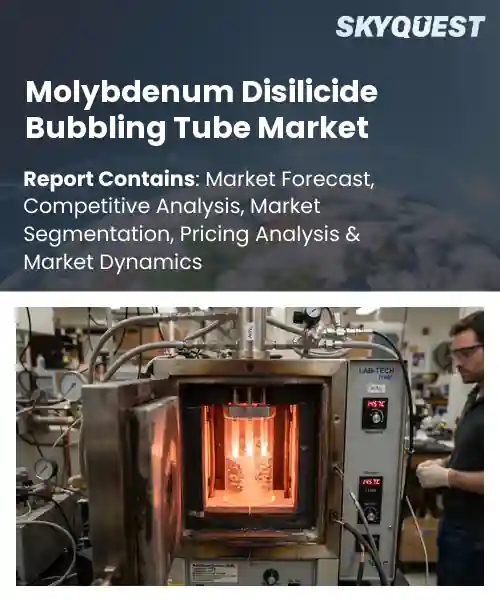
Molybdenum Disilicide Bubbling Tube Market
Report ID: SQMIG20I3921
Report ID: SQMIG20I3921
[email protected]
USA +1 351-333-4748
Report ID:
SQMIG20I3921 |
Region:
Global |
Published Date: September, 2026
Pages:
157
|Tables:
121
|Figures:
77


Global Molybdenum Disilicide Bubbling Tube Market size was valued at USD 420.0 Million in 2024 and is poised to grow from USD 490.98 Million in 2025 to USD 1712.31 Million by 2033, growing at a CAGR of 16.9% during the forecast period (2026-2033).
The global molybdenum disilicide bubbling tube market supplies ceramic components that atomize metal vapors for high‑temperature processes such as semiconductor deposition, aerospace propulsion, and advanced metallurgy. Its significance lies in MoSi₂’s oxidation resistance and ability to endure temperatures above 1,600 °C, which improves line efficiency and reliability. The market originated in the early 2000s when thin‑film producers required robust delivery systems for silicon and metal‑oxide films; Japanese and U.S. pilots reported throughput gains of roughly 30 %. In the last decade, rising demand for electric‑vehicle batteries and hypersonic engines has intensified adoption, turning the segment into a strategic focus for material‑technology investors globally. One key factor driving the molybdenum disilicide bubbling tube market is environmental regulation that forces manufacturers to cut emissions while keeping productivity high. Because MoSi₂ tubes run without coatings at extreme temperatures, they lower energy use and remove hazardous coolant by‑products, matching plant operations to carbon‑footprint targets. This benefit has spurred adoption in thin‑film solar‑cell factories, where vapor‑phase epitaxy tools now depend on bubbling tubes to create uniform silicon layers while reducing power consumption by 15 %. Defense contractors also integrate the technology into engine test rigs, creating a demand pipeline that promises sustained double‑digit growth and opportunities for coating‑service firms.
How is AI-driven automation influencing the Molybdenum disilicide bubbling tube market?
AI driven automation is reshaping the molybdenum disilicide bubbling tube market by linking design, manufacturing and quality assurance in a seamless loop. Advanced algorithms generate optimal tube geometries that balance heat resistance and flow characteristics, while machine vision inspects each unit for micro defects in real time. Robotics equipped with predictive maintenance software adjust process parameters on the fly, reducing scrap and shortening lead times. Suppliers can respond faster to custom orders, and end users benefit from more reliable performance in high temperature applications such as aerospace engines and industrial furnaces. The overall effect is a more agile supply chain and heightened product consistency.In July 2024 a leading producer announced an AI controlled production line for molybdenum disilicide bubbling tubes, increasing throughput and consistency while lowering manual intervention, which supports market growth by delivering more reliable components to demanding sectors.
Market snapshot - (2026-2033)
Global Market Size
USD 420.0 Million
Largest Segment
Straight Bubbling Tubes
Fastest Growth
Custom-Shaped Bubbling Tubes
Growth Rate
16.9% CAGR
To get more insights on this market click here to Request a Free Sample Report
Global molybdenum disilicide bubbling tube market is segmented by tube type, grade, application, end user and region. Based on tube type, the market is segmented into Straight Bubbling Tubes, Bent Bubbling Tubes, Custom-Shaped Bubbling Tubes and Others. Based on grade, the market is segmented into Standard Grade and High-Purity Grade. Based on application, the market is segmented into Glass Manufacturing, Metallurgical Processing, Ceramic Manufacturing, Semiconductor Processing and Others. Based on end user, the market is segmented into Glass Manufacturers, Metallurgical Companies, Ceramic Manufacturers, Semiconductor Manufacturers and Others. Based on region, the market is segmented into North America, Europe, Asia Pacific, Latin America and Middle East & Africa.
Straight Bubbling Tubes segment dominates because its simple geometry aligns with the core design of most furnaces, enabling reliable gas distribution and easy maintenance. Manufacturers favor this type for its proven durability under high temperatures, which reduces downtime and operational risk. The inherent cost efficiency and straightforward installation further reinforce its preference across diverse production lines, cementing its leadership in the market throughout the industry worldwide and future growth prospects.
However, Bent Bubbling Tubes segment is witnessing the strongest growth momentum as manufacturers seek flexible configurations to fit constrained furnace spaces. The ability to route gas streams around obstacles enhances process uniformity, attracting glass and metal producers. This adaptability fuels design innovations, expanding market opportunities and driving accelerated adoption across production facilities.
High-Purity Grade segment leads because its exceptional chemical stability and minimal impurity content meet the stringent performance criteria of advanced processes. Users in semiconductor and high‑tech glass applications rely on its superior resistance to oxidation, which ensures consistent bubble formation and prolongs tube lifespan. The confidence in product reliability reduces maintenance cycles, while the ability to operate at extreme temperatures unlocks capabilities that lower‑grade alternatives cannot provide, solidifying its market leadership.
Meanwhile, Standard Grade segment is emerging as an area manufacturers adopt it for less critical furnace operations. Its adequate performance at moderate temperatures satisfies demand in conventional glass and ceramic lines, where budget constraints dominate purchasing decisions. This acceptance drives volume expansion, prompting suppliers to scale production and innovate cost‑effective formulations, thereby accelerating market growth.
To get detailed segments analysis, Request a Free Sample Report
The region benefits from a deep integration of high‑temperature material expertise with rapidly expanding sectors such as aerospace, advanced manufacturing, and renewable energy equipment. Strong industrial clusters in Japan and South Korea foster close collaboration between component manufacturers and end‑users, accelerating technology transfer and product customization. Government initiatives emphasize strategic materials and support research institutions that drive continuous innovation in refractory alloys. A well‑established supply chain ensures reliable access to high‑purity raw materials, while a skilled engineering workforce sustains rigorous quality standards. These combined strengths create a resilient ecosystem that consistently meets demanding performance requirements, reinforcing Asia Pacific’s leadership in the global market.
Molybdenum Disilicide Bubbling Tube Market in Japan is propelled by a robust aerospace sector that demands superior thermal resistance for turbine components. The country’s emphasis on precision engineering and advanced manufacturing techniques supports the development of high‑performance tubes for industrial gas turbines. Collaborative research between universities and leading manufacturers drives material enhancements, while strong export capabilities expand market reach beyond domestic boundaries.
Molybdenum Disilicide Bubbling Tube Market in South Korea thrives on a dynamic renewable energy industry that requires durable components for high‑temperature processes. The nation’s focus on smart manufacturing and integration of cutting‑edge materials into power generation equipment fuels demand. Government‑backed innovation programs encourage the adoption of advanced refractory solutions, and a growing domestic supply chain enhances production efficiency and responsiveness to market needs.
North America experiences accelerated growth due to heightened investment in clean energy infrastructure and advanced propulsion systems. The United States and Canada prioritize the development of high‑efficiency turbines for power generation and aerospace applications, creating a strong demand for materials that can withstand extreme temperatures. Collaborative ecosystems between research institutions, defense contractors, and industrial manufacturers foster rapid prototyping and adoption of next‑generation refractory technologies. Environmental regulations encourage the shift toward more efficient, low‑emission equipment, further stimulating market activity. The region’s extensive engineering talent pool and robust supply networks ensure timely delivery of high‑quality components, reinforcing its expanding market presence.
Molybdenum Disilicide Bubbling Tube Market in the United States is driven by a sizable aerospace and defense sector that requires reliable high‑temperature solutions for jet engines and propulsion systems. Strong emphasis on research and development within leading universities and private firms accelerates material innovation. The country’s focus on renewable energy projects, particularly advanced gas turbines, also fuels demand for durable refractory components, while a mature industrial base supports efficient production and distribution.
Molybdenum Disilicide Bubbling Tube Market in Canada benefits from a growing emphasis on clean power generation and industrial process optimization. The nation’s commitment to expanding renewable energy capacity, including high‑efficiency turbine installations, creates a need for resilient high‑temperature materials. Collaborative initiatives between research centers and manufacturing firms promote the adoption of advanced refractory technologies, while a skilled workforce ensures high standards of product quality and reliability.
Europe reinforces its market role through a concerted focus on sustainability, high‑performance engineering, and cross‑border collaboration. Leading automotive manufacturers and aerospace firms prioritize lightweight, heat‑resistant components, driving demand for advanced bubbling tubes. The region’s strong regulatory framework encourages the adoption of energy‑efficient technologies, prompting investment in next‑generation turbine systems. Research consortia across Germany, the United Kingdom, and France facilitate knowledge sharing and accelerate material breakthroughs. A well‑integrated supply chain, combined with a reputation for precision engineering, enables European producers to meet stringent quality expectations and expand their influence in global markets.
Molybdenum Disilicide Bubbling Tube Market in Germany is anchored by a powerful automotive and industrial machinery sector that seeks high‑temperature resilience for engine and turbine applications. The country’s emphasis on engineering excellence and rigorous standards drives continuous improvement of refractory products. Collaborative research institutions and leading manufacturers work together to refine material properties, supporting the nation’s reputation for precision and reliability.
Molybdenum Disilicide Bubbling Tube Market in the United Kingdom benefits from a vibrant aerospace industry and a growing focus on low‑carbon energy solutions. Investment in advanced turbine technology for power generation and marine propulsion creates demand for robust high‑temperature components. Strong ties between academic research centers and industrial partners foster innovation, while a skilled engineering workforce ensures high‑quality production.
Molybdenum Disilicide Bubbling Tube Market in France is propelled by a dynamic aerospace and renewable energy landscape that requires durable materials for high‑temperature environments. National initiatives supporting clean energy transition encourage the deployment of efficient turbine systems, increasing demand for advanced refractory tubes. Collaborative efforts between research laboratories and manufacturers drive material enhancements, reinforcing France’s position as a key contributor to the European market.
To know more about the market opportunities by region and country, click here to
Buy The Complete Report
Increasing Demand for High Temperature Materials
Adoption of Advanced Manufacturing Techniques
High Production Cost of Molybdenum Disilicide
Limited Availability of Raw Materials
Request Free Customization of this report to help us to meet your business objectives.
Top Player’s Company Profile
Recent Developments
SkyQuest’s ABIRAW (Advanced Business Intelligence, Research & Analysis Wing) is our Business Information Services team that Collects, Collates, Correlates, and Analyses the Data collected by means of Primary Exploratory Research backed by robust Secondary Desk research. As per SkyQuest analysis the global molybdenum disilicide bubbling tube market is being propelled primarily by the rising demand for high‑temperature materials in aerospace and power‑generation equipment, while the adoption of advanced manufacturing techniques such as additive‑manufacturing further fuels growth by enabling complex tube geometries and tighter tolerances. The market is led by straight bubbling tubes, whose simple design dominates because it fits most furnace configurations and offers cost‑effective reliability. Asia Pacific remains the dominant region, driven by strong industrial clusters in Japan and South Korea. However, the high production cost of molybdenum disilicide poses a significant restraint, limiting price competitiveness for cost‑sensitive buyers.
| Report Metric | Details |
|---|---|
| Market size value in 2024 | USD 420.0 Million |
| Market size value in 2033 | USD 1712.31 Million |
| Growth Rate | 16.9% |
| Base year | 2024 |
| Forecast period | (2026-2033) |
| Forecast Unit (Value) | USD Million |
| Segments covered |
|
| Regions covered | North America (US, Canada), Europe (Germany, France, United Kingdom, Italy, Spain, Rest of Europe), Asia Pacific (China, India, Japan, Rest of Asia-Pacific), Latin America (Brazil, Rest of Latin America), Middle East & Africa (South Africa, GCC Countries, Rest of MEA) |
| Companies covered |
|
| Customization scope | Free report customization with purchase. Customization includes:-
|
To get a free trial access to our platform which is a one stop solution for all your data requirements for quicker decision making. This platform allows you to compare markets, competitors who are prominent in the market, and mega trends that are influencing the dynamics in the market. Also, get access to detailed SkyQuest exclusive matrix.
Table Of Content
Executive Summary
Market overview
Parent Market Analysis
Market overview
Market size
KEY MARKET INSIGHTS
COVID IMPACT
MARKET DYNAMICS & OUTLOOK
Market Size by Region
KEY COMPANY PROFILES
Methodology
For the Molybdenum Disilicide Bubbling Tube Market, our research methodology involved a mixture of primary and secondary data sources. Key steps involved in the research process are listed below:
1. Information Procurement: This stage involved the procurement of Market data or related information via primary and secondary sources. The various secondary sources used included various company websites, annual reports, trade databases, and paid databases such as Hoover's, Bloomberg Business, Factiva, and Avention. Our team did 45 primary interactions Globally which included several stakeholders such as manufacturers, customers, key opinion leaders, etc. Overall, information procurement was one of the most extensive stages in our research process.
2. Information Analysis: This step involved triangulation of data through bottom-up and top-down approaches to estimate and validate the total size and future estimate of the Molybdenum Disilicide Bubbling Tube Market.
3. Report Formulation: The final step entailed the placement of data points in appropriate Market spaces in an attempt to deduce viable conclusions.
4. Validation & Publishing: Validation is the most important step in the process. Validation & re-validation via an intricately designed process helped us finalize data points to be used for final calculations. The final Market estimates and forecasts were then aligned and sent to our panel of industry experts for validation of data. Once the validation was done the report was sent to our Quality Assurance team to ensure adherence to style guides, consistency & design.
Analyst Support
Customization Options
With the given market data, our dedicated team of analysts can offer you the following customization options are available for the Molybdenum Disilicide Bubbling Tube Market:
Product Analysis: Product matrix, which offers a detailed comparison of the product portfolio of companies.
Regional Analysis: Further analysis of the Molybdenum Disilicide Bubbling Tube Market for additional countries.
Competitive Analysis: Detailed analysis and profiling of additional Market players & comparative analysis of competitive products.
Go to Market Strategy: Find the high-growth channels to invest your marketing efforts and increase your customer base.
Innovation Mapping: Identify racial solutions and innovation, connected to deep ecosystems of innovators, start-ups, academics, and strategic partners.
Category Intelligence: Customized intelligence that is relevant to their supply Markets will enable them to make smarter sourcing decisions and improve their category management.
Public Company Transcript Analysis: To improve the investment performance by generating new alpha and making better-informed decisions.
Social Media Listening: To analyze the conversations and trends happening not just around your brand, but around your industry as a whole, and use those insights to make better Marketing decisions.
REQUEST FOR SAMPLE
 REQUEST FREE CUSTOMIZATION


Want to customize this report? This report can be personalized according to your needs. Our analysts and industry experts will work directly with you to understand your requirements and provide you with customized data in a short amount of time. We offer $1000 worth of FREE customization at the time of purchase.
Feedback From Our Clients


 USA (+1) 351-333-4748

